In his 2009 project—a reportage from Ukraine entitled Black Sea of Concrete —the artist showed how the Black Sea’s coastal landscape had been transformed by human activity connected with the political situation, the collapse of the Soviet Union and the emergence of new statehood. Two years later, in his next work, 7 Rooms , Rafał Milach presented fragments from the lives of seven people in their thirties living in Moscow, Krasnoyarsk and Yekaterinburg, thereby telling a story about people born in the Soviet Union but now living in Putin’s Russia. In The Winners , a project made between 2010 and 2013, the artist photographed the winners of various competitions organised by the authorities and drew attention to the propagandistic dimension of the Belarusian system of government.
This is the second Atlas Sztuki project prepared in partnership with Starmach Gallery. In autumn 2015, we presented a solo exhibition in Łódź of works by Professor Jerzy Nowosielski from the collections of the Nowosielski Foundation and Starmach Gallery. What prompted us to organise another exhibition together with the Kraków gallery—a gallery associated above all with the Kraków Group and the masters of geometric abstraction—was not solely the success of Professor Nowosielski’s painting exhibition. The current exhibition is also a consequence of the natural development of cooperation between two galleries operating within the Polish art world.
The Film Form Workshop, founded in 1970 as a student research society at the State Higher School of Film, Television and Theatre in Łódź, quickly became Poland’s most important avant-garde art formation of the 1970s. The Workshop’s activities continue to inspire many artists and remain the subject of art-historical research. The development of video art in Poland is inseparably linked with the Film Form Workshop. Its pre-eminent place in the history of the Polish avant-garde resulted from the synergy of many factors, which have now been analysed to a considerable extent, although undoubtedly not yet fully understood.
The work of Newsha Tavakolian, born in Tehran in 1981, is virtually unknown to Polish audiences. The Iranian photographer combines war photojournalism with art in her practice. Self-taught, Tavakolian began her professional career at the age of sixteen, working for the Iranian daily Zan. Two years later, she was the youngest photographer to document anti-government protests by the opposition in the Iranian capital following the 1999 presidential election. The following year, in 2000, Tavakolian joined the photographers working for the New York agency Polaris Images. Since 2002, she has photographed not only in Iran but has also spent many months in Iraq: during the Second Gulf War, later during the occupation of Iraq and, most recently, during the Islamic State offensive in the country.
We open Atlas Sztuki’s fourteenth exhibition season with a solo exhibition of works by Professor Stefan Gierowski, a major figure in contemporary avant-garde painting and a great master of Polish art.
The exhibition of works by Robert Rauschenberg at Atlas Sztuki, curated by Dr Alison Nordström—an independent curator of more than 200 exhibitions staged on several continents and the author of numerous publications on photography, for many years associated with George Eastman House in Rochester, the world’s oldest museum devoted to photography, and artistic director of Łódź Fotofestiwal in 2015–2016—has many dimensions.
The Hoffmann Collection—the joint achievement of Erika and Rolf Hoffmann—is an exceptional collection. This is not only my opinion: experts regularly emphasise both the collection’s extraordinary character and the unusual way it is presented. Erika Hoffmann-Koenige makes the works accessible in her Berlin apartment. Every July, she prepares a new presentation of the collection. To date, she has presented a selection of works outside its Berlin home only once—seven years ago in Dresden.
In Light of the 20th Century Avant-Garde is a project created for the Atlas Sztuki exhibition space by Andrzej Paruzel—an artist working with video installations, film and experimental photography; a graduate of the State Higher School of Film, Television and Theatre in Łódź and of geography at the University of Warsaw (which is why, in the 1980s, he signed his art texts “Master of Earth Sciences”); a member of the Film Form Workshop; and a co-founder of Zespół T (with Janusz Kołodrubiec, Tomasz Konart, Małgorzata Paruzel, Janusz Szczerek and Piotr Weychert)—art groups established at the Łódź Film School in the 1970s.
La déchirure is French for a tear, but also a rupture; it refers both to matter and to the individual. It can describe a repeated action or an enduring state. In art, it is an attempt to articulate a lack of coherence, to notice edges moving apart, frayed shapes and blurred colours. In the French sound of the phrase la déchirure , we hear the onomatopoeic sound of paper tearing, fabric ripping and glass shattering. We pronounce the words with the hiss of exhaled air and a breath caught with difficulty.
Painting exhibitions at Atlas Sztuki have always attracted great interest. For this reason, we are especially pleased to present works by Professor Jerzy Nowosielski—an outstanding artist and a great master of Polish painting. While preparing the exhibition, I spoke about it several times with Professor Stanisław Fijałkowski—one of Poland’s most distinguished contemporary artists and himself a painter—who calls Jerzy Nowosielski “a truly great painter”, adding that “artists of this stature are born very rarely”. He also notes that a spiritual world can be seen in every landscape, portrait and nude by Nowosielski, and in Professor Fijałkowski’s view this is precisely what is so important in Nowosielski’s painting. The Jerzy Nowosielski exhibition is a celebration of painting. The artist
We open Atlas Sztuki’s thirteenth exhibition season with a solo exhibition by the Russian artist Igor Makarevich. Makarevich, whose work is largely unknown in Poland, is a highly regarded Russian Conceptualist on the international contemporary art scene.
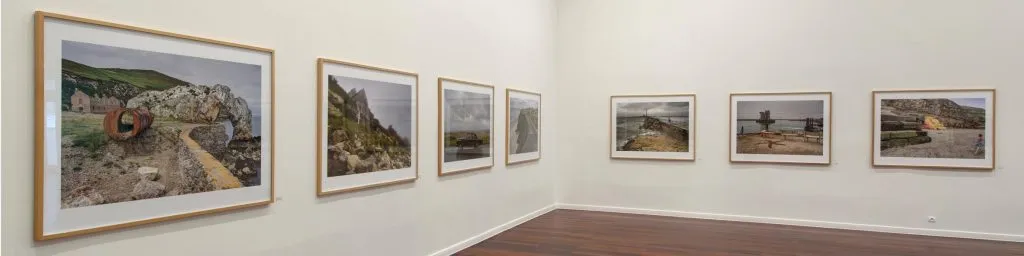
29.05.2015 – 13.09.2015 | Carl De Keyzer completed the project Moments Before the Flood in 2012. For several years, the artist travelled along Europe’s coasts, seeking to answer the question of whether Europe was prepared for a possible sudden rise in sea levels. Moments Before the Flood was one of twelve projects shortlisted for the 2012 Prix Pictet—an international photography prize addressing sustainability. The series has since been shown several times in the artist’s solo exhibitions and, as part of the Prix Pictet Power Exhibition Global Tour, has visited twelve venues on three continents, including the Saatchi Gallery in London and the Museum of Photographic Arts (MoPA) in San Diego.
The exhibition of a selection from the Dr Werner Jerke Collection is another presentation of a private art collection at Atlas Sztuki. During the past twelve years of our exhibition programme, we have shown a selection from a private Polish collection once and part of a German collector’s holdings once. Exhibitions of private collections remain rare in Poland, although collectors themselves are far more numerous. Some, however, prefer for various reasons to keep their collections secret and not make them available to the public. Showing one’s own collection requires courage. A widely known person—as collectors tend to be—chooses to submit their decisions to judgement or, more precisely, criticism. There are also collectors who would present their holdings but have no opportunity to do so.
The German Democratic Republic existed from 7 October 1949 to 3 October 1990. At the time of its establishment, the East German state had a population of 18.4 million; over the years, this figure fell by more than 1.7 million. After almost 41 years as a socialist state with a political and social system modelled on that of the Soviet Union, the GDR disappeared from the map, while the federal states that had made it up acceded to the Federal Republic of Germany. Today, nearly 25 years after the fall of the GDR, little remains of the state that no longer exists. In Berlin, both German residents and tourists can visit the DDR Museum to learn how people lived in the former East German state: they can see the inside of a typical GDR flat, sit in the driver’s seat of a Trabant—the world’s
Jean-Marc Caracci has been working on the Homo Urbanus Europeanus project since 2007. The artist photographs solitary human figures caught in urban space. He began the series in Bratislava, the capital of Slovakia, before visiting Riga, Vilnius, Sofia, Madrid, Warsaw, Rome, Ljubljana, Zagreb, Belgrade, Tallinn, Helsinki, Reykjavík, Paris, Brussels, Oslo, Stockholm, Prague, Berlin, Istanbul, Lisbon, Bucharest, Tirana, Budapest, Vienna, Athens, Luxembourg, Copenhagen, Amsterdam, London, Dublin, Skopje, Podgorica, Sarajevo and Pristina. He photographed some of these cities on several occasions.
Holy War is the second project by Wojciech Wilczyk to be presented by Atlas Sztuki. There Is No Such Thing As an Innocent Eye —the artist’s earlier project—was shown in 2009 in Łódź and subsequently presented at many venues in Poland, including Poznań, Kraków, Warsaw, Radom, Wrocław, Katowice, Zamość and Piła, as well as outside Poland, including Chemnitz, Bucharest, Chișinău, Paris, Vitebsk, Minsk and Dresden. It will be shown in Oradea, Romania, this December. Few art projects can boast such a long list of exhibition venues.
Bert Danckaert produced the Simple Present project between 2007 and 2013, visiting more than a dozen major cities across four continents. The work of the Belgian photographer, born in Antwerp in 1965, is little known—indeed, practically unknown—in Poland. The artist’s exhibition at Atlas Sztuki is the Polish audience’s first encounter with his work. Bert Danckaert graduated from the Royal Academy of Fine Arts in his native city in 1990. He now teaches photography at the Royal Academy of Fine Arts Antwerp. He also writes extensively about photography, and his texts are regularly published in respected photography journals.
The energetic potential of the painterly dialogue between Fehér and Lipski lies not only in formal affinities. Nor does it arise solely from the conviction that, in both cases, we are dealing with remarkable painting. Is there, then, something more? Are there subtler, less obvious territories to which the imaginations of Fehér and Lipski refer—territories that make the confrontation between their paintings more than an encounter between two individualised, independently developed painterly worlds? It seems that this less tangible connection between Fehér and Lipski is emotional rather than formal. It is created by the surreal, spectral quality of the images, the unsettling relationship between the figures and objects appearing on the canvases and their surroundings, and the poetics of
Roger Ballen was born in New York in 1950, but has lived in Johannesburg, South Africa, since the early 1980s. He studied psychology at the University of California and geology at the Colorado School of Mines, where he also received his doctorate. He initially worked as a geologist in South Africa, but his enthusiasm for photography prevailed and, as a result, he has been making photographs there for more than thirty years. His first photographic experiments as a student focused on political and social issues and adopted a photojournalistic approach. This way of looking continued in his early photographs made in South Africa, such as those included in the book Platteland: Images from Rural South Africa (1994). Working with empathy and a journalist’s outlook, Ballen portrayed white people
From the very beginning of Atlas Sztuki’s activities, we had planned an exhibition by Katarzyna Kozyra. Kozyra is one of Poland’s best-known artists and an important representative of critical art; her work is inseparably linked to the country’s new reality after 1989. She became widely known at the outset of her artistic career thanks to her 1993 graduation work, Pyramid of Animals . Unfortunately, the publicity generated by the media was largely negative. Her subsequent works— Blood Ties, Olympia, The Bathhouse, Men’s Bathhouse —addressed difficult social issues such as death, illness and encounters with nudity. They were widely discussed but often misunderstood and even censored, as in the case of two of the four photographs comprising Blood Ties . Katarzyna Kozyra was labelled a
Everything hums except what gurgles. In his exercises in declension, using electronic displays, Kozłowski “shows” the gurgling of the media. He subjects the same words scrolling across the displays to grammatical analysis. On several dozen boards, individual words are methodically declined through every case. To what extent is this grammatical logic an attempt to bring media chatter under control, and to what extent is it a rhetorical device—that is, one that amplifies the rhetoric of words that not only scroll incessantly across the displays but are also repeated in every possible grammatical case?
Zbigniew Rybczyński—a cinematographer, maker of experimental animated films, video works and music videos, and a pioneering adopter of high-definition television—first visited Atlas Sztuki on 14 September 2012. The occasion was the opening of the group exhibition Eastern Front , prepared by Professor Józef Robakowski. On 1 March this year, during a meeting with the audience, the artist spoke about his creative journey; we also showed several of Zbigniew Rybczyński’s films and music videos. His lecture, films and music videos were received enthusiastically by the audience. After two brief but remarkable encounters with Zbigniew Rybczyński’s work, the time had come for a solo exhibition. We invited Professor Józef Robakowski to help create the exhibition; he accepted and became its curator
The idea for Teresa Tyszkiewiczowa’s exhibition at Atlas Sztuki came from Professor Stanisław Fijałkowski, who repeatedly emphasised in conversation the artist’s exceptional character and her significant influence on the formation of Łódź’s artistic community. He noted that Tyszkiewiczowa was not only an artist working in non-geometric abstraction, but also a person who, alongside Władysław Strzemiński and Stefan Wegner, exerted a considerable influence on the shape of the State Higher School of Visual Arts in Łódź.
The Trembling Machines (Maszyny drżące) of Lodz Kaliska is the third project prepared by the artists for Atlas Sztuki. Different from the majority of previous projects, for which this avant-garde artistic group is famous. Two last projects carried out in cooperation with Atlas Sztuki: Alementarz from 2007 and The Chinese are watching Atlas Sztuki ad (Chinczycy ogladaja reklame Atlasa Sztuki) from 2008 also differed from what the artists made us used to for years. However, The Trembling Machines (Maszyny drżące) is the most serious project from all. Marek Janiak, one of the members of Lodz Kaliska, said that this is: “a story about nostalgia, endurance and dying. It is also a story about a myth going away. About a drama, when the place of this myth is not taken by a new, more lively