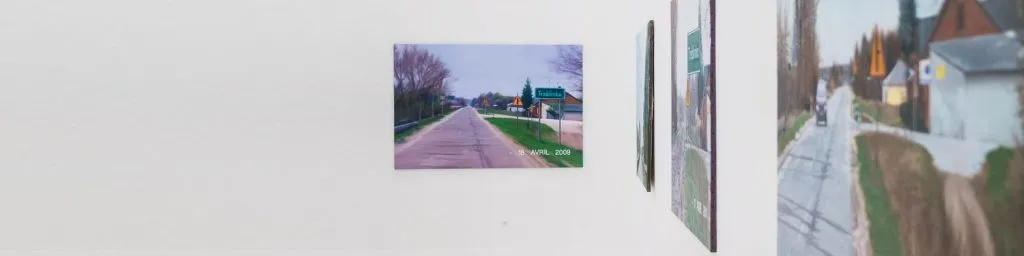
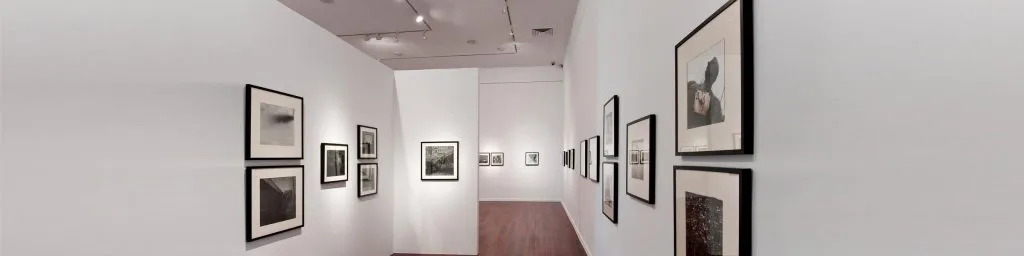
Wojtek Wieteska was born in 1964. He graduated from the Cinematography Department of the Łódź Film School and also studied art history at Paris-Sorbonne University (Paris IV) and the University of Warsaw. The artist taught at the Łódź Film School. As a photographer, he has realised solo projects including 36 x Paris , Reality , Far West , Tokyo , N.Y.C. #02 , Still Life , Warsaw Station , Protest 2007 and Flights 91_08 . His photographs have appeared in Gazeta Wyborcza, Magazyn Gazety, Rzeczpospolita, Pozytyw, Fototapeta, Przekrój and numerous illustrated magazines. Wieteska has also directed advertising films.
Seventy years ago, on the eve of the Jewish festival of Passover, an uprising broke out in the Warsaw Ghetto—the first urban uprising of the Second World War. The insurgents could not succeed; theirs was a desperate act, a choice to die with dignity and weapons in their hands. The uprising was brutally suppressed, while most of the Jewish population was murdered within the ghetto or at the Treblinka extermination camp. The Warsaw Ghetto Uprising is regarded by the Jewish people as one of the most important events in their history.
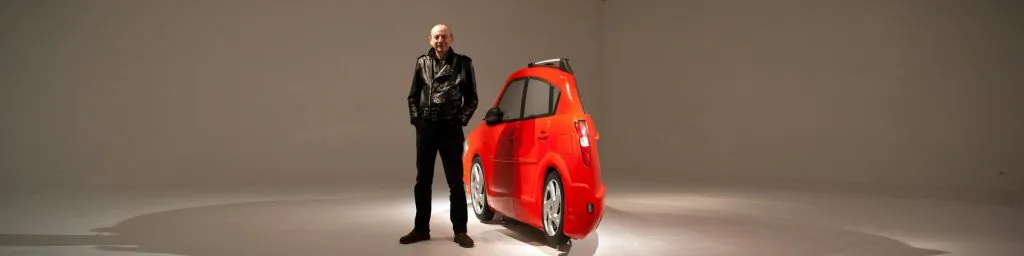
Zbigniew Libera’s project refers ironically to advertising photography. He had worked on it since 2010. He entitled his “work in progress” Reality Is Flat , in which, as Bożena Czubak suggests, one may discern a parallel with the ideas of Alain Robbe-Grillet, the French writer, screenwriter and precursor of the nouveau roman . He considered “flattening” vision one of the rudiments of the modern condition and the antithesis of the traditional, pre-modern understanding of depth. Whatever the case, this is also the starting point for Libera’s work, which seeks to demonstrate the truth of the theory of flat reality. To do so, he uses not so much the car as a canonical product of modern culture as its image. Reality is flat, Libera says, because we see it mediated through an image that
The Centre of Everything presents Fire-Followers and Spatial Forms . As the artist describes it, Fire-Followers is a film about art, progress, fear of catastrophe and unexplained events. It is also a film about extraordinary plants that need fire in order to grow. The relationship between sculpture and catastrophe is the subject of Karolina Breguła’s second project. The artist is interested in catastrophe in its various dimensions. Catastrophe is often accompanied by suddenness and an element of surprise; the scale of the resulting destruction varies; it affects more than people alone; and there is something extraordinary and fascinating in catastrophe itself.
According to Strzeminski Szczekacz created cubist, neoplastic and unistic compositions in quick succession. The initial direction, however, was cubism, which, according to Strzeminski, is “the threshold through which every visual artist should pass, is an objective school of a form based on the strict laws of construction.” Within the exhibition presented in Atlas Sztuki the artist`s works coming mostly from the Berinson Gallery and from the collection of the Art Museum in Lodz and the Collection of doctor Werner Jerke were displayed. On behalf of our exhibition two texts concerning the creative output of Samuel Szczekacz were written.
Eastern Front was the fourth encounter with Józef Robakowski at Atlas Sztuki. Professor Józef Robakowski—the originator and curator of Eastern Front —asks what influence the arrival of several avant-garde artists from Russia in the 1920s had on the art and culture of Łódź. The exhibition featured works by the following artists: Władysław Strzemiński, Karol Hiller, the Jung Idysz group, Samuel Szczekacz, Julian Lewin, Konstanty Mackiewicz, Alexander Rodchenko, Pavel Filonov, Dziga Vertov, Sergei Parajanov, Günther Uecker, Stanisław Ignacy Witkiewicz, Wacław Szpakowski, Gerard Jürgen Blum-Kwiatkowski, Wojciech Wiszniewski, Józef Robakowski, Zbigniew Rybczyński, Wojciech Bruszewski, Ryszard Waśko, Małgorzata Borek, Kamil Kuskowski, Zygmunt Krauze, Łukasz Ogórek, Anna Orlikowska, Maciej
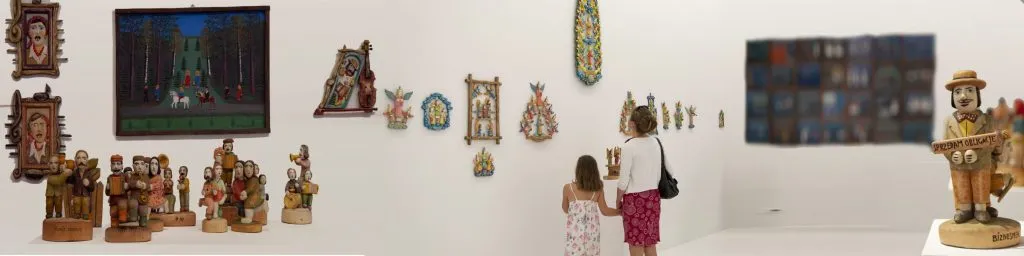
While the Farmer Sleeps, His Crops Keep Growing presents the work of two folk artists, Stanisław Koguciuk and Jan Uścimiak. The idea for a joint exhibition came from Jagoda Barczyńska, head of the contemporary art department at the Museum of Chełm Land in Chełm. During nine years of exhibitions at Atlas Sztuki, we built our programme by seeking to show highly diverse dimensions of contemporary art. We decided that, after fifty-seven exhibitions, the time had come for folk artists, who are rarely hosted by contemporary art galleries. The joint exhibition will feature paintings by Stanisław Koguciuk and sculptures by Jan Uścimiak: artists who use different techniques and have different backgrounds and life stories, but who share a common passion—a heartfelt love of art. Both are known to
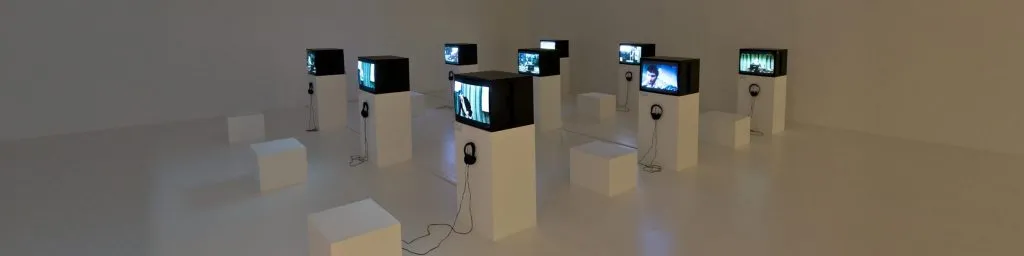
Joseph Beuys’s videos document artistic actions and a discussion held on 21 January 1970 with Beuys, Max Bense, Max Bill and Arnold Gehlen on Provokation Lebenselement der Gesellschaft – Zu Kunst und Antikunst. The videos come from the collection of the Joseph Beuys Medien-Archiv, founded in 1996 at the Hamburger Bahnhof – Museum für Gegenwart.
From 2010, Anna Baumgart conducted an artistic investigation into the fate of an agit-train that set out from Moscow for Berlin in 1920 but stopped in Koluszki near Łódź. Like other agit-trains, its carriages hosted exhibitions, meetings and lectures, and artists were among those involved in its activities. The artist invited Professor Andrzej Turowski to collaborate on the project. This created a fascinating and exceptional situation: on one side, an artist representing the current of critical art; on the other, a scholar, historian of contemporary art and art critic. The meeting of artist and scholar resulted in a unique project that crossed previously established boundaries. Anna Baumgart made the film Conquerors of the Sun , while Professor Andrzej Turowski wrote The Locomotive of
In a conversation with the artists, Sebastian Cichocki observes that they occupy “a highly distinctive position on the map of artistic practices and strategies in Poland. By consistently transferring their ideological commitment to animal rights into the field of art, moving fluidly into activism and ceding authorship of their works to other beings and species…”. As Cichocki goes on to note, this position has consequences: the artists operate somewhat at the margins of museums and galleries. […] The invitation to collaborate with Tatiana Czekalska and Leszek Golec—artists who, for both artistic and philosophical reasons, occupy a distinct position in contemporary Polish art—should surprise no one.
Dr Erich Marx’s collection is the most important and formidable private art collection in Berlin. It is also one of the leading collections of contemporary art in Germany and the world. Part of the collection—including works by Andy Warhol, Joseph Beuys, Robert Rauschenberg and Cy Twombly—was first shown at Berlin’s Neue Nationalgalerie in 1982, to an enthusiastic reception. Following this presentation, the authorities of the federal state of Berlin, wishing to keep Dr Erich Marx’s collection in the city, decided to convert the disused former Hamburger Bahnhof railway-station building for the presentation of contemporary art and to install the largest series from the core Marx Collection there as a permanent display.
Station Opera , with a libretto written by Marcin Polak, is Atlas Sztuki’s first project outside the gallery—and in a space that is public in the fullest sense of the word. Its setting is the old Łódź Fabryczna railway station, from which the final trains departed on 16 October 2011. *Marcin Polak (born 1973) is a graduate in photography from the Leon Schiller State Higher School of Film, Television and Theatre in Łódź. The artist has created actions revitalising Łódź’s public and social space, including LipowaOdNowa, Punkt dla Łodzi, Miej Miejsce and Ratujmy Łódzkie Murale. His projects address important social and political issues, seeking to foster dialogue between society, institutions and elites.
Stefan Krygier was an outstanding student and continuator of Władysław Strzemiński’s work and of the tradition of the Łódź avant-garde in Poland after the Second World War. The artist, who died in 1997, was associated with Łódź throughout his life and was an important figure in the city’s and Poland’s artistic communities. After graduating from the State Higher School of Visual Arts in Łódź, he also received a degree in architecture from Warsaw University of Technology. The artist worked in painting, graphic art and activities at the intersection of spatial forms and environments. He also produced architectural and urban-planning designs, both independently and with his wife, Krystyna. He devoted a great deal of time to education, teaching visual arts and architecture to thousands of
Anna Konik’s solo exhibition presented two of the artist’s video installations. For the first time in Poland, the full version of The Villa of the Entranced was shown, a project that premiered in April 2010 at the Max Liebermann Haus in Berlin. The artist also created a new work entitled Play Back (of Irene) . In a text written especially for the Atlas Sztuki exhibition, Dr Marcin Giżycki observes that “in the installation Play Back (of Irene) , Konik attempts to enter particularly deeply into the psyche of her next protagonist—a mountaineer who survived a dangerous fall. Once again, the artist seeks to create a symbolic space that would reflect a specific event, someone’s experience, in a more tangible and sensual manner than a straightforward film recording or the spoken word. This
[…] Looking at the artist’s photographs, in which inhabitants recorded during long exposures against a backdrop of nineteenth-century or older architecture become more or less blurred traces of their physical presence, one may invoke Walter Benjamin’s concept of the “aura”, defined by the author of A Short History of Photography as “a strange weave of space and time: the unique appearance of a distance, however near it may be”.
In the project named in the title, the Twożywo art group took as its material fourteen publications by Emil Cioran, the Romanian philosopher, theorist of nihilism and essayist. Using excerpts from Cioran’s books, Mariusz Libel and Krzysztof Sidorek created a new work: their own collection of graphic works, published as a book-album. The publication’s authors also took responsibility for its appearance. Twożywo’s work, itself a work of art, was carefully produced in a collectors’ edition.
The time has come for manifestations of incalculable art: a multimedia exhibition described by its author, Józef Robakowski, as “a mental operation enacted in a gesture that is unpredictable, phenomenal, cosmic, uncommon, revolutionary, singular, bizarre, sexual, fraudulent, sarcastic, unique, perverse, humorous, deviant, spectacular, eccentric, subcutaneous, indecent, fantastic, grotesque, incredible, peculiar, distorted, absurd, tawdry, magical, outrageous, ominous, irresponsible…”.
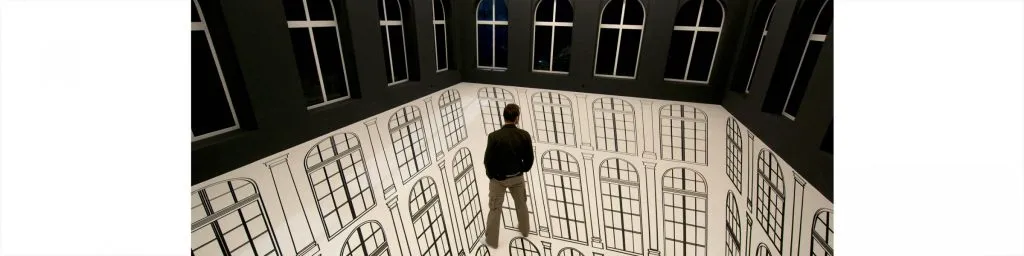
The artist created a special project for Atlas Sztuki that responded to the architecture of the gallery building and its surroundings. She produced two installations entitled Abyssal and 1,001 Days , assigning the principal role to the building’s windows—a membrane connecting the interior with the outside. Playing with the architecture of exhibition spaces has been present in the artist’s work for years. Illusory space, light and shadow, time and its passing are recurring aspects of Silveira’s practice. At Atlas Sztuki, she created two different installations: one connected with the passage of time ( 1,001 Days ) and the other oriented towards the gallery space ( Abyssal ), although the apparent hole or abyss also evokes an archaeological conception of time.
Lipski’s painting appears, above all, to celebrate everyday visual experience and articulate a need to capture its ambiguous essence. One of the artist’s basic tools—a kind of artistic sketchbook—is photography, which tears an image from the deterministic grip of passing time for a fraction of a second while simultaneously becoming an immaterial emanation of the photographed subject’s aura. Lipski’s paintings are therefore the result of a collision between two media: painting and photography. His painterly sensitivity and free use of photography as a visual pretext—one that stimulates but does not restrict the imagination—make possible the pictorial effects characteristic of his paintings, increasingly phantasmagorical in his latest works and detached from a veristic perception of reality.
Jörg Immendorff and Markus Lüpertz are among the most recognisable and influential figures in post-war German art, and both achieved enormous international success. Born in 1945, Immendorff worked not only in painting and sculpture. He taught at numerous schools for many years before becoming a professor in 1996 at the Kunstakademie Düsseldorf, from which he had been expelled in 1969 because of his political involvement (the artist studied in Joseph Beuys’s class). Immendorff led a turbulent life for many years, culminating in his arrest and conviction in 2003 for possessing substantial quantities of cocaine and participating in numerous orgies. Shortly after Jörg Immendorff’s death in May 2007, the American magazine Time wrote that a great artist had died—one who, like no other, had
It is difficult to imagine Atlas Sztuki’s exhibition programme—in which we try to present everything of interest in contemporary art—without Józef Robakowski. Both a master and a classic, over the years he has worked as a multimedia artist, film director, maker of documentary and experimental films, writer, art critic and organiser of independent artistic life. Now associated with the Łódź Film School, he taught successive generations of artists, critics and art curators at a number of higher-education institutions for many years. In short, he is a versatile artist and a one-man orchestra; an artist who has achieved considerable success in Poland and abroad; a highly important and active figure in Łódź cultural life. In addition, he is a cheerful and kind person. At Atlas Sztuki, Józef
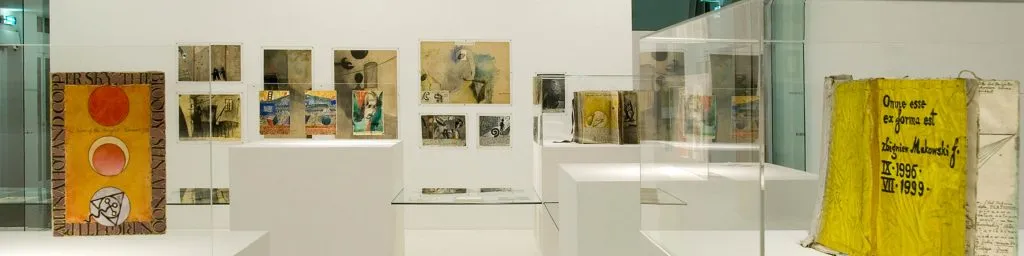
Zbigniew Makowski took part in exhibitions and encounters that shaped Polish art in the 1950s and 1960s. During several months in Paris in 1962, he had the opportunity to meet André Breton and artists associated with Surrealism and the international Phases group, and to participate in several of the group’s exhibitions. Alongside painting, the artist also wrote poetry. Zbigniew Makowski presented his work in dozens of solo exhibitions in Poland and abroad, and represented Polish art in numerous prestigious international exhibitions. His works are held in the collections of leading museums in Poland and around the world.
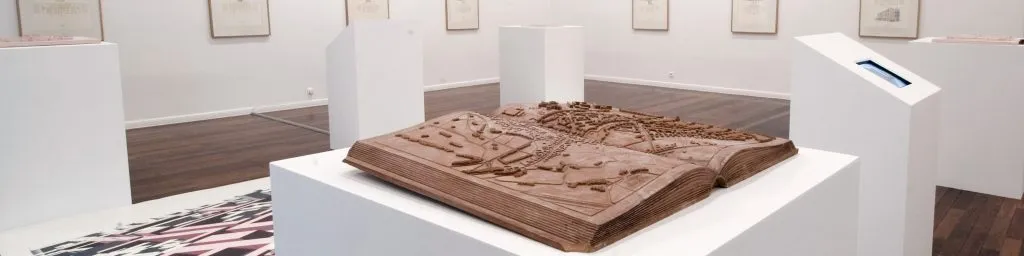
Rob Krier, a Luxembourgish architect and urban planner, devised the concept for the redevelopment of central Łódź around EC1—the part of the city bounded by Narutowicza, Kopcińskiego, Targowa and Kilińskiego streets. Professor Krier has created dozens of major architectural projects, realised in Germany (Berlin and Potsdam), the Netherlands (Amsterdam and The Hague), Austria (Vienna) and his native Luxembourg, among other places. They have also been shown in numerous art galleries and museums, including, to mention just one recent example, the German Architecture Museum in Frankfurt am Main. The exhibition will present Rob Krier’s architectural designs, including his proposal for Łódź.
In his latest project, the artist invites viewers to encounter genuine still lifes. Kamil Kuskowski explains that the exhibition should be understood on two levels: as a feast for the eyes and as a literal feast. We will admire both compositions prepared by the artist and the finest works of the old masters reproduced in catalogues of their art. In the literal sense, viewers will be able to eat only fragments of the still lifes arranged by the artist. Despite his young age, Kamil Kuskowski, a graduate of the Łódź Academy of Fine Arts, has already achieved a great deal, and not only as an artist. He is exceptionally active: in a short period, he earned a doctorate, became a lecturer at his alma mater, curated numerous exhibitions and, alongside all of this, continued to make art. He is