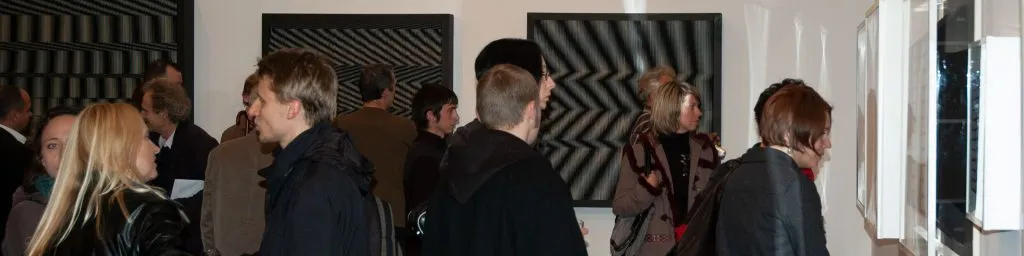
“Poles do not see very well” was Professor Maria Poprzęcka’s answer when I asked why Ludwig Wilding and his work were entirely unknown in Poland. Wilding is an established artist in Western Europe. The opening this May of his retrospective Visuelle Phänomene at the Museum für Konkrete Kunst in Ingolstadt drew crowds of visitors from Western Europe. I myself could barely move from one gallery to the next. Works by the artist, who turned eighty this year, are held in numerous European and American collections. The lack of familiarity with Ludwig Wilding’s work in Poland probably also stems from the fact that Op Art was never particularly popular in this country. The artist himself points out that the movement’s name in a sense restricted and narrowed the reception of its works to the
Rafał Jakubowicz’s project ti tabu dibu daj inaugurates Atlas Sztuki’s fifth year of exhibitions. Taken by the artist from the lyrics of a disco polo song, the exhibition’s rather abstract-sounding title arouses curiosity. Rafał Jakubowicz says: “I always try to use the minimum means needed to express what I want to convey. If something can be expressed using, say, five kilograms, we do not need to use fifty-five. In art, paradoxically, five can weigh more than fifty-five. The message should be subtle.” In producing his latest project at Atlas Sztuki, the artist has decided to remain faithful to his customary approach. He will turn the exhibition space into sports halls.
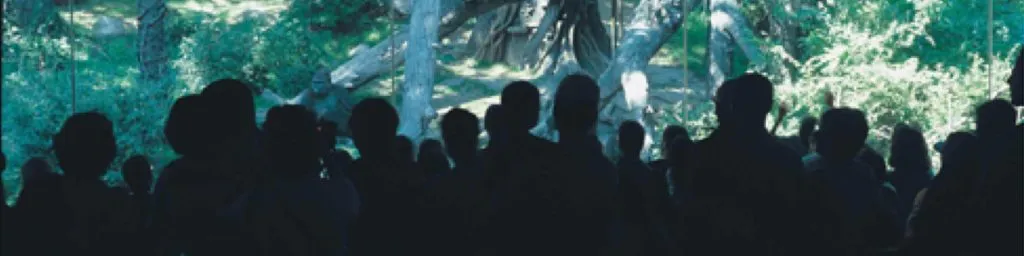
It is difficult to imagine a better conclusion to another—the fourth—exhibition season than a presentation of work by Łódź Kaliska, a group that has participated actively and with considerable success in Polish artistic life for almost thirty years. In mid-June, we will be delighted to present Łódź Kaliska’s latest brilliant project, Alementarz , at Atlas Sztuki. Several months of collaboration on Alementarz mark the second encounter between Atlas Sztuki and Łódź Kaliska. Our first came while producing the five artists’ previous project, Chinese People Watching an Atlas Sztuki Advertisement . Following last year’s presentation of Chinese People… at the 2nd Łódź Biennale, the work will be shown this year in Wrocław, Poznań and Rome. Several galleries abroad have expressed interest in
As I write these words, the form of Dominik Lejman’s exhibition at Atlas Sztuki is slowly crystallising. In the texts published in the catalogue, readers will find little information about the artist’s latest project. Nevertheless, it is clear to everyone involved in preparing the exhibition that it will be a fascinating work of video painting by an exceptionally versatile artist who describes himself as a painter and whose work has already been presented in numerous distinguished galleries in Poland and abroad. […] Ryszard W. Kluszczyński observes that “Even before it was confronted with video on its own ground, Lejman’s painting was already characterised by internal complexity, multiple layers and a polyphony of discourses. It is worth emphasising that this effect was achieved primarily
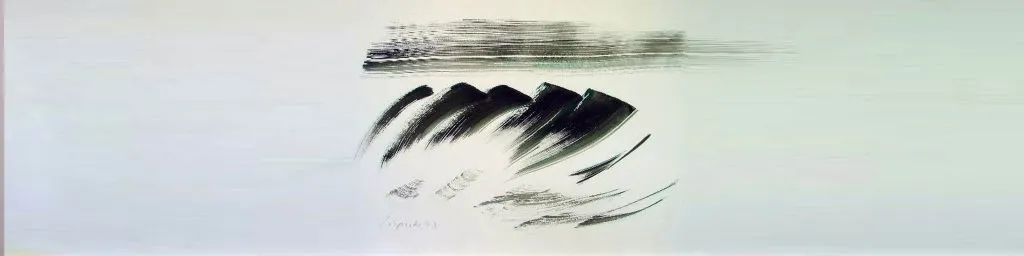
The Atlas Sztuki presentation of Siegward Sprotte’s painting will feature fifty works by an artist whose practice is entirely unknown in Poland, although his works are held by the Pushkin Museum in Moscow, the San Francisco Museum of Modern Art, the Shanghai Art Museum, the Mellon Collection in Washington, the Calouste Gulbenkian Museum in Lisbon, the Carnegie Museum of Art in Pittsburgh, and major German museums and galleries including the Berlinische Galerie, Berlin Museum, Staatliche Gemäldesammlung in Dresden, Altona Museum in Hamburg, Staatsgalerie Moderner Kunst in Stuttgart, Staatliche Kunsthalle Karlsruhe and Potsdam Museum. Most of these venues have also held solo exhibitions of Siegward Sprotte’s work. […] The Atlas Sztuki exhibition included several early works from the
The exhibition of works by Rafał Sobiczewski is another Atlas Sztuki presentation of an artist associated with Łódź. A graduate of the Łódź Academy of Fine Arts and now an assistant professor there, Sobiczewski remains outside the artistic mainstream. […] According to Magdalena Wicherkiewicz, author of a text on his work, he “places an equals sign between the corporeal and spiritual aspects of existence”. She observes that “there is something difficult in Sobiczewski’s painting that makes us experience a kind of unbearable torment, the painful authenticity of the painterly gesture and thought. Looking at his paintings causes almost physically palpable pain and anguish, although at the same time we sense a trace of a particular tenderness towards the figures depicted”.
In September 2005, for the first and so far only time in Poland, Atlas Sztuki presented part of the collection created by Gerhard Jürgen Blum-Kwiatkowski at Museum Modern Art in Hünfeld. The Argumenta exhibition featured 226 works by 127 artists. It attracted enormous interest and was seen by many visitors, a number of whom remain under its impression to this day.
In April 2006, Janek Simon organised an exhibition of contemporary Polish art in Antananarivo, the capital of Madagascar. It was exceptional for many reasons. Exceptional because it was the first presentation of Polish culture in the country. Exceptional because it included no work by a Polish artist: Simon presented works by Vlad Nancă from Romania, Ivan Moudov and Krassimir Terziev from Bulgaria, Erik Binder from Slovakia and the Czech group Guma Guar. Although no works by Polish artists were shown in Antananarivo, Janek Simon’s considered selection created an exhibition that addressed Poland’s situation and its problems: the rise of nationalism after the 1989 transition, Church interference in politics, the degradation of public space, mass and mindless consumption, and the issue of
Elżbieta Janicka’s The Odd Place is an exceptional exhibition: minimalist, austere and ascetic in form. It comprises only six black-and-white, large-format photographs of the air in… or perhaps above? Auschwitz II-Birkenau, Kulmhof am Ner, Majdanek, Bełżec, Sobibór and Treblinka, together with the looped sound of thirteen recordings made at these sites. Yet, as Rafał Jakubowicz observes in his moving text on the exhibition, it is “So little and so much. The dominant sensation is silence. The silence of the white, large-format photographs and the silence recorded in spaces of death”. Within this silence arises a torrent of questions about memory, the past, the causes of the destruction of European Jewish civilisation, our response to the Holocaust, identity, and the ambiguity of products
Robert Rabiega’s exhibition Study of Space concludes Atlas Sztuki’s third year of exhibitions. We show different areas of contemporary art, presenting both established artists and those at the beginning of their creative journeys. After several exhibitions by artists of international stature, the time has come for another—the third—exhibition by an artist working in Łódź. Robert Rabiega, a graduate of the Łódź Academy of Fine Arts, remains outside the artistic mainstream. This is undoubtedly a conscious choice on the artist’s part.
On 3 May this year, the Museum of Modern Art in New York will open a retrospective of Lech Majewski’s work entitled Conjuring the Moving Image . The programme will include the world premiere of the artist’s latest work, Blood of a Poet , produced in partnership with Atlas Sztuki especially for presentation at MoMA and Atlas Sztuki. In Blood of a Poet , Lech Majewski used video to record scenes and images he had carried within him for years. As he puts it, he “created the visual equivalent of a book of poetry, in which individual scenes are ‘read’ like poems”. The invitation from an institution as prestigious as MoMA is evidence of the recognition accorded to his extraordinarily rich and varied practice, in which the artist—working, depending on the form, as a film or theatre director
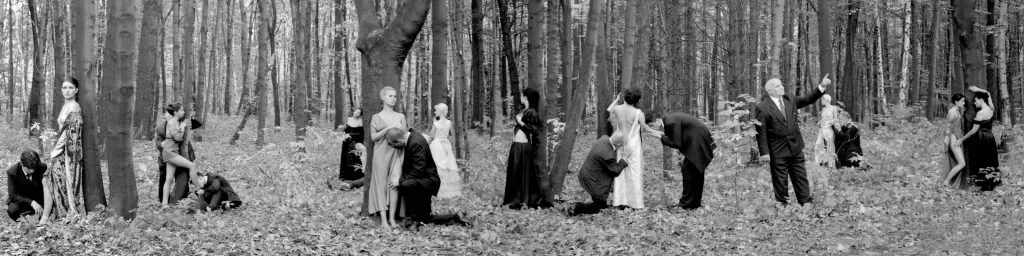
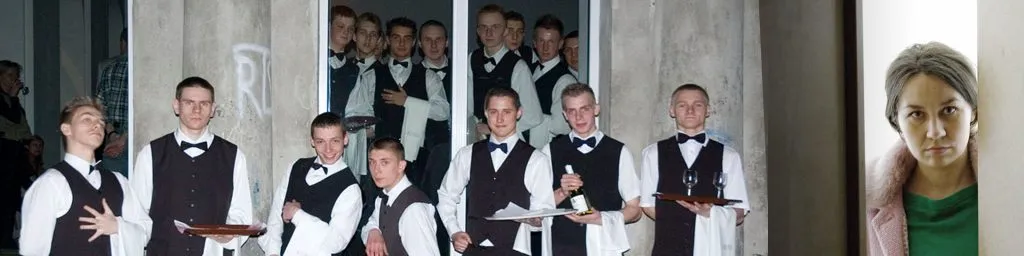
The action prepared for Atlas Sztuki in Łódź draws on the many ambiguities inherent in the ceremony of an exhibition opening. It is meant to be pleasant, like a social gathering, but unexpected discomforts will be waiting. In the hierarchy of openings, waiters guarantee an event’s high status. So let there be a hundred of them. We like to be served—but to such an extent? Will the omnipresence of waiters not first provoke embarrassment and then irritation? What is more, the diligently served audience will walk across loose floorboards. On the one hand, then, there is the waiters’ overprotectiveness; on the other, uncertainty with every step. At an exhibition opening, one does not think about avoiding getting a heel stuck between the floorboards. Here, suddenly, visitors must watch their
Eroticism and sex are undoubtedly among the most absorbing areas of contemporary life. They are what excites and intrigues us. Marzena Kawalerowicz has devoted her entire artistic life to the human being and sensual love. She has remained faithful to them for years. In a conversation with Krzysztof Cichoń, Andrzej Walczak and Tomasz Załuski, the artist says: “Exploring the subject of sex was a challenge for me from the outset. I knew what I was capable of and what I represented, and I thought it would be a challenge suited to my artistic and mental capacities. Very few people depict sex seriously; they often turn it into satire, which I strongly dislike. For me, sex is a struggle…”. Reading the conversation with Marzena Kawalerowicz, one has the impression that nothing could alter her
Ilya Kabakov’s artistic career has already spanned almost half a century. Born in Dnipropetrovsk in 1933, the artist has lived and worked in the West since 1988. That year also marked the beginning of his triumphant progress through the world’s leading exhibition venues, where he primarily creates his installations. The institutions that have presented Ilya Kabakov’s work include the Museum of Modern Art, the Jewish Museum and Ronald Feldman Fine Arts in New York; Kunstmuseum Bern; the Stedelijk Museum in Amsterdam; the Hirshhorn Museum in Washington, DC; the State Tretyakov Gallery in Moscow; the State Hermitage Museum in St Petersburg; Donald Judd’s Chinati Foundation in Marfa; and Tate Gallery in London.
At present, it is difficult to imagine exactly what Christian Tomaszewski’s reconstruction in Łódź of the atmosphere, scenes and objects from David Lynch’s Blue Velvet will look like. It is already clear, however, that the problem around which the artist circles in this work (and not only this one, but also his previous projects) concerns an eruption of fiction into reality—an eruption triggered by inconspicuous objects, works of art and, in a sense, fetishes that form the material dimension of the artist’s imagination. It is no accident that David Lynch’s film—invoked by Slavoj Žižek in the chapter on fetishism in The Plague of Fantasies —became the starting point for Tomaszewski’s work.
Gerhard Jürgen Blum-Kwiatkowski disliked being called an arts organiser or populariser. He described himself as a creator of exceptional states. In fact, he was an extraordinary artist, art theorist and, above all, creator of exceptional states. For the first time, we had the pleasure of presenting Polish audiences with part of the collection of Museum Modern Art in Hünfeld in the Argument a exhibition.
To be naked is to confront the truth about oneself. Standing before us, the figures in Cezary Tkaczyk’s photographs reveal not only the truth about themselves but, by analogy with a mirror, the truth about who we are or would like to be. Although the figures clearly look towards the viewer, their nakedness does not seem to be placed “on display”. What is absent here is the conventionalised framing, mask and erotic purpose characteristic of the nude. The figures’ nakedness is merely a declaration: this is who I am, this is what I look like. An informational and documentary context.
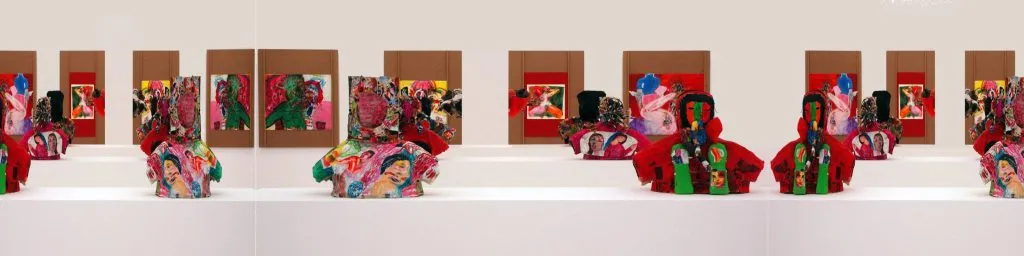
Almost everyone wrote about his three major works—the book-albums Rock Dreams (1972, text by Nik Cohn, over a million copies sold in the 1970s), The Big Room (1986, text by Michael Herr, screenwriter of Apocalypse Now ) and Twentieth Century Dreams (1999, text by Nik Cohn)—from reviewers at The Independent, International Herald Tribune, Libération, The Observer, Newsweek and Globe, through Penthouse Magazine and Elle, to Cuba’s Cartelera. Residents of Paris, New York, Tokyo, Milan, Havana and Munich, among other cities, have been able to see exhibitions of his work. Guy Peellaert is not widely known in Poland. Until now, Polish readers have encountered his work through books. The artist himself, who creates his work with books in mind, tells Tomasz Załuski in a fascinating interview that
One work, made especially for this presentation, will be cut into pieces during the opening. Anyone who declares that they will appear in Sopot with “their” fragment on a specified day will receive it as their property. By inviting people to take part in this artistic action, we are once again trying to elicit a response from the viewer and draw them into play and dialogue with art. We want to move beyond the standard practice of opening successive exhibitions with mechanical regularity, in the belief that this alone is enough to attract an audience.
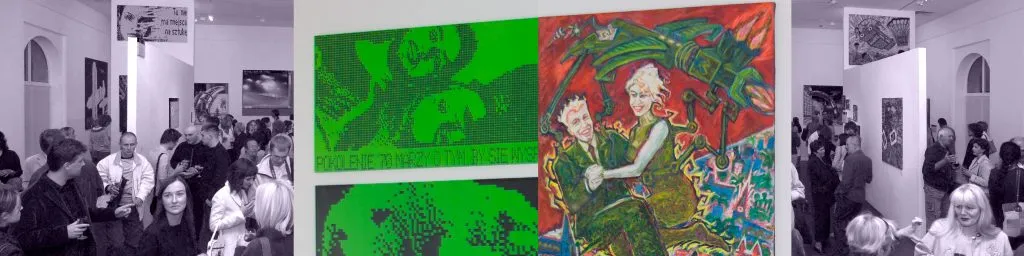
These are usually terse messages taken from the language of newspapers or the copy of advertisements and leaflets. They sound like press headlines yet are also intensely personal. Hand-painted letters clumsily fitted into the rectangle of the canvas, disregarding the rules of spelling and always set against a flesh-pink ground, give the statements an individual character. Alongside the texts appear realistic depictions of items of clothing. It is clear that they have been used and worn by someone, but now they are empty and impersonal, no more than traces. The eloquent absence of the body in these icons is replaced by the “corporeality” of the text paintings. The two complement one another and complete each other’s meanings.
Why this particular curtain? One could, after all, have tailored a curtain closer to the local spirit. The most sensible solution would have been a curtain in the tradition of Strzemiński’s Unism—the artistic community would appreciate it, the authorities would be pleased and primary-school groups could be shown it without concern. Technically, the matter would be simple: it would amount to choosing a canvas of the appropriate dimensions and weave. Complete Unism. It is also difficult to call a length of grey canvas kitsch. And the colour is very Łódź. Leaving Strzemiński aside, the city of Łódź really does sometimes have the colour of canvas; entire districts even have the colour of a shroud. But a realistic curtain? An allegorical one? Painted by Naliwajko?
At the heart of graphic art lies the idea of reversal , taken directly from the relationship between matrix and print. In Piechura’s prints and posters, reversal often becomes subversion: slightly roguish, conjuror-like, surprising and different—the reverse —of the aristocratic refinement of his means. It has accompanied Piechura since his graduation work, in which he showed, among other things, a spherical die. What else, if not the literal subversion of reversal, is the circular inscription ZachódnaWschodzieWschódnaZachodzie on his poster from 2000?
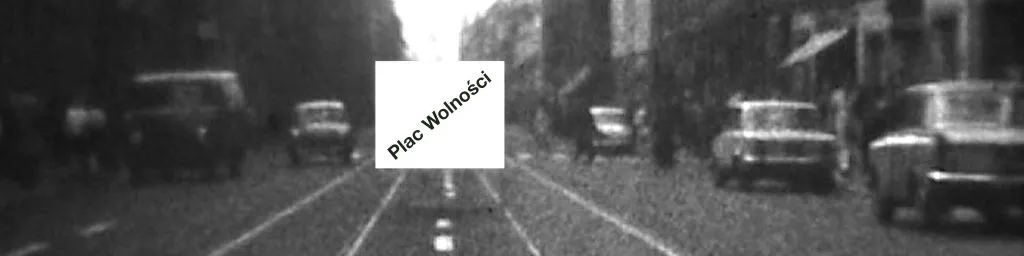
In 1974, Tadeusz Piechura made a nine-minute film. In the centre of a static frame, aligned with the main street, stands a white sign bearing the indistinct words “Freedom Square”; after a moment, the word “Square” disappears. Thirty years later, Piechura once again positioned his camera in the same place and filmed the same thing. Or did he? We see the same frame, the same sign bearing the same words, the same lack of response from the surroundings. We are naturally inclined to regard the first film as more important—but why, exactly? What actually happened in 1974, and what are we looking at? An image of what was in fact a daring, though ignored, political demonstration? Of a Conceptual fascination with film? Of private experiments with a new Soviet movie camera? Whose memory should we
Whether considered inventive or mechanical, the juxtaposition of works by Krzysztof Skarbek and Laura Pawela constitutes a kind of exhibition machine, capable of generating new meaning from the works placed together and of setting the viewers’ thinking in motion (including that of the author of this text). Juxtaposing these works undoubtedly exposes them to a relationship with one another. A “juxtaposition” as an “exposure to relation” may reveal something in the works or produce something within them; diminish or overemphasise the importance of certain features; redistribute the emphases; completely change the articulation of a given work; or even transform it by suggesting interpretive ideas not previously considered by the viewer.