"Man cannot express himself on the outside not only because others speak him - he cannot express himself above all because only what is already arranged in us, mature, is suitable for expression, and all the rest, i.e. our immaturity, is silence. Therefore, form will always be something compromising for us - we are humiliated by form.(...) And finally, won't a man who is always below value, always compromised (so far as being a human being means being "worse", worse than what he himself produces) not seek the discharge of his mental life in the sphere proper to him, that is, in the realm of cheesy?" Witold Gombrowicz Journal 1953 – 1964, 1957 [22] , Kraków 2011, p. 342. We chose a non-obvious, five-part form. We gather and watch in silence. Fortunately, books treated as building material
We are optimists, so we are looking around for a vast and preferably dry plateau. We take plans seriously, which is why we sometimes act in accordance with the young Leibniz’s maxim: Calculemus ! There are about 7.7 billion people like us living on Earth. Sooner or later, we shall ask them about the five most important books in their lives. Well over a billion will certainly answer that they have encountered nothing of the kind. And given that reading is becoming an elite and anachronistic occupation, perhaps as many as half will answer that way before we manage to ask the question. Taking into account the time that will pass, population growth and its geographical and cultural distribution, let us assume that four billion people have held more than five books. We are optimists: what will
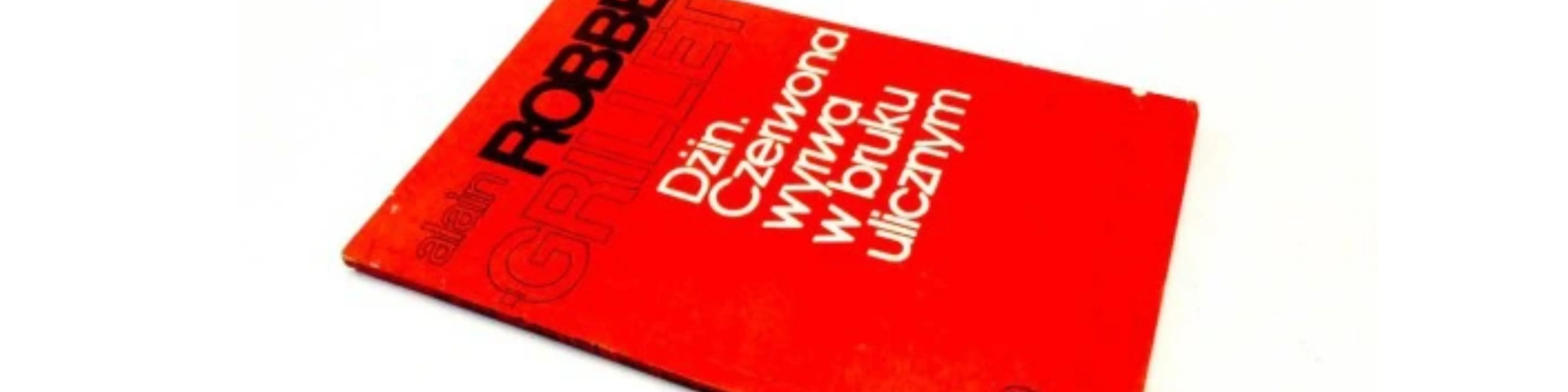
We are working to bring order to what we have. It will take a little longer. We recently discovered that no one has yet given us a single book by Alain Robbe-Grillet. Why did that, of all things, surprise us? ‘The text is organised into five sections called “spaces” and identified by their ordinal number, preceded by a chapter entitled INCIPIT (five pages), followed by a chapter entitled CODA (also five pages).’ This is part of a description of his 1976 novel Topologie d’une cité fantôme . We are not numerical fetishists. Numbers are important, but they cannot describe the human world. If they could, we would not collect sheets of paper printed with letters; we would calculate. In the afterword to Robbe-Grillet’s House of Assignation, published by Czytelnik in early 1967, Comrade Adam
They read the book: Prt M Hrw. It sounds strange because it's old. Today it is pronounced something like this: peret em heru. The best-preserved specimen, exactly 9.70 meters long, was found in the tomb (KV46) of Juj and his wife Tuju in the Valley of the Kings in 1905. What has changed since then? Everything, but the most important things and the little things are the same. Juju, the priest of the god Min from Ahmin, if he read, did it by scrolling the text with a gesture similar to us by leaning over the smartphone. This Egyptian from the 18th Dynasty, like modern teenagers, did not imagine that the text could be flipped. There were no sheets or codes yet. Reality, as today, seemed to be one continuous band of events: flow, a stroke of tacted rhythm of days and nights. The title of the
Whatever model of governance becomes most widespread in the first half of the twenty-first century, the role of re-presentation will grow. Re-presentatio is a concept as fundamental to power as it is to the human way of thinking. Hence the constant suspicion that certain modes of independent thought are nothing more than plotting against the authorities: crimen laesae maiestatis. The domain in which independence of thought can be manifested is likely to shrink. This is mainly because power now re-presents itself exclusively through media and technology. And power, as the stronger party, will win the struggle for control of the media. The tendencies already evident towards expanding the means by which prestige is displayed are surprisingly archaic; they resemble the re-emergence of feudal
Once, as T. S. Eliot was getting into a taxi, the driver is said to have told him: ‘You are T. S. Eliot.’ Surprised by the question, the poet asked the taxi driver how he knew. ‘Ah,’ the driver replied, ‘I have an eye for celebrities. Only yesterday evening I picked up Bertrand Russell and asked him: “Well, Mr Russell, what is it all about?” And do you know, he could not answer me?’ (John Naughton)
At the time, Henryk Stażewski said: ‘Thoughts travel fastest: where they come from and where they are rushing, no one knows. If you managed to capture a single thought, that would be art.’ I am convinced that Opałka’s idea was captured in much the same way. His resolute decision enables us to explore unidentified dimensions. Through that decision, he opened a universe for himself in which to exist. There he finds possibilities for drawing closer to the essence of infinity. With his two-sided wooden book entitled ‘The Never-Ending Sentence’, Eugen Gomringer says everything through the inner ‘you’. Only ‘you’ has the right to speak about itself, because no one can exist within ‘you’. The question arises: why do we struggle to find words that say nothing?