
The Impossible
As long as we can imagine the impossible, we have a chance of rebuilding and winning.
As long as we can imagine the impossible, we have a chance of rebuilding and winning.
In circumstances of a violent crisis, the information begins to be transferred and reaches through quite new channels. Beyond the standard spectrum of communication. There is not much we can understand from the Chinese TV message. But the colours are immediately commented on and attract attention far beyond the usual range of the medium.
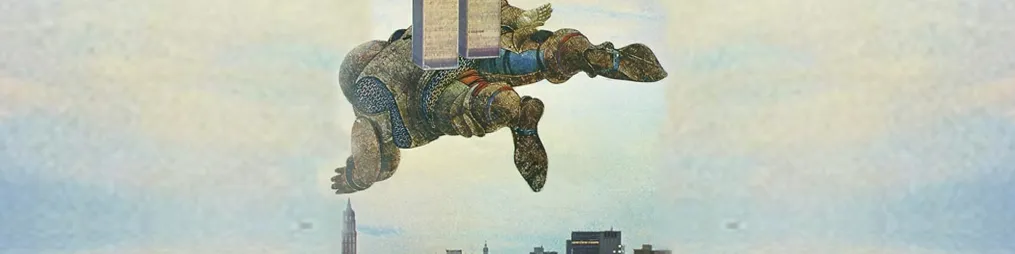
Ever since the Decembrist revolt—if not since Alexander Radishchev published Journey from St Petersburg to Moscow in 1790—the idea of an open, empathetic society in Russia has always been alive and always marginal. Given today’s saturation of the media with information, there is a chance that the decisive events will take place in the streets of Moscow and St Petersburg rather than on the front line. The protests need not be bloody, but they must be numerous and resolute, like those in Moscow in August 1991. This could be Russia’s display for the world. A good one or a bad one.
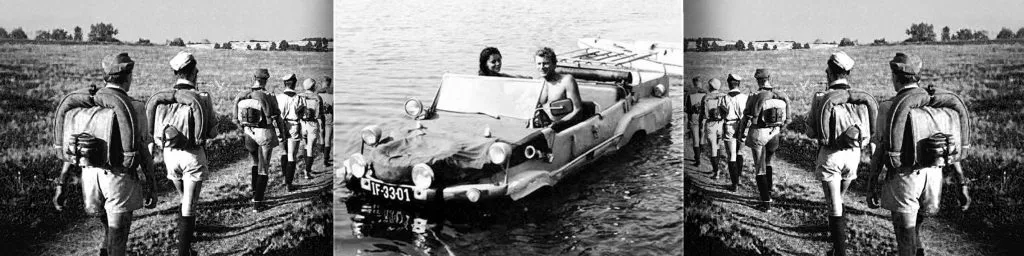
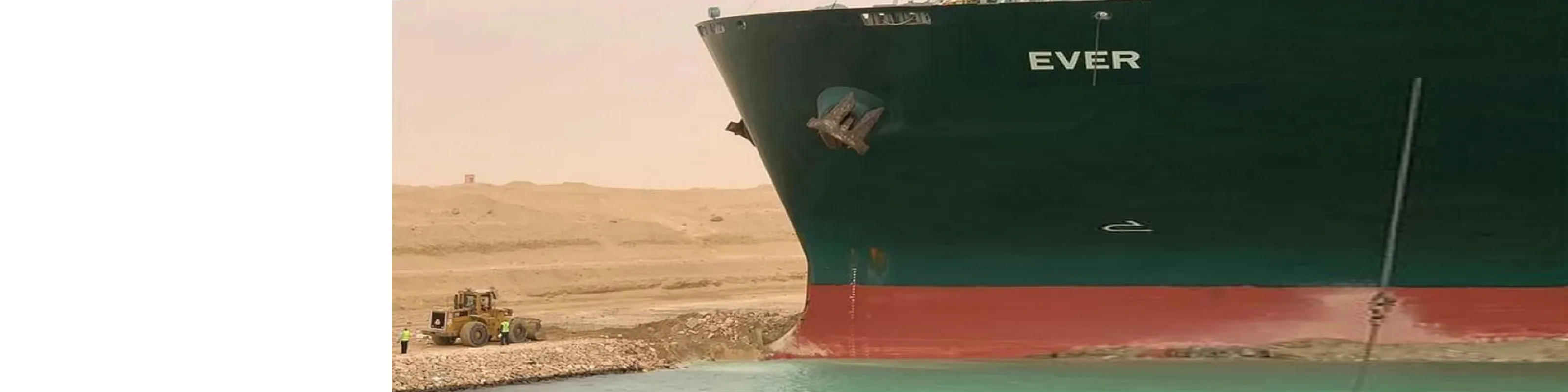
These must be among the few frames in which vehicles recognised as off-road, associated with ‘military technology’ and the fording of waterways do not herald anxiety and misfortune. Fifty years ago, in 1971, a television series was made about the adventures of Pan Samochodzik, hero of Zbigniew Nienacki’s series of books for young readers. The first episode, ‘ Pan Samochodzik and the Knights Templar ’, was shown by the television of Comrade Edward’s era in 1972, half a century ago. News broke that Netflix was returning to the story. One wonders how they intend to do it—in colour? Without Mikulski? Perhaps in the dark atmosphere of a Masurian-Scandinavian crime story, like cinematic fairy tales for thirty-year-olds? That era was one great work of propaganda smoke and mirrors. It is
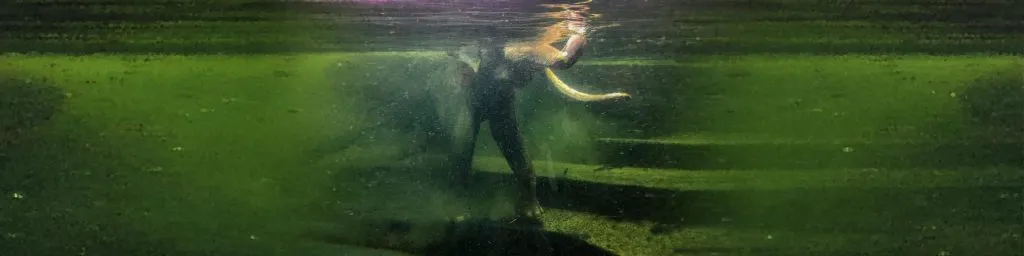
In Łódź we have a dancing elephant. Why is it so interesting at least one elephant does not make spring. It began on November 22, 2021 when we accepted the invitation of Tomek Ciesielski, an artist-researcher from the University of Lodz/New Theatre. In the spaces of the palace at ul. Skłodowska-Curie 11 implemented the programme of the New Theatre and the University of Łódź entitled “Getting to know a dancing elephant. Contemporary performative research". It consisted of three parts: the exhibition "Work Practice and Workplace", the external installation "Method and Tool" and a weekend of performance activities and shows. The idea of the programme referred to an ancient Indian parable about six men who came across an elephant. Each of them was a blind person. One of them grabbed the tail
Young people in Łódź. This time, entrepreneurs. Since they are entrepreneurs, it goes without saying that we, the slightly older members of Think Lodz, are on their side. Thanks to an influential member of our Council, we managed to postpone—substantially—the deadline for submitting FORMS to the ‘Łódź for Young Entrepreneurs’ project. Why? We were waiting for the result of the latest online poll for Youth Word of the Year 2021. The young Łódź factory owner was REBRANDED as a young Łódź entrepreneur long ago. This was meant to demonstrate the ability to combine current language flexibly with images that are not necessarily the latest; it showed yet another capacity for adaptation demanded by contemporary (business) culture. The winning word was ‘ śpiulkolot’ , while the sonorous farewell ‘
Just over a year ago, the jury of Animalis 2020 —a triennial competition for animal-themed painting organised for more than a dozen years by the MM Municipal Art Gallery in Chorzów—was almost unanimous in wishing to award the prize to a painting in shades of grey and black made by Michał Cygan in 2019. After reading the title, ‘The Place Where Dogs Die’, some jurors decided that the picture was too drastic and too literary. Painters were strongly represented on the jury, and with Silesian reliability they preferred different varieties of realism to imagined fantasy. Of course, someone may abandon a dog in a forest, but such an accumulation of cruelty in one place and one frame seemed a gross exaggeration at the time. It did not fit inside the ‘jury’s head’, and the painting did not win
For two decades, Łódź was the setting for a spectacular theatrical performance—the view that the city had hit rock bottom. Human beings have a highly developed capacity to aestheticise catastrophes, especially theatrical (political) ones. Thanks to the Greeks, in the finale now unfolding before our eyes in Łódź, we are released from an excess of emotion through ‘catharsis’. Unfortunately, the unfolding changes in the climate cannot be watched like a theatrical performance. The ancient theory of catharsis assumes that the spectator lives longer than the performance lasts. In this case, that is far from certain.
This question has become a phrase in its own right within Polish culture, leading a rich and independent life beyond journalistic writing. It is asked by Grand Duke Constantine in Wyspiański’s play ‘ November Night’. He hears the secret agent Makrot reply: ‘(…) Yes, it is November now—so my ears are keen. It is the time when spirits walk among the living—and together become as brothers.’ As is customary in Poland, literature explains the events of everyday life. Today’s secret agents evidently share that belief. It is otherwise difficult to explain why the speed cameras along the route of the Warsaw march on Independence Day were carefully wrapped in black plastic. Let us take this as an encouraging sign. Contrary to popular opinion, the machinery of the state has certain inviolable
Łódź turns on a 200-year wheel. Work is beginning on the new City Hall in Łódź—after almost two hundred years. The first was built in 1827 and is inseparably associated with the beginnings of industrial Łódź. The story of the new City Hall began in 2007 with Rob Krier. Invited to Łódź by the Foundation, he placed the City Hall at the very centre of Kobro Square. He made it the principal landmark and was convinced of its role in stimulating the development of the New Centre of Łódź. Krier did not believe that Łódź Fabryczna station would be sunk below ground and hidden beneath the square. How remarkably the history of this strategic site in the city centre has unfolded. It is worth recalling in connection with the new City Hall. More than worth it—we must. This history reveals the road the
A modestly sized trompe l’oeil (46.5 × 63.9 cm), painted by Adriaen van der Spelt in 1658 and now in the collection of the Art Institute of Chicago, perfectly illustrates just how distrustful we are of the image of our surroundings. Spelt painted a still life with flowers, but did so in a way that invoked the story of the rivalry between the ancient painters Zeuxis and Parrhasius. Adriaen van der Spelt, Matrix, 1658 The true subject of this painting is a moment of revelation, when ‘true’ nature unveils itself. The feeling that we live in the Matrix, separated from reality not by one curtain but by an infinite number of them, never leaves Homo sapiens . One wonders why.
Even when absolutely no element of reality has anything to do with what media images show us, as long as the status quo is maintained, we will regard such images as something perfectly natural. Photo after: The Guardian
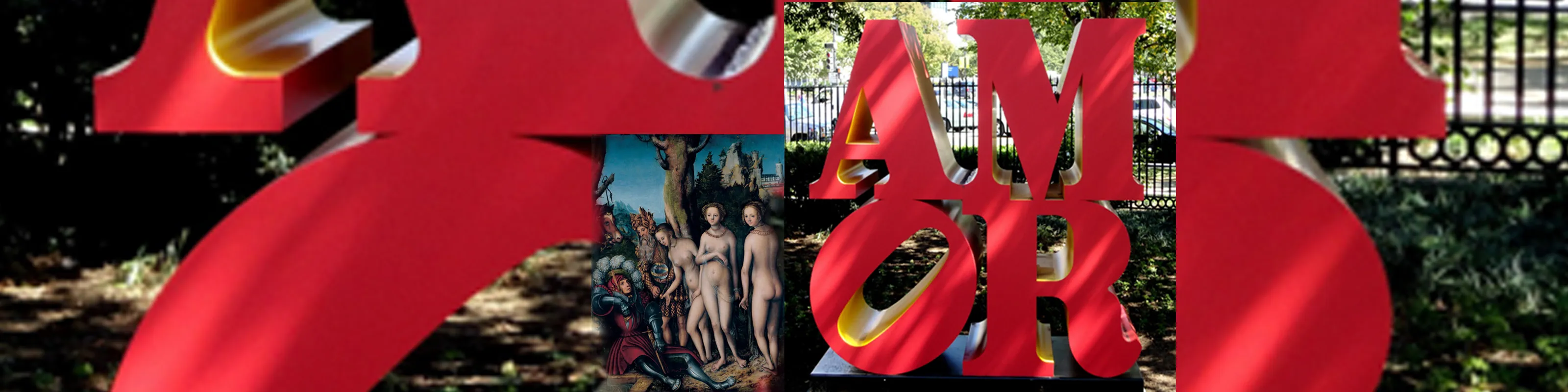
We remain interested in unifying models of reality. We try to simplify the account of the fundamental physical forces. We are excited by every report of the discovery of new elementary particles. Since the end of antiquity, we have had three Greek words naming an equally fundamental force—love: φιλία, ἔρως, ἀγάπη ( eros, agápē, philia ). So far, there is no prospect of unifying them. On the contrary, the twenty-first century promises to be an age of dividing love into its various kinds. Amor _National_Sculpture_Garden_DC_ version of Robert_Indiana work: Love Lucas Cranach the Elder, ‘The Judgement of Paris’, c. 1512–14, Kimbell Art Museum
Images fascinate us. We have insisted that the machines we build should recognise them too. We are also fascinated by the ability to turn images into money. It has just been revealed how a self-driving Tesla ‘sees’ its surroundings. It is a surprisingly simple image. Now that everyone can see it online, it will begin a life of its own. It is only a matter of time before we read about an artist who turns this black-and-white picture into a work offered at auction. Tesla’s car did not stop in front of da Vinci’s portrait of the Mona Lisa. Because there was no person beside it. https://insideevs.com/news/518918/tesla-vision-hacker-shows-depth/ Tesla’s system may remain inoperative for a long time. This image will be monetised regardless. Perhaps it will become a non-fungible token (NFT), the
We know it is a dangerous clot. We simply do not know whether the blocked artery supplies the brain or the heart. Unfortunately, the prognosis is poor in either case. It turns out that we have no up-to-date anatomical atlas of the world.
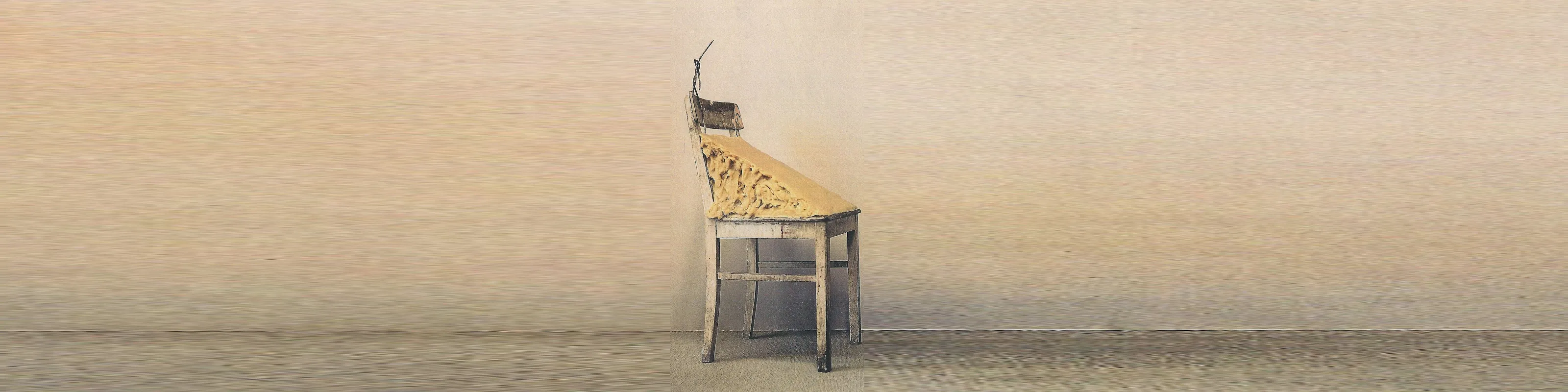
Context determines how the meaning of a sign is ultimately read. Especially when it concerns things as fundamental to our civilisation as hay, for example.
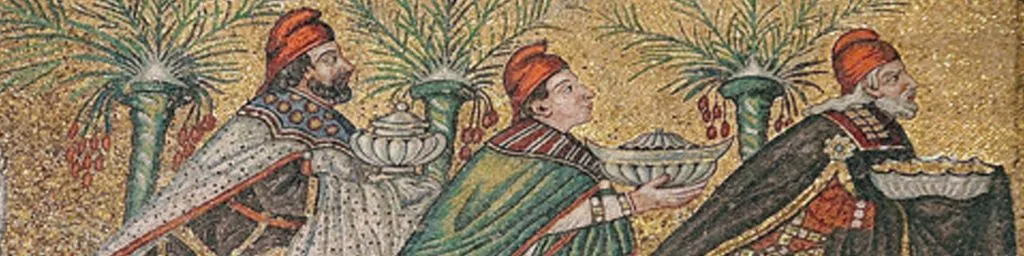
The Star of Bethlehem is a phenomenon produced by the great conjunction of Jupiter and Saturn: the alignment of celestial bodies with an observer. On 21 December 2020, it will be possible to see the great conjunction of Jupiter and Saturn, the two largest planets in the Solar System. The planets will be 0.1 degrees apart. From Earth, this will make them appear as a single, very bright point in the sky. The Star of Bethlehem is a rare phenomenon. It was last seen in 1226, and after 2020 the next will not occur until 2080, followed by 2400. This year, the Star of Bethlehem will appear in the sky on the night of the winter solstice, 21 December. What we regard as ‘very bright points’, as clear signs, is to a considerable extent the result of involuntary calculation and the overlapping
Once the name of our city is translated, it becomes clear why the library of the Nautilus (belonging to Captain Nemo) interests us so much here in Łódź. The difference between the submarine invented by Jules Verne and underground Łódź seems slight. Captain Nemo talks about Łódź as a vehicle for carrying the imagination beyond the horizon. Books that reveal someone’s selection lead by the shortest route to their owners. They are a kind of paper search engine that makes it possible to reach another person—whether below or above the surface.
On an early autumn afternoon in 1954, Frank O’Hara ended his poem Music [ Music ] with the words: ‘(…) As they’re putting up the Christmas trees on Park Avenue I shall see my daydreams walking by with dogs in blankets, put to some use before all those coloured lights come on! But no more fountains and no more rain, and the stores stay open terribly late. ’ [2 October 1954] Nine years later, the war ended. The world gazed towards a bright future. Did it happen terribly late ? As soon as possible? Does anyone still need dreams? Dreams , of course—we remain on the bright side of the force. ‘Wir bilden einen lieben Reigen, Die Freiheit spielt auf allen Geigen, Musik kommt aus dem Weißen Haus, Und vor Paris steht Mickey Maus We’re all living in Amerika, Amerika ist wunderbar We’re all living
At first, the matter seems simple. Treat books as an element of architecture. A book, a brick—what difference does it make? Arrange a set of similar elements. A simple task. Then, once we have mastered these simple things, we read in Lacan: ‘In the beginning was the Word’, with which I entirely agree. But before the beginning, where was it? That is what is truly unfathomable. (Jacques Lacan, The Triumph of Religion). All right: arrange something out of books—but where? In what? What plot, what space do we have at our disposal? How many dimensions does it have? Is it external, internal, dual? A professional architect who begins to ponder this loses their footing; their confidence in action deserts them. They quickly realise that they are suspended in an abyss through which not even Captain
‘I cannot stand his Human Comedy . Think how easily the finest soup is spoiled by adding a teaspoon of stale fat or a little toothpaste. (…) It is easier to hate someone for picking their nose than to love them for creating a symphony. For a detail is characteristic and defines a person in their everyday dimension.’ (Diary, Sunday , 1958). And now, how are we to stir these random and frequently out-of-date ingredients in our 5in cauldron? Clockwise, or perhaps to the left, so as at least to delay the moment when it becomes clear that what has been pre pared may figure on the menu—or rather the panel: order & collect —as the human comedy? Such is the fate of lasting ventures, foundations and institutions, especially ‘cultural institutions’. Their intention and purpose is always to bustle
So September, as almost always immaculately cheerful and Łódź again with a full mouth, four-cultural (direct injection, LPG, turbocharging, catalyst, of course). Łódź city funny, city saving (like Babel and Babadak, but not yet Berlin), aware of the importance of each of her movements. In concentration, like a prządka, Parka celebrates every thread of her past. More congresses, festivals, and events on the vidnorug. Enhancement. So September, as almost always immacubly sunny. We open up to different cultures, we plant like a grandmother in the summer. Let's read an emigrant's remark from 1955: "(...) what were the possibilities of intellectual, aesthetic, philosophizing between me and Argentina? I was fascinated by the pit in this country, and it was the mountain. I was captivated by the
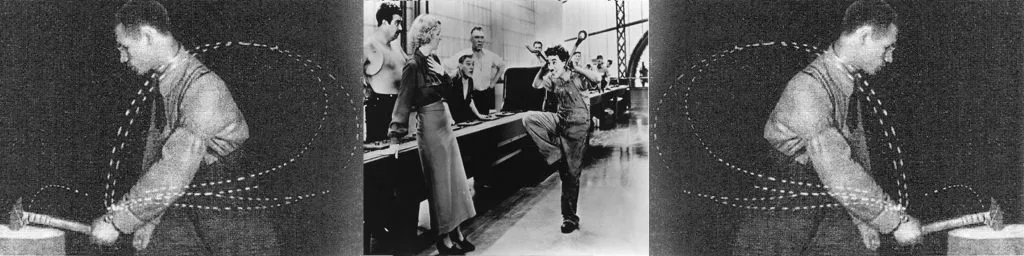
In Siegfried Zieliński's great book, Media archaeology. About the deep time of technically mediated listening and seeing , translated by K. Krzemieniowa on page 303 we read: “In the article On the trends of proletarian culture Gastiew wrote; "The machine controls living people. Machines have ceased to be objects of control, they have become their subjects". (...) In the future, working people would be "the modes of a huge machine". There would be a psychology identical to the rules that determine the operation of the automaton, with its two states: "being turned on" and "being turned off" and a closed set of functions" The author conscientiously refers to another publication at the quote: R. Traub, Lenin and Taylor. The Sichicksale of the "Wissenschaftlichen Worksorganisation" in the
"- Once upon a time, a long time ago, almost as a child, comrade Czyklin - said Pruszewski - I noticed a woman passing by me, as young as I was then. It could have been in June or July. Since then, I felt sad and began to see and understand everything. But I didn't see her anymore. So I want to look again. And he doesn't want anything more.(...) Czyklin imagined exactly Pruszewski's pain, because he himself, although less memorable, once suffered from the same pain, after losing a thin, strange, light man who silently kissed the digger on the left side of his face. Thus, one and the same, rare and charming object interacted from near and far on both of them. - She's probably already old now - he said after a while. - Nothing, she's just tired and her skin is grayed or cooky now