Turning Off the Light Changes Nothing
Dominik Lejman in conversation with Jarosław Suchan
Jarosław Suchan: In many of your works, especially the recent ones, you introduce the viewer into your video paintings. A camera installed in the gallery records the person looking at the work and plays the image back with a delay of several dozen seconds, allowing that person unexpectedly to see themselves in the picture they are watching. The viewer ceases to be merely an outside observer and also becomes a participant in the event. In one interview you suggest that this elevates the viewer to the status of co-author, shifting them from a passive to an active role. But is it not rather the case that you objectify the viewer in this way, turning them into an object of manipulation?
Dominik Lejman: It seems to me that by introducing the viewer into such an event I am really only commenting on a situation in which they are continually implicated anyway. I merely alter the framing a little. It is not I who objectify the viewer; the viewer has already been objectified by the entire environment of vision machines in which they find themselves one way or another. My works are more a commentary on how this objectification takes place, how the viewer is reduced to the role of an extra, how they become an ornament. I show how a human being becomes the object of processes that transform them into yet another passive visual sign. I reproduce these processes to make the viewer aware of the situation they are in and generally fail to notice.
J.S.: What do you think is chiefly responsible for this situation?
D.L.: The emergence of the photographic darkroom and the cinema auditorium was an important moment; through them we were able to begin looking differently at the world and, above all, at ourselves.
J.S.: In commenting on this state of affairs, you continue to use painting.
D.L.: Yes, I am definitely a painter. If only because the surface separating us from what we look at is important to me. I remain outside the situations I reproduce, and despite everything I expect my viewer to occupy the same position. I think that looking from precisely this vantage point at narratives in which they are usually enclosed may offer them a kind of benefit. One need not paint with a brush to be a painter. Although, once the projections cast onto them are switched off, most of my works remain paintings even in the traditional sense — merely “poorly lit” ones. The projections are simply their illumination. Paintings can be illuminated in different ways; I illuminate them with spectacles, with cinematic projection…
J.S.: But surely this is more than illumination. It is not a pure, undisturbed beam of light…
D.L.: We are continually being “illuminated” by projections of one kind or another. We cannot escape them. Painting that does not use video is likewise condemned to projections. They are all the clichés we use to construct an image of reality. I believe that every kind of painting that is not merely craft is projection painting.
J.S.: Your works are exceptionally aesthetic; one could even say beautiful. What purpose does their aesthetic quality serve? Is it merely meant to seduce the viewer?
D.L.: Beauty is quite a serious taboo in contemporary art. My works are shamelessly beautiful, but beauty operates in them as a trap. Here again it is a kind of commentary: a commentary on the mechanisms that allow us to repress the fact that a painting is a decorative object. Hanging on the wall of a private home, it is something intended to adorn or soothe. The problem is how it might simultaneously become an optical instrument that expands our vision.
J.S.: Do you accept that your paintings may do nothing more than adorn or soothe?
D.L.: My paintings accept their condition, which is one of defencelessness. I once discussed this with Krzysztof Wodiczko. He believes in the power of images. I value his perspective, but mine is more pessimistic; perhaps that is why I make such pretty pictures. I do not believe my works can save anyone, or that in the world as it is this commentary can be anything more than decoration. Yet because it speaks about being decoration, it may reveal something to us. When one sees people on fire or other dreadful things turned into tiny, flickering fragments of wallpaper projected onto a wall, I hope that the scale, which utterly degrades the human drama, makes one begin to think somewhat differently.
J.S.: You continually insist that through your art you merely comment on certain situations that exist anyway. Yet you have also made works that do not comment on reality but seek to affect it. I am thinking of your projections in a children’s hospital in Warsaw. Although the medium and convention of these works are light years removed from the practice of the modernist avant-garde, I nevertheless see in them a distant echo of avant-garde utopias. I am thinking of the idea of shaping and transforming reality through aesthetics, using tools drawn from art.
D.L.: I am not alien to Adorno’s position — and this is probably the modernist element — to the position of someone who believes art to be a mechanism for translating reality, or a kind of filter through which we look at reality and through which we can bear what would otherwise be unbearable. This is close to my own experience as an artist: I cannot really recall ever being inspired by things that are charming by nature. I use art to transfer what is uncomfortable into situations that make it possible to accommodate that discomfort. This kind of accommodation took place at the hospital on Działdowska Street in Warsaw. When I arrived there, I saw a space so unrewarding and degraded that it really ought to have been demolished and the hospital rebuilt. Demolition was of course out of the question, so the only option was somehow to accept the space. But how can one accept something like that? Certainly not by turning off the light. Turning off the light changes nothing; sooner or later we have to emerge from the darkness. The only thing I could therefore do was leave the space in the light, introduce into it an “actor” in a situation similar to that of the patient, and translate that situation appropriately. The “actors” I brought into the hospital through wall projections were therefore animals filmed at the zoo, under conditions that severely restricted their freedom and resembled those of the young patients. These adverse conditions were translated into an attractive image that did not, however, conceal the adversity — did not conceal the degraded architecture — but somehow made it possible to accept it.
J.S.: The naked human body often appears in your work, especially in the earlier pieces. This makes me realise that you belong to the same generation as Katarzyna Kozyra, Artur Żmijewski and Paweł Althamer — artists who made the body one of the principal media of their art. Your ways of using it nevertheless differ considerably.
D.L.: I find it difficult to compare myself with other artists of my generation… Generally speaking, I think the body in my work is more anonymous, more objectified. I do not show faces because I am more concerned with conveying how we experience corporeality today. Lucian Freud paints in such a way that texture becomes a substitute for human tissue, oil paint an equivalent of corporeality. In my art, references to the body are equally abstract — one might say formal — in character. They do not address social issues, at least not directly, but the way we perceive the body in a new visual environment. It is truly fascinating. When I began projecting images of people directly onto architectural surfaces, I realised that the architecture operated more physically in these works than the human body. Corporeality today is, paradoxically, something highly ephemeral.
J.S.: A spectral body.
D.L.: It is a spectral body, and rather than telling a story about this spectral quality, I try to “translate” it through media experiments. The point is to experience this new body: its breath, movement and substantiality.
J.S.:Your latest work, or at least the most recent one I have seen, Offer One Another the Sign of Peace, is based on footage recorded during a Catholic Mass. Religious motifs also appear in earlier works: Moroccan Shroud, the Powerprayer series, Consecration and San Pietro. Where does your interest in this sphere come from?
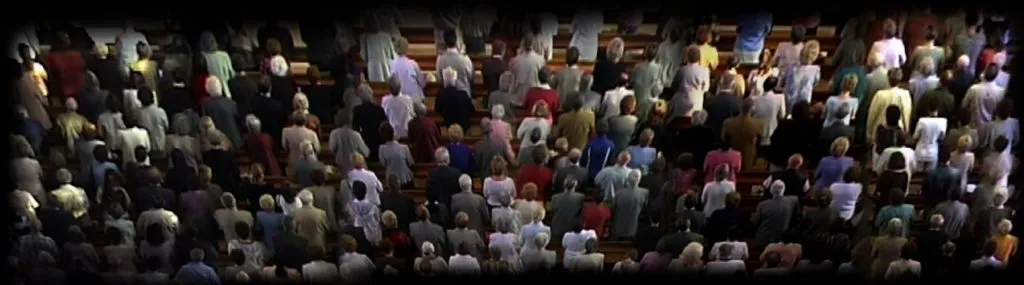
D.L.: In fact, I approach it in what one might call a “superficial” way. I generally believe that an extraordinary amount can be drawn from superficial observation. The Powerprayer series, for example, arose from a simple association between the figure of a praying person and the posture of a motorcyclist hurtling at great speed, racing against who knows what — perhaps time, perhaps eternity. It has nothing to do with the local context of Polish Catholicism, although I have noticed that the longer I live in this country, the more frequent inspirations of this kind become. In these works I show — it is only an intuition — situations that somewhere on a deeper plane may be equivalents of religious ritual in a technologised world. Offer One Another the Sign of Peace is likewise a “superficial” observation of people whom I do not know and about whom I know nothing, people who for me form nothing more than a kind of ornament. This ornament remains static and comes alive at only one moment: when the worshippers offer one another their hands in the sign of peace. For almost its entire duration the projection is a nearly abstract image built from the “pixels” of human figures, and only in that one four-second instant does it cease to be abstract. This temporal proportion is undoubtedly significant and says a great deal about these people and their faith. I draw out this meaning solely by observing the surface, rather like the Impressionists, who likewise did nothing more than observe reality. Yet, as Kracauer wrote as early as 1927, observing what lies on the surface can sometimes explain more to us than in-depth analyses.
J.S.: But such observation is never innocent. However hard you try, you always “contaminate” it with meanings of your own.
D.L.: The decision to look, in this country and at this particular moment, at precisely such a fragment removed from its liturgical context is of course not without significance. It is not an innocent gesture, but I believe my role is precisely to abstract certain phenomena, to tear them from their natural environment so that they reveal meanings otherwise overlooked. I bring them into the gallery and place them in an artificial, abstract situation in the hope that this will allow them to act more powerfully.
J.S.: One of the worlds you subject to observation is that of institutions — both artistic institutions and those associated with big business. Through photomurals you evoke the interiors of multinational corporations’ offices, the corridors of corporate headquarters, gallery back rooms and so forth. One might see this as a manifestation of institutional critique…
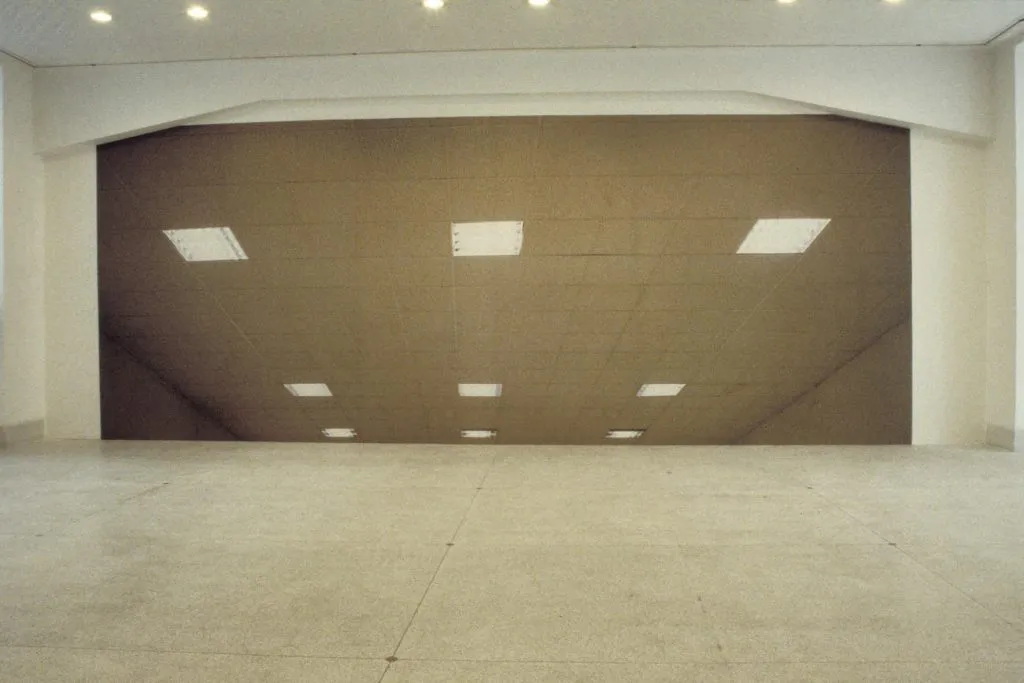
D.L.: Manifesting powerlessness can also be a form of critique. Saying that art is powerless does not mean remaining silent. I do not know whether you noticed, but the interiors in those photomurals are enlarged. Scale is the point here: the proportions between the viewer and the magnified image of a gallery back room or the office of a major company. On the other hand, it is about relations between the institution and the artist. In reality, an artist is someone who provides a service: by making an exhibition, for example, they are effectively decorating the gallery. By reaching for a photomural — itself a kind of decoration — I merely intensify the role of designer that has already been imposed on me. What is at issue, then, is the powerlessness of both viewer and artist in the face of the institution.