
The Mediatisation of Art and Public Space: Reflections on the Work of Dominik Lejman
Ryszard W. Kluszczyński
The history of video art began in the 1960s. Its first ventures therefore coincided with the activity of Fluxus, a movement to which the newly emerging art was linked by the radicalism of its creative stance, nonconformity and disregard for many previously binding artistic standards, including institutional ones. As a result of these affinities, the chronological parallel between the two formations often developed into relations far more significant than mere artistic kinship. These connections also meant that a number of important works belonging to this inaugural chapter in the history of video art simultaneously formed part of the history of Fluxus.
These and other video works made at the time, as well as the processes and relationships in which those works and their creators were entangled, are also part of Dominik Lejman’s history. He had just been born. He presumably did not yet know that he would one day join the company of artists through whose work the contemporary paradigm of art was being transformed. But his future was already being prepared. As it later emerged, it was being prepared, among others, by precisely these artists.
History, meanwhile, marched tirelessly on.
The innovative character of electronic art and its extremes, both artistic and political-ideological, made relations between the new art and the established institutional art system extremely difficult. Over the following decades of the new discipline’s development, as they refined the technology and developed their ability to use it, video artists therefore formed their own sphere of operation, their own poetics and their own institutions. As a result, for many years choosing the status of video artist or media artist meant eo ipso choosing a position alternative to the artestablishment; it meant locating oneself in the underground, in the sphere of avant-garde activity. The character of the avant-garde itself was thereby transformed as it became increasingly saturated with media technologies. The historical form of the avant-garde, founded in manifestos formulated as early as the first and second decades of the twentieth century, gave way to new phenomena, or at least underwent serious internal differentiation. This differentiation produced a new component within the avant-garde paradigm, one possessing relative autonomy: avant-garde media art.
These two institutional systems—the media system, in which video art was beginning to play an increasingly fundamental role (the institutions representing avant-garde filmmakers established in the 1960s were joined in the 1970s by a growing number of organisations founded by artists using electronic media), and the traditional museum-and-gallery order—long remained fundamentally isolated from one another. Responsibility for this state of affairs naturally lay with the traditional art establishment, since it possessed the power either to incorporate video art (or media art more broadly) into the general paradigm of art or to reject it. For a long time—despite the fact that many media artists, as Dominik Lejman would also do in the near future, by no means avoided other artistic disciplines, often giving their art a multi-, inter- or multimedia character—the art establishment chose to reject media. It did not permit the two systems to coexist on equal terms, pushing media art beyond what might have been their shared territory. Even when some museums finally began acquiring video works for their collections—most often those structurally closest to traditional determinants of the work of art, namely video sculptures and video installations—they all too often assigned them a decidedly subordinate role. A similar disregard for media art was evident in the selection of works for exhibitions and in the standards or customs governing exhibition architecture. As Heinrich Klotz was still emphasising in 1993, while impressive works of media art could be seen in presentations such as Documenta, museums in their exhibition practice generally contented themselves with placing a monitor in the foyer. And if they did include several video installations in an exhibition, as happened in the case of Metropolis, they placed them in the basement, directly beside the toilets1.
Such a state of affairs could not, however, continue indefinitely. First, because works of media art were increasingly entering into intermedial dialogue with traditional artistic disciplines. Moreover, awareness of this situation was becoming ever more widespread. One example is a multi-part, meticulously produced programme on video art prepared and broadcast by Spanish television at the end of the 1980s (Dominik Lejman had just begun studying at the Academy of Fine Arts in Gdańsk). Its individual episodes presented the relationships between video art and other artistic fields—video and painting, video and music, video and installation, and so forth—relationships shaped by artists consistently and with full awareness. Second, the separation between traditional art and media art could not be maintained because of the phenomenon already mentioned: the steadily increasing coexistence, within the practice of one and the same artist, of works made with very different tools and media—painting, sculpture, installation, photography and video.
The transformations taking place both within the structures of the works being created—affecting their ontology, poetics and creative instrumentarium—and within their creators’ attitudes and artistic programmes could not leave the order of art in its existing, intact form. Consequently, the 1990s, which Klotz indicted for their treatment of media art, were already the scene of highly significant transformations in the matter under discussion. On the one hand, the development of digital technologies and their invasion of the field of art, which led to the emergence of new phenomena such as interactive installation art and virtual-reality art, greatly complicated and differentiated the internal structure of the media-art world while simultaneously diminishing the importance of video within it. On the other hand, as video art slowly (but probably irrevocably) ceased to play a central role on the media scene, it began in return to enter territories of the art establishment previously closed to it. A visible and significant manifestation of this process at the time, as Ulrike Lehman observed, was the fact that artists using video technology in their creative practice began representing their countries at presentations as significant to the traditional art system as the Venice Biennale: Jenny Holzer in 1990, Nam June Paik in 1993 and Bill Viola in 1995, to recall the particularly spectacular achievements of this period2. I believe we may conclude that this marked the beginning not only of the process of the museumisation of video discussed by Lehman, but also of another phenomenon that complemented it while moving in the opposite direction: the process of the mediatisation, or perhaps rather (especially in its initial phase) the videofication, of art (media art generally entered the traditional art system in the form of videoart at the time).
The mediatisation or videofication of art—a process in which Dominik Lejman was now also participating—manifested itself in the progressive erosion and consequent dismantling of the boundaries that had separated the world of traditional artistic disciplines from that of media arts, and thus also separated video artists (media artists) from the world of the art establishment. A growing number of artists, even those who worked exclusively with media technologies, were no longer inclined to call themselves media artists or video artists. An attitude was becoming widespread in which the character of the art produced and the ways in which it was classified were determined not only by the media used, but also—sometimes above all—by the manner and purpose of their use. This is precisely why Bruce Nauman’s, Tony Oursler’s and Nam June Paik’s video installations in Karlsruhe belong to the collection of the Museum of Contemporary Art, alongside works made in traditional artistic techniques, rather than to the nearby Museum of Media Art. It is in the latter, meanwhile, that one finds the interactive works of Lynn Hershman, Luc Courchesne and Jeffrey Shaw.
In its initial phase, as I have already noted, the process of art’s mediatisation occurred almost exclusively through video art (and, to a far lesser extent, artists’ film). This is the origin of the neologism “videofication of art” used in this text (constructed on the model of the earlier notion of the cinefication of theatre). Today, however, the process of art’s mediatisation is also beginning to encompass spheres of artistic practice that are developing through digital computer technologies and the new-media art emerging around them. Yet not all forms of digital art have already been granted the honour of an ennobling acceptance within the traditional paradigm of art. Christiane Paul rightly proposes distinguishing between two forms of digital technology’s presence in the contemporary art world: technology as instrument and as medium3. Digital new-media art, interactive installation art and netart still operate in exile, developing in separate and distinct territories of art. The presence of digital instruments in painting or sculptural practices, meanwhile, offers the latest contemporary examples of art’s mediatisation, a further stage in abolishing boundaries and restoring the unity of art—a unity now based, however, on new principles.
As I have mentioned, Dominik Lejman’s practice began in the 1990s, precisely when video was decisively entering the spaces of the art system and advancing the processes of its mediatisation. It therefore also entered the spaces of Lejman’s painting—a painting already prepared, however, for this confrontation. It was multi-zone, multi-plane painting in which the dialogue of painterly substances, reinforced by a diversity of painting techniques, brought different forms of representation into collision, producing an impression of multiplied pictorial worlds (Untitled (Veterinarian), 1996); or in which combining a graphic symbol with an almost realistic representation led to the creation of a multifaceted system of semantic references (Convertible Cathedral, 1997). Even before being confronted with video on its own terrain, Lejman’s painting was already characterised by internal complexity, multiple planes and polyphonic discourses. It is worth emphasising that this effect was achieved principally through material and structural procedures rather than thematic ones.
The same was true of the installations Lejman created. Their constituent objects sometimes had a paradoxical character: an object, and thus an entity intended to be durable, made from the impermanent material of ice, but painted (Helmet, an element of the installation Powerprayer, Kiel, 1998). Another example, still more striking and foreshadowing the subsequent transformations in Lejman’s work, comes from the installation Transformations of Presence (1996), where a glass object (durable matter) is linked to an animated hologram (a play of light between objecthood and representation, between being and appearance). The entire Transformations of Presence series was characterised by similar internal tensions, an iridescence that prevented unambiguous classifications (see, for example, Moroccan Shroud, 1994). As with his paintings, the polyphonic complexity of his objects and installations was achieved principally through material-structural strategies.
The media turn in Lejman’s work thus proves to be a prepared turn, one that almost emerges logically from the works preceding it. As a result of this turn, however, Lejman’s art found a new kind of dynamic coherence, a new set of properties that would henceforth characterise his works and help determine their meaning.
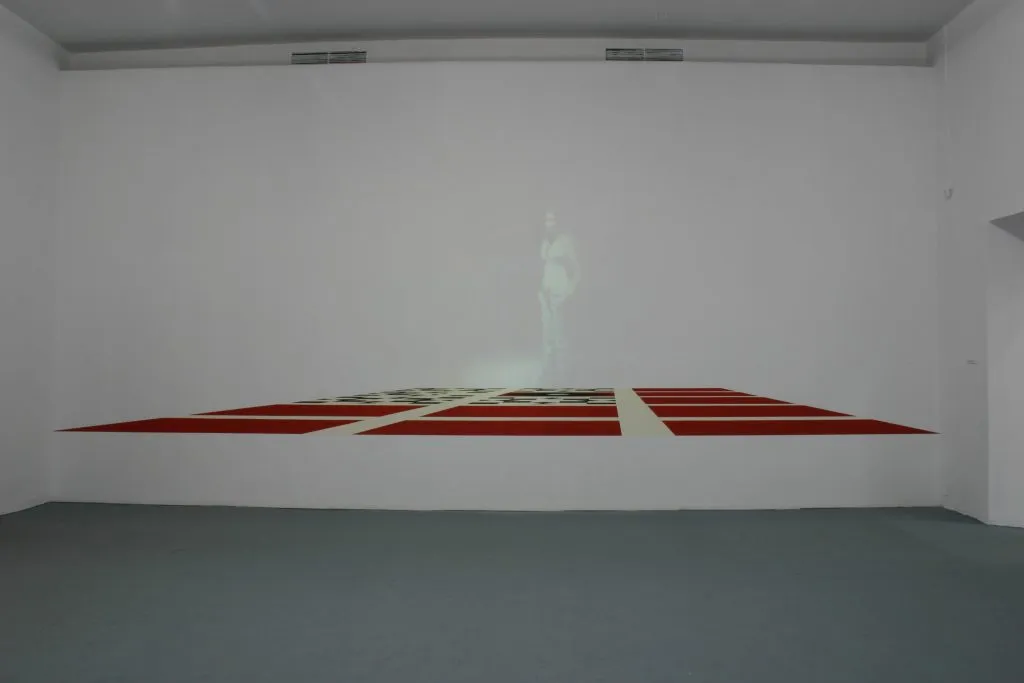
In this new phase of Lejman’s practice, painting encountered and joined with video, together forming an integrated, multilayered hybrid structure so characteristic of contemporary cultures. Painting merged with video in a paradoxical form in which permanence, stillness and finality coexist with changeability, movement and transience; in which, as Łukasz Ronduda has aptly noted4, the logic of the gallery white cube remains in continuous conflict with the logic of the video-projection blackbox. This paradox and conflict arise from the attempt made there to identify the classical screen of painting with the dynamic screen of video (I invoke Lev Manovich’s typology of screens)—an identification that can never be fulfilled and remains an eternal play of opposites, but which also prevents either party to this conflictual relationship from preserving its purity or autonomy, or gaining and maintaining an advantage over the other. The complexity of Dominik Lejman’s video-painting is not founded solely on its combination of different screens. After all, they serve different forms of imagery and representation, different both structurally and—what seems particularly important—materially. The source of Lejman’s works’ perceptual specificity lies in the difference between painterly matter and the immaterial spectre of the video projection. This, in turn, has a significant influence on their semantics.
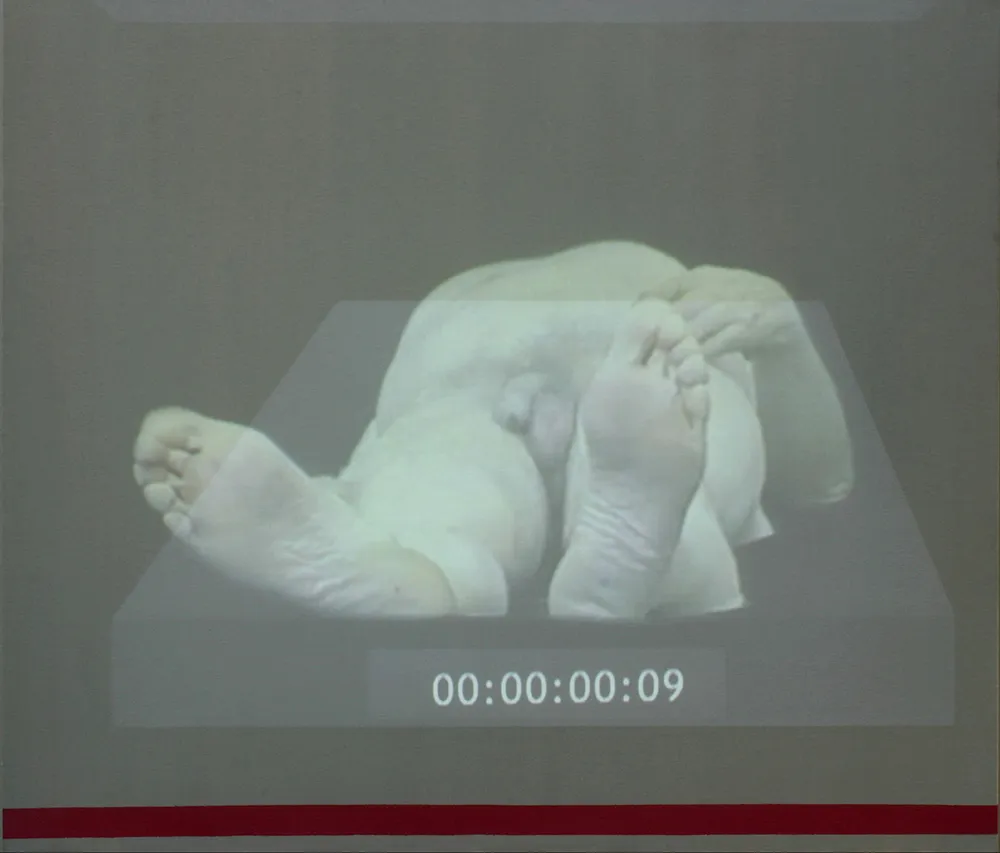
The richness of meaning in Lejman’s works also grows from the relationships they initiate at compositional, generic, stylistic and thematic levels. Here we encounter a multitude of diverse intertextual references that complement the intermedial relationships described thus far. Sometimes these intertextual relations are highly specific, linking Lejman’s work to another, explicitly indicated artistic creation. We encounter this kind of reference in Status (One Hour with Timecode), 2005, which alludes to Mantegna’s painting. Similarly constructed individual references may direct our attention towards particular places, such as San Pietro, 2005, or events, such as New York Marathon, 2004. At other times, intertextual references are more general, invoking styles, periods, or design and architectural solutions.
In every work by Lejman, all these intertextual relations combine with intermedial ones, producing a complex network that determines the character of the work’s experience on each occasion. These networks link artistic media and technical communications media with the world of artefacts and with categories from the history of art, culture and human civilisation that manifest themselves through the experience of the work. They connect classical conventions and values with post-classical technologies, premodernity with postmodernity.
The term video-painting, which I used earlier to describe Dominik Lejman’s art, is not sufficient to describe it fully. In recent years, his works have increasingly assumed the character of video frescoes or video murals, annexing the materiality of their surroundings, giving the arranged space the character of augmented reality, virtualising selected environments and, in a sense, making Lejman’s video-painting a form of in situ painting. Media, painterly and architectural aspects combine in his art, giving it a complex intermedial character.
The architecturalisation of Lejman’s works also reveals the interest in the public sphere characteristic of his art and deeply, permanently present within it. This brings techniques of surveillance and control into the instrumentarium of his practice, and questions of individual autonomy and relations with others into the subject matter of his works. Together with its media instruments, the process of art’s mediatisation can readily introduce the media’s characteristic connections with public space, discursiveness and interest in social issues. In Dominik Lejman’s practice this assumes an almost programmatic character. The media turn in his work proved simultaneously to be a turn towards the public sphere.
1. See the interview Klotz gave to “Living”, 1993, no. 1.
2. U. Lehman, Notesonthe “Museumization” of Video Art, in Videonale6, catalogue.
3. Christiane Paul, Digital Art, 2005.
4. Łukasz Ronduda, Aesthetics of the Risk Society: On the Art of Dominik Lejman, in Present Perfect, 2005, exhibition catalogue.