
From Spectacle to the Scene of Exposure
Tomasz Załuski*
‘Painting’ and ‘the contemporary’: today, perhaps, these concepts are once again entering into a tense relationship, striving to determine and define one another. Yet is their configuration still possible? Can it be conceived at all and, more importantly, realised? Can one work ‘painterly’ today in such a way as to create a ‘painting of contemporary life’ worthy of the name? These questions cannot be avoided, particularly when one hears voices here and there in Poland announcing a ‘return to painting’ and witnesses exhibition projects such as New Old Masters at the National Museum in Gdańsk or Polish Painting of the Twenty-First Century at Zachęta in Warsaw.
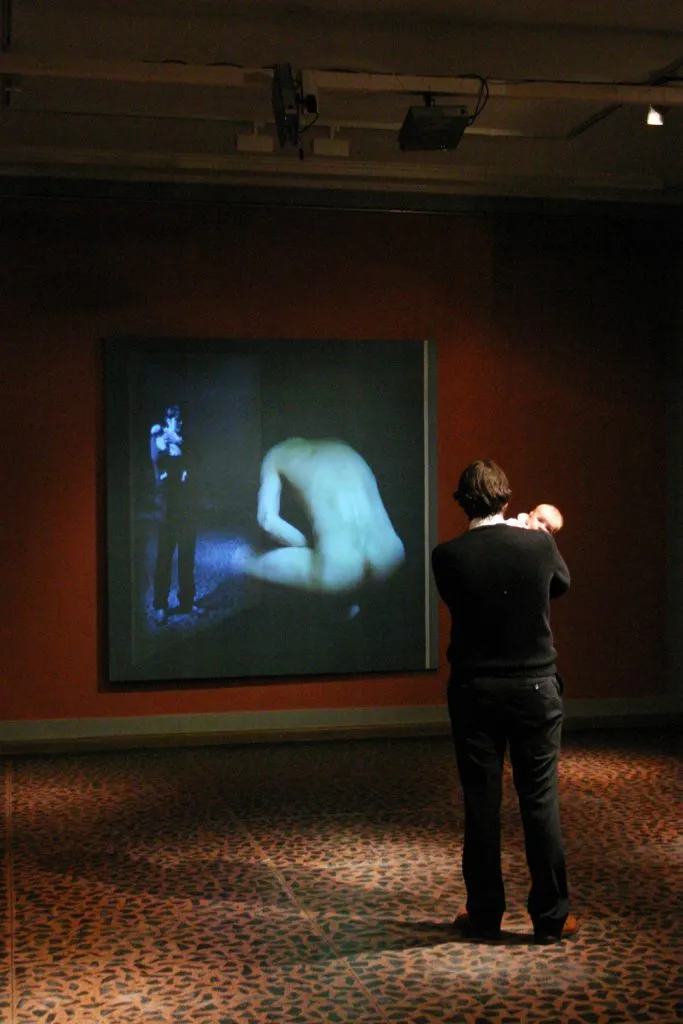
Each exhibition articulated the meaning of painting’s supposed ‘contemporaneity’ differently, yet both presented visions that, to put it mildly, must be regarded as ‘misguided’. In the first case, we encountered a self-exposing specimen of the Fourth Polish Republic’s cultural policy: an example of promoting conservative ideology through art that was supposedly intended to cultivate the traditional values of painterly craft, beauty, aestheticisation, idealism and humanism, while ostentatiously demonstrating its disengagement from the present. Incoherent in its very juxtaposition of a ‘sublime’ conception and works that inadvertently compromised it, the exhibition ultimately amounted to a classic ‘half-baked failure’ or an attempt to ‘reheat a corpse’: an inept flight from the contemporary rather than an effort to confront it. The exhibition Polish Painting of the Twenty-First Century , in turn, was a not entirely intelligible mixture, devoid of expression and substance, comprising paintings by canonical figures of twentieth-century Polish art and a mass of ‘current’ but insipid and unconvincing works. Among them, one could only occasionally pick out a handful that responded to the imperative of contemporaneity in an interesting way. The exhibition not only failed to answer the question of the present-day forms assumed by the relationship between ‘painting’ and ‘the contemporary’; it was also unable to formulate the question itself with any clarity.
The question of the ‘contemporaneity of painting’ nevertheless remains valid and today seems to impose itself as newly relevant—that is, relevant in some new, different and as yet unspecified way. Perhaps we find ourselves in a situation where Baudelaire’s The Painter of Modern Life should be ‘rewritten’ anew, repeated, as it were, while undergoing all necessary transformations and thereby being adapted to altered present conditions. Perhaps, too, in writing ‘our’ Painter of Contemporary Life, it would be particularly worthwhile to revisit such elements of Baudelaire’s programme as the emphasis on the diversity, ephemerality, contingency, eventfulness and singularity of reality on each occasion, together with the demand that these aspects be conveyed both in what is presented and in the very structure and manner of presentation. Moreover, in this connection it is worth remembering that, on the assumption that ‘the rapid movement of life, the daily metamorphosis of things, demands […] an equal speed of execution’1, Baudelaire considered drawing and lithography the best means of depicting his own modernity-contemporaneity. He thus moved beyond the traditional infrastructure of painting: understanding it more ‘metaphorically’, he expanded its meaning or transported it beyond itself, and in doing so seemed to locate the technique of contemporaneity in a distinctive form of painting beyond painting.
This expansion or transposition, this being-outside-itself, also defines the painting of contemporary life in the singular form represented by Dominik Lejman’s works. Employing the photographic image and projecting moving video images onto a variety of surfaces—including traditional painting supports—the artist continues to view himself as a painter and stubbornly resists attempts simply to classify his practice as video art. His works belong rather to the hybrid category of ‘video painting’2, an internally diverse field in which the video image is used in practices that refer in various ways to the problems of painting. This is all the more justified because Lejman himself employs the related terms ‘video fresco’, ‘video mural’ and ‘video wallpaper’ for different kinds of his works. To reveal properly the role played by video technology in Lejman’s practice, however, one must first outline more broadly the context of earlier attempts to expand the problems of painting or take it beyond its traditional infrastructure, which form an important point of reference for the artist’s work.
These include above all works from the sphere of minimal art, as well as Daniel Buren’s practices, which resemble them in certain respects. In the most concise terms, painting’s movement outside itself involved a shift of emphasis from the object-picture itself to the surroundings in which it appeared, to the overall situation in which the viewer encountered the object and to which the viewer also belonged as a bodily being. This situationality emphasised that the viewer existed in the same time and space as the object-picture, and gave the viewer a sense that the work depended to some extent on their participation and was incomplete without it. In other words, this situationality foregrounded the relations between the picture-object and its surroundings, among them the relation with the viewer who looked at the picture-object and experienced themselves as part of the situation that helped shape it.
This remarkably apt characterisation was offered by Michael Fried in his otherwise critical 1967 essay Art and Objecthood3. Minimalism was criticised there for its ‘theatricality’, a quality linked precisely to the attention paid to the work’s overall situation, and above all to the emphasis on the spectacle, the ‘theatrical situation’ in which the viewer observes the art object, with its staging and overt manipulation of the object-viewer relationship. Fried writes that the minimalist work confronts the viewer insistently and aggressively stands in their way, forcing their participation while simultaneously isolating them and producing a disturbing effect of distance akin to that caused by the silent presence of another person. Indeed, minimalist works are said to possess a dual ‘anthropomorphism’: the size of the works is closely related to that of the human body, while their ‘hollow’, ‘pneumatic’ structure suggests the presence of an inner, secret life. It is precisely this act of confrontation by the work, which forces the viewer’s participation, together with the effect of distancing the viewer, that becomes the object of Fried’s critique. For these are signs of the inauthenticity of a work whose presence is incomplete, relational and in this sense ‘scenic’, as well as of the mediated character of the contact the viewer enters into with such a work. Fried suggests that a work of art can defeat theatre only when it gives the impression of complete self-presence, independent of the viewer insofar as it takes no account of the viewer’s existence. Paradoxically, only then will there be no distancing effect; instead, appropriate conditions will be created for the viewer’s complete ‘absorption’ by the work, for an act of truly ‘communional’ immersion in it. It is therefore unsurprising that the only art to escape theatricality virtually automatically is said to be fundamentally immersive cinema. Painting, by contrast, appears in fact to remain trapped within the vicious circle of a theatrical ‘dialectic’, in which a relative and partial effect of anti-theatricality can be produced only by strictly theatrical means, through manipulation of the relationship with the viewer4. This is no accident, because according to Fried the inauthentic mode of being, corrupted or distorted by theatre, is universal in both art and life.
The motif of the universality of inauthentic, theatricalised life also plays a central role in the discourse of the ‘society of the spectacle’: the discourse of Situationism, which in turn forms an important context for Daniel Buren’s early works. As Guy Debord wrote, ‘the life of societies governed by modern conditions of production appears as an immense accumulation of spectacles. Everything once lived directly has receded and assumed the form of representation.’ This social ‘spectacle is not simply an accumulation of images, but a social relationship between people mediated by images’5.
Paradoxically, one might say that Situationism approached Fried in its nostalgia for authentic presence and the immediacy of social relations, and in its critique of the social spectacle as a world of appearances. In the sphere of art, however, Fried attached his hope of overcoming theatricality to the viewer’s absorptive immersion in the work and criticised minimal art’s ‘situationality’ from this position; Situationism, by contrast, emphasised precisely that ‘situationality’ and the reflective, critical or even emancipatory potential of the distancing effects that could arise within it. It is worth juxtaposing Fried’s faith in the non-theatricality of immersive cinema with Debord’s highly distancing and de-immersive 1952 ‘film situation’, Howls for Sade: a film without images in which words from the loudspeakers were accompanied by a white screen illuminating the auditorium, while moments of silence brought darkness, which also concluded the film in a twenty-four-minute coda. Fried himself was quite sceptical of practices of this kind. Referring to the demand that stage lighting remain visible in Brecht’s theatre, he pointed out that this disillusioning device had itself already become a type of theatrical convention6. In other words, he drew attention to theatricality’s inevitable and puzzling tendency to appropriate every distancing effect and absorb it into its repertoire. As Jean-Luc Nancy observed some time ago, ‘it is precisely this limitless ability to recuperate the Situationist critique that demands attention. The unmasking of appearances itself moves effortlessly within the realm of those appearances, since it can define what is proper and authentic—what is not appearance—only as an obscure opposite of the spectacle’7.
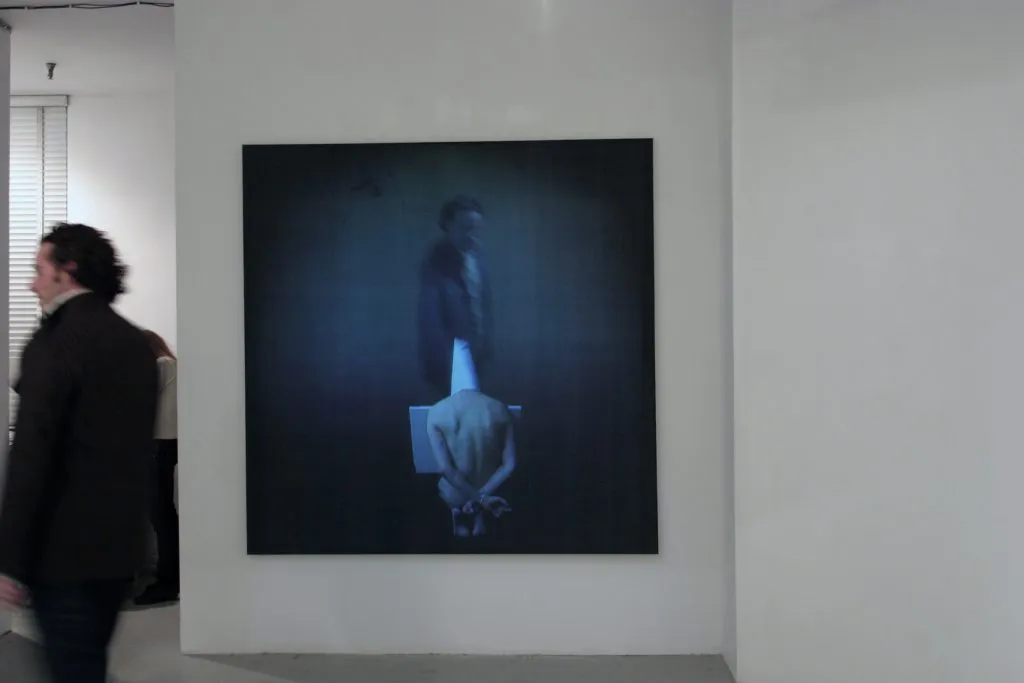
This, then, is the complex, indeed convoluted situation in which Lejman’s video-painting practice develops. In many respects, the artist’s works fit the ‘theatricalising’ categories Fried proposed to describe minimal art. They emphasise situationality and foreground the relationship between the picture-object and its surroundings. They also confront the viewer ostentatiously and, by manipulating their relationship with the viewer, cause viewers to experience themselves as factors actively completing or helping to shape the work’s overall situation. This contains the first element of the expanded ‘painterliness’ of Lejman’s work: the creative shaping of the situational picture-viewer relationship. Treating the traditional painting support and other surfaces as screens for video projections, the artist seeks an increasingly complex and, in a certain sense, ‘interactive’ participation of the viewer in the work. Video technology makes this possible. In recent works such as Yo Lo Vi, the viewer’s activity in front of the picture is recorded by a video camera, appropriated in this manner and then projected onto the picture’s surface beside another, pre-existing projection. The viewer’s confrontation with the picture is therefore staged and presented to the viewer directly on the picture’s surface.
On the other hand, both Lejman’s own commentaries and his practices contain many more or less direct references to the Situationist motifs that entered the repertoire of numerous other critical discourses on contemporary society. Lejman approaches contemporary society as a collection of mass spectacles performed by its members in countless places and institutions, such as streets, churches and museums. Every spectacle operates through number and mass; its element is the statistical. It is therefore most fully realised in collective scenarios that normatively define the ‘roles’ of human individuals as contemporary society’s ‘extras’. Above all, it is also a spectacle of visual information. Through a functional message composed of readily recognisable clichés and stereotypes, this information imposes upon us a quasi-consumerist act of reading rather than seeing, thereby producing a kind of ‘cataract’ and restricting our imagination’s creative capacity for projection. This informational, collective spectacle inevitably leads to the aestheticisation, or a distinctive ‘ornamentalisation’, of every message, thereby neutralising its content in advance. By providing the aesthetic pleasure that comes from deciphering these ‘ornamental’ formulas of communication, from the visual reading of collective arrangements that form various kinds of ‘human wallpaper’, the spectacle ultimately constitutes a form of informational ‘anaesthesiology’: it numbs its participant-viewers and removes from view the fact of the individual human being’s existence as such. It is in the name of every singular existence, different and unrepeatable on each occasion, that Lejman attempts to look critically at the fascinating and excessively soothing beauty of statistical ‘scenarios’ and ornamental ‘abstractions of crowds’.
Situated within this context, Lejman’s artistic practice is clearly much closer to the aspirations of the Situationists than to Fried’s postulates. The artist wants his works to give the viewer at least a slight reflective, and perhaps critical, distance from the spectacularity of the contemporary world. First, the projection of a virtualised, spectral image obtained through contemporary means of recording and surveillance takes place in his works in a fairly brightly lit space, in the situation of ‘the lights being on in the cinema’. It is therefore intended to perform a de-immersive role, disrupting the effectiveness of the technological spectacle and allowing it to be seen as such. For this reason, Lejman does not use sound, which could surround and absorb the viewer immersively. Second, in those works—Conditional Discretion and Yo Lo Vi—where the viewer’s image, or rather the virtual trace of their presence, is projected onto the picture plane, de-immersive distancing occurs insofar as viewers observe their ‘entry into the picture’ from outside and intensely experience their existence beyond this situation, their separateness from the picture’s surface.
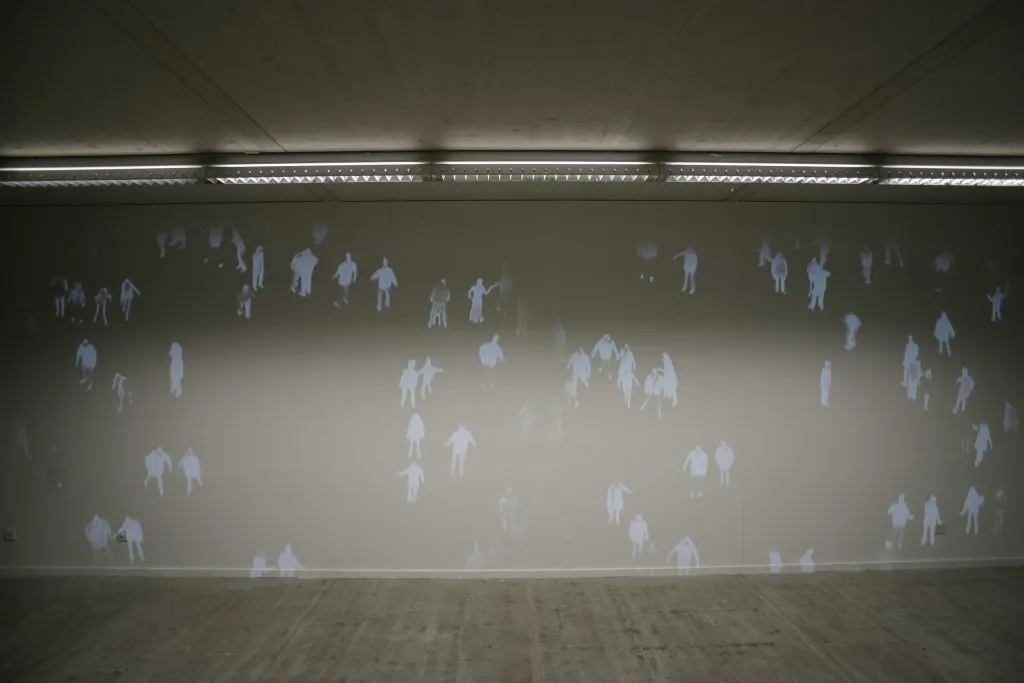
Third and finally, distance from the phenomenon of ‘visual anaesthesiology’ carried by aestheticised messages is to be achieved through the ostentatious repetition and accentuation of their ornamental character and formal beauty. Paradoxically, poison administered in an increased dose becomes medicine here. The artist inscribes projections of human collectives into decorative arrangements and shapes—Dandelions, New York Marathon, Statistical Garden—and reduces the scale of media images, including images taken from news reports, bringing them closer to the elements of a computer game—Media Frottage. He also abstracts ‘documentary’, mechanically recorded moving images: he reverses them into ‘negative’, reduces them to black and white, and compresses their tonal range, thus taking their realist reference to the limits of recognisability—Skaters, Hang Gliders. By widening the gap between a visual-information message and its supposed content, the singular event it is meant to report, and by giving us distance from this inadequacy of the message, these devices are in some way able to evoke the event’s inaccessible singularity itself. It is also evoked by the fact that the documentary material recorded and processed by Lejman sometimes reveals only a tendency for people spontaneously to arrange themselves into quasi-ornamental patterns. At certain moments, the silhouettes of Skaters moving across an ice rink seem to sketch particular formal configurations, only to disintegrate immediately through acts of individual departure from the statistically correct trajectory.
In their distancing effects, Lejman’s works seem entangled in the same difficulties encountered by Situationist discourse. On the one hand, the unmasking of the spectacle’s mechanisms operates within the spectacle itself and cannot be supported by any escape beyond it towards a concrete, defined alternative. Like the Situationists, Lejman appeals here only to the value of the unfettered imagination of a person capable of making their own creative imaginative projections instead of performing ready-made, ‘statistical’ scenarios. On the other hand, Lejman’s works are complex configurations of anti-theatrical and theatrical devices, while the ‘gadget-like’ appeal of the technology employed in them can itself be perceived as highly spectacular and, in this sense, ambivalent.
These difficulties open the way to a somewhat different, complementary interpretation of Lejman’s works, analogous to the one Jean-Luc Nancy proposed in relation to Situationism. A key role in Nancy’s interpretation is played by the concept of ‘exposure’ or ‘being exposed’, meaning the fact of existing in a constitutive but also confrontational and transformative relation with others: ‘“to be exposed” means to be “placed, positioned” in exteriority, according to exteriority, to have to do with exteriority within the very intimacy of the interior. In other words, it means having access to what is proper to existence, and therefore, of course, to what is proper to one’s own existence, only through “expropriation”, exemplified by “my” face, always exposed to other faces, always turned towards the other and facing them’8. Nancy indicates that Situationism contained an ‘intuition of society exposed to itself’: a society deprived of every essence given once and for all and of any single proper form of being-together, but existing instead in a transformative relation with itself. Situationism ‘revealed quite clearly, although not fully, the question of society’s relation to itself. “The society of the spectacle” is at once an unmasking of the generalised spectacle-market and an affirmation of society facing itself, and perhaps even more an affirmation of society as exposed to itself and to itself alone’9.
Nancy emphasises that every critique of the spectacle, however indispensable, must find its reference point or support in something other than an obscure opposite of the spectacle. Consequently, ‘the present situation of “social being” should be understood in a way entirely different from the schema of limitless self-consumption […]. If we try to read it differently, the phenomenon of the generalised “spectacle”, together with what we call its “teleglobal dimension” […], may reveal something entirely different’10. That something is the fact that social being, or the social bond, is being-in-relation, and relation always presupposes the separateness, difference and mutual distance of individuals whom it both connects and separates. The social bond is never a union, a ‘communion’ of individuals who would merge immersively in direct contact, but the mutual exposure of their distinct singularities, their being-for-one-another and being-towards-one-another. It is a relational coexistence that demands completion and participation from others and, in this sense, is fundamentally ‘theatrical’ or ‘scenic’, or at least presupposes the emergence between individuals of a certain—each time different—scene of exposure: ‘even if social being is not directly “spectacular” in any of the accepted meanings of the word, it is in any case essentially a question of being-exposed. It exists as being-exposed […]. Society’s being-towards-itself is the network and mutual referral of co-existence, that is, of plural coexistences. This is why every society gives itself its spectacle and gives itself as spectacle, in one form or another’11.
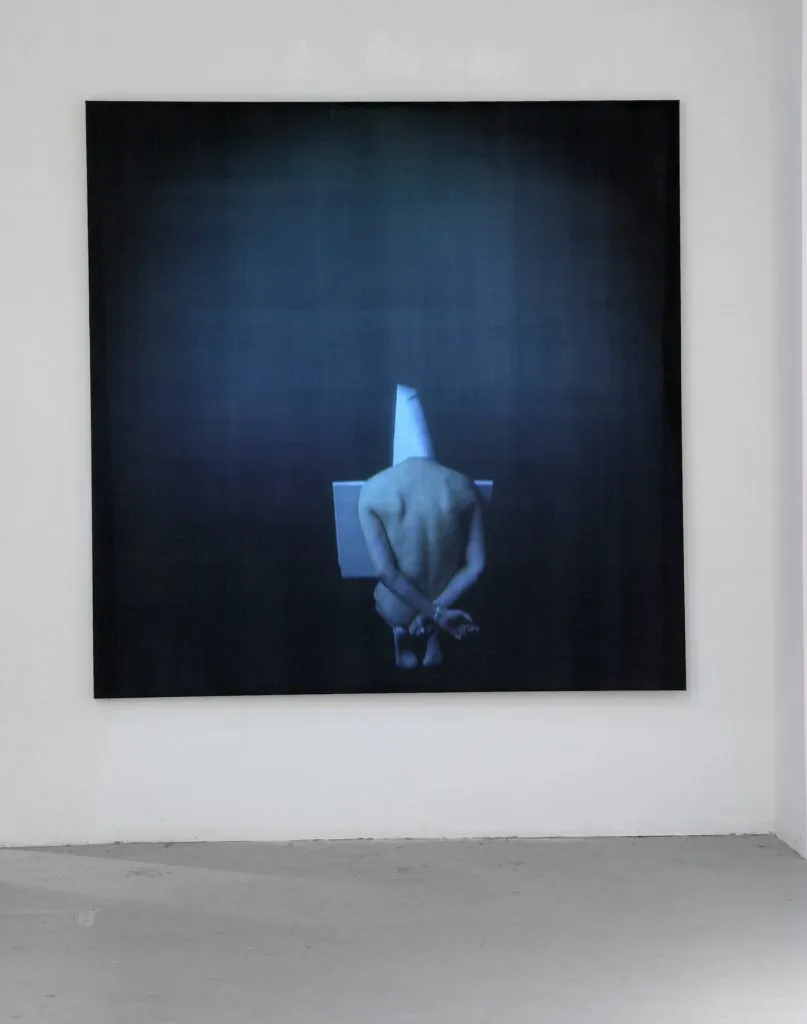
Lejman’s latest video-painting works, including those prepared for the exhibition at Atlas Sztuki, can be treated precisely as scenes of such singular exposures. The image of the viewer recorded by a video camera is projected onto the surface of a picture or wall and confronted there with a projection that already exists. This occurs, however, with a visible delay of several seconds. Viewers therefore do not see themselves in the picture as in a mirror; they can only observe how their ‘own’ gestures and actions, performed moments earlier, become separated from them and acquire new meaning in a tense, awkward and uncomfortable confrontation with another ‘motif’ projected onto the picture. This motif may refer to current sociopolitical problems and events: in the case of Yo Lo Vi, shown in New York, it was a staged quotation from a painting by Goya that there evoked irresistible associations with both the Ku Klux Klan and acts of abuse committed by soldiers against prisoners at American military bases. The video-painting delay therefore causes viewers to lose control over their image and enables them, on the picture’s projection stage, to experience exposure itself: the event of being exposed to a singular other and the way in which their relationship with that other helps shape the meaning of their ‘own’ actions. Through the delay, action regains the properly political meaning described by Hannah Arendt12: it ceases to be the production of a ‘work’ or effect controlled from beginning to end by a single author, and becomes a never entirely predictable, ‘interactive’, antagonistic and communal process through which tense relations form among multiple, differentiated individuals. Employing Nancy’s words once more, one might ultimately say that what Lejman’s ‘delayed’ video painting exposes on its multiple, different scenes on each occasion is ‘a community confronting itself, we standing opposite ourselves […]. Confrontation undoubtedly belongs to community: it concerns both a clash and a position, an encounter face to face with oneself in order to challenge and put oneself to the test, to share out one’s being by means of a distancing interval that is also the condition of that being’13.
Lejman’s art is a singular form of painting contemporary life: a contemporaneity divided, exposed to itself and confronted with itself, suspended between the immeasurable social spectacle and the discreet scene of mutual, singular exposure that slowly emerges through it. It is a painting of a contemporaneity facing itself, divergent from itself and delayed in relation to itself.
*Dr Tomasz Załuski is an assistant professor at the Academy of Fine Arts in Łódź.
1 Ch. Baudelaire, The Painter of Modern Life, in: idem, Aesthetic Miscellanies, translated into Polish by J. Guze, słowo/obraz terytoria, Gdańsk 2000, p. 312.
2 This category was proposed by Jarosław Lubiak when explaining the conception of the exhibition Pictures as If Painted, organised in collaboration with Kamil Kuskowski in December 2006 at Galeria Bielska in Bielsko-Biała. The works presented there as singular examples of ‘video painting’ also included Lejman’s video fresco Skaters.
3 M. Fried, Art and Objecthood, in: G. Battcock [ed.], Minimal Art: A Critical Anthology, New York 1968, pp. 116–147.
4 Fried analysed this paradox extensively in his books on eighteenth- and nineteenth-century French art.
5 G. Debord, The Society of the Spectacle and Comments on the Society of the Spectacle, translated into Polish by M. Kwaterko, PIW, Warsaw 2006, pp. 33–34.
6 M. Fried, Art and Objecthood, op. cit., pp. 146–147.
7 J.-L. Nancy, Être singulier pluriel, Éditions Galilée, Paris 1996, p. 72.
8 J.-L. Nancy, Preface, in: idem, The Inoperative Community, trans. P. Connor, L. Garbus, M. Holland, S. Sawhney, University of Minnesota Press, Minneapolis 1991, pp. xxxvii–xxxviii.
9 J.-L. Nancy, Être singulier pluriel, op. cit., p. 75.
10 Ibid., p. 77.
11 Ibid., p. 92.
12 H. Arendt, The Human Condition, translated into Polish by A. Łagodzka, Fundacja Aletheia, Warsaw 2000, pp. 195–256.
13 J.-L. Nancy, La communauté affrontée, Éditions Galilée, Paris 2001, p. 51.