
Without the Veil
Zofia Lipecka
“Only then did the veil fall from our eyes,” Jankiel Wiernik wrote of his arrival at the Treblinka death camp in the late afternoon of 24 August 1942. Travelling in an overcrowded, airless railway wagon, he and his companions in suffering still hoped that they were being taken to Ukraine to work. When the train reached its destination, the veil of hope and imagined fate fell from their eyes, and a terrifying reality appeared.
In the installation Warsaw–Małkinia, the opposite occurs. Images from a film showing an ordinary train journey are displaced by what we imagine while listening to Wiernik’s testimony. Eventually the film breaks off, the veil of the visible disappears and, in the darkness, as we continue to listen to the witness, we imagine the nightmarish sight: “The square was strewn with corpses, some clothed and some naked. Their faces were contorted with fear and horror. They were black and swollen. Eyes wide open, tongues hanging out, brains spattered, bodies deformed. Blood everywhere…”1
Our inability to feel another person’s suffering and death forms a barrier that makes the horror impossible to represent. “No one, even with the boldest imagination, could picture what I saw and experienced,” Wiernik warns. “Nor could any pen describe it.”2 If this is impossible for someone who survived the Holocaust, it is all the more so for generations born after the war. In abandoning the visualisation of violence and cruelty, I do not seek to create a safe screen before what cannot be expressed or imagined. I introduce no symbolic void, euphemism or metaphor. Such an attitude would be an escape. When Georges Didi-Huberman travelled to Birkenau, climbed the guard tower and looked towards the ramp, he told himself: “It is unimaginable, so I must imagine it nevertheless. In order to represent at least something, the minimum of what we can know.”3 Here, that minimum of knowledge and representation consists only of what the witness was able to communicate to us from the abyss of his experience and what we ourselves are capable of imagining.
The veil of the visible also falls when we visit sites of the Holocaust, such as Treblinka. Instead of an ordinary, peaceful view of a village, forest and fields, we see the bloody scenes that unfolded there. Here, too, looking is replaced by imagination. Viewing the monument is not especially conducive to this; rather than revealing memory, it wraps it in an aesthetic and abstract veil. A place acquires meaning through our awareness and knowledge of it, not through what we see.
One can choose not to visit places marked by the crime of exterminating the Jews. One can close this dark chapter of history in the name of the principle that “life must go on”. This is an understandable veil of forgetting that allows survivors to continue living. More troubling is the veil of repression drawn by those who should remember. In art, Gerhard Richter made such a choice in adopting a tabula rasa position. The gesture of blurring or erasing a shameful past is omnipresent in his work: when he destroyed most of the works he had made before 1962, especially a portrait of Hitler; when he blurred the portrait of his Uncle Rudi in uniform so that it became indistinct; or when he stained and almost entirely overpainted commemorative photographs with opaque paint. Blurring in his painting is synonymous with ambiguity: the artist avoids adopting an unequivocal ethical position and thereby assigning political meaning to his work.
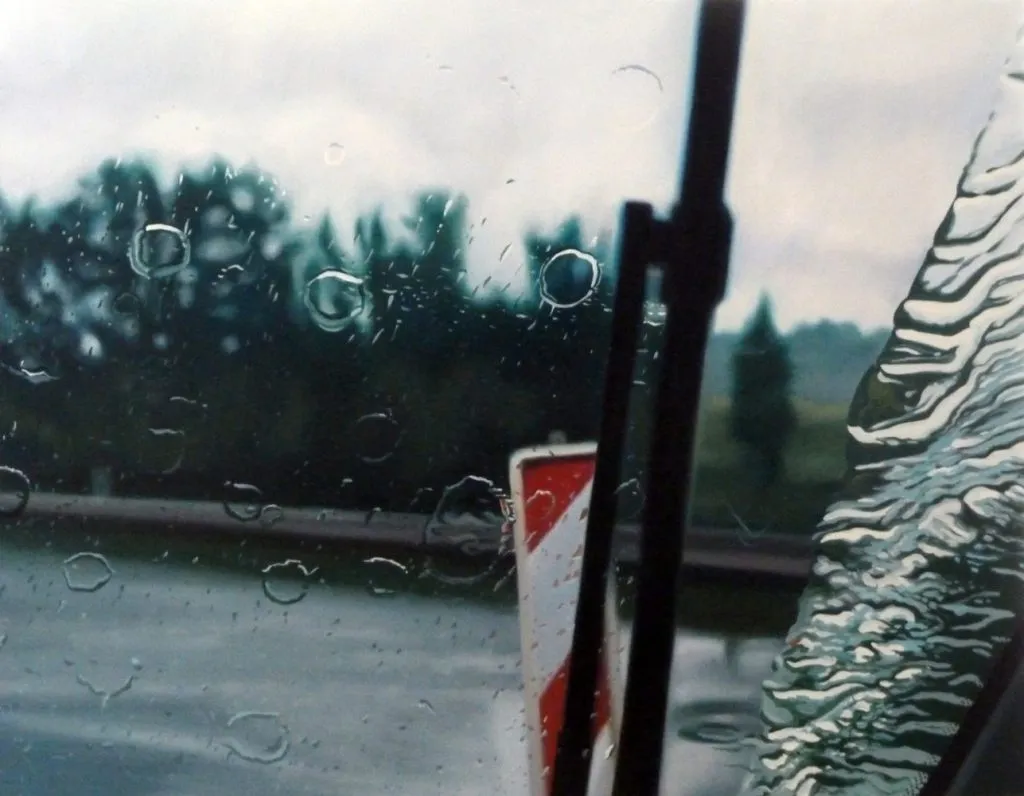
The problem of the blurred image and its relationship to the past has become central to my art. I approach it differently from Gerhard Richter. Blurring is not a goal, but a stage. It is not erasure, but a question of visibility and the difficulty of seeing. Many filters impede sight: atmospheric ones dependent on the weather; material ones such as screens, panes of glass and prisms; filters of light and painting; those connected to mechanical means of recording and processing the image; movement, which makes it difficult to grasp form; and, finally, the eye’s limited capacity. A lack of focus means that the images I paint cannot be perceived immediately, but reveal themselves gradually and slowly. Looking at an image oscillates between desire and disappointment. This discovery, or rather unveiling, of the image is not merely the viewing of space, but also an experience of time. In astrophysics, looking into the depths of space means studying the past of the universe. For me, similarly, the problem of visibility is connected to the problem of remembering the Holocaust.
Although the unveiling of a traumatic past is condemned to remain incomplete and arouses dissatisfaction and melancholy, naming trauma psychoanalytically enables résilience: understanding it sufficiently to continue living with it. The blurring of an image referring to the past may be perceived as a metaphor for the fragility and transience of memory. For me, it is above all a challenge: to what extent can the inaccuracy, blurring and artificiality of the image — whether painterly or mediated, fictional or documentary — enable us to reach the past? Memory is a filter that causes the image to fade and oscillate between the visible and the invisible, because impossible to see. Unveiling memory, by contrast, strives to disperse this fog. It raises not so much the problem of visibility as that of the meaning of what we see or cannot see. In the process of unveiling memory, legibility becomes as important as visibility, and word and name complete the image.
Within this process, the aesthetic problem of the possibility of representing and expressing the past — especially when practically no traces or witnesses remain — becomes an ethical problem: do we have the right to declare the memory of the Holocaust obsolete? The ethical choice to side with the image, testimony and transmission of memory in turn poses a political problem: why keep returning to the past; should we not concern ourselves instead with the present and the future? To ask what purpose recalling the Holocaust serves today is to ask how it relates to the present. “Let people know. Let the whole world know what ‘Western culture’ is,” Wiernik replies.4 Aware that the Holocaust represented the absolute collapse of the modern, rational civilisation in which we live, I believe that its memory remains relevant and, more than that, indispensable. It constitutes a paradigm demanding continual verification of the moral condition of contemporary societies. Critical consciousness and moral sensitivity arising from reflection on the Holocaust are fundamental values on which democracies rest. They cannot be confined to the past. The point, as Tzvetan Todorov writes, is that “without remaining prisoners of the past, we should place it in the service of the present”.5
1. Jankiel Wiernik, Rok w Treblince / A Year in Treblinka, Council for the Protection of Struggle and Martyrdom Sites, Warsaw, 2003, p. 13.
2. Ibid., p. 12.
3. Georges Didi-Huberman, Écorces, Paris, 2011, p. 30.
4. Jankiel Wiernik, op. cit., p. 12.
5. Tzvetan Todorov, Les abus de la mémoire, Paris, 2004, p. 61.