
The Shape of Memory
Zofia Lipecka in conversation with Piotr Kosiewski
Piotr Kosiewski: In 2001 you created the installation After Jedwabne, which concerns the Holocaust. You turned towards the past. Why?
Zofia Lipecka: It was not some calculated choice, but a direct response to Jan Tomasz Gross’s book Neighbours, and above all to the debate it sparked. I used video and mirrors to create the possibility of coming face to face with a repressed history.
P.K.: It features the faces of people from different generations, cultures and nationalities. The work prompts a question about the universalisation of the Holocaust.
Z.L.: Yes, and Elżbieta Janicka raised it in the text accompanying the After Jedwabne exhibition at Zachęta. I must emphasise that universalisation was not my aim. I will quote a passage from a lecture I gave at the École Pratique des Hautes Études in 2011: “I wanted to confront the viewer, particularly the Polish viewer, with the history of the Holocaust, which took place in Poland and for which Poles bear some responsibility. My intention was not, however, to stigmatise Poles as a group. […] I addressed the installation to individuals, which is why I filmed people of different nationalities, cultures and generations. If After Jedwabne acquired a universal, or rather international, character, that does not mean it forms part of the discourse of universalising the Holocaust.”
P.K.: You returned to the subject of the Holocaust in later works, including the series of paintings Treblinka Project, yet each time you speak about the present. In After Jedwabne we see people living today, while the paintings show contemporary views of Treblinka and Oświęcim.
Z.L.: My aim is not to tell history by recreating past events, but to look at history today: at how memory functions now, particularly the memory of the Holocaust. And above all—this is what interests me at present—at how that memory can be passed on. To return to the question of universalising the Holocaust, it is less a contemporary problem than one belonging to the communist era. The discourse about the Second World War at that time omitted the Holocaust and did not call it by its name.

P.K.: People spoke about Nazi crimes without stressing that their victims were primarily Jews. It was only after the fall of communism that attitudes towards the Holocaust began to change in Poland and other post-communist countries.
Z.L.: Above all, collective awareness came to recognise that, as Henryk Grynberg wrote, this was not a crime against humanity in the abstract, but a crime against the Jews. Besides, the problem of universalisation is not connected solely with Poland and the Eastern Bloc. In 1955 Alain Resnais made Night and Fog, one of the first important films about the concentration camps during the Second World War. Not once does the word “Jew” appear in it! Neither Allied discourse nor that of the communist bloc spoke of the extermination of the Jews.
P.K.: Yet recent decades have brought a change in this perspective, aided among other things by Claude Lanzmann’s 1985 film Shoah. But why did visual artists take up the subject?
Z.L.: In Poland?
P.K.: Yes, but not only there.
Z.L.: In Poland, the fall of communism undoubtedly played a part. New opportunities for historical research emerged and archives were opened. The subject began to be discussed, and artists followed that path. But in the West? I do not know whether such a profound change occurred. Artists here are certainly less attuned to this subject. In France, for example, it receives little attention. Admittedly, this year in the Normandy town of Coutances, an association of secondary-school pupils devoted to the memory of the Holocaust organised an exhibition of my painting series Treblinka Project. But that was an exception. Even so, a discourse that deliberately ignores the particular nature of the Holocaust, and thereby blurs responsibility, is still present—and not only in Poland.
P.K.: Was this change in thinking about the Holocaust not also encouraged by a different view of the past: an interest in individual histories, particularly those of people who had often been overlooked—victims, minorities and marginalised groups? Studies began to appear that presented the past from their point of view, rather than that of abstract collectives or privileged individuals. You also draw on these individual testimonies.
Z.L.: Today, alongside the history of the Holocaust itself, the history of Holocaust memory is also studied. Annette Wieviorka introduced the question of the witness and the way in which witnesses shape the memory of the Holocaust. For me, testimonies are invaluable material. Individual experiences bring us closest to the past and allow us, to some extent, to imagine it.
P.K.: Your installation After Jedwabne consists of three elements: Szmul Wasersztajn’s recollection of the events of 10 July 1941, read by Andrzej Seweryn; screens on which we see the faces of people listening to his account; and mirrors. These alter the viewer’s status. In the reflections, viewers see themselves and their own response to Wasersztajn’s words.
Z.L.: While listening to the testimony, the viewer is forced to confront this history. The mirrors make viewers cease to be mere spectators and become participants in what is taking place within the space.
P.K.: You break down the dichotomy between the person looking and that which is being looked at.
Z.L.: The very form of the installation means that we experience video differently from a film watched in a cinema. The footage used in my installation also differs from, for example, Agnieszka Arnold’s Neighbours. It is not a documentary. I show neither victims nor perpetrators. I do not recreate the course of events. I place the recipient in a situation in which they are not a spectator but literally and physically become part of the installation; they can touch the screen. It is a provocative situation, encouraging viewers not to remain indifferent to this history.
P.K.: This work seems to speak more about the memory of the events than about the events themselves.
Z.L.: Exactly. The title itself, After Jedwabne (rather than About Jedwabne), indicates that this is a critical work about the memory of those events, not about the events themselves.
P.K.: With After Jedwabne in mind, Philippe Piguet writes that the artist “is wary of anything that might help recreate the concrete form of events that no longer exist in real space or time”. This observation can also be applied to your later works. You do not try to reconstruct those events.
Z.L.: I invoke them only through a witness’s account: Szmul Wasersztajn’s in After Jedwabne and Jankiel Wiernik’s in the installation Warsaw–Małkinia.
P.K.: Yes. Except that it is not subjected to “artistic treatment”: it is not processed, and so on. It remains a quotation placed within a contemporary work.
Z.L.: Indeed; it is the point of departure and the element on which the entire installation is based.
P.K.: I ask because the release of Agnieszka Holland’s film In Darkness recently prompted another round of debate in Poland about whether art concerning the Holocaust can be created. It was argued that we must confine ourselves to testimonies and must not create works about the Holocaust.
Z.L.: Adorno maintained that poetry could no longer be written after Auschwitz. I think that, in a sense, this position is untenable, because it is precisely through contemporary works of art that the memory of the Holocaust is preserved: through texts and images. This may be a historical film such as Agnieszka Holland’s In Darkness, a documentary such as Claude Lanzmann’s Shoah, or my own video installations and paintings on canvas. I do not think the issue is one of opposing documentary and fiction, raw testimony and literature, but rather of finding an adequate form. In short, I believe that this history must be represented, especially as traces of the Holocaust disappear and its last witnesses pass away. The question, however, is how to do so.
P.K.: In Treblinka Project, as well as in the works concerning Oświęcim, you paint the present-day road leading into these towns.
Z.L.: After completing After Jedwabne, I felt a need to continue exploring the memory of the Holocaust in some way. I decided to travel to Treblinka every year, photograph it and then paint on canvas the entrance to the village, at the point where the place-name sign stands. This is how Treblinka Project came about. The first time I visited, the sight of that entrance was a shock. I was similarly shocked by an inconspicuous road sign bearing the name Oświęcim, which I saw while travelling on holiday.
P.K.: What caused that shock? The ordinariness of the situation? The fact that entering these places is just like entering any other town or village in Poland?
Z.L.: The contrast between the ordinariness of the place and its name, along with everything that name carries with it.

P.K.: You turned to painting—a medium one might regard as the least suited to addressing such a subject.
Z.L.: I think that was precisely what interested me, although I can only see it now, in retrospect. When I decided to paint, it was not so clear. But I felt that it was dangerous. Painting is a primal form of art. Its history is very long, far longer than that of photography or film. I felt it was important to confront this tradition with the subject of the Holocaust; that it made sense to address it on canvas, because this entails questions of beauty and aesthetics that are so important throughout the history of art.
P.K.: Artists turn away from painting precisely because it is burdened by the past and entangled in so many things. Your gesture might be read as an attempt to defend it.
Z.L.: It is not so much that I defend painting as that I ask why people turn away from it. What are the reasons?
P.K.: And how would you answer that question?
Z.L.: Above all, because competition from new media—video and photography—has emerged. Yet I do not believe their appearance should disqualify painting, precisely because painting has a longer history. Perhaps turning away from it is a kind of escape from history, its errors and contradictions. That question interests me.
P.K.: But do artists not also turn away from painting out of a fear of aestheticisation, of its entire entanglement in the question of beauty, and because of its commercialisation? It remains the most “productive” discipline on the art market.
Z.L.: I do not think aestheticisation—the replacement of meaning by decoration—is a problem confined to painting. It is a problem for art in general: its submission to fashion, the market, entertainment and so forth. As for commercialisation, photography, video and spatial objects are now the works most eagerly shown in major exhibitions, which increases their market value. And cinema, as Walter Benjamin foresaw, is today the most powerful cultural industry. So it seems to me that painting now occupies a very weak position.
P.K.: The paintings in the Treblinka Project series are very close to photography, unlike your earlier paintings, in which you often used signs and symbols and referred to archetypes. In these most recent works you confront painting with the experience of photography and film.
Z.L.: Yes, my paintings are close to photography, but they do not confront it in the way Hyperrealism does; rather, they make use of it. I am interested in the problem of seeing reality, and photography and video extend the capacities of the eye. At the same time, painting based on observation leads me to reject the signs and symbols that once interested me.
P.K.: Why? This was an important strand in your work: paintings containing signs, outlines of objects or beings, and geometric figures. Everything that Andrzej Turowski, drawing on Roger Caillois, associated with symbolic thought. Have these things ceased to be legible in today’s world?
Z.L.: I am afraid they were never legible. They were always ambiguous and obscure. In the case of the Holocaust, barbarity and evil, however, the symbol is not an appropriate means of expression.
P.K.: Do we have to speak plainly?
Z.L.: In French we say appeler un chat un chat—to call a cat a cat.
P.K.: In the project Warsaw–Małkinia you return to video. Jankiel Wiernik’s recollection of his deportation to Treblinka in 1942 is juxtaposed with the present-day places where those events occurred. We see people in Warsaw walking through the streets on the site of the former ghetto, talking and enjoying themselves; someone rides a bicycle… Then we see people travelling by train. Finally, darkness falls. All that remains is the sound of the text being read. Once again you bring two realities together: testimony and the present.
Z.L.: Yes, I wanted to juxtapose the testimony of a man who was deported to his death in an extermination camp with an ordinary experience: a train journey, setting off on holiday… I hope that this association will remain in the memories of those who see the installation and leave some trace there.
P.K.: To restore memory, while also signalling that this was the experience of ordinary people?
Z.L.: To make everyone feel that this concerns them; to allow them to imagine today that something like this could happen again, and could also happen to them. I do not mean an emotional identification with the victims of the kind offered by Hollywood films. Rather, empathy combined with reflection on the event.
P.K.: You also avoid a monumental treatment of the Holocaust. There is no pathos in these works.
Z.L.: I avoid it because monumentality makes memory dead, abstract and official. Besides, today memorials and museums tend to be built rather than monuments. I also believe that art can transmit this memory in some way—not only deconstruct it, but also build it. It can enable the viewer to learn something about the past while recognising that this history affects their life. Finally, art’s strength lies in its ability to speak about the past not only on anniversaries or when commissioned by the authorities. And, as I would wish, it can reach each person individually.
P.K.: You say that you want history to reach people. But do we not tend to flee from the past today?
Z.L.: Of course; we all flee from what is painful and negative, and all the more so from the horror of history. We escape into life. I want history to permeate that life, so that it is not lived entirely without awareness. More than that, I am convinced that art is essential to life. Yet we cannot continue to make art as though the Holocaust and the barbarity of the twentieth century had never occurred. That is impossible.
P.K.: You ascribe a very important role to art, and have done so for a long time. Andrzej Turowski wrote of your paintings and installations from the 1980s that you use them to introduce order. It is art that orders the reality around us.
Z.L.: Oh, that is prehistory. My 1991 exhibition at Muzeum Sztuki in Łódź concerned my interest in history, nature, harmony and symmetry. At a certain point, however, harmony and symmetry were undermined by the shadow of the Holocaust. More than that, the pursuit of them—especially in social life—began to seem profoundly disturbing to me. We must remember Nazism’s drive to establish a new order.
P.K.: An ordering, also through a striving for symmetry, including symmetry in its most tangible form, as exemplified by the architecture of the Third Reich. It was an art that sought order, an ordering of nature.
Z.L.: An order that is deadly.
P.K.: In your paintings, in a different way of course, you also ordered nature.
Z.L.: I did, but at a certain point I realised that this order was dangerous. I related it to history and to civilisation, including contemporary civilisation. I began to wonder what lay behind this desire to establish order.
P.K.: In many of your works, such as Fruits of Chance and Boîtes Noires, an element taken directly from nature appears.
Z.L.: Those works concern not so much nature itself as the problem of representing it and the culturally imposed ways in which it is perceived.
P.K.: Of ordering and simultaneously recreating it. Of modes of representation.
Z.L.: My explorations in art are connected with the fact that I studied art history.
P.K.: Did it provide you with a point of reference?
Z.L.: Not really. I became interested in the contemporary world fairly quickly, but my way of looking at it was certainly shaped to some extent by art history.
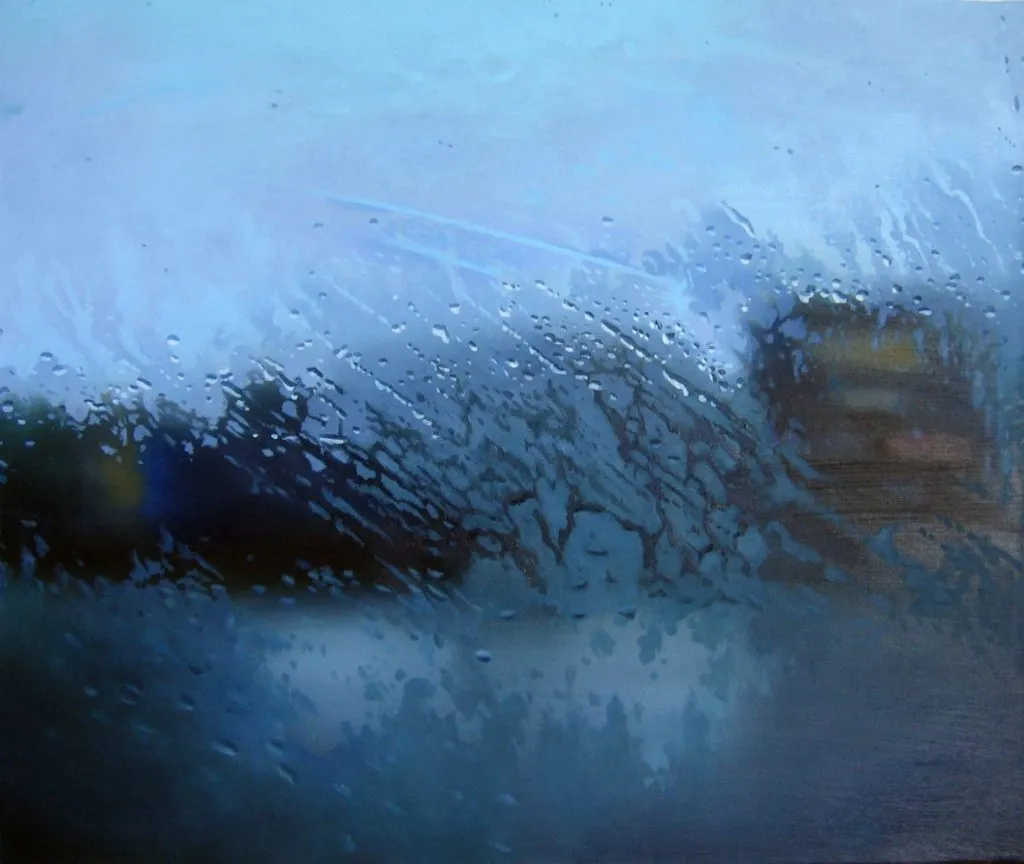
P.K.: In some of your other recent works the image seems distorted, blurred or out of focus—reflected in water, as in the Reflet series. Do these works also address the problem of representation?
Z.L.: Here I am more interested in seeing. It is important to me not only to explore how to address the Holocaust, but also simply to paint. This is connected with the question of visibilité—visibility, the difficulty of seeing. It concerns not only the possibility of seeing as an optical process, but also the possibility of remembering. I am interested in the relationship between vision and memory. I believe that the visual arts—not only painting, but also photography, film and video—are essential for passing on memory. Texts alone are not enough.
P.K.: Images also serve us in everyday experience: they help us to make the world around us familiar.
Z.L.: I am interested in always remaining in the present, while allowing an image to refer to the past as well.
P.K.: These images also relate to the problem of illusion, which is so important in the tradition of art.
Z.L.: What we see is only an image, and therefore something relative and imperfect. It cannot be treated as a revelation of truth. Images, like memory, are relative. For me, the visibility of the image is connected with recovering the past from oblivion—especially, as Izabela Kowalczyk has written, a past inscribed in space. Visibility is a transposition of the question of memory into the field of the visual arts.
P.K.: You quoted Izabela Kowalczyk’s words about space. In your work, space functions on several levels. There is the space transferred into the image: in your paintings and videos you invoke places in which history once unfolded. But you also place the viewer within that space.
Z.L.: There is the problem of perceiving space and of the layers that prevent us from ever truly reaching the object we are trying to see. This is also related to our relationship with time and its passage. But I do not want to reduce our conversation to overly abstract concepts. As you said, space has different meanings in my work: it can be an illusion, a place marked by the crimes of the Holocaust, or a video installation—that is, a form of communication.
P.K.: In the visual arts, the problem of time—its presence within the work and the way it is conveyed—is particularly acute.
Z.L.: Perhaps I am repeating myself, but I will say it once more: for me, looking is a way of reaching a certain past, and thus a kind of journey through time. Yet the extent to which that past is visible to the viewer is no longer up to me. Their awareness and knowledge of history matter. Nor can I summon the past in its former shape. All I can do is show a contemporary reality that nevertheless refers to the past.
P.K.: Landscape is a very important element in your most recent works. That almost demands questions about their relationship with the tradition of landscape painting.
Z.L.: Yes. I have a problem with German Romanticism in general—with its aesthetics and with the way it frames the questions of beauty and art’s place. It is extraordinarily alluring, but also dangerous.
P.K.: It carries the danger of placing art on a pedestal and granting the artist an exceptional status.
Z.L.: The vision of the artist as demiurge. The dominance of emotion over reason, an escape from reality, the introduction of mystery… Through what I do, I try to disenchant this art. By painting landscapes depicting sites of extermination, I undermine the traditions of Romanticism, pantheism and fascination with nature.
P.K.: In Friedrich’s paintings, nature leads us to the supernatural. Here nature leads us to history.
Z.L.: Crime shows through nature. After the Treblinka camp was dismantled and razed to the ground, the Germans planted lupins there.
P.K.: This recalls Wilhelm Sasnal’s painting Forest, which uses a frame from Lanzmann’s film. Trees dominate the work. They were witnesses to the tragic events.
Z.L.: Exactly. I greatly value Sasnal’s painting, as I do Luc Tuymans’s. I have a completely different relationship with Gerhard Richter’s work. On the one hand, it fascinates me; on the other, I feel that he erases memory because he has a problem with it. For me, by contrast, as I have said, the visibility and representability of the past are very important questions.
P.K.: Is the image a means of restoring the past? Does it have a force perhaps even greater than that of words?
Z.L.: It is certainly no weaker. In fact, I believe that the image cannot be separated from the word. It does not function on its own, but always with some form of commentary. As Susan Sontag said, images without commentary have no determinate meaning. They can be interpreted in different ways. Because the ethical dimension is so important, words and names have great significance in what I do.
P.K.: The title of the work and the text accompanying it.
Z.L.: Yes, but also the name Treblinka, placed directly within the paintings.
P.K.: In the name of ethics, you accept a certain limitation of the image’s role. You do not make it absolute.
Z.L.: Art must allow viewers to respond to what they see, but it must also encourage or invite them to do so. At the same time, works concerning the Holocaust should contain no ethical ambiguity. To return to Richter’s painting, it seems to me that a certain ambiguity is present there. This makes his works very close to me on the one hand, yet very distant on the other. This is probably connected with the fact that he is a German artist and belongs to a different generation from mine.
P.K.: With Richter, I am not entirely sure what, for example, his well-known portrait of Uncle Rudi in a German uniform is meant to be.
Z.L.: We do not know whether it represents a fascination with that period, nostalgia for it, or merely a recollection. In any case, it is not a critique. I, on the other hand, certainly strive to make my works more unequivocal in their ethical dimension.
P.K.: Some people argue that engaging with the Holocaust today is opportunistic, or even that it is being used as an instrument in present-day culture wars.
Z.L.: What I do is absolutely essential to me. Travelling to Treblinka has become a need. Is that opportunistic or not? I certainly do not think that making work about the Holocaust is an opportunistic choice here in France. In Poland? Perhaps it is different there, but that does not interest me. Yet I have the impression that making works on this subject does not result from submitting to any particular expectations. Nobody wants to hear about the Holocaust any more. Some believe that too much has already been said about it. Others argue that different problems should be addressed now: Syria or Rwanda. It is always possible to find arguments when one does not want to speak about the subject. The Holocaust, like other issues—for example those concerning various minorities—is a very difficult subject. Anyone who says that addressing such matters is opportunistic is treating them superficially. The Holocaust poses a fundamental problem: the problem of evil in history. It is a problem with which, even today, we are unable to come to terms. I do not know whether we ever will.