
Recollecting Space in Zofia Lipecka’s Work
Izabela Kowalczyk
Zofia Lipecka’s art concerning the Holocaust can be read in terms of post-testimony and the recollection of space. Art of this kind is connected with the weight of an unworked-through past whose wounds have still not healed. As the artist herself says, this art concerns “an awareness of belonging to a history marked by the Holocaust, a painful awareness connected with a sense of guilt”1. With reference to later generations’ memory of the Holocaust, Marianne Hirsch proposed the term postmemory2. This is a powerful and highly particular form of memory: rather than being based on personal experience, it is mediated by imagination and artistic creation. It is, as it were, supplemented by imaginary or artistic representations. Postmemory is experienced by descendants of Holocaust survivors and thus relates to events that cast a tragic shadow not only over the survivors’ lives, but also over those of subsequent generations. Those events were so powerful that they eclipsed every other memory, yet can never be fully assimilated or understood. Postmemory reveals itself through displacement—in another place and after a considerable delay in relation to the events to which it refers. It is also an obsessive and explosive memory, allowing neither peace nor respite3.
In the Polish context, however, it is worth noting that alongside postmemory understood in this way, art also contains narratives that can be described as post-testimony. This refers to the particular experience of witnessing the Holocaust, an experience that has not been worked through here. In Poland, it is only relatively recently that people have begun to speak of the Holocaust as an exceptional event that befell the Jews, yet “these matters are still not self-evident to Polish society, which, on the map of pain and humiliation, finds it difficult to grant the victims of the Holocaust a special place”4. Michael C. Steinlauf maintains that the memory of the Holocaust remains an “unassimilated memory” here5. He points to the complex and traumatic experience of Poles who, while victims of Nazism, simultaneously became witnesses to a genocide committed on their soil. After the war, antisemitism led to numerous murders and pogroms, the largest of which was the Kielce pogrom of 1946. It subsequently found expression in state policy and manifested itself most powerfully in the antisemitic campaign of 1968–70, when approximately twenty thousand Jews were forced to leave Poland6. The experience of witnessing the Holocaust and the problem of coming to terms with it remained unworked through. Steinlauf wonders how it was possible for the Holocaust not to have been truly perceived by Poles—how they could see the events without understanding them—and says that the consequence is a continued life beneath the stigma of the Holocaust7. Zofia Wóycicka, in turn, indicates that our greatest problem is the unfinished mourning for Holocaust victims, unfinished because it was suppressed by communist authorities, who removed the memory of the victims’ identity from public discourse8. This also concerns the point made by Zygmunt Bauman: that the world created by the Nazis dehumanised both its victims and the passive witnesses to genocide, forcing the latter “to invoke the logic of self-preservation in absolving themselves of inaction and moral insensitivity”9. If, as Jan Błoński argued in his groundbreaking 1987 essay Poor Poles Look at the Ghetto10, there were no passive spectators of the Holocaust and everyone present at the crime was tainted by it, then this experience demands critical working-through—a process that began very late, essentially only in the 1980s and 1990s.
For roughly two decades, art itself has produced projects concerned with “restoring memory”. Artists strike at the Holocaust’s “unassimilated memory”, challenge official historical narratives and popular representations of the past, ask about collective memory and propose a critical engagement with memory, thereby contributing to what Ricoeur, following Freud, calls the work of recollection (remémoration).
“In the case of recollection, the emphasis is on the return to awakened consciousness of an event recognised as having occurred before the moment when consciousness declares that it has experienced, perceived and learned it”11. What is at stake, then, is the evocation and recognition of an event’s significance. This is a critical memory, distinct from repetition-memory.
Zofia Lipecka also proposes such critical work on memory in some of her works. The artist addressed the difficult subject of Polish complicity in crimes against Jews in the installation After Jedwabne, presented at Zachęta in Warsaw in 2008. As she acknowledges: “The idea for the installation arose first from the shock caused by reading Gross’s book. I was devastated. As a Polish woman, I felt particularly responsible; I felt guilty! Then I was outraged by the reactions the book provoked in Poland: the defence of national honour, concern for Poland’s reputation abroad, haggling over the precise number of victims, and finally the categorical denial that the inhabitants of Jedwabne were responsible for the crime”12.
The work consisted of sound, videos and mirrors. The films were projected on opposing walls (two projections on each wall). They showed the emotions appearing on the faces of people of different nationalities as they listened to perhaps the most moving and terrifying passage in Jan Tomasz Gross’s Neighbours13—Szmul Wasersztajn’s testimony about the events in Jedwabne. The voice of Andrzej Seweryn reading the passage broke through a difficult-to-identify but irritating noise (an aeroplane? engines? information noise?). The images of people confronted with Wasersztajn’s testimony changed periodically, only to return elsewhere. The two remaining walls were covered with mirrors that multiplied the images, but also forced viewers to relinquish the safe position of observers. Viewers were thus drawn, as it were, into the work, incorporated into the rhythm of endlessly proliferating images, and thereby themselves became participants in the event.
Confronted with this work, we see ourselves and must ask about our attitude towards the genocide that Poles perpetrated against Jews. As we listen to Wasersztajn’s account, unbearable images arise in our imagination. They become the recurring images of horror about which Georges Didi-Huberman writes14. They seem so terrible as to be almost unrepresentable. The images appear in consciousness as part of what has been termed “mental projection” (Elżbieta Janicka’s phrase)15, yet visualising them seems beyond our strength, something we may be unable to bear. We therefore do not want to look, which can be read as a symptom of psychological resistance to horror16. Didi-Huberman is right, however, that at any cost we must give shape to what is described as unrepresentable, and must look and listen in order to understand. What is at stake is incorporating into our memory knowledge that breaks the taboo which itself produces paralysing terror and continues to burden our understanding of history17.
Lipecka did not create a visualisation, but forced viewers to listen to Wasersztajn’s testimony; she also installed mirrors so that each person could see themselves. We observe the response these words provoke in listeners, readers and ourselves. According to this work, we are the screen upon which an unworked-through history projects its image.
In Lipecka’s installation, which also appears to be a characteristic example of post-traumatic art, repetition is a repetition of trauma. The emphasis, however, is placed upon confronting that trauma, meeting it face to face, looking oneself in the eye and thus asking whether it can be borne. The work shows that the traumatic past is neither unimaginable nor a media image, but above all an unhealed wound. In this sense, such art offers hope of healing. It undertakes, as it were, the work of mourning and grieving, thereby fulfilling the task Dominick LaCapra set for history: recognising trauma in order to recover from it18.
Like other contemporary artists addressing Holocaust memory, among them Elżbieta Janicka, Mirosław Bałka and Rafał Jakubowicz, Zofia Lipecka therefore asks about the past in her work, but from a contemporary perspective. She considers how our reality preserves traces of the traumatic past. She is also interested in the problem of the memory of place and in what, following the already cited Ricoeur, might be called the recollection of space. Zofia Lipecka’s exhibition at Atlas Sztuki addresses this problem and consists of two parts: the video installation Warsaw–Małkinia and oil paintings from the Treblinka Project series (in progress since 2004).
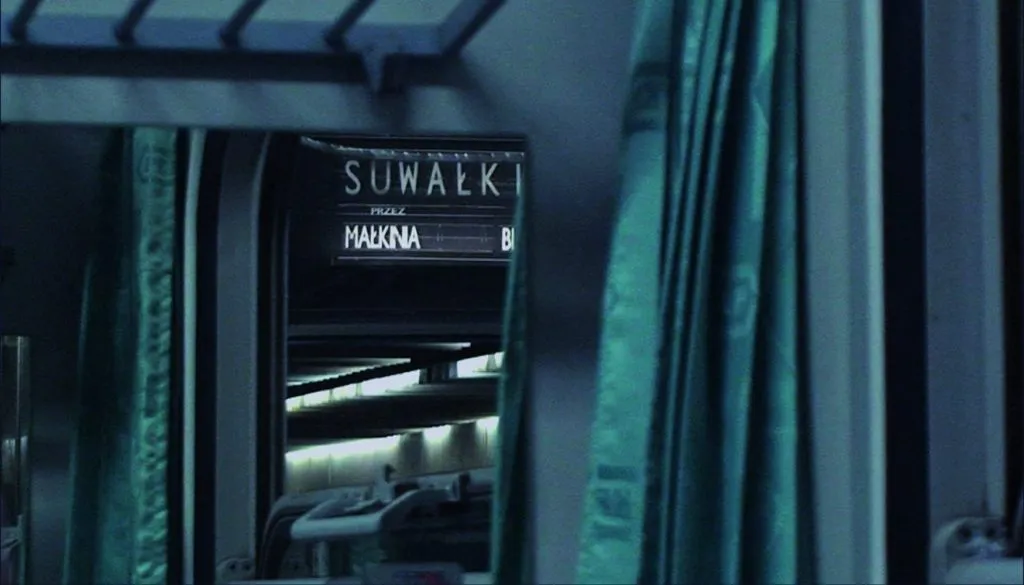
The installation consists of four videos showing a train journey from Warsaw to Małkinia, the final station on the way to Treblinka. The film was recorded on 23 August 2010, the anniversary of Jankiel Wiernik’s deportation to Treblinka. The installation’s soundtrack is a passage from his testimony describing the round-up in the Warsaw Ghetto in 1942, the march of the captured Jews to Zamenhof Street, the order to enter the railway carriages and the arrival at Treblinka after a stop in Małkinia.
Wiernik described the moment when people were led to the railway carriages as follows: “Naked reality appeared before our eyes. Carriages. Empty carriages. A summer day, beautiful and hot. The sun seemed to rebel against this lawlessness. What had our wives, children and mothers done? Why? The sun hid behind the clouds. It was beautiful, radiant and bright. It did not want to look upon our torment and humiliation”19. The testimony invoked in Lipecka’s installation ends with words describing the journey from Małkinia to Treblinka: “The train moved off; a few minutes later we arrived at the Treblinka camp. Only then did the veil fall from our eyes. On the roofs above the barracks stood Ukrainians with rifles and machine guns. The square was strewn with corpses, clothed and naked. Their faces were contorted with fear and terror. They were black and swollen. Eyes wide open, tongues hanging out, brains scattered, bodies deformed. Blood everywhere. Our innocent blood. The blood of our children, brothers and sisters. The blood of our fathers and mothers. And we, defenceless, felt that we would not escape our fate…”20.
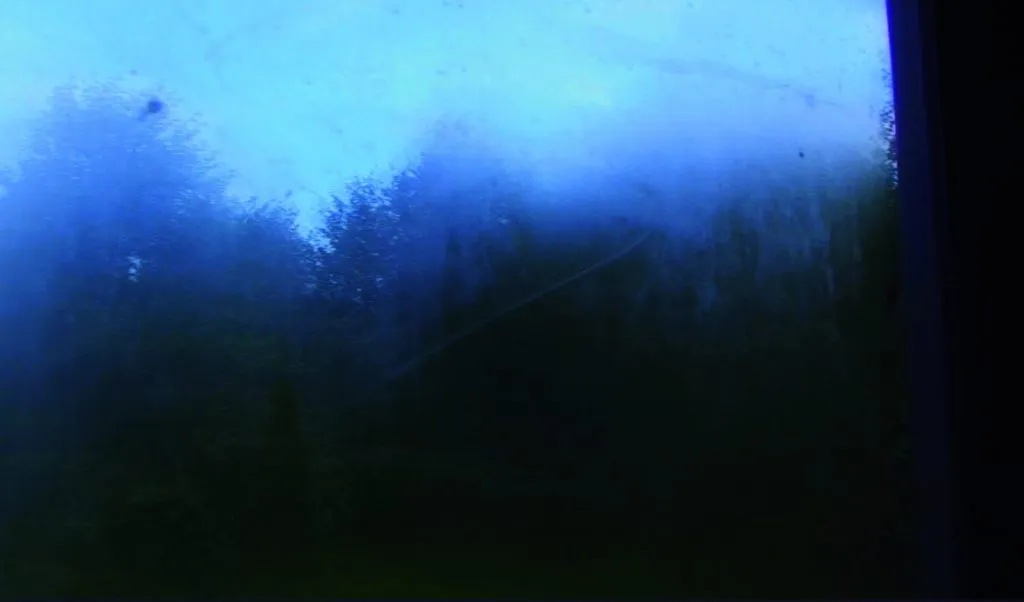
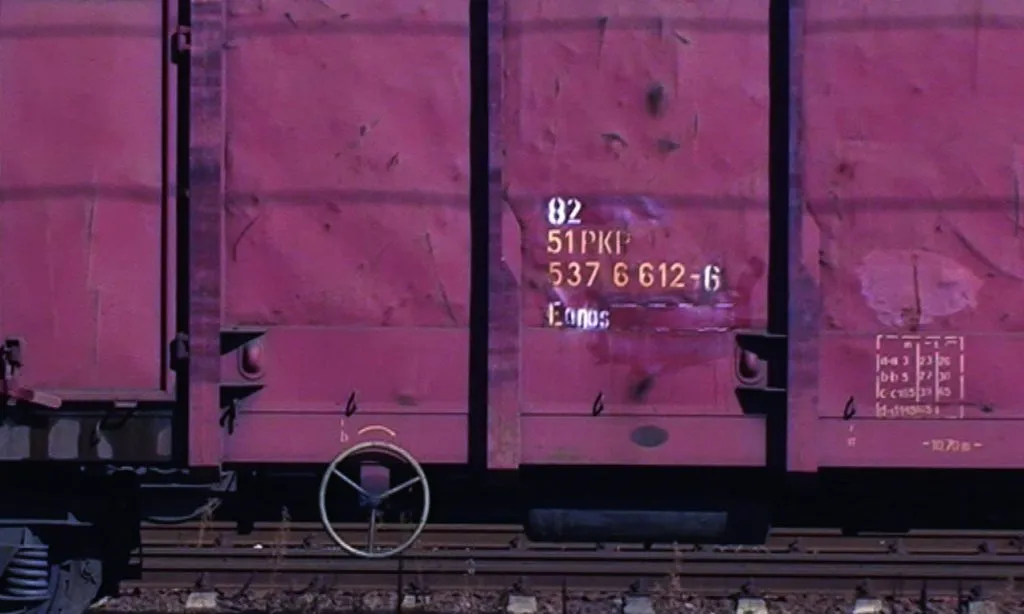
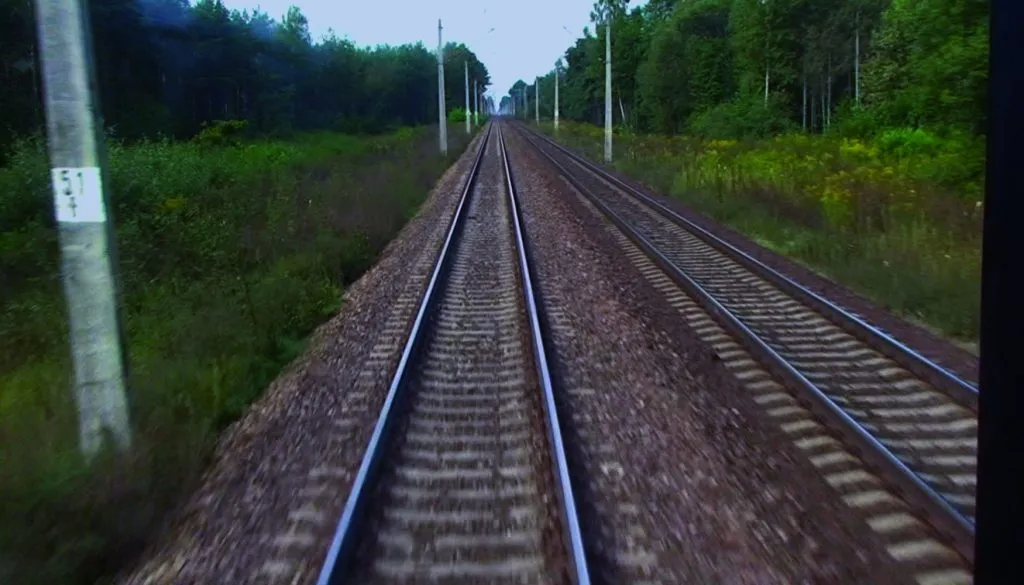
The film shows parts of contemporary Warsaw described in Wiernik’s testimony—the area around Zamenhof Street. It is a fine day; the streets are fairly empty and parked cars can be seen. Someone cycles past, a dog runs carefree through a park, and people make their way to work. Slow camera shots move in close to sections of buildings and street signs. A railway station then appears, followed by a shot of blue sky. With the camera, we move inside a train. People sit absorbed in their own affairs in the comfortable carriages of the express train to Suwałki via Małkinia and Białystok; some gaze through the window. The train departs and passes through a dark tunnel, with only white lights appearing from time to time. We then see the tracks receding behind the train, indistinct landscapes through a dirty pane and, once again, the people seated in the carriage. Finally, the station at Małkinia appears, small but neat and clean. The final scenes of each of the four films show arriving and departing passenger and freight trains. The camera lingers over the goods wagons—people were transported to Treblinka in similar ones.
Although the film takes us along the same route described by Wiernik in his testimony—a route that then meant a final journey, a journey to death—today we can no longer find traces of that horror. Railway tracks and freight wagons may, of course, evoke the Holocaust, because our collective imagination was transformed after Auschwitz. Yet apart from these symbolic images, we find nothing that would testify to the tragedy. People travel in comfort; they are calm and relaxed, have water to drink and watch the views through the window. They thus have everything that was so painfully absent for those transported to the death camps. Those people travelled crammed together—eighty to a dark, airless wagon—tormented by thirst and hunger. As Wiernik wrote, the journey was “boundless agony”. Lipecka thereby points to the absence of traces of the sinister past and to the continuing importance of testimony for preserving memory.
Discussing Claude Lanzmann’s Shoah, Jacques Rancière observed that the film also speaks about the disappearance of traces. “It is not the executioners and victims who must be represented,” the philosopher says, “but the process of a double effacement”21. Rancière draws attention to the first sentence that appears in Shoah: “This story begins in the present”, and notes that the logic of conventional history is reversed here, beginning from the “here and now” in order to speak about the past. He also emphasises the importance of formal means that confront the substance of Szymon Srebrnik’s testimony with the emptiness of the place in which he is shown: a vast clearing near Chełmno. This scene in Shoah points to an inadequacy—“The inadequacy of the deserted site to the speech that fills it assumes the character of a hallucination”22. At the same time, the Holocaust that is represented here, its reality, is also the reality of its disappearance and of its unthinkable character. This is achieved through the camera’s work and a certain cinematographic device, because the clearing near Chełmno shown in the film is not in fact so large. “The camera enlarged it subjectively in order to mark the disproportion, to make the action commensurate with the event. It falsified the representation of the site in order to convey the reality of extermination and the disappearance of its traces”23. Alongside Giorgio Agamben and Georges Didi-Huberman, Rancière is one of the contemporary philosophers who openly oppose the postulate of unrepresentability. He indicates that unrepresentability does not exist as a property of an event. “There are only choices. The choice of the present against historicisation; the choice of representing the measurability of means and the materiality of the process, against representing causes”24. Respect for an event need not, therefore, suspend artistic means, while starting from the “here and now” forces us to ask what these events mean to us today. The same occurs in Lipecka’s installation, whose camera follows the route Jankiel Wiernik travelled to Treblinka. By juxtaposing contemporary images of the same places, in which life now proceeds at a calm, undisturbed rhythm, with words conveying torment and humiliation and describing a journey that became a limit experience, the work likewise confronts us with inadequacy. It prompts questions about how the memory of those events can be preserved today, how they should be remembered and whether they can be understood.
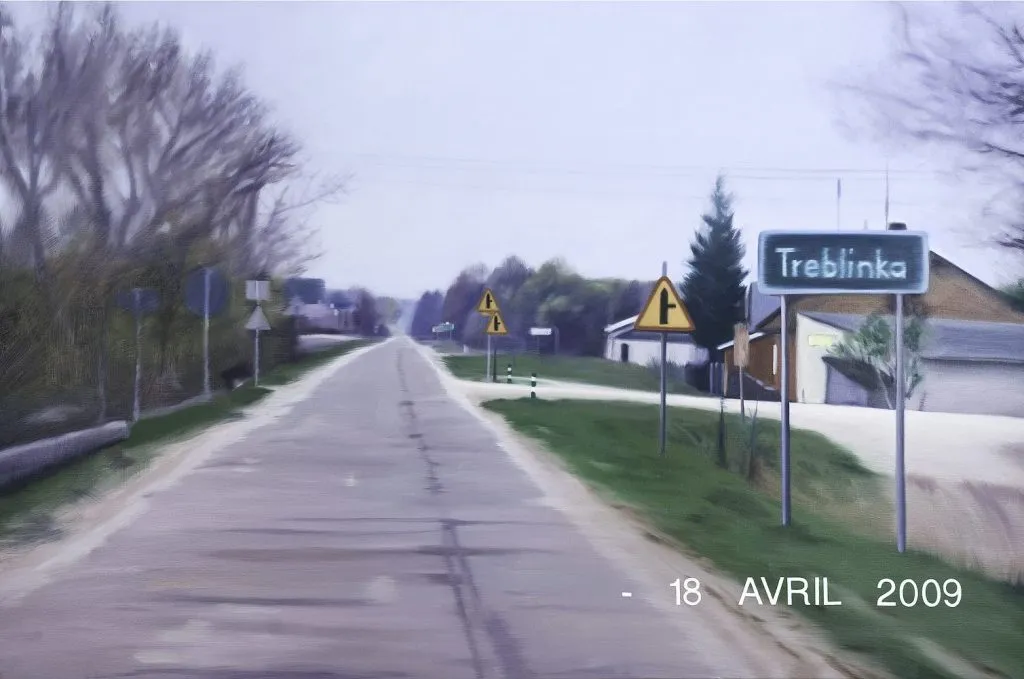
The paintings in the Treblinka Project series also point to absence. Since 2004 Zofia Lipecka has travelled to Treblinka and each time photographed the entrance to the village at the point where its place-name sign stands. From these photographs she creates oil paintings in a fixed format of 130 × 195 cm. In 2012 the sign was moved several hundred metres further on, but Lipecka decided to continue photographing and painting the same place. The paintings show a damaged road along which a car sometimes passes, and on other occasions a bicycle, although in most canvases the road is empty. Trees and road signs can be seen, with houses outlined in the distance. Each painting also contains, in its lower-right corner, the date captured in the photograph. The artist most often arrives in April, when nature is coming back to life. She also visits in winter, resulting in a snow-covered landscape dominated by leafless trees and an overcast or pale sky.
In 2008 Lipecka made her journey in July, and in 2010 in May. Particularly in the July painting, based on a photograph taken on a beautiful sunny day, the lush, succulent green of the grass and leaves dominates. The sign bearing the name Treblinka stands in the foreground, concealed in shadow as though unimportant. As in the earlier work, the horror of this place is not visible here either. It may be revealed only by the place-name sign, which in collective memory is still associated with a site of torment and death.
There were two camps at Treblinka: a labour camp and a death camp. In the Nazis’ view, the extermination camp—Treblinka II—was the most “perfect” of all, because it was the best organised and most efficient25. Construction began in late May or early June 1942, and the first transport of Jews from the Warsaw Ghetto arrived as early as 23 July. Halina Taborska outlines the camp’s history: “The camp, situated four kilometres from Treblinka station beside the railway line leading to an open-cast gravel quarry, where prisoners from the Treblinka I penal labour camp had worked since 1941, was intended to liquidate the largest concentration of Polish Jews, in the Warsaw Ghetto. Most of those killed there were Jews from the districts of the General Government, but victims also came from distant countries such as Bulgaria and Greece. The death factory operated for thirteen months, and the precise number of its victims is difficult to establish—according to the Encyclopedia of the Holocaust, it was 870,000”26. Treblinka’s first commandant, Irmfried Eberl, wanted to surpass the other camps in the number of Jews murdered, who were killed despite the low capacity of the three gas chambers and the failure of the engine that supplied the gas. Scenes of the utmost horror unfolded here. Corpses from railway transports were not cleared away; bodies fermented in burial pits, accompanied by a terrible stench that spread throughout the surrounding area. In August 1942 Franz Stangl, previously commandant of Sobibór, became the new commandant and decided to build six new gas chambers and clear the grounds. From February 1943, corpses were burned immediately after gassing, and those in the burial pits were also incinerated in order to erase the traces of the crime. As Taborska writes: “Bones that had not burned were crushed, all the ashes were buried in the abandoned graves between layers of sand, and lupins were planted”27.
A prisoner revolt broke out here in August 1943, and the camp was dismantled in November 1943. Today, nothing at the entrance to Treblinka indicates that these horrific crimes were committed here. Only the camp, preserved in its former configuration, with a central monument standing on the site of the gas chambers, recalls the Holocaust that took place there.
It is worth asking, however, to what extent the surrounding landscape preserves any traces of the past, or whether they have instead been entirely erased. As Lipecka’s paintings show, nature continues to renew itself in this sinister place, as though indifferent to what occurred there, while rural life also proceeds at a leisurely pace. Does anything exist, then, that might be called the memory of place?
We can speak of the memory of place in the case of sites bearing traces of the past and of its conflicts and tragedies, but also in the case of inconspicuous, forgotten places where the traces of the past have been erased, although their sinister atmosphere can still be felt. “Where every possibility of transmission has been blocked, phantom sites arise, becoming an arena for the free play of imagination or the return of repressed meanings”28, and this is precisely what Treblinka becomes in Lipecka’s work. The artist is most interested in experiencing space, and above all in the extent to which it is possible to feel the trauma of a place. Lipecka acknowledges: “I do not attempt to represent past events. (…) I try only to express the reality of the place in which the crime was committed. In other words, physically to experience being present there, confronting it”29. Her paintings therefore contribute to the recollection of space.
The artist searches for particular traces of the Holocaust that might be described as affective. Paul Ricoeur wrote about traces of this kind, drawing attention to the ambiguous meaning of the concept of the “trace”: as archival, affective and cerebral imprint. History concerns itself with traces fixed in writing and possibly archived, but alongside them there are affective and cerebral or cortical traces, which are studied by the neurological sciences30.
The affective trace is connected with the feeling of a “shock caused by an event that can be described as striking or significant”31. It seems that as material traces of the Holocaust disappear in places such as Małkinia and Treblinka, it is precisely the affective trace that becomes most important. Lipecka thus points to the duty to remember and preserve testimony, and to the need to resist forgetting. Ricoeur writes that our duty to remember is connected with a debt to the past, because we are indebted to those “who preceded us in what we are”32. Repaying the debt also means taking an inventory of our inheritance, including an inheritance that may be uncomfortable and burdensome. Our indebtedness should take the victims into account above all: “among all those others to whom we are indebted, we grant priority, for moral reasons, to the victims”33. What is involved, however, is neither the abuse of the idea of justice nor a “memorialising frenzy”, but rather critical work on one’s own past and memory, work that may allow one to recognise one’s own place in history.
Izabela Kowalczyk, art historian, cultural studies scholar and associate professor at the University of Humanities and Journalism in Poznań. Author of the books Dangerous Liaisons between Art and the Body (2002), Body and Power: Critical Art in Poland in the 1990s (2002), Polish Mothers, Boys and Cyborgs: Art and Feminism in Poland (2010), and Journey to the Past: Interpretations of Recent History in Polish Critical Art (2010). Author of articles on critical art, popular culture, feminism and interpretations of history in contemporary art. Critic and exhibition curator. She edits the online journal Artmix (Art—Feminism—Visual Culture), http://www.obieg.pl/artmix/, and runs the blog http://strasznasztuka.blox.pl.
1. Zofia Lipecka, The Construction of Holocaust Memory in Art: The Memory of Place, unpublished typescript. Courtesy of the author.
2. Marianne Hirsch, Family Frames: Photography, Narrative and Postmemory, Cambridge, 1997.
3. Ibid., p. 22.
4. Sławomir Buryła, Unwanted Truths and the Need for Their Social Articulation, in Holocaust Memory: Cultural Representations and Commemorative Practices, eds T. Majewski and A. Zeidler-Janiszewska, with the collaboration of Maja Wójcik, Łódź, 2009, p. 325.
5. Michael C. Steinlauf, Bondage to the Dead: Poland and the Memory of the Holocaust, trans. A. Tomaszewska, Warsaw, 2001.
6. Ibid., p. 94.
7. Ibid., pp. 67, 69.
8. Zofia Wóycicka, Arrested Mourning: Polish Disputes over the Memory of Nazi Concentration and Extermination Camps, 1944–1959, Warsaw, 2009.
9. Zygmunt Bauman, Modernity and the Holocaust, trans. F. Kunz, Kraków, 2009, p. 418.
10. See the collection of essays Jan Błoński, Poor Poles Look at the Ghetto, Kraków, 2008.
11. Paul Ricoeur, Memory, History, Forgetting, trans. J. Margański, Kraków, 2006, p. 79.
12. Zofia Lipecka, op. cit.
13. Jan T. Gross, Neighbours: The Destruction of the Jewish Community in Jedwabne, Poland, Sejny, 2000.
14. Georges Didi-Huberman, Images in Spite of All, trans. Maja Kubiak Ho-Chi, Kraków, 2008, p. 81.
15. Elżbieta Janicka, Confrontation: On Zofia Lipecka’s Audiovisual Installation After Jedwabne (2001–2003), in Zofia Lipecka, After Jedwabne, exhibition catalogue, ed. Hanna Wróblewska, Zachęta National Gallery of Art, Warsaw, 2008, p. 27.
16. Georges Didi-Huberman, op. cit., p. 81.
17. Ibid., p. 221.
18. Dominick LaCapra, Writing History, Writing Trauma, Baltimore and London, 2001.
19. I quote passages from the testimony as cited by Zofia Lipecka. Jankiel Wiernik, Rok w Treblince. A Year in Treblinka, Council for the Protection of Struggle and Martyrdom Sites, Warsaw, 2003. Polish version: pp. 12–13; English version: pp. 48–50.
20. Ibid.
21. Jacques Rancière, Aesthetics as Politics, with an introduction by Artur Żmijewski and an afterword by Slavoj Žižek, trans. J. Kutyła and P. Mościcki, Warsaw, 2007, p. 130.
22. Ibid., p. 131.
23. Ibid.
24. Ibid., p. 132.
25. Halina Taborska, Art at the Site of Death: Polish Memorials in Nazi Immediate-Extermination Camps, in Holocaust Memory, op. cit., p. 36.
26. Ibid., pp. 36–37.
27. Ibid., p. 37.
28. Aleida Assmann, Spaces of Memory: Forms and Transformations of Cultural Memory, trans. P. Przybyła, in Collective and Cultural Memory: A Contemporary German Perspective, ed. Magdalena Saryusz-Wolska, Kraków, 2009, p. 114.
29. Zofia Lipecka, op. cit.
30. Paul Ricoeur, op. cit., pp. 25–27. Ricoeur uses different terms for these distinctions. Elsewhere, he speaks of the trace as material, affective and documentary imprint. See ibid., p. 189. He also describes traces imprinted in the brain as cortical or mnemonic traces, and affective traces as inscription-affections. Ibid., pp. 554 and 565. Moreover, a close relationship exists between cortical and psychic traces: “There is no contradiction between affirming the capacity of inscription-affections to persist and endure and our knowledge of cortical traces; access to the two kinds of trace entails different modes of thought: existential on the one hand, objective on the other.” Ibid., p. 565.
31. Ibid., p. 25.
32. Ibid., p. 118.
33. Ibid.