
The Only Road
Andrzej Turowski
‘The car’s wheels glide along a road built by Jewish hands. I look around to see whether anyone can hear my heart beginning to beat so loudly. And, as always when we come face to face with something we have thought about at length, trembled before in fear, something that has tormented the imagination incessantly, it turns out that actual contact with it affects us quite differently from what we imagined. I try to summon from memory the faces of all those dear and closest to me for whom the road by which we are approaching Treblinka was the last.
If the immortality of the soul truly existed, their souls would surely be wandering around this place. Among souls that can find no salvation. For a mass of people perished here. Who knows—perhaps Jewish souls are the mist now hanging above our heads.
We can already see the rails of the Siedlce–Małkinia line. It is there, right there. To the left of that little wood.
And over this wasteland hangs a leaden sky, so low that one can reach it. Milky-grey mist fills the entire space. Conifers loom in the distance as if covered by a black veil. The sun has grown pale and dim. Like a small, round human face, it looks down on everything from above. Like the wrinkled face of a mourner, suddenly aged by pain.—Where did such mist come from?—someone in the car asks.
—There will always be mist over this place—answers the Treblinka survivor. And I can see clearly that he wants to add something, something great and profound. Something he has never said before in his life. But he cannot’1.
Rachela Auerbach, Treblinka: A Report
7 November 1945
Rachela Auerbach was one of the documentarians of the Holocaust. She helped create and preserve the celebrated Ringelblum Archive, a testimony to the Warsaw Ghetto. By gathering accounts and facts, she sought to convey the historical truth about what had happened at the sites of Nazi crimes, the greatest genocide in history. She travelled to Treblinka immediately after hostilities ended, and there, confronted with what she saw—or perhaps more accurately, with what she could no longer see—she wrote what might appear an ordinary report about this thoroughly commonplace place, abandoned among fields and now shrouded in the mist of the gassed and incinerated bodies of more than 800,000 Jews.
‘It is, after all, a senseless accident that our bones are not scattered across this field,’ she recorded as the thought returned, ‘for we were condemned to the same death, in the same place…’.
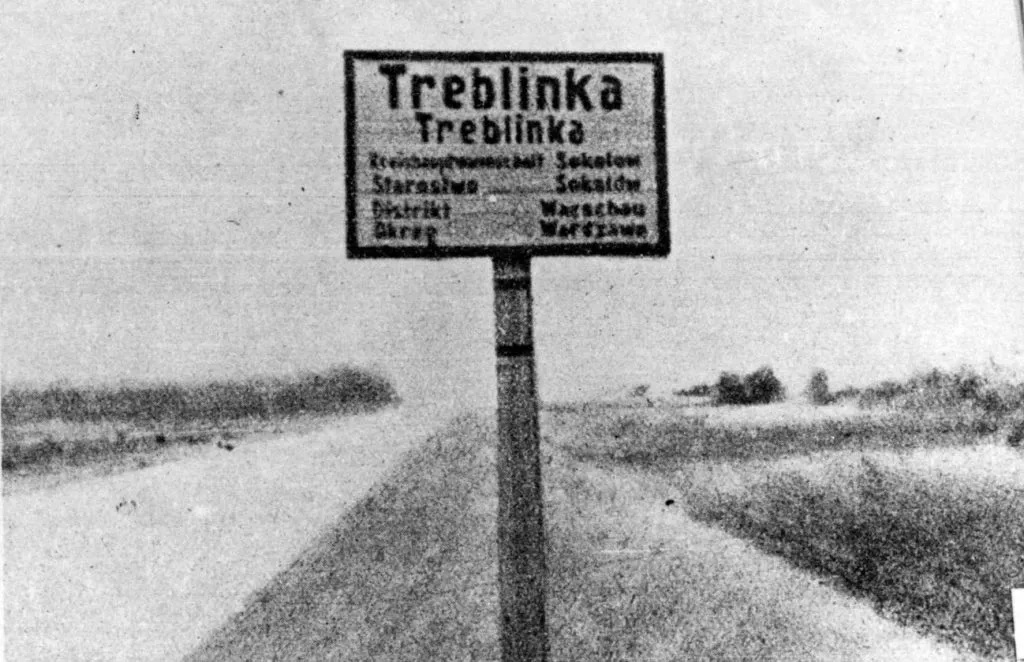
When Rachela Auerbach approached Treblinka in 1945, the German sign bearing the place name no longer existed. Today it is familiar from a documentary photograph, one of the few surviving testimonies to the terrifying name of this place of death. The rectangular board on a wooden post, inscribed ‘Treblinka’ and giving its administrative affiliation in both German and Polish, stood in the grass at the roadside, to the right of a gravel road running into the distance. Its geometry dominated the horizon. Cultivated fields stretched along both sides of the road, whose perspective, plotted with a surveyor’s precision, formed an ideal space.
In the distance, one could discern the outlines of a wall of forest and clumps of trees. There were neither people nor dwellings in the photograph. There was no life. The rigorous order of what was probably a retouched photograph contrasted with the imperfect focus of its receding planes, the blurred contours in the distance and the effaced shape of the landscape. Looking at the photograph, one had the impression of silence ringing in the ears and a visual void in which only the monstrous word Treblinka pulsated.
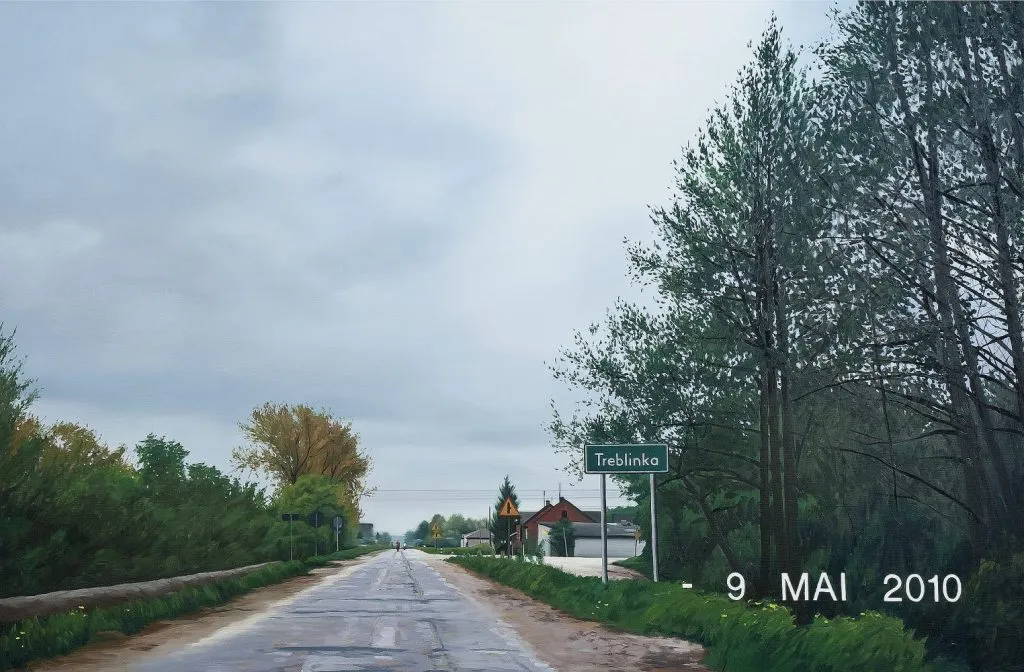
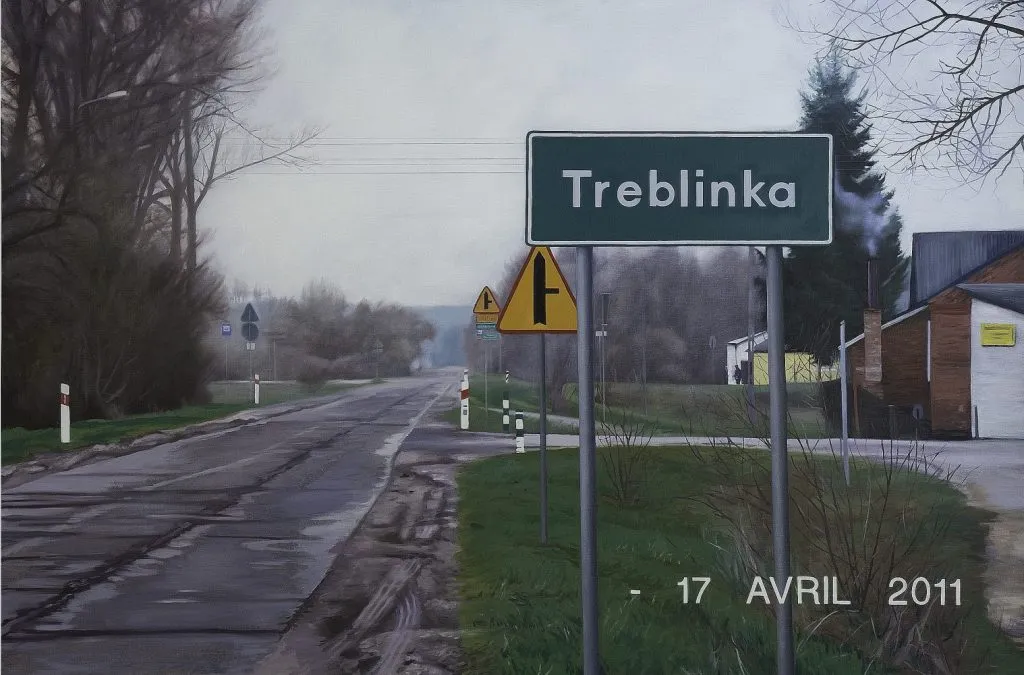
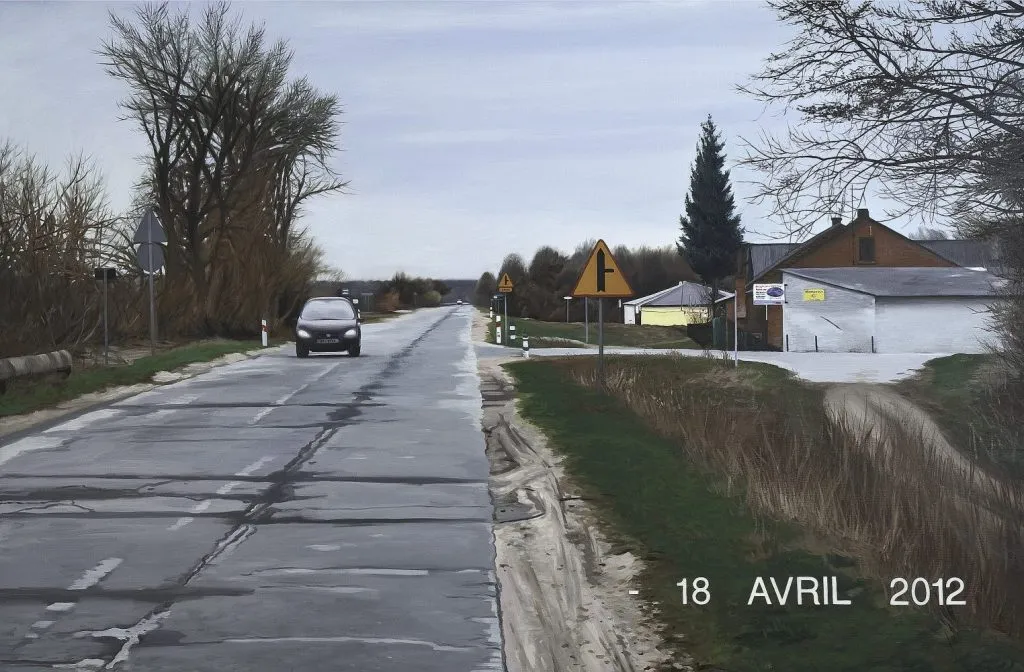
Zofia Lipecka’s Treblinka project, begun in 2004, intentionally refers to this photograph. Since then, the artist has travelled to Treblinka each year, stopping before the new sign that now bears the place name and taking a photograph of the road towards the extermination camp, situated much further away. She then repeats the photographed view in a painting, giving it the date on which the photograph was taken as its title. Depending on the weather, the season and time of day, the light and reflections, shadows and contrasts, the more or less precise positioning of the camera, the photographic technique and the way the picture is painted, the individual views differ, though they retain a similar scheme. Just as in memory, something becomes effaced and something comes alive; some fragments lose their focus, while others assume distinct forms. Sometimes something unexpected enters the frame and draws attention; sometimes a detail disappears for ever. Each year the gaze glides differently across the road’s surface and takes in the overgrown verges; it circles differently among buildings, puddles, trees and copses, saturating itself with colours in different ways. The eye assumes different poses and gives them shifting forms of expression: sometimes duration, at other times an artificial transience. Images come alive within the gaze.
For direct witnesses of the Holocaust, describing the Nazi crime committed against the Jews encountered a fundamental difficulty residing in its inexpressibility. It halted at the threshold of metaphor, which, unable to find verbal or visual equivalents, could not encompass the void. The historical discourse of the earliest accounts, laden with guilt, dissolved into the immateriality of an experience that eluded representation. The power of epic memory was the only form of accusation and resistance to cruelty. Poetry, as Adorno saw it, appeared defenceless. Today, still facing the necessary challenge of the Holocaust, we distribute the emphasis differently and, above all, take care to provide proof of truth through the force of material testimony without disturbing the peace of the dead. While remaining within the aura of memory and the symbolism, bound up with it, of circling around the unattainable, we must pay particular attention to the trap of sublimating the inexpressible into abstract symbolism. It is a danger that may lead us to perceive the tragedy of the Holocaust, and the complexity of the many individual histories embedded within it, in terms of a transhistorical fate or postmodern absence. Equally dangerous is an unequivocal pull towards archaeological history and the loss of the empathetic (and traumatic) dimension of the tragedy, which in relation to the Holocaust is necessary precisely because of its inexpressibility. I am not convinced that today, as Frank Ankersmit would have it in the name of that crucial quality, ‘appropriateness’, we are condemned to aesthetics rather than to the concepts of truth and moral good invoked by history when facing so difficult a challenge as the Holocaust. And yet, contrary to Adorno, Ankersmit would say today from a historian’s perspective: only poetry can speak about the Holocaust. If I am to agree with this conviction within certain limits, it will be only when poetry is stripped of the value of artistic fiction and aesthetics is treated as politics—that is, as a shared perspective on perceiving, thinking and acting in the contemporary world. In this formulation, the opposition between history and aesthetics (archaeological truth and artistic imagination) loses its value, while memory, rooted in the past, becomes an element of a creative imagination directed towards the future. The aesthetics of the unimaginable (poetry) can henceforth be reconciled with the aesthetics of that which is made present (history).
Several strands in Zofia Lipecka’s work relating to the Holocaust intertwine with the contemporary in an effort to apprehend a lost presence in visual experience. Lipecka is concerned not with the metaphysical void of the invisible, but with the concrete, empty place left by those who saw it but did not survive. It is a place seen in the face of death and, at the same time, the limit of the corporeal eye saturated with the reality of life’s end. The artist therefore speaks of the Holocaust not as something impossible, but as precisely possible and terrifying by virtue of that possibility. The concept of memory understood in this way is the fundamental problem and the very basis of thinking about the contemporary. In her art, memory fills the void of the Holocaust by summoning witnesses and evidence, extracting events and images from the explored terrain. Memory in Lipecka’s work strives for close-ups, setting in motion metonymic chains of visual imagination that, directed towards the unattainable, stop at the edge of the void and surround themselves with the present. Memory is imagination.
My painting, the artist would say, is not a search for the absolute; it does not seek to reach the essence of things. Painting is an experience of seeing. It is an experience that oscillates between desire and melancholy, impression and emptiness, imbuing contemporary art with an aura of transience and elusiveness (absence/presence; seeing/not seeing). In relation to the contemporary, the artist gives concrete form to the impermanence of her experience of the surrounding world through the sensory luxuriance of colours, the spatial spreading of shapes, the matt surfaces of misted panes, a blurred view, the eye’s momentary accommodation to atmospheric changes, a fragmentation of representation and a deformation of perception. She constructs images on the road, leaving the city and moving from place to place; through the window of a car or train, she arrests them with the camera shutter, divides them into sequences and sharpens their planes.
Art has meaning, Lipecka would probably agree, insofar as it teaches a new way of looking, teaches the relativity of every gaze, exposes conventions as schemas, disturbs peace of mind and awakens self-doubt, and repels dogmatism and intolerance. It points to the singularity of what we have grown accustomed to regard as ordinary. Art, Bauman says in one interview, is about ‘permanent extraordinariness’, by its nature incapable of solidifying into a new ordinariness. In other words, it is about art that, within the fragility of existence, calls for permanent foundations that only fragility can guarantee. Liquid times attribute precisely this quality of ‘eternal duration’ to states of impermanence and incompletion, thereby abolishing modernist oppositions between creation and destruction, necessity and chance, continuity and rupture, and finally fashion and art. Through deliberate understatement and a blurring of the boundaries between conceptual stereotypes, contemporary art provokes thought—but thought akin to moving without a map or guide. This is art that confronts us with fate. The utopias of place (u-topia) so characteristic of the avant-gardes of old are today replaced by utopias of the road (u-via), which offer life no meaning, expressing merely the uncertainty of fate rather than the order of fulfilment. Fate is the embodiment of what is unknown and, as we suspect, Bauman writes, also unknowable: something that cannot be explained or understood. Art on the road, bearing the burden of fate’s mystery, is not a means of experiencing beauty (‘perfection’) or giving shape to life (‘intelligibility’), but an expression of non-reconciliation with the world to which it belongs and a critique of the form it itself creates.
In this context, Adorno’s words that ‘the happiness of the spirit is forbidden amid mounting misery and the population explosions of impoverished peoples, amid past and future catastrophes’ acquire a new meaning. Adorno insisted that after Auschwitz only poetry taking Auschwitz as its point of departure was possible. Zygmunt Bauman was convinced that after the Holocaust only a sociology taking the Holocaust as its paradigm was possible. In Lipecka’s view, the shadow of the Holocaust falls inevitably across the postmodern vision of art. This is the conscience of an art that, entangled in silence, seeks to cry out; condemned to the archive, it must make it live; condemned to history, it must burden it with memory. In connection with the Holocaust, memory defines loss and marks our experience of time with melancholy. The memory of the Holocaust is a monstrous paradigm of contemporary civilisation, inscribed into art as a project critical of its own culture. Artistic tension in Lipecka’s work forms between the acuity of critical vision and the melancholy of the lost gaze.
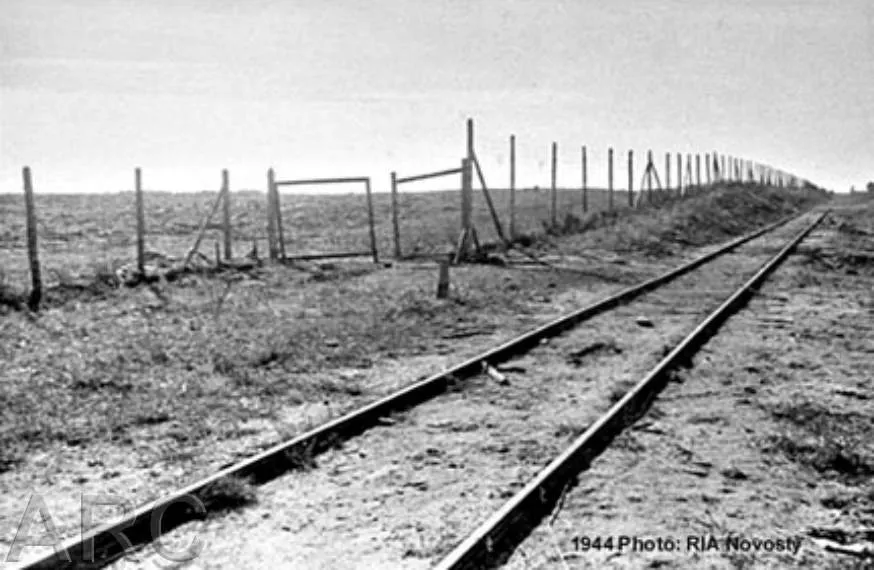
In Lipecka’s work, every road is a repetition of that Only One. ‘Here it is—the saddest of all Jewish roads,’ Auerbach writes in the already quoted report from Treblinka, ‘the route travelled by hundreds of thousands of Jews in wired-up freight wagons filled to the brim, in conditions worse than cattle taken to slaughter… In principle, we too ought to travel there by rail, or perhaps even go on foot. Like devout pilgrims journeying to holy places. We should repeat all the stations along the Jewish road of death. But the milestones of this Golgotha have not yet been put in place. For the time being, we are not yet going to Treblinka as one visits the graves of loved ones. We are simply going with an investigative commission to inspect the site itself. The only pain we accept without regret is the blow of the cold wind lashing our blue-red faces in the speeding car.’
Lipecka’s 2013 video installation Warsaw–Małkinia repeats that road. The road travelled by Jankiel Wiernik together with many other Jews on 23 August 1942, in a transport to Treblinka. The installation consists of four videos projected simultaneously, filmed during the artist’s contemporary train journey from Warsaw to Małkinia, the final station before Treblinka. The video was made in 2010, precisely on the anniversary of Wiernik’s deportation. The installation’s soundtrack is a reading of an excerpt from Wiernik’s testimony, published in 1944. In her own commentary, Lipecka writes that the video installation creates a tension between a banal train journey and a description of the experience of someone who travelled the same route to the death camp. My work ‘seeks to arouse emotion without excluding reflection; by referring to the past, it does not permit us to withdraw from the present. Creating an association between a train journey and deportation, it embodies the postmemory of the Holocaust.’ At four in the afternoon, Wiernik recalled, the train departed. ‘A few minutes later we arrived at the Treblinka camp. Only there did the veil fall from our eyes. Ukrainians with rifles and machine guns stood on the roofs above the barracks. The yard was strewn with corpses, some dressed and some naked. Their faces were contorted with fear and terror. They were black and swollen. Eyes wide open, tongues hanging out, brains splattered, bodies deformed. Blood everywhere. Our innocent blood. The blood of our children, brothers and sisters. The blood of our fathers and mothers. And we, defenceless, feel that we shall not escape our fate.’
Alongside memory in Lipecka’s work—as an infinite approach, directed towards the past, to a place, a traversing of the road, a pulsation of mnemonic matter—we encounter a process of repetition (postmemory), a precise rhythmisation of events calculated for the future. This repetition is, in essence, a ceaseless movement away from and towards the empty territory in time, driven by an ethical compulsion to plot the same perspective of the Holocaust’s existence within modern society.
It is also a critique of that society which, linking modernity with the concept of progress, bred intolerance. A society which, in the name of overriding tasks, sought to sift out, remove, exclude and eliminate everything—and everyone—that stood in the way of achieving its goal. Bauman’s metaphor of the gardener and the ‘gardening state’ gives a clear image of this attitude. ‘The Holocaust,’ Bauman writes, ‘was born and executed in our modern rational society, at the high stage of our civilisation and at the peak of human cultural achievement, and for this reason it is a problem of that society, civilisation and culture.’ It is unique in comparison with other instances of genocide precisely because it is modern.
The Holocaust was not, as is often claimed, an uncontrolled eruption of human hatred within modern civilisation, nor an irrational act of authoritarian aggression. On the contrary, Bauman argues, it was an organised undertaking by the extensive structures of fascist power and ordinary German people; it bore every hallmark of rational social engineering, exploiting the technological and bureaucratic potential of modern society. Thus the most terrible evil in human history arose not from a violation of order, but conversely from the establishment of that order’s indisputable, infallible and immutable rules, and at the same time from the elimination of mechanisms of control from social life. The most important lesson of the Holocaust, Bauman writes, is an awareness of the need to take the critique of the civilising process seriously, including its tendencies to disrupt and invalidate the ethical motivations of social action. In the project of modernisation, particularly close and critical attention must be paid to its inherent tendency to emancipate the premises of rationality from moral conduct, and to elevate the principle of rationalism into a law that excludes other criteria of behaviour. The Holocaust could be carried out, Bauman emphasises, only under conditions in which moral impulses and convictions became marginal, redundant, remote, neutralised or invisible in the face of subordinating bureaucratic discipline and the logic of rational action. The entire machinery of the Nazi state worked to create such a situation. The Holocaust was the cruel face of modernity, the terrifying and extreme consequence of social intolerance and the striving for a pure world, whose hygiene was to be guaranteed by the extermination of the other/the stranger.
Andrzej Turowski, art critic and historian, professor of art history at the University of Burgundy in Dijon, France. Honorary doctor of the Academy of Fine Arts in Łódź. As an art critic, he collaborated with Foksal Gallery in Warsaw for a decade during the 1970s. Author of several hundred scholarly studies and critical articles published in many languages, and more than a dozen books (including Existe-t-il un art de l’Europe de l’Est?, 1986; Builders of the World, 2000; Malevich in Warsaw, 2002; and Art That Kindles Anxiety, 2012). Curator of several dozen exhibitions, including, in recent years, Awake and Dream (2009) and Particolare (2011) at Palazzo Donà in Venice, and Repetitions from the Theory of Vision at the Ujazdowski Castle Centre for Contemporary Art in Warsaw (2010).
1. Rachela Auerbach, Treblinka. Reportaż, in Zagłada Żydów. Studia i materiały, no. 8, Warsaw 2012, p. 75.