
Zbigniew Rybczyński: Image Researcher
Siegfried Zielinski
While still young, the French poet Arthur Rimbaud abandoned his intention to steal the eternal fire from Olympus and, as a consequence, withdrew completely into the private life of a merchant. Before that happened, however, he experienced a brief moment of happiness — he experienced love. “… The body, a treasure to be squandered”, he wrote grandly in the poem Youth. In Seven-Year-Old Poets, in turn, he recalled a time of love between mother and child untainted by mistrust or calculation; here we may also find echoes of his feeling for his beloved Verlaine, although perhaps above all a poetic projection. Middle High German, a historical form of the German language, possessed a special word. It was “Lip”, meaning both love (Liebe) and body (Leib). Thus even dogmatic Gnostics, who regarded the physical (Physikoi) with contempt and assigned it to the material, nevertheless used the word “Leibe”, which united both concepts, when they wished to describe what most people understand, venerate and practise as love.
Zbigniew Rybczyński carries within him that Rimbaud-like fire: the force that is an indispensable condition for a strongly developed relationship with the world that is both poetic and constructive. Seen in this way, the whole “machinery” works well and makes sense only if one accepts that the world in which we live deserves the repair it needs — and can be repaired. Art cannot exhaust itself in gestures of aesthetic conjecture and procedure alone. It is a privileged field of experience insofar as its concern is to grasp and realise, with great sensitivity and by aesthetic means, what is alien, enigmatic and difficult for us to access. This requires a certain “porosity” in the artist’s organs of experience, allowing impulses from the external world to pass through — at once the greatest blessing and a considerable danger. To speak through the image about the Other and express it through artistic means demands a readiness that I personally describe as being a seismograph: sensitive to recognising and defining the vibrations of the Other. The thick, armoured skin needed in fields such as politics, economics or public administration is entirely inadvisable here. But thin, permeable and porous skin offers only limited protection and entails a particular fragility and susceptibility to injury. It makes its possessor vulnerable to seduction, wounding and exploitation.
Rybczyński is a person of great complexity and therefore sensitivity: simultaneously a passionate artist and a citizen of the world hungry for knowledge, a technical inventor and a perfectionist. Driven by his inclination towards the Other and by the illuminations afforded by experiencing reality, he continually wishes to change the world for the better and never abandons that project. The fire within him has burnt without going out for more than fifty years. Quite the opposite: Rybczyński repeatedly undertakes great challenges. His latest fantastic project arose after he returned home from the United States: the construction in Wrocław of a modern, comprehensive studio for image technologies and an associated research institute.
Although over recent decades the artist has undertaken different activities in different parts of the world — between Poland, Vienna, New York, Berlin, Cologne and Los Angeles — they cannot be considered separately. They make up his life’s work, connect with one another and together form the heterogeneous components of a single great film project. The word “project” is not used accidentally: I also understand it literally here, as a projection cast into the future. Rybczyński is a sculptor and Constructivist painter, a draughtsman and animator, an inventor and engineer of newly created image-space-times. His subjects are connected with everyday life and the profane sphere, but his passions remain geometry, physics and fundamental questions concerning the structure of our material world and the ways in which it is understood and experienced. With mathematical precision, he constructs spaces that simultaneously exist beside one another and contain one another, while their movements may additionally be defined by different vectors. Rybczyński discovered and developed a film technique combining optical and mechanical elements with advanced electronic and digital video techniques linked to a computer. He demonstrated that they make possible an experience of time and space entirely different from the one familiar to us from non-mediated reality. Over the past twenty years, he has mastered a particular foreign language: the language of algorithms. With it and the aid of a computer, he can create wholly artificial worlds and conditions of seeing that allow us to extend and even exceed the capacities of our limited sense of sight.
Moreover, among his other talents, Rybczyński displays above all a consistent artistic position. He does not seek to use new technologies to make the visible more spectacular, sharper or doubled. He has never been interested in the slightest in any form of representational realism, Socialist or otherwise. As an artist, he uses technology to reveal something that could not previously be seen or heard. He produces projections of certain images in precisely the same sense in which late-medieval alchemical treatises understood the act of projection as the final stage in transforming base metal into luminous gold. Adding the philosopher’s stone (lapis philosophorum) to matter composed of mixed, diverse elements caused it to turn into gold — and to acquire that beautiful glow which always makes it easier for us to endure the earthly world together with its profane character, and not lose faith.

The surfaces of Rybczyński’s video images and films are often classified as Surrealist. This description might be taken as a compliment, but first the term must be freed from its association with a particular period in art history, namely Surrealism. It can then be used to describe aesthetic surfaces that play with the laws governing the image, distort and stretch it, create collage or introduce unusual relationships among its individual elements. In a few short paragraphs, let us consider how this master of synthetic reality works and creates his mad relationships of Space and Time, shifting the boundaries of the possible.
In 1980, Rybczyński undertook a Sisyphean labour: working sixteen hours a day for seven months, he made the ten-minute film Tango. In 1982, it won him the Academy Award for Best Animated Short Film — with the additional gift from the Los Angeles police of a night in custody. The small, claustrophobic room — the setting for the petit-bourgeois idyll staged in Tango — becomes a veritable madhouse full of nervous, hurried and meaningless movements through the mechanically repeated entrances and exits of the same characters, performing the same absurd activities over and over.
Yet a magnificent work devoted to studying the dynamics of relationships among objects in space while introducing different temporal vectors into it had already appeared a year before Tango, in 1979. It was the film My Window. Twenty-one years later, precisely at the turn of the century, Rybczyński presented the film at the Zentrum für Kunst und Medientechnologie (ZKM) in Karlsruhe. The audience was unusual: a group of relativity theorists, quantum physicists and other specialists who had gathered to honour the endophysicist and chaos theorist Otto E. Rössler. Rybczyński’s cinematic experiment provoked their utmost astonishment and delight. Yet it rested on a gesture of great simplicity. Against the static, wallpapered wall of a room were placed three three-dimensional objects that clearly illustrated the problem of a space containing another space: a television broadcasting a newsreader, a cage with a bird perched on a crossbar and an opened bottle of red wine. The camera facing the scene was fixed immovably to the ground and connected to a crank of the kind familiar from the early years of cinema, when film was advanced by hand. In My Window, however, the invisible crank moved the entire cinematic space, together with the subspaces installed within it, slowly rotating them through 360 degrees.
The action’s rhythm was set by the camera that had recorded an Austrian television newsreader. He reported dramatic political events, including the danger of war on the borders of the People’s Republic of China and power realignments involving Iran. The director’s joke, however, was that the space itself and the structures placed within it remained static while their contents rotated anticlockwise. Consequently, only the wine in the bottle and the image on the television turned. A complete 360-degree rotation lasted exactly two minutes, as did the entire film.
When the quantum physicists, neurobiologists and mathematicians gathered at ZKM saw this short work, they were simply speechless. With his playful gesture, the artist showed them with great precision how, as early as the late 1970s, he imagined the possibilities of parallel space-times nested within one another. The length of a life cannot be exceeded. But when time is technically objectified, it can become the subject of arbitrary editing. Time in cinema is reversible: it can be accelerated or slowed, and its associated spaces can be freely processed and combined. With the digital video image, the possibilities of intervention become still more radical. Every single image and each fragment of an image is, both technically and aesthetically, an independent image with its own time. Everything can be reduced to sequences of pixels and image strips. From these, spatial illusions are formed in video images. It is a highly effective method that permits alterations to space down to the level of microstructures.
From the earliest years of his practice, Rybczyński worked obsessively on both the technical and imaginative parameters of these experiments. Tango, which brought him international fame and recognition, became the most spectacular point in his career and the basis from which he could develop his interest in rhythm and in the interactions of time and space in cinematic images and video techniques. In The Fourth Dimension (1988), Rybczyński presented a subjective version of the biblical creation story, conveyed through the image alone. His story of Adam and Eve is an endless weave of encounters, separations and reunions, and a complete negation of the accepted conditions of space. Architecture’s rigid verticality appears to have no influence whatsoever on the figures and their movements. The film was still made through traditional cinematic means, yet the artist performed a task that would later be done by computer. Rybczyński wanted especially intensely to manipulate shots of the figures, so they were reproduced on film negative through a narrow slit 480 times, each strip separately. In post-production, this enabled him to assemble every individual space-time from separate strips, line by line. Each strip of the image could thus belong to a different temporal order and interpenetrate with neighbouring lines to create dynamic spirals. Remarkably, when chaos theory uses visualisation to depict the temporal dimension of an attractor — in the analysis of dynamic systems, a point that attracts nearby trajectories (translator’s note) — the resulting images are more abstract but very similar.
Shortly before this, Rybczyński had interpreted the pop anthem calling for world peace,
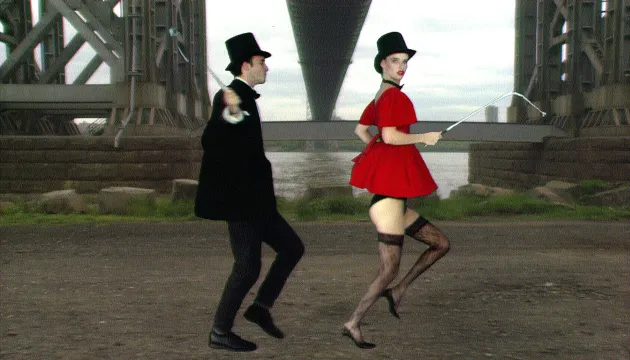
John Lennon’s Imagine (1986). This music video is a utopia obeying its own laws, translated into images and based on catatonic gestures. The child’s process of individuation, shown from little boy to adult man, unfolds through an inexorable succession of rooms through which the journey seems endless. The constantly moving figures continue onwards, yet repeatedly enter the same room. Beyond its windows, the panorama of Manhattan extends throughout, with the twin towers of the World Trade Center still standing. The successive stages of life are shown stretched out horizontally. There is no death to end everything. Existence is open and always infinite, as in existentialist philosophy or Martin Heidegger. The individual’s passing is staged as an endless dance upon the stage.
The Orchestra (1990) contains six very different spaces, transformed in accordance with Rybczyński’s visual obsessions. Its starting point was six classical compositions from the canon of European musical culture: Mozart’s Piano Concerto No. 21, Chopin’s Funeral March, Albinoni’s Adagio, Rossini’s The Thieving Magpie, Schubert’s Ave Maria and Ravel’s Boléro. Schubert’s song, for example — oscillating between the edge of the abyss and the greatest heights — was staged by Rybczyński in Chartres Cathedral, with its exceptional verticality. Inside, a young naked couple undertake their imaginary honeymoon among the heavy columns of the dark sacred interior, which the director said was difficult to illuminate even with 250-kilowatt spotlights pointing upwards. The section concerning the Russian Revolution, in turn, became an opportunity for Rybczyński to interpret the Stairway to Heaven motif to the slowly developing theme of Ravel’s melody. Figures symbolising proletarians and intellectuals climb rough-hewn wooden steps in an endless procession, their arduous ascent symbolising the liberation movement that led to the rise of Soviet power. The movement’s dramaturgy may recall Schoenberg’s oratorio Jacob’s Ladder, known from its surviving fragments: the ascent reaches neither climax nor conclusion but seems continually to return to its starting point.
The nearly half-hour video Steps (1987) is a tour de force in superimposing different temporal planes, but also a reference to Rybczyński’s own cinematic socialisation. It verges on sacrilege by taking on a sacred object in film history: Eisenstein’s Battleship Potemkin. Rybczyński reaches for this cinematic relic to stage a peculiar encounter between East and West. In the 1980s, it was a legible reference to the rivalry between Gorbachev’s Soviet Union and Reagan’s United States. Rybczyński represented it through an encounter between images belonging to two different orders. He could do so through his masterful play with advanced electronic technology, and in this approach he was not so different from the great Eisenstein, who in Steps is even called the God of cinema. In the 1920s, the Soviet director stood at the height of his virtuosity and of the power grounded in film technique. His photographic frames, edited one after another, seem to say: Look how freely I handle the material of film! Look and listen, so that you reject the old, superficial forms of hearing and seeing, and a new, deeper cinematic perception breaks into your consciousness!
Steps: when the film’s title appears in an early frame, it seems engraved, while the scratches and abrasions disturbing the image faithfully imitate the materiality of celluloid. In a wide, initially motionless frame, the still-empty Odessa Steps, a mighty relic of monumental architecture, gradually appear. Slowly, with the aid of blue-box technique, tourists are introduced into the image-space; with them come gaudy colours and sunglasses with brightly coloured frames. They eat hamburgers, are armed with cameras and camcorders, and dress without taste. They look exactly as we imagine average American tourists travelling through Europe. They can try out the steps. They can test the taste of the reality of illusion.
Suddenly events burst into the frame: the Odessa photograph is violently disturbed, and electronically generated characters resembling figures from a game appear. “Please don’t be afraid, it’s only a film set!” the excited director shouts, leading his group up the steps. They follow willingly. In this world, the director is the initiate. He leads the participants in this voyage impossible into the departing twentieth century, and television viewers through the subtleties of editing, inserting and cutting out. Through them he brings the monochrome photographs of Eisenstein’s protagonists together with the tourists’ colourful figures in a collage combining different temporal planes. Paintbox technology, used with great skill, enabled him to colour individual elements of the film and transfer them from Potemkin’s world into that of 1980s television and cinema. A time machine arose: an oilcan, a prop taken from that former time, lubricates the wheels of the pram that will roll towards Odessa harbour several minutes later. The director literally reaches into the imaginary film-space, wagging his finger at the baby in the pram and teasing it. The tourists can admire individual characters from Eisenstein’s film, but step by step they themselves are increasingly built into the architecture of successive scenes. Gradually, the differences among the individual spaces, so distinct aesthetically and technologically, begin to blur. Both those taking part in the experiment and the observers before their screens gradually become participants in this audiovisual comedy of errors.
To create an interface between the system of film technology and the people using it, Rybczyński needed no devices or technical prostheses. His virtuoso staging itself possesses breathtaking force. The artist seems able to connect viewers directly to the source of energy. “Electricity is the soul of television.” These words, written by Jean-Paul Fargier for Cahiers du cinéma while reflecting on the specificity of video, are translated here into the immediate illusion of movement. Nothing matters more than this audiovisual spectacle. Those entering the space created by Rybczyński can no longer, in fact, be called viewers or an audience. Drawn into a game with their own perception and invited into spaces of the imagination, they become participants in the event. Only advanced computer games in the second half of the 1990s achieved a similar intensity of experience. In the early 1990s, I wanted to show Steps in an unusual location, the Neoclassical staircase of the University of Salzburg. During test screenings, however, we concluded that the perceptual disturbances caused by such dynamic and displaced relations of space and time would be so powerful that viewers might tumble down the steps straight into the projection. In the end, we showed the film in an ordinary auditorium.
Gene Youngblood, author of the legendary book Expanded Cinema (1970), called artists who had worked passionately since the 1960s to reunite technology, science and art through advanced technologies new renaissance artists. To me, Zbigniew Rybczyński is a TNRA — a true new renaissance artist — because he represents, lives and celebrates this idea as radically and consistently as no other inventor or constructor concerned with the illusion of moving images. At the same time, unusually, he preserves an idea of beauty familiar from the European Renaissance, far closer to the homogeneous image-worlds of Sandro Botticelli or Michelangelo di Lodovico Buonarroti Simoni than to contemporary art.
In many countries today, image research — so-called new-media technologies — is presented as an allegedly wholly new field in which art, science and technology meet and combine in a special way. Yet this means only that academic institutions have discovered as a novelty something from which there has long been no turning back. Rybczyński needs no such labels. He has investigated the possibilities of a new imagination, understood as technical imagination, ever since he first picked up a pencil, paintbrush, camera or film camera, and then more complex computer-based tools for processing and designing images. Through his creative transformations, both the space in which his image-world arises and the space in which it is subsequently presented — the cinema, for example — become a space of possibility, the potential space by which the British psychologist and paediatrician Donald Winnicott described the space in which mother and child conduct a dialogue and shape experience through play. Technology can perform no worthier function.
Siegfried Zielinski, Berlin, November 2013
*Translated from German into Polish by Marta Skłodowska
Siegfried Zielinski, Professor of Media Theory and of the Archaeology and Variantology of Arts and Media at Universität der Künste Berlin; Michel Foucault Professor of Techno-Aesthetics and Media Archaeology at the European Graduate School in Saas-Fee, Switzerland; and director of the Vilém Flusser Archive in Berlin. He co-created Germany’s first course in media studies and media consultancy (1982), founded the Academy of Media Arts Cologne and served as its rector from 1994 to 2000. He is the author of numerous books and articles and editor-in-chief of the series Variantology: On Deep Time Relations between the Arts, Sciences, and Technologies, of which five volumes have appeared to date (2005–11). He is a member of the North Rhine-Westphalian Academy of Sciences, Humanities and the Arts, the Akademie der Künste in Berlin, the European Film Academy, the Magic Lantern Society of Great Britain and the Board of Trustees of ZKM Karlsruhe, and an honorary senator of the Institute for Media Archaeology in Hainburg, Austria.