
I Am an Image
Zbigniew Rybczyński in conversation with Piotr Krajewski
Piotr Krajewski: You have devoted yourself to creating moving images. Where did your earliest choices and inspirations come from? Were their sources the visual arts or a fascination with cinema?
Zbigniew Rybczyński: Art was the most important thing to me from the beginning. I did not play football with the other boys; instead, from childhood I painted and spent time in museums among pictures by the great masters. I had immense respect for the artists whose work I saw there and for their art, but I also sensed the gulf separating me from their mastery. I was fascinated by the old masters, the Renaissance and Baroque, but also by Picasso. I tried to discover the secrets of their painting, their vision of the world and their distinctive craft. I did not copy any particular paintings by these admired masters, but I tried to paint in their styles, to find their idiom and their way of reaching the world. I even acquired a certain proficiency in representing subjects as they did. My Picasso was genuinely quite successful. I was admitted to art school in Warsaw. We studied in Łazienki Park, which also gave us a wonderful sense of grounding in historical art. It was precisely then that I discovered cinema for myself. I would sit through three screenings a day. Cinemas opened in the morning then, so one could begin at ten and attend screening after screening. In Poland at the time, cinema was available in its finest form: European cinema—Bergman, Godard, the Russians—and Polish cinema, including Has. So-called ambitious cinema predominated, in what was then its best form. I understood that what now interested me was the moving image. I saw clearly that the static image, painting, belonged to the past; that if one wanted to do something important now, something that responded most effectively to today’s world, it had to be a moving image. I therefore decided to become a director. Much in my life happened by chance. One important accident occurred when the father of my friend Ksawery Piwocki asked what I wanted to do in life. I remember that when I answered, ‘I want to be a director, to make films’, he gave me serious advice that went something like this: ‘As a director, you will always depend on someone else, someone possessing real knowledge of the means required to achieve your vision. The person who has genuine knowledge of film, its craft and language, is not the director but the cinematographer. The cinematographer commands the true craft and must understand image technologies and their secrets.’ I realised that, in order to be the author of my own films, I first had to become a cinematographer. I needed to study film technology and know at least as much about it as I already knew about the process of painting. For the Film School entrance examination, I brought files of my drawings and sketches and spread them all over the floor before the committee…
P.K.: At the entrance examination for the Cinematography Department, you did not show photographs…
Z.R.: No, because I did not take photographs. Photography did not interest me at all, nor did sculpture. I was interested only in painting. I often say that great paintings were fantasies made in times when mud and stench surrounded people. Painting consists of idealisations of what photography would show only as ugly and incomplete… I showed exclusively works of visual art, but they accepted me. Later, of course, I had considerable contact with photography; it was connected with many different classes in the cinematography course. But I treated it solely as part of the film cinematographer’s craft, not as something autonomous. It was important as a technique offering substantial knowledge of the image and optics, but the image itself interested me only as a moving image. And that presents entirely different problems, ones photography does not experience. As a cinematographer, I began to discover that the problem of film—the film image one would like freely to assemble from multiple moving layers—was the non-standardised movement of the camera. More precisely, I was troubled by the impossibility of repeating the same camera movement so that everything would align when several shots were later combined into a single scene. Then came further problems of scale and synchronisation. The problem of the scale of filmed objects is a characteristic feature of film. I have always believed that an image can be constructed from anything visual: drawing, painting, multiple exposures, miniatures and full-scale models; that all of this can ultimately be combined into one imagined image. The image can be built by filming separate layers, recording all the elements and combining them into that single, unique image. That is how a painter works, so I never lost the pictorial thinking instilled in me by painting. This is how I imagine creating an image with technology. The point is not what technology allows one to do, but to use it to express what one intends, what was first born in one’s mind as a vision.

Although I did not deliberately invent things I would later be unable to realise, I continually encountered resistance from technology that made it impossible to achieve my ideas in a straightforward way. Because I could not do what I intended, I became interested in why it could not be realised. At first, I did not solve anything; rather, I worked around the various problems, attempting to outsmart them or cheat a little. Ultimately, however, I concluded that one first had to name the problem and then solve it as far as possible. This led to various experiments: my inventions involving motion control, devising equipment, technology and engineering, questions of optics, and finally programming. In fact, each successive film, video production and high-definition work of mine solved another problem. Yet it required years of work, experiments and discoveries to create a system that allowed me freely to create visions as moving images. And this is far more than special effects. It is precisely the image capable of meeting today’s challenge. It is the contemporary image.
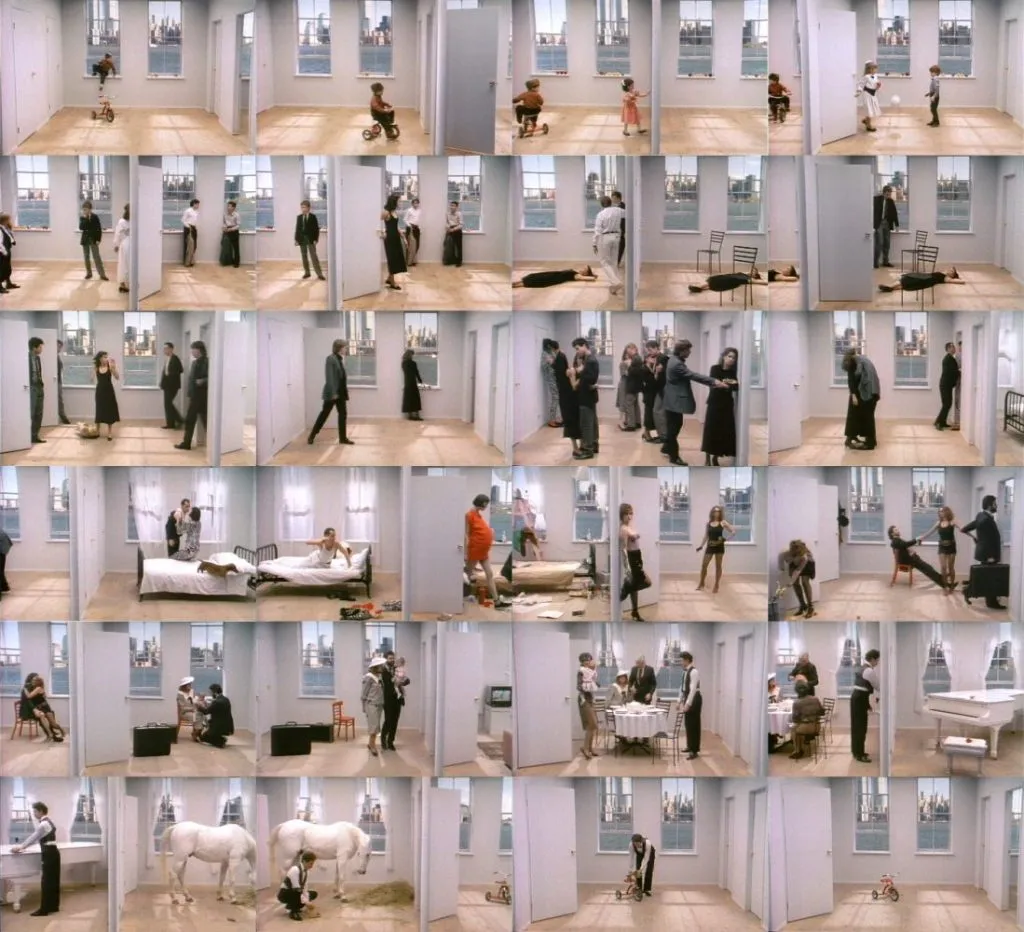
P.K.: Do you believe that if, as an artist, you do not pursue this kind of knowledge, you will be unable to express contemporaneity meaningfully in your work?
Z.R.: I do not think I can say that I am a contemporary artist. I do not fit with everything currently classified as art. Most of what we see in museums and galleries is a profound regression…
It pains me that the contemporary image lacks the brilliant intellectual depth of Renaissance pictures. Botticelli painted in a world made of mud and filth—and yet here are Venus, a shell, a beautiful woman and flowers in the air. This is something that constitutes a great human fantasy. Those fantasies remain the same today, but how can they be realised with tools whose dominant function is to record the world as it is? Painting did not seek or do this. One can see it by comparing nineteenth-century paintings with photographs of the same places, especially cities: the difference between vision and recording becomes clear. That is why the entire special effects industry arose. The problem, however, is that multimedia fields cannot be combined with optics, that everything is badly designed: the lens, the computer screen. This creates difficulties that are merely concealed by ever newer and more expensive methods rather than resolved at the source. There is no standardisation of the image.
P.K.: You are a creator and do not consider yourself an artist? Who, then, are you: a filmmaker, a scientist? From what position do you formulate your demands?
Z.R.: It is difficult to speak about oneself, but you ask me who I am: a filmmaker, an artist? So I shall answer honestly. Kafka once wrote that he was literature, and I shall say: I am an image; I am an expert on the image. I am aware of how all the accumulated errors of every field involved in creating the moving image are combined and layered within the image: optics, computers, programming, chip design, image theory… The repetition of an error that has persisted for five hundred years—that the image is based not on the sine but on the tangent of the angle—is, for me, the fundamental error of optics. It means we have not produced a single lens that simply shows what we see with our eyes. This is precisely what I decided to work on. I proposed a solution to the problem and developed the optics of a universal lens that makes it possible to standardise image geometry, which in turn opens the possibility of mastering camera movement precisely. This is where the standardisation of the image I have advocated for years begins.
P.K.: What new possibilities for creative work are introduced by this universal-lens geometry, motion control and standardisation?
Z.R.: The hero of our age is GPS, positioning technology that determines location and indicates the position of a point with an accuracy of 1/1000 mm. Yet this is the twenty-first century and we do not have a single lens or camera that can be placed at such a point, because today’s lens has no such point of reference. In optics there is no point: there are screws with which a camera can be attached to a tripod and placed somewhere, and an arrow used to measure focus, but the optical construction does not permit the creation of such a point. This is exactly the fifteenth century. Every lens in the world today creates an individual image. No two lenses are identical. Not only is there no point from which the world is photographed, but the image from every lens is unique, distorted differently. We can make close-ups and adjust the zoom, nearer or farther. Yet no optics allows us to assume that we shall now see 58.5 degrees. That is impossible because the lens lacks this point of reference. I believe it is important to have one. As a consequence, everything in the moving image is unique; one cannot repeat a shot in exactly the same way. To achieve this, in Los Angeles we specially constructed motors and an entire driver in order to repeat and enforce the same zoom position…
P.K.: Forgive me, but are these not two entirely different issues? The first arises from the imperfection of the construction itself: the fact that you cannot repeat a shot, build an identical lens or reproduce exactly the same zoom is, let us say, a technical matter connected with imperfect tools. The second, however, concerns your questioning of the theoretical premises of optics, which belongs to the exact sciences. Moreover, it is one of the oldest sciences, so it seems unlikely that it has never before addressed the issues with which you are concerned.
Z.R.: And yet! You are right that optics was one of the first true physical sciences, but it continues an intellectual concept that was sufficient in the fifteenth century and that, for various reasons, we still accept. From Galileo onwards, it may be called genuine physics, formulated as recorded theory. The difficulty is that Galileo, and later the other great figures who worked on optics, wanted to see images we cannot observe with the naked eye: the macro- and micro-worlds. They sought to see distant stars or details of the micro-world inaccessible to the eye, so they developed theories and built instruments to see things invisible to the naked eye. None of those great minds dealt with human vision. They saw the world, a beautiful and distant world, through a highly restricted angle. They focused! They did not need to see the ugliness of the world at a wide angle, so their optics did not concern itself with human vision.
The practical development of optics occurred to meet the needs of printing during the Industrial Revolution in the nineteenth century. The idea emerged of using a lens and printing techniques to create a so-called reproduction lens, approximately and in simplified terms the prototype of today’s photocopier. This made it possible to photograph a sheet of handwritten musical notation and turn it into a printing plate. Previously, the notes had to be engraved. It is much easier to photograph reproductions for books and newspapers than to engrave them. Everyone therefore assumed that the image fitted within a reference grid, small squares together forming a grid in which the objective was to reproduce the picture evenly, as though in a contact print.
P.K.: Flat, without taking space into account…
Z.R.: Precisely, flat! And space is not flat. Space is a highly complex phenomenon. Yet we apply to it an optical technique that arose from observations conducted through the very narrow angle of a telescope or microscope, combined with a reproduction lens designed for flat representation. The subsequent development of optics concerned only how to improve this, make it wider and, while broadening the angle of view, maintain a reasonably regular grid. The entire development of optics, and later the support provided by computer graphics and computer programming, has consisted in maintaining this grid across an ever wider angle of view. But talk to someone who works in computer graphics about changes in the angle of view…
This remains an insoluble problem, so present-day special effects are manual labour, albeit performed with computers, which is why producing films costs hundreds of millions of dollars. There is no method other than correction, frame-by-frame work to join movement in space credibly from multiple shots filmed at different scales, because none of it fits together. At the same time, the industry continues to develop. Directors, creators and writers produce bold visions. They invent them, but in practice they do not know how to make them, so they entrust them to specialists. Those specialists, in turn, have tools at their disposal. They know that a great deal of money will be involved, that many computers will be needed, with numerous software packages on each computer and many people, each of whom has mastered one program, working in three shifts for a year or more. Yet these writers, directors and creators do not realise that the people who develop software and construct computers know too little about the image. This is not amusing.
The contemporary image therefore requires us to begin with optics and correlate software with it in order to create lenses that repeat what computers do, so that every lens does the same thing and does not differ from another, but is simply universal. A new standardisation of the image is needed; otherwise, we shall create nothing of value.
Compared with works of the past, the majority of today’s special effects are a pitiful achievement. This is because creators and technology have parted company…
P.K.: Returning, then, to your self-identification: you began studying in the Cinematography Department in order to become a director. Is it not similar now? You work on image theory and programming, which today must complete what was previously the cinematographer’s domain…
Z.R.: I do not know whether it is the cinematographer’s domain, but it means dealing with problems without whose solution there is no point in creating further images! I understood that one could write and realise anything in a computer. At first, when I did not know how, I hired a programmer. I spoke with him and gave him advice and mathematical formulas—my own. Later, I began programming myself. That is what the world of science is about. A wonderful world. I am a person with passion and a sense of mission. I feel that art is a responsibility, that one must know a great deal and possess experience before daring to say something, to create the next masterpiece. I have fully reconciled myself to the possibility that I may not make such a masterpiece. I believe that developing and striving to remain faithful to one’s ideas is most important. I am faithful to the fascination I have had since childhood.
P.K.: Are you therefore close to this way of practising art and this vision of the artist as part of a more general endeavour? Instead of aspiring at all costs to be an individual, should the twenty-first-century artist seek to participate in processes that may at least enrich the world cognitively?
Z.R.: I believe there are many things we cannot, and worse still do not want to, define from the outset. So-called avant-garde art has never won my heart, because I do not understand the concept ‘avant-garde’. For me, the avant-garde encompasses all those places where mysteries are discovered, where one moves forward and opens doors no one has entered before. This is happening today in medicine and in every science where research and discovery continue. Yet when I enter a modern-art gallery, I do not see art connected with that process today.
I own a few pictures by Picasso, Dalí, Vasarely, Nikifor and more contemporary artists. Most are famous painters, often people I know well, but their pictures are not inspiring in any way. In any way at all. Picasso is not inspiring to me. It is very easy to discover his working method, which makes him immediately recognisable, but he added nothing to the world. He introduced only his mark, the mark of Pablo Picasso. For me, this is not knowledge of the world; it merely adds patterns, a recognisable name and signature. It contains none of the participation, conversation, civilisation or great purposes served by art in the past. And that should be the meaning of artistic activity.
Knowledge must occur on another level. That is why I shall tell you that knowing the past is important, because these human dreams possess a certain coherence. How many people dreamt of travelling to the Moon, even if only in literature and later in film? Eventually, we found a tool and went there. I believe that inspirations, dreams and fascinations are shared and coherent!
P.K.: Do current technologies for creating the moving image not allow those shared dreams and fascinations to be expressed?
Z.R.: If, in real vision, I moved and, as I changed my point of view, discovered that you changed your geometry along with that movement—for example, that you were flat—if I discovered that in the real world, I would probably end up in a psychiatric hospital. But when a lens does it, distorting a solid and representing it differently with every movement, no one is even surprised. Within one field of view, we accept symbol and reality, two different orders of image. For me, the technology of the image, of the new image that must be created, is a technology that will reproduce our vision. Just as I see you now in the space of this room, and when I put on glasses I see the same thing. Existing lenses cannot do this; they will not reproduce the image seen by the naked eye. But if we create a technology that reproduces the image normally seen by our eye, only then will we have true virtual. This must happen. It will be the breakthrough in art, culture, everything. Few people today understand the fundamental importance of this issue, so in the field of the image we remain in an era equivalent to the state of printing before Gutenberg.
P.K.: What you propose is both the construction of a lens and the software accompanying it?
Z.R.: Of course. In my view, these are the most interesting creative problems today, in today’s world. When people speak about artistic, art-and-science creation, these are the subjects, these are the visions to realise! It is necessary to deal with these problems, because without solving them there is no point in creating further images. People ask why I do not make films, why I made my last one eighteen or twenty years ago. They do not understand that I am working on a film. For me, this is work on the tool and its development. I concluded that it has meaning, that these are the tools with which those ideas can be realised, with which one can attempt to convey that reality, and that one needs tools and a system to realise that mental reality. Very many things contribute to this.
P.K.: Are you not paying too high a price for this desire to create a new theory and ideal tools you will be able to use?
Z.R.: But I already created such a tool many years ago. Now I am repeating what I created twenty years ago. At that time, I still lacked one complementary element: computer graphics. At the same time, I realise that twenty years have passed and I have not brought about satisfactory progress in this field, while problems remain unresolved today. Nothing has changed. I simply want to standardise these things. I am also thinking of passing this knowledge to the next generation, to young people. A time comes when you have cut your teeth on something and a new generation appears that grasps everything instantly. I know that what I am doing consists of necessary steps. What I said about the future of the image must happen.
P.K.: You speak about this as a sense of an inner mission or obligation, as tasks you set yourself. But what about your own creative practice?
Z.R.: But this is precisely the creative practice. I want to write software because what concerns the moving image has been written badly. You need knowledge and strength to say that all of it is worthless.
The history and origins of computer graphics are based on mistaken premises. It was certainly not written by a humanist who possessed knowledge of the image, and the consequence is that everything is excessively complicated. Writing computer code is not treated as mastery of the contemporary literary language. Equally troubling is how humanities circles regard computer language and code as skills belonging to cyberneticists and programmers, while they in turn do not fully understand what they are doing. The consequences are immense. Programs are created chiefly by people who lack the knowledge and awareness that we possess some two thousand years of fairly good art, of creating extraordinary visions. Programming is the language of our age, and interfaces can become creative in the hands of millions of people. These are extraordinary things, astonishingly powerful. That is why the masterpiece of the twenty-first century will be made in a programming language! This language can create something millions of times more complex, real, extraordinary and revelatory than writing a book. Yet humanists have not become conscious of this. Is that not a scandalous error of the age?
P.K.: In setting the direction of your own work with a sense that it was worth pursuing, did you live solely with problems of the image? Or did the places where you worked and highly concrete experiences also play a role in your work? You spent part of your creative life, the 1970s, in Poland; the 1980s to the early 1990s in the United States; and then the 1990s in Germany…
Z.R.: In Germany from 1994 to 2001, in Berlin and Cologne, while in the early 1980s there was also Austria…
In every city where I lived and worked, I sought knowledge of its past: maps, prints, paintings, photographs and books connected with it. These searches produced substantial collections of all manner of things. I gathered a great deal. This concerned New York, Berlin, Cologne and now Wrocław. A connection with a place and its past is important; that past is one of the most important sources of inspiration. Alongside historical art, these things inspire me considerably and connect me with the past in a highly concrete way.
P.K.: The period since the 1970s has brought extraordinary changes in the world, including political ones. A description of that world is visible in some of your early films, such as Holiday. Did events such as the fall of the Berlin Wall influence your visions or affect your works in any way? Did you feel that these too were challenges demanding some form of response?
Z.R.: I think this can be seen in my films from that period. When I was shooting The Orchestra, immense changes were taking place in the world. We were working on the Boléro sequence when the Velvet Revolution occurred in Prague, followed by crowds on the Berlin Wall. We kept watching CNN as it unfolded. We viewed these events while filming; we saw the fall of the Wall almost live. The moment when we finished the final shot was highly memorable. The champagne cork popped, and together with the entire film crew in my Hoboken studio we celebrated and looked at the television, where exactly the same thing was happening: we saw people drinking champagne and celebrating. In this way, I drank champagne and celebrated simultaneously with those with whom I had made the film and those who had brought down the Wall. It was extraordinary. Several years later, on the day Yeltsin officially announced the end of the Soviet Union, the main programme on Russian television at eight in the evening showed The Orchestra…
Certainly, all these new experiences would now find their way into the film I would like to make, into this first film of mine… Yes, that is the principal subject: the world itself. I am fascinated by the world, technological and scientific development, politics, mass consciousness and society. It is fascinating, but also difficult…
There is an immense conflict between humanists, the intellectual elite, and the group of technologists within this political business. This is a major problem; there is no synchronisation between them. Someone invents something in science or technology—because this is where the true revolution changing the world is happening today—but the opinion-forming group of humanists knows nothing about it. This ignorance, rather than scientific and technological development itself, is a threat to the world. The elites remain unaware yet already critical; everyone shouts in protest, but without understanding. This is hypocrisy. To criticise corporations, cognitive capitalism, global warming… but where is creation to take place?
Perhaps it is not enough to destroy superficially; that is easy criticism, apparently engaged but carrying no obligations. Perhaps art should preserve the capacity to participate truly and profoundly in these processes?
For me, to create today means engaging in the process of improving the world, improving nature. The contemporary artist should be someone—a creator, a god, a genius—with immense knowledge that enables participation in this process.
P.K.: Is this what the contemporary role of the artist should be?
Z.R.: It should be a highly elite occupation. I would associate it with great people and with realising visions of the world. If I were to formulate it, I would say: create visions, bring them into being!
*The conversation was conducted during preparations for the exhibition The State of Image: Pioneers of Media Art—Zbigniew Rybczyński and Gabor Body, presented between 2011 and 2013 at the Akademie der Künste in Berlin, ZKM in Karlsruhe and the Vasarely Museum in Budapest (exhibition curators: Piotr Krajewski and Miklós Peternak). The text appeared in German in Positionen IV: Polen, Steidl, Göttingen, 2011.
Piotr Krajewski is artistic director of the WRO Media Art Biennale and chief curator of the WRO Art Center. He has created numerous exhibitions and international art projects, and authored publications issued in Poland, Germany, the United States and Japan. He previously taught at the University of Wrocław and currently lectures at the University of the Arts in Poznań and the Eugeniusz Geppert Academy of Art and Design in Wrocław. He is also a guest lecturer at universities abroad. He participates in international conferences devoted to art, curatorial strategies and contemporary cultural creativity. He has advised the European Commission and Japan’s Agency for Cultural Affairs. He curated Zbigniew Rybczyński’s exhibitions A Treatise on the Image (Stary Browar, Poznań, 2009) and The State of Image (AdK, Berlin, 2011; ZKM, Karlsruhe, 2012). He lives in Wrocław.