
Too Much! The Frame and Excess
Jarosław Lubiak
A monstrous overproduction pours forth as though from a cornucopia. Today, unusable overproduction is the product of what Jacques Derrida called ‘the system of duction (production, reproduction, induction, reduction, and so on)’1. Inexhaustible abundance threatens bloated swelling, a fatal surfeit. An equally monstrous overproduction—or, more precisely, over-reproduction—of images, images of images and still more images of those images, and so on, also plays its part. In fact, this is intensified replication, unbridled self-reproduction in digital processing: a veritable flood of copies that creates a surplus impossible to squander. The excess of replicas appears impossible to dispose of. Could any grand feast digest this inexhaustible surfeit of goods? Could some ruinous potlatch consume the pathological hypertrophy of abundance? Could any visual consumption devour these obsessively over-reproduced images? A feast of painting, perhaps?
Whether it intends to or not, ‘A Feast of Painting’—an exhibition proposed by Kamil Kuskowski and Atlas Sztuki—confronts these questions, seeking to locate art within what Georges Bataille called the general economy2. The question is whether the painterly installations comprising Kuskowski’s exhibition constitute the effective wasting of the accursed share, the squandering of excess in an act of pure loss: an act offering the sole possibility of symbolic action, the sole possibility of a gift that exceeds the restricted economy of commodity exchange.
In ‘A Feast of Painting’, continuing earlier themes in his work, Kuskowski simultaneously proposes capturing within frames and liberating from frames. He develops the question of the parergon—the frame—previously raised in the MuzeuM series, among others3, while also going beyond it by confronting it with the category of excess, which is crucial to the general economy. One might say that, in a perverse dialectic, he attempts to capture excess within frames—the gilded frames of easel paintings—while at the same time seeking to release it and abandon it to the loss of luxurious expenditure, to a wasteful offering through which art is constituted as a symbolic act.
A Parergon without Lack
‘A name spoken by someone reminds us of the Dresden Gallery and our last visit there: we walk through the rooms and stand before a painting by Teniers that depicts a gallery of paintings. Let us further recall that its paintings in turn depict paintings, which themselves bear legible inscriptions, and so on; in this way, we may judge how far the nesting of representations within one another can actually be produced and what degrees of mediation exist in relation to apprehensible objects,’ writes Edmund Husserl4. The remembered visit to the Dresden Gallery is an example here of perceptions, memories and imaginings that ‘fit inside one another like boxes’5. The boxes are metaphors for degrees of mediation, constituting successive representations of apprehensible objects. The example contains five boxes: b1—the recollection; b2—the Dresden Gallery; b3—the painting by Teniers; b4—the paintings in Teniers’s painting; b5—the legible inscriptions on the paintings shown in Teniers’s painting. The example provides an excellent introduction to the phenomenological method. Developing its logic, one might say that this method consists in opening successive boxes, eliminating one intermediary after another and tearing away the veils of representation in order to reach what lies concealed in the final box: that which presents itself directly rather than being mediated in representation. Through this telescopic method, one may approach the disclosure of what phenomenology seeks most fervently—or even dreams of: the intuitive apprehension of the thing itself.
At first glance, it might seem that the inscriptions should constitute the contents of the final box, the sought-after object concealed beneath too much packaging, like a maliciously wrapped present or a deeply hidden Kinder Surprise. Perhaps, to dispel this impression more forcefully, Husserl deliberately avoids mentioning, for example, the fruit that must have been represented in some of the paintings visible in the gallery painted by Teniers. Husserl does not speak of delicious, fragrant fruit whose intuitive apprehension might be achieved in a successful still life. Instead, he speaks of inscriptions and, having mentioned them, adds the abbreviation ‘and so on’—a signal of infinite continuation. For the inscriptions do not constitute an object hidden in the final box. They too are a box containing further boxes; they are an intermediary leading to other intermediaries, a representation referring to something else. In the final instance, Husserl can move so effortlessly from images—which are, after all, materialisations of perceptions, recollections or imaginings—to inscriptions—which are conventional signs for concepts—because, in his view, the structure of the sign, of that which refers to something else, since a sign by definition shows what it is not, determines the structure of every representation, including the image and thus also the painted image.
It was presumably this indication of the signifying structure of every representation and the indication—of which Husserl was not fully aware—that reference within such a structure is, by its very nature, infinite, that caused Jacques Derrida to invoke this example at the final stage of his deconstruction of Husserl’s philosophy6. Whereas Husserl believed not only that such a thing as the thing itself existed, but also that phenomenology could discover the manner in which it appeared in perception, Derrida, radically developing Husserl’s theses and intuitions, states that ‘the thing itself is a sign’ and consequently that ‘appearing itself does not reveal presence, but makes a sign’7. Derrida cites Husserl’s example in the chapter in which he introduces the concept of the supplement, whose framework cannot be escaped. The supplement appears because the thing itself demands it, because the thing lacks fullness, if only on account of its transience. Take fragrant and delicious fruit, for example—sweet grapes, say—which decays so quickly. Does it not demand a supplement in the form of a painted image that would add durability to it? Does still life not supplement the manifestations of the thing that fruit is with what it lacks? Does painting not appear because the thing demands to be supplemented by an image?
For Husserl, however, the painted image is entirely transparent in relation to perceptions, recollections or imaginings—as though the medium of painting had no effect whatsoever on what appears in the image. This allows him to juxtapose a recollection with the perception of an image and with what is made visible in it, completely disregarding the substantial differences between the individual elements of the juxtaposition. Although the phenomenon of painting constitutes one of his key examples, it remains overlooked. Yet given that ‘phenomenology… is always a phenomenology of perception’8, painting ought to be a particular object of phenomenological study: nobody has investigated the phenomenon of perception more thoroughly than painters, and there are no more precise materialisations of that phenomenon than painted images. For Husserl, however, the painted image does not differ from the image that appears in perception or recollection; like them, it is one of the manifestations of the thing itself. It is otherwise with Derrida, for whom painting becomes one of the things and its phenomenon is subjected to broader reflection.
The painted image supplements the thing, yet at the same time it does not attain a fullness that would free it from the need for another supplement. For the work of art—the ergon—this role is performed by the frame—the parergon. Presumed to be wholly external to the work, it is an ‘excess, supplement, addition’; it lies outside the work while remaining closely bound to it. As Derrida demonstrates, the work could not constitute itself without the frame9.
At the same time, he emphasises both the necessity and the impossibility of separation. Frames are the parerga of paintings: ‘not because they stand apart, but, on the contrary, because they are more difficult to detach, and above all because without their quasi-detachment, a lack would—or would not—appear within the work, which, where lack is concerned, amounts to the same thing. What makes them parerga is not reducible to their exteriority as something added to the work; rather, it is a structural, internal bond that attaches them to a lack situated within the ergon. And this very lack would be constitutive of the unity of that ergon’10.
Husserl therefore fails to see painting, perceiving in it only a transparent supplement to the recollection, perception or imagining of the thing itself. Derrida, in turn, sees painting as constituted by a lack that demands supplementation through a frame. And Kuskowski?
Beginning with Derrida’s parergon, with the frame as something constitutive of painting, Kuskowski undertakes a series of actions that ultimately exceed its restricted economy—what Derrida calls economimesis11—and move towards a certain economy of excess.
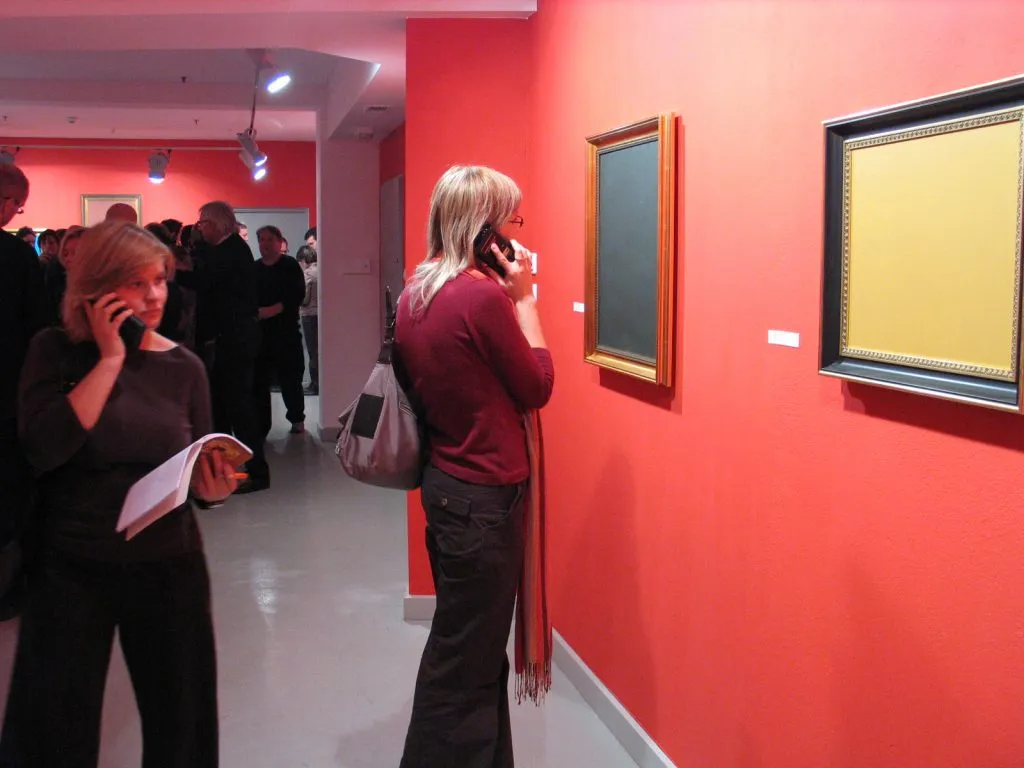
In one of the two parts of the painterly installation ‘A Feast of Painting’, Kuskowski creates a situation that appears analogous to the one described by Husserl. Thus: we enter Atlas Sztuki in Łódź and see pictures hung irregularly inside it; inscriptions appear on the pictures, most often the familiar names of great painters; we can approach each exhibit, examine it and even remove it from its frame and look inside, inspecting the images it contains and sometimes even discerning images within those images. The box structure of Husserl’s example is therefore repeated here, although differences emerge: box 1—the imagining of the situation created by the artist’s invention; b2—the gallery interior; b3—the parerga; b4—the inscriptions; b5—the images discovered in b4; b6—the images within the images; and so on. A radical change is already visible in b1, not only because we are dealing with an imagining rather than, as in Husserl, a recollection, but above all because this reveals a radical change in the role of the artist and thus of art. The artist—moreover, an artist addressing the question of painting—does not paint pictures here. He does not act as a specialist in materialising perceptions, like the paradoxical empirical phenomenologist whose role traditional painters most often assumed. On the contrary, he makes an inventive discovery: he creates a situation in which painting and the painted image are exceeded.
Kuskowski radically breaks with the phenomenological tradition of painting—the tradition of sensitively recording the perceived manifestations of things in painterly matter. What appears inside the frames is not the stretchers of paintings, but impressive albums about painting: truly monumental collections of images. These are no longer collections of perceptions, imaginings or recollections, still less their materialisations, but merely collections of their superbly printed reproductions.
The surprising nonchalance with which Husserl moves from the image that is a recollection or perception—and thus an image existing only within consciousness—to the material painted image, which exists primarily outside consciousness, could only have been motivated by what Walter Benjamin called the authenticity of the work of art, guaranteed by its handcrafted uniqueness as a record of particular perceptions12. Such nonchalance, however, seems entirely impossible in the case of reproductions. They are not themselves things: if an easel painting is a thing, here it is the album that is the thing, not the reproductions it contains. Nor do they make any, even false, promise of leading to the disclosure of an intuition of the thing itself, as painting did in Husserl’s example. Benjamin emphasises that mechanical reproduction destroys the aura of the work of art, the thing through which the thing itself—fragrant and delicious fruit, for example—may manifest itself, or at least give a sign of itself. Reproduction belongs to the order of the copy, an order in which multiplied images have no connection with things, but are generated by the mechanics of replication.
Instead of repeating Benjamin’s lament for the loss of the aura, however, Kuskowski confronts us with the present situation, in which painting has been subjected to the mechanics of replication. He confronts us with a situation in which viewers experience painting far more often through reproductions than through live contact with the authentic thing, the painted picture. By placing albums of reproductions in gilded frames, Kuskowski effectively turns them into painted pictures.
In the case of these pictures, the parergon is not added to the work; rather, the album becomes a work by being placed within a frame. The frames transform the album into a picture—literally, a picture with an inscription; metaphorically, a picture of painting’s current condition. More importantly, however, the parergon does not appear here to supplement a lack constitutive of the ergon: it is not a lack in the work that creates the need for framing. On the contrary, it is excess that forces the use of frames.
The parergon protects the viewer from the danger of confronting the crisis of over-
-reproduction. The frame is an attempt to tame the surplus, at least for a moment.
The Accursed Share without a Frame
Only for a moment, because the surplus cannot be tamed for long. Whereas the box structure in Husserl’s example presupposes, in keeping with telescopic mechanics, the placement of one representation inside another, in the situation created by Kuskowski box 3, and especially box 4, constitutes a veritable Pandora’s box concealing the accursed plague of over-reproduction. It is enough to remove any album from its frame and open it to unleash the surplus concealed within.
Let us imagine a situation in which all the reproductions enclosed in albums were not held within their frames but were, say, printed on individual sheets piled into a heap or scattered entirely chaotically around the room, or presented one after another in a projection. Any attempt to view them would be a curse. It would be a genuine potlatch, the actual destruction of a specific mass of reproductions. But could such a potlatch—necessarily fragmentary—or such destruction of what is, in fact, a small portion of reproductive excess have any significance in the face of the immensity of the accursed share generated by global over-reproduction? This wasteful squandering cannot be treated as an actual loss of the swollen surplus, because no single action could have any significant effect on it. This is presumably why Kuskowski instead attempts a symbolic act. The frame enables the initiation of symbolic action: it transforms albums of reproductions into pictures and becomes an instrument of transfiguration. Even if this is something of a conjuring trick, the transfiguration nevertheless takes place: mechanical reproductions are transformed into a work possessing an authenticity equal to Benjamin’s handcrafted object. For Benjamin, the work’s authenticity was connected with ‘the work of art’s unique and unrepeatable relation to the place and time of its existence’13. In Kuskowski’s case, is not the very selection of albums and the arrangement on the gallery walls of the pictures made from those albums connected with a time and place? In principle, this installation is not intended to be presented anywhere or at any other time, and it therefore constitutes a ‘unique and unrepeatable’ work. Even if an attempt were made to show it again, it would require reconfiguration or at least painstaking reconstruction. The transformation of reproductions into elements of a ‘unique and unrepeatable’ work actually occurs, but only for a moment. Once withdrawn from the exhibition, they will return to their inauthentic existence.
An even more ‘unique and unrepeatable’—and thus, in Benjamin’s terms, ‘authentic’—situation is created by the second installation in ‘A Feast of Painting’. It might seem that, contrary to all philosophical reservations, the artist has managed to find the final box, the lost box in which the dreamed-of and long-sought treasure—a philosophical Kinder Surprise—is concealed: the thing itself. No longer a faithful representation, no longer perfect imitation, no longer an exact materialisation of perceived manifestations. Instead, the thing itself presents itself, appears, becomes present and offers itself to the viewers’ gaze—and not only to their gaze.
Kuskowski presents authentic still lifes, sophisticated compositions forming refined analogies to the finest examples of Western painting. He precisely arranges the fruit: sweet grapes, fragrant lemons, smooth apples and ripe pears. He adds a carafe of water that bends the rays of light and places beside it a glass that catches the reflections. All these and other elements form elaborate compositions based on the finest models.
In fact, these are authentic pictures, once again enclosed in golden frames. Viewers can surrender to the delight of visual consumption, to the pleasure of looking at picturesque configurations. Yet they may go still further. They may cross the boundary marked by the frames: they may not only put a hand into the picture’s field and touch it, but even taste one fruit or another. They may do more still: eat them all, down to the last morsel. For these still lifes are composed of living fruit, while stretchers enclosed in gilded frames form platforms for the pictorial compositions.

To cross the boundaries of the picture—is that not an eternal dream? To consume a still life—if it kills what it represents in order to grant it eternal permanence, does it not promise eternal consumption? Kuskowski corrects the still-life tradition, transforming it into living nature and guaranteeing endless consumption, one that is not merely visual. Kuskowski’s living natures are always to await consumption, at least for the duration of the exhibition at Atlas Sztuki.
On the one hand, eating the picture destroys the symbolic status that art has always sought to establish. It destroys that status because it restores the use value of the things from which the picture is made: they return to their most banal function, the satisfaction of vital needs. On the other hand, however, it is impossible to avoid an association with the film La Grande Bouffe, directed by Marco Ferreri in 1973, in which refined consumption becomes a means of ultimate loss—the loss of the consumers themselves, who not only squander resources in an obscene feast, but above all squander themselves, sacrificing themselves on the altar of rampant consumerism. Death is the logical consequence here of excessive consumption, or, which amounts to the same thing, of the radical consumption of excess.
There is undoubtedly something obscene in Kuskowski’s endless possibility of consuming these living natures, in their refined inexhaustibility, which would form an aesthetic, though certainly not ethical, counterpoint to the decomposition that uneaten food products in hypermarkets habitually undergo. By opening the frames of his still lifes, Kuskowski offers viewers a grand feast and the risk of losing themselves in accursed excess. Yet the accursed share cannot be consumed; rather, accursed is anyone who attempts to do so.
While symbolically exposing us to this temptation, Kuskowski does not offer it in practice. What actually occurs in these pictures is the destruction of the thing itself, or rather of the promise of the thing’s revelation made by Kuskowski’s pictures. For only apparently are the still lifes a presentation, a making-present and an appearance of fragrant, sweet fruit. Or rather, they are these things only as long as they remain pictures: as long as the boundary marked by the frame is not crossed and the parergon guarantees the inviolability of the ergon.
The moment even a single hand breaches that boundary, the moment even the smallest grape is plucked, the thing itself, hitherto revealed in the majesty of its manifestations, ceases to be itself and becomes a sign. Jacques Lacan describes the mechanism of such a transformation. At one point, he invokes the famous story of the rivalry between Zeuxis and Parrhasius: ‘Birds flew down to the surface on which Zeuxis had applied patches of colour, taking the picture for edible grapes. Let us note that the success of such an assumption does not imply that the grapes were perfectly imitated like those we can see in the basket held by Caravaggio’s Bacchus in the Uffizi. Had the grapes been painted in this way, it is unlikely that the birds would have been deceived: why would they perceive grapes represented with extraordinary likeness? There must instead have been something more reduced, something closer to a sign…’14. Extraordinary resemblance, nearly perfect imitation, does not arouse the desire to consume. It instead arouses the desire to contemplate the perfection of the picture, admiration for the art or even the trick of representation. According to Lacan, the fact that birds began to flock towards the grapes painted by Zeuxis indicates that their desire was instead awakened by some signal, that they received a sign. It is this sign that releases an irresistible desire, the desire to consume the image. If the arrangements of grapes or other fruit forming Kuskowski’s living natures were perfectly composed in imitation of paintings—in a perverse reversal of the category of mimesis—if they were pictures in some sense, the boundary marked by the frame could not be crossed. The parergon would protect the ergon’s integrity and inviolability, while the work would offer itself exclusively to visual consumption, remaining a particular reproduction of painted images. Only at the cost of a certain reduction—while still remaining within the ‘system of duction’—a reduction to the sign and therefore at the cost of imperfection, will the fruit natures not become dead, will they not become pictures, but may remain alive and offer themselves for consumption. Only on condition that the frames are removed can the accursed share undergo actual loss and the image be consumed. Only this situation—the destruction of the picture by eating the fruit that forms it—establishes a paradoxical gift: viewers may satisfy the desire awakened in them by the sign created by the work. Only the wasting of actual resources, of real fruit, that particular matter from which Kuskowski creates his pictures, endows them with meaning. The continuous renewal of the pictures throughout the exhibition makes the necessity of loss tangibly, even edibly, perceptible.

In ‘A Feast of Painting’, Kamil Kuskowski exceeds the restricted economy—economimesis—and moves towards the general economy by making a series of shifts within what Derrida called ‘the system of duction (production, reproduction, induction, reduction, and so on)’. We have attempted to identify some of them: by using reproductions to produce an authentic work, he simultaneously reduces the image to a sign and consequently abandons it to desire—in Derrida, the system of duction, la duction, also includes charm, allure and seduction, séduction. By suspending the authority of the frame and making it possible to cross the boundaries marked by frames, he destroys the work. The physical destruction of the work, offering it without expecting any recompense, creates a particular response to Bataille’s critical diagnosis: ‘Under present conditions, everything contributes to obscuring the fundamental movement that seeks to restore to wealth its function: the gift, expenditure without return’15. At the same time, only this physical annihilation, this offering without recompense in response to an insatiable desire, makes possible the symbolic action through which art is created. Art is condemned to oscillate, in a constant effort to exceed this opposition, between Bataille’s economy of excess and Lacan’s economy of lack. Art suspended in a situation in which there is always too much and never enough.
1 Jacques Derrida, The Truth in Painting, translated into Polish by Małgorzata Kwietniewska, Gdańsk, 2003, p. 17.
2 Georges Bataille, The Accursed Share; The Economy on the Scale of the Universe; The Limit of the Useful, translated into Polish by Krzysztof Jarosz, Warsaw, 2002.
3 Kamil Kuskowski: Muzeum / Museum, Muzeum Sztuki, Łódź, 4–30 November 2005; Galeria Piekary, Poznań, 13 December 2005–10 November 2006.
4 Edmund Husserl, Ideas Pertaining to a Pure Phenomenology and to a Phenomenological Philosophy, translated into Polish by Danuta Gierulanka, Warsaw, 1967, p. 351.
5 Ibid., p. 350.
6 Jacques Derrida, Voice and Phenomenon: Introduction to the Problem of the Sign in Husserl’s Phenomenology, translated into Polish by Bogdan Banasiak, Warsaw, 1997, pp. 174–75.
7 Jacques Derrida, Of Grammatology, translated into Polish by Bogdan Banasiak, Warsaw, 1999, p. 77.
8 Derrida, Voice…, op. cit., p. 175.
9 Derrida, The Truth…, op. cit., p. 68.
10 Ibid., p. 71.
11 Ibid., p. 138.
12 Walter Benjamin, The Work of Art in the Age of Mechanical Reproduction, translated into Polish by Janusz Sikorski, in Walter Benjamin, Angel of History, Poznań, 1996.
13 Benjamin, The Work…, op. cit., p. 204.
14 Jacques Lacan, The Four Fundamental Concepts of Psycho-analysis, ed. Jacques-Alain Miller, trans. Alan Sheridan, London, 1994, pp. 111–12.
15 Georges Bataille, The Accursed Share; The Economy on the Scale of the Universe; The Limit of the Useful, translated into Polish by Krzysztof Jarosz, Warsaw, 2002, p. 46.