
In Praise of Nothing
Sebastian Cichocki
In her recently published essay Mind Wide Shut,1 devoted to the desire for fear and paranoia in the contemporary world, Berlin-based artist and writer Hito Steyerl touched upon a remarkably interesting thread running through the history of art and politics: the “politics of the monochrome”. At first sight, the world of non-representational painting and the problems of liberal democracy occupy opposite poles. But consider a highly concrete and tangible instance of their coexistence: terrorist alerts in the United States, each assigned an appropriate colour — excluding the “peaceful” green. One need only choose, announce and “apply” the right colour for the public mood to plummet at once, as though an invisible enemy were storming the city. Another example of the political, but also linguistic, use of colours lies in the revolutions and grassroots social movements that have erupted in different parts of the world in recent years. We might name the Rose Revolution in Georgia in 2003; the Cedar Revolution in Lebanon in 2005, to which green was assigned; the Orange Revolution in Ukraine in 2004, the best known in our part of the world — but also the opposing “blue” resistance of Viktor Yanukovych and his supporters; or the so-called Tulip Revolution in Kyrgyzstan in 2005, awash in pinks and yellows. Hito Steyerl connects these facts with the modernist tradition of using monochromes: in Rodchenko’s 1921 yellow, blue and red paintings they manifested the death of painting, while Malevich’s White on White (1918) was treated as reaching the true “essence of art”. Steyerl writes: “It seems no coincidence that the monochrome as an art form appears in times of aesthetic and political turmoil. The function of political monochromes is very similar. They signify both the end of politics as such — the end of history, the advent of liberal democracy — and the beginning of an era of ‘total sensation’.” The pool of political colours is limited, but new properties adapted to current criteria and expectations can always be assigned to them. At any latitude, a monochromatic alert scale legible even to an illiterate person can be introduced and used as a “screen saver” to suppress unwanted grassroots phenomena. Yet it can also work in reverse, like a red rag to a bull — an animal that is itself colour-blind and reacts only to the movement of the fabric. A red-and-white banner could serve equally well as the rag…
We are looking at a blue monochrome surrounded by a solid, decorative gold frame. It is dignified yet idyllic, spacious yet disciplined. Let us set aside all the implications carried by blue, the entire “prehistory” of seeing and perceiving colours that we can trace through art, literature and national politics — the blue portions of flags intended to symbolise loyalty and trust, for example. This time, let us reject the past without hesitation; we have been supplied with a complete set of data that guides our reception with remarkable precision. The picture, by Kamil Kuskowski, bears the austere and thoroughly familiar title Polish Landscape with Storks (2004). It is accompanied by a text recorded on the museum audio guide, from which I quote: “The meadow merges with the sky at a horizon line placed one-third of the way up the composition. The austere, monotonous landscape is complemented by a pair of storks in the background. The discreet figurative staffage, like the tree growing at the water’s edge and the second tree positioned at the right of the frame, emphasises the space and allows the scale of distance to be grasped.” And so on. What is absent suddenly appears, like a rabbit drawn from a hat by a skilful conjuring trick. Both the aforementioned Polish Landscape and Kuskowski’s other works — he is an ironic painter who examines the surface of the abstract picture and its paradoxes with a Conceptual, institutional-analytical bent — reflect an important property of contemporary art: its symbiotic relationship with the spoken word, which in psychoanalytic terms might be called an oral fixation. Art longs to be “narrated”; it gladly abandons the material ballast of the object, “using” it only to initiate a narrative, and circulates as oral transmission, discussion, gossip, an opinion dropped between the lines, a suggestion. Meanwhile the image itself grows ever more silent, surrounded by the din of stories unfolding in parallel. Faced with one of Kuskowski’s Monochromes (2004–05) — or, indeed, with his other works, such as Painting Subjects (2002) or the earlier Deconstructions (2000) — we can therefore dramatise the picture to our heart’s content, surround it with subplots and lend it an anecdotal, sentimental or political-critical character. Nor should we feel excessively compelled to seek analogies and dig through the “sedimentary” layers of tradition. What is more, we can cover institutional critique, the revival of Conceptual strategies and relational aesthetics with another thick layer of earth. Kamil Kuskowski’s works are, after all, an impudently proud and self-sufficient praise of nothing: a nothing that can at any moment, and with tremendous speed, become anything we desire. The artist understands the new rules of the game we have played for centuries on art’s uneven playing field. Kuskowski writes in his artist’s statement: “It is only by convention or illusion that we see a glint in the eye within a lump of white paint, a lock of curly hair in the trace left by the movement of the brush, and a fragment of sky in a broad patch. The monochrome shows this to be a delusion: we see only paint in which we wish to see a picturesque landscape, elegantly scattered apples or an alluring nude.” At this point we should also invoke Jacques Rancière, a highly influential thinker today, who traces both the image’s entanglement in political discourse and the consequences of its prematurely announced death: “The end of images is rather a historical project that lies behind us, a vision of the development of modernist art formed between the 1880s and the 1920s, between the age of Symbolism and that of Constructivism. It was during this period that the project of an art freed from images manifested itself in many ways: freed not only from the old figuration but also from the new tension between naked presence and the history inscribed in things, and simultaneously from the tension between artistic operations and social forms of producing or not producing resemblance.”2 Despite this prematurely posted death notice — or perhaps because of it — Kuskowski has stubbornly bound himself to painting, clinging to it while simultaneously trying by stealth to force the mute canvas to speak. But how can a paint-covered canvas be induced to “emit messages”? How does one explain pictures to a dead hare? Or let us go further still — let us update the problem, since today we are free to travel through time at will: how could one explain James Coleman’s latest film, Retake with Evidence (2007), to Pieter Friedl’s stuffed giraffe from The Zoo Story (2003)?3 One thing is certain: the less visible something is in art, the more withdrawn and concealed, the greater the grounds for suspecting that we are dealing with toxic, dangerous material. Nothing is devious and resists definition, which is why it irritates — all the more if we forcibly attempt to bind this indeterminacy to convention and tradition. The nothing enchanted within non-representational art, through its amorphousness, instability and fluidity, can become entangled in political deliberations without for a moment losing its autonomy or properties. As Rancière wrote, “Art is not political because of the messages or feelings it conveys about the order of the world. Nor is it political because of the way it represents the structures of society, the conflicts or identities of social groups. Art is political through the very distance it assumes in relation to its functions, through the type of time and space it institutes, through the way it divides that time and peoples that space.”4 Distance is a highly useful term: distancing oneself is an effective and reliable weapon, especially when it concerns the functioning of art itself, the rules governing that functioning and the tense relationships art enters into with the outside world. Today we confront an entire spectrum of conflicting interests. Above all, it is a struggle for the imagination, for the vast mental territory that artists and politicians alike seek to occupy. It is a violent play of appearances, not always fair or comprehensible, yet immensely exciting. Alongside its “kneading” of the image’s politics, Kamil Kuskowski’s art also produces a justified and natural description — an addition to the image in the form of literary references, metaphors, philosophy and art history. We encounter an accumulation of trails and quotations, stockpiled as though in fear of the moment when the image will fall silent forever. But how many times can the same picture be painted? Can we continue indefinitely to apply the same solution, attempting to open different doors with the same key — desperately and naïvely believing that we shall finally find the right one?
In what situation does the same colour signify something important, and when does it cease to mean anything at all, becoming a little pigment on canvas? If we knew the answers, we would probably abandon the laborious business of following well-worn paths, cease insisting that we were right and stop staring at a monochrome plane with such deadly seriousness. A framed plane, it should be added. As the artistic practices of the last century have taught us, whatever has been framed begins to bear the marks of: a. critique; b. praise; c. revenge (delete as appropriate). In his artist’s statement, Kuskowski — like all “salon institutional critics” — invokes Derrida and his parergon: “the museum produces discourse, giving meaning to what is presented within it; works, in turn, never fully submit to this power and retain the possibility of resistance. It is precisely the frame that symbolises this autonomy, the work of art’s constitutive autonomy from every external discourse.” Paradoxically, however, frames lend Kuskowski’s monochromatic works an unexpected lightness, allowing us almost entirely to ignore the fact that we see n o t h i n g. Here the frames are therefore more ornament than secret link to the museum tradition.
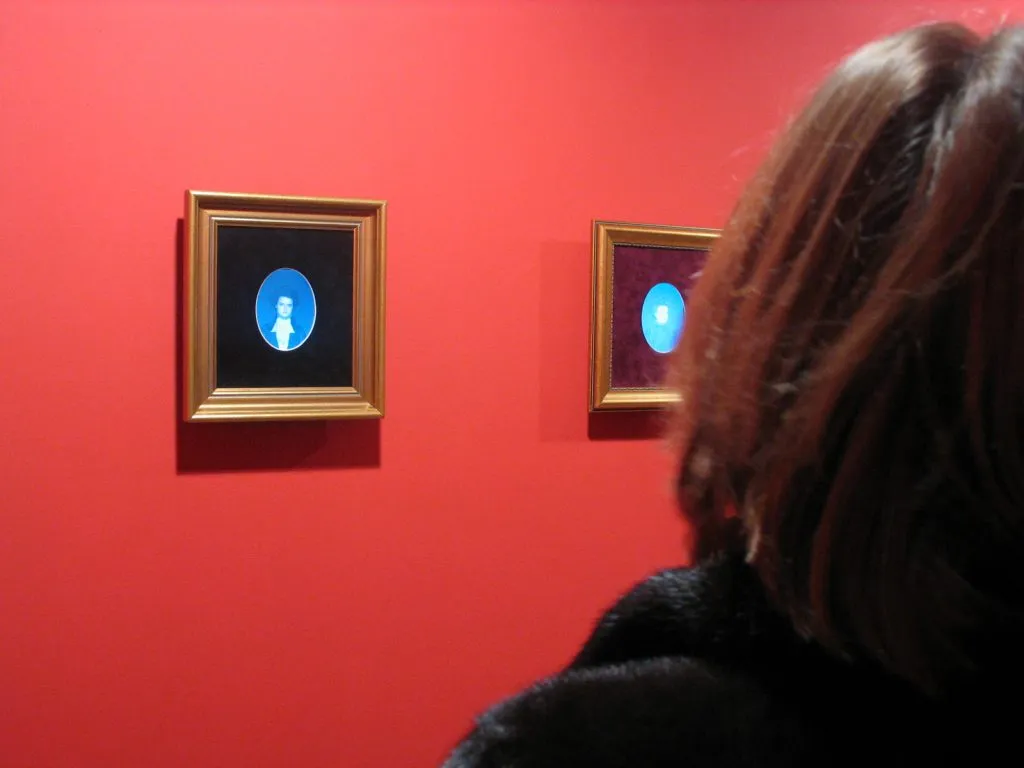
Kamil Kuskowski’s art also contains “flirtations”, humorous sketches and anecdotes. One need only mention the series Portraits of Łódź Maidens (2005) or Consumer Paintings (2002), which open breaches — even if these are not devoid of “art-historical” roots — in a museum space pregnant with meanings and contexts. Interestingly, Kuskowski also admits that one of his series, Tits (2005), “reveals the repressed eroticism of every abstraction”.
This corporeal firmness, this fleshiness of the image — concealed and bashfully buried beneath the shavings of metalinguistic carpentry — is a fascinating trail that, for unknown reasons, is seldom followed. Just as the monochrome can become the basis of a simplified political alert system for Steyerl, sexual arousal can have monochromatic equivalents of its own. In truth, writing about the merits and potential of monochrome pictures in 2007 is risky, even if their erotic connotations are set aside. One can write anything — just as leaning over a blank sheet of paper with a pencil can lead to every possible outcome; we might summon at least the spirit of the Conceptual “conspirator” Mark Lombardi. One can also abandon the writing halfway through without moving any closer to the desired conclusion. This inherent purposelessness should occasion no surprise, since our principal concern is the praise of nothing — however cynical and devious this may sound, and however much it reduces our search to sterile deliberations conducted in an elite salon. As long as this nothing remains the art world’s greatest fetish — its Holy Grail and burning crown of thorns, a fetish desired by institutions (“we want to be invisible again!”), artists (“we want to be ambiguous!”) and the public (“we want to worship!”) — we have no choice but obediently to join the congregation of monochromatic emptiness. The worshippers of a great Nothing that can suddenly become a political bomb or an act of institutional sabotage.
- Hito Steyerl, Mind Wide Shut: Art in the Age of Fear, in Don’t Worry, Be Curious!, ed. Dorothee Bienert, Frankfurt 2007, pp. 22–24.
- Jacques Rancière, Estetyka jako polityka [Aesthetics as Politics], Warsaw 2007, p. 56.
- Both Friedl’s and Coleman’s works were presented at Documenta 12 in Kassel and were among the most widely discussed works in the exhibition. The Turkish artist Oğuz Tatari conceived the idea of combining them in a single video.
- Ibid., p. 24.