
In Conversation with Henryk Cześnik
interviewed by Krzysztof Cichoń
Krzysztof Cichoń: What does a day of creative torment look like when you live in Sopot? A walk on the pier in the morning, then creating in torment, and in the evening a visit to the Bim-Bom theatre.
Henryk Cześnik: No, absolutely not, it is all the other way round. You have to begin with the time you go to bed: three or four in the morning. You get up at nine or ten, go to the academy and hold office hours for two hours. Then I return, having lunch and doing some shopping on the way, followed by family and household matters. Either way, I do not start working until after dark; I do not work creatively during the day. As for work, neither my teaching nor my own creative practice has any fixed hours. It is completely relaxed and I do not get worked up. There was a period – many years ago, but it did happen – when for two years I did not enter the studio at all and did absolutely nothing. I felt no pressure, had no idea, no inspiration, and did not want to force anything artificially…
K.C.: Two years passed and suddenly it changed?
H.Cz.: It did, under the influence of some impulse; I felt that I simply had to. Often you have a period of inactivity, but it is enough to see a good painting somewhere and the restlessness begins. It may be a painting, a situation, a damp stain on a wall, anything.
K.C.: What is this painting that will be cut into pieces at Atlas Sztuki?
H.Cz.: For now I only have a vision of it and its dimensions.
K.C.: And how do you feel about cutting up your paintings?
H.Cz.: I do not know. I have never done it before, never cut up my works, and I feel a little as though I were consenting to a child being cut apart. But the action is interesting.
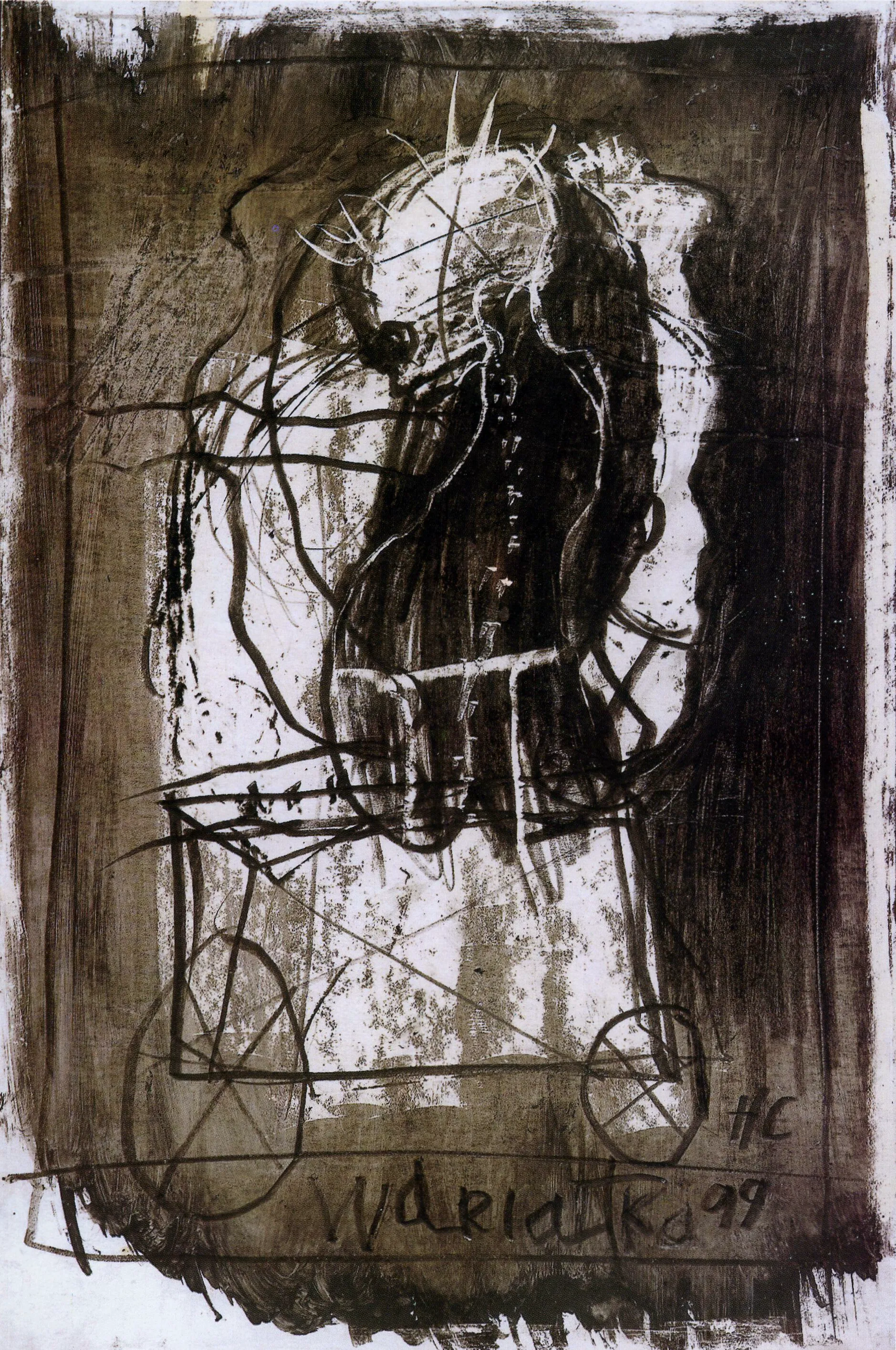
K.C.: Do you think the picture can be reassembled from the cut pieces in Sopot this August?
H.Cz.: I doubt it. Some time will pass, the tension will subside and people will not be bothered.
K.C.: It will be more like lacework than a Cześnik painting.
H.Cz.: Though quite a few friends from the Tricity are planning to come to Łódź for the opening at Atlas Sztuki, so they will probably arrive with their pieces.
K.C.: Are you counting on the locals?
H.Cz.: Yes. Today people are more likely to trip over one another than to have time for anything, such as a meeting to reassemble a painting.
K.C.: Have many of your bedsheets been destroyed?
H.Cz.: Not one has perished. Someone once asked me whether my bedsheet could be washed in a washing machine. I joked that it could; they failed to understand the joke and washed it. Half remained, but it is still visible and still exists. I destroy very few things. If I begin and am dissatisfied, I can always undo it. If it is oil, there are new grounds; alternatively, I force myself to continue, making an experiment with myself in how to escape such a hopeless situation. It is like chess – a game that begins badly drags on, crawls along, and it is difficult to find a way out. A bedsheet is slightly different because it is an alla prima technique, and even bathing it in various solutions will not remove what is there completely. Sometimes a chance gesture is enough to break the deadlock. It may be an entirely accidental gesture.
K.C.: When did Cześnik become Cześnik? When did the ‘handwriting’ of your paintings, as you yourself have called it, become established?
H.Cz.: It began before my diploma with Kachu Ostrowski in 1977. That was when I started making the first bedsheets, and above all the process was accelerated by ceratorits. Ceratorit was a printmaking technique offering unlimited possibilities. It was intaglio and relief printing at the same time, and one could work creatively right to the end, to the final stage. Even by wiping away the ink, one could shape the atmosphere of the works. It gave me an awareness of unlimited freedom, an understanding that there is no situation without a way out and that one can continue indefinitely – which means long enough not to overstate things. At some point you have to leave it alone, because saying too much is worse than leaving something unsaid. Better to leave a work halfway than to overstate it. In my view, an overstated work would be one for further alteration, for destruction. You would have to start again; in fact that sometimes happened, and I admit that the effects could be surprising. The painterly tissue accumulated through mistakes. The results were surprising and unforeseen, but consciously retained later. A conscious accident simply ceases to be an accident.
K.C.: I wonder what Henryk Cześnik would not paint? From time to time one presumably paints something entirely unlike one’s own ‘handwriting’?
H.Cz.: The unrestricted interpretation of this painting allows new things that I did not intend to appear. An interest in the human being is characteristic, but not in that person’s skin – in their interior. If one is to paint at all, it is the interior; every situation must be approached individually.
K.C.: Have you painted anything without people?
H.Cz.: There have indeed been several works, literally just a few, with no human being in them at all. But at the same time, the person was there. You could feel them inside. For me at least, this is obvious. Even when we draw the construction of a chair, the presence of a human being can be felt all the same. The chair was not created as an aesthetic, non-functional object. Sometimes there is more of that person than if they were actually present. Because the chair is so worn, because it has that atmosphere. From the appearance of an object that Sherlock Holmes used for several decades, we can surmise what kind of person he was and what his psychological make-up was. One can reflect on it, and it is far more interesting than saying that the man had such-and-such a name, lived so many years and did such-and-such a thing. I prefer this conjectural but far more compelling story.
K.C.: Do you ever make impressions?
H.Cz.: No. I have not thought about it. I do not want it to be the outer skin. If I want to show the constitution of a pyknic, I can use a choleric. Because I happen to believe they have a pyknic rather than a choleric interior, although their external features suggest otherwise. I am always more interested in a psychological treatment.
K.C.: People have written about ‘bedsheets full of emotion’. Does that hospital aura matter?
H.Cz.: It is enormously, fundamentally important. If I do not have bedsheets like that, I do not work on bedsheets. I could go to a shop and buy a hundred of them, but it would make no sense. Even those sheets that carry some life within them I alter and augment by soaking them in various solutions, to heighten their emotionality further if it is too weak. It began with looking at sheets that bore such emotional – let us say – biological painting that I became interested in how I might intervene in it further.
K.C.: And what would you say to a talented young person who came to your studio and said that, in their view, art is one hundred per cent intellect?
H.Cz.: I would not wish to contradict them. I am open to every path, provided that in my view it is good. I believe that art can only be divided into bad and good.
K.C.: And when and how is that decided?
H.Cz.: One hundred per cent intuition. My intuition. I cannot be a teacher without relying on my intuition. Every discussion in the studio, sometimes a very heated one, is a discussion about the specific weight of that art, not what it is. The discussion concerns how much consciousness it contains, how much accident, to what extent it is controlled, what thought it contains and whether it is substantial or shallow. The discussion is there to prevent you from standing still. You cannot simply let your hands drop and remain standing. I consider such behaviour pointless.
K.C.: At some point you have to stop being afraid, and then you begin to see more…
H.Cz.: Even at the price of a mistake. Everyone has the right to overlook something important. You sense intuitively whether someone is going astray or not; it is not really a matter for deliberation, but a question of intuition.
K.C.: And can one discern that transition in your work, beyond fear, when a person stops worrying about what others say and does their own thing?
H.Cz.: In a very natural way, the world of my interests simply came down to earth. Even in the third and fourth years of my studies I made entire series of biblical scenes, Crucifixions, and I did not even notice the moment when that passed into human everyday life.
K.C.: There is no need to reach for grand narratives when nearby things are so interesting? Perhaps one sees more with time?
H.Cz.: Apparently I needed that phase. I cannot explain it; I have always trusted my intuition.
K.C.: I would be glad to obtain a few simple recipes from you – perhaps a recipe for a successful artistic career, or for a Muse?
H.Cz.: Damn, that is a very difficult question. Anyone who knows my private life well knows that it is not so simple…
K.C.: And does that knowledge help one see more in your paintings?
H.Cz.: No, I do not think it is necessary. If we speak of Muses, I would not narrow the concept to its traditional female form. My Muse is probably curiosity about life. That presumably accounts for my travels and my tendency to wade into turbulent situations. I am certainly not an easy person to live with. I have just received a text message: ‘I beg you, just stay calm in Łódź’…
K.C.: Fredro was right: Cześnik Raptusiewicz…
H.Cz.: But I have no enemies. I think I am warmly received and understood. I believe I am good company in various café, travel and riotous situations.
K.C.: What is the place of intoxicants in an artist’s life?
H.Cz.: I can only say what it is like in my case. I create brilliantly when I have a terrible hangover. A hangover brings enormous remorse. It is as if I wanted to compensate for owing someone something. Unfortunately, by the next day the truth is out, and most of the things perpetrated under the influence of intoxicants are works to be reworked, not shown. Though there is a fairly large cycle of more than a hundred works – and ‘a hundred’ evokes a hundred-millilitre shot, and not just one – that were made in a pub, usually at SPATiF.
K.C.: And was the cycle conceived that way from the outset?
H.Cz.: No, it is a form of payment at the bar, usually on whatever papers can be found there. The bartenders collect these works. The titles are of course illegible, even to me.
K.C.: It is a beautiful tradition. You paint on bedsheets, cardboard and signs. Do you sometimes make pictures on proper stretchers?
H.Cz.: Rarely. When I do, it is by way of contrast with my rubbish tip. The same applies to the studio. Visitors are surprised by the sterile order prevailing there. The floor is white, the walls are white. People generally imagine that with this kind of painting the studio looks like Bacon’s – nowhere to put your foot. But I must have order, because with the degree of concentration in which I work I cannot afford to look for anything; if I begin searching, I may as well stop painting at once. I have to do it quickly.
K.C.: Is it a continuous flow?
H.Cz.: Yes. It used to last one, two or three days without leaving the studio. I could not tear myself away, because I knew that if I did, I would be in a different mood and a different painting would emerge. Now I take breaks more often. Still, there comes that moment of fatigue when you cease to see.
K.C.: What are your private visual pleasures? You do not look at the sea, so what do you look at?
H.Cz.: I hate talking about it. Whenever I began, I heard that I was infantile – nothing but abuse…
K.C.: Now you absolutely must tell me.
H.Cz.: I would rather tell an anecdote about Professor Ostrowski, who came to school with a hangover. He came in and said: how good it is to take a walk with a hangover, because a person with a hangover is always a tourist. I have walked this way all my life and never saw that a little tree was growing on the roof; now I have seen it. He was delighted…
K.C.: A hangover broadens your vision. What comes first: a sketch of the composition, the face that will appear in the painting?
H.Cz.: I know roughly what I will look for and what I am aiming towards. Then I prepare certain aids so that it does not take too long, so that it changes and I do not grow tired of one fragment. As a rule, however, I do not know how it will develop; I may be delighted by something that appears unexpectedly on the canvas. I leave myself plenty of room for adventure, for the unknown. Otherwise you can design something and that is the end of it. Long ago I fought a battle with Professor Ostrowski, who emphasised technique and, for large formats, required preparatory cartoons. Eventually he concluded that if I made the cartoons, I would never make the painting.
K.C.: Lately one hears that painting is finished as something capable of speaking about the present…
H.Cz.: I have heard that for several decades and somehow nothing remarkable has happened. Kachu Ostrowski had a theory that those who had moved very far away from painting ought to attend open-air painting sessions – to purify themselves. I am not afraid for the condition of painting. There were non-painterly tendencies that promised to last, but they did not survive and today are documented only in descriptions. Painting continues all the time; I think it is a natural human need.
K.C.: Is it difficult to be an artist? Let us place it on a scale alongside the profession of a doctor or a miner.
H.Cz.: It gives enormous satisfaction. It is exhausting mainly because you do not know what tomorrow will bring. You must be extremely resilient psychologically and very determined. Just as love is determination, you have to love it. If someone answers that question honestly for themselves, they have a chance not to give up. There are countless temptations to surrender. It is enough to renounce oneself; after all, one can make money from painting. You only have to be technically proficient and do what others accept.
K.C.: How much does a Cześnik cost today?
H.Cz.: It varies, from completely free – gifts handed out for nothing or as a sign of gratitude – to about twenty thousand. The most expensive picture I sold went for the equivalent of some three hundred thousand zlotys. Doctors and lawyers most often buy my work; I do not know why.
K.C.: Is there anyone whose assessment of your work you would heed?
H.Cz.: No. Such a person does not exist. I do not care; it changes nothing. Whether a critic writes that I am shit or that I am magnificent, I will still do what I do. I play my own game. For many years I went entirely unnoticed and was invited to no exhibitions. I worked for the drawer and the shelf.