
The Chameleon’s Clear Conscience
Jerzy Krechowicz
Henryk Cześnik is an unmistakably singular and instantly recognisable artist, combining a violent and passionate vision of a mutilated world with an equally violent painterly matter that appropriates and binds everything together. He is an artist whose style is simultaneously the boundary between what is regarded as the result of a distinctive language and the condition in which language is nothing more than the artist’s presence.
A disintegrating, decaying space with a blasphemous register of the absurd pressed into it. The real, tangible presence of congealed paint means that one understands it more through the physical qualities of matter than through any literary context. And the painting is always like the clear conscience of a diving chameleon. Always, like a sponge, saturated with cognac, madness and childlike zeal. Always full of pasted-on moustaches, interpolated sentences, bloody razor marks and diligently erased secrets. When, amid the clanging of crushed sheet metal, from a dense cloud of dust and debris still ground by severed wheels, the slightly battered but intact constructor of this murderous threshing machine emerges, you can be certain that you have just come nose to nose with Cześnik.
Somehow, he cannot be separated from an endless succession of irrational and obscure episodes. Like a magnetic anomaly, he continually attracts every supposedly ingenuous fraud, unsuitable fiancée and counterfeit banknote. The bizarre echo of imagined events constantly trails behind him like the neighbourhood fool. Yet in the distorted landscape of advertising and global trade, amid the fumes of electronic babble, software thieves and an excess of monstrous entertainment, Cześnik’s childlike faith in the power of imagination does not resemble the bravado of a novice masochist. As dutiful as the orchestra on the Titanic and equally disinherited from salvation, Cześnik is nevertheless unpredictable only on Fridays. And he certainly does not spend them identifying with the Maid of Orléans, as Utrillo once did. He passes them with his own phantoms, which makes him less than tolerant of the other days of the week. One can admittedly picture him in the Provençal meadows of art, dozing in the shade of burdock leaves, but probably only through clenched teeth. Even his leisurely, cursory mockery is acquiring an increasingly nihilistic cast.
It is quite possible that he once began like everyone else: with a one-minute revelation of the creative force of his own language. The magical transformation of a licked pebble — the first act of creation. Saliva covers the pebble’s surface like varnish, revealing tiny speckles, veins and dark tones in its depths. Before a matt greyness clouds it once more, the pebble gleams and shimmers like a dragonfly’s wings.

At times, he still looks for similar prompts. They may be anything: pieces of cardboard, bedsheets, roofing felt or anything reasonably flat spotted somewhere, provided they are full of streaks, scars, stains and minor damage. Cześnik appropriates them without unnecessary ceremony because they have the advantage of already being half painted. Time, chance and nature have worked on them for long enough. Then comes the first idea, the first step into the abyss — and impatience with his own slowness.
It is rather as if, in mid-flight, he relied solely on scaffolding that swayed and billowed like a vast diaphragm before silently disintegrating, sending every board and support flying aside. Although afterwards it is no more than a split shadow on the retina, it remains the only constant element of this joyful catastrophe. The slightly limping spirit of improvisation, apparently so willing to grant freedom from rules and rigours and almost to negate form, nevertheless leads him towards his own beginning, which, like handwriting, consists entirely of inalienable discipline.
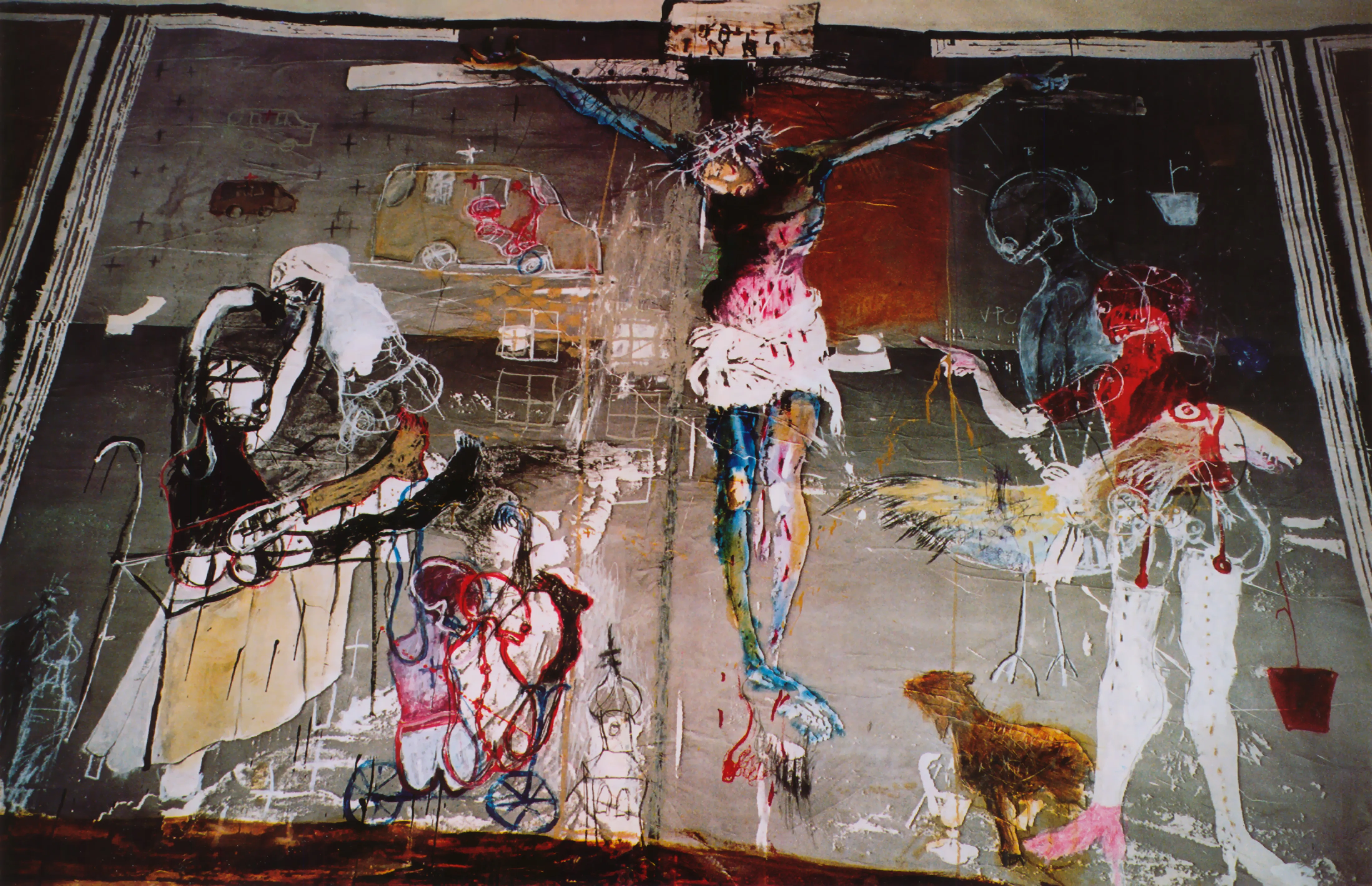
At first, it is not even an intuition and certainly not an intention. Chaotic trails of spreading stains and lines describe only themselves, arising more from gesture than will, until they unwittingly form the first shape. Something appears that does not yet fully exist and is immediately blurred, yet is simultaneously accepted through exclusion.
From this point onwards, not only intuitive but conscious actions begin to couple into a process that proceeds with increasing fluidity, governed by its own rhythm and logic. When the complete conception finally emerges — what has hatched from intuition, gesture and decision, as well as in defiance of those decisions — nothing can be ruled out, including the possibility that this first version of the painting is also the final one.
It could, of course, have happened quite differently, but in any case the painting is born far from its viewers.
Most often, this is only one of several possibilities, altered and corrected until every fear, colour, shadow and emotion — even the same day, still recurring — has been transformed into a painting. Nothing is erased, so it does not matter how many changes precede the appearance and settling of the final form. It was not the telling of a story that determined these changes, though the story played its part, but the establishment of the painting’s internal equilibrium: the simple secret of harmony.
Cześnik’s painterly language is based on the mobile elements of a dynamic process whose intuitive logic tends to use monosyllables. Yet the determination and radicalism of his imagination simultaneously make it resemble a hailstorm. Even brushes assume the role of instruments of torture, attributes of domination or merely spikes for dragging rubbish about. This parallelism of qualities forms the particular aerostatics of his language. It combines a distant echo of the subconscious or reflection of the artist’s personality with the formal inventiveness of brutal transformation, and an ever-expanding register of absurdity and degradation with a stylistic distinctiveness that goes far beyond distinctiveness. All this flows and merges into a universal code of an internal reality that cannot be penetrated. Only his paintings reveal, to some degree, its dark territory and the range of its possibilities.
Although we live in a world saturated with images, images themselves interest only a few. Soon we will treat them like denunciations written in an unknown language, speaking of matters we will never discover. They will resemble windows aimed into darkness, a disappearing trail through a labyrinth. Our laziness constantly compels us towards superficial conclusions. A stain that happens to resemble a human torso aspires to the role of Saint Sebastian: the embarrassing triviality of literature attempting to explain painting. We stretch a footbridge of words between two languages, trying to enter the image as though sight were no longer capable of discovering truth.
When an eyeless deep-sea fish crawls from a freshly raised molehill at your feet, you may regard it as a slightly exaggerated demonstration of the relationship between cause and effect. Yet in Cześnik’s garden, even Jungian synchronicity looks like a pair of abandoned stilts. One can naturally insinuate that in Cześnik’s work we must push through layers of appearances and through our own fondness for the excessive number of wheels on which his imaginary rolls. It is always full of obscure rituals, madness, brusque epigrams, disorderly virtuosity and censored secrets.
Space shifts and undulates; lines converge, interweave and scatter among stains, squeezing through successive layers of paint like a pack of scavengers. Born from matter, they continue to feed on matter; the boundary of tamed reality ends with them.
Even if Cześnik were to regard painterly matter itself as the only end, means or possibility, he would still call its universality into question. Only when unrecognised and stripped of everything, even of that unknowability, could it become the identity of his degraded world and the fatalism of human destiny: the sole form of existence available to mutilated absurdity. This is, of course, entirely impossible, but it is precisely for the fragility of our judgements about impossible things that he deserves to be valued most highly.