
What’s Tomorrow? American and European Painting from the Erich Marx Collection in Szczecin
Katharina Schlüter
“Painting is dead, long live painting” was the title Gabriele Hoffmann1 gave her review of Johannes Meinhardt’s book The End of Painting and Painting after the End of Painting2. In doing so, she expressed the fundamental dilemma in the contemporary development of this art form. The very concept of the “end of painting” first emerged at the beginning of the twentieth century. The medium then appeared finally to have reached its limits, ennobled by Kazimir Malevich’s Black Square on a White Ground, painted in 1915. The 1950s brought Art Informel and Abstract Expressionism. American painters such as Jackson Pollock and German artists such as Wols followed a new principle — the disregard of form — and with their “direct painting”3 created classics of art history, including Pollock’s Number 32 of 1950 and Wols’s Komposition (Composition) of 1946/47. The next wave was Conceptualism and Minimalism, which dominated the 1970s, before expressive painting and groups such as the Neue Wilde (New Wild Ones) emerged in the following decade. Contextual art and installation prevailed in the 1990s.
Today, at the turn of the millennium, painting is undergoing yet another renaissance. The art market is witnessing a genuine painting boom, also visible in the Marx Collection, which includes works by Polish painters such as Wilhelm Sasnal and Zbigniew Rogalski, German artists such as Eberhard Havekost and Tim Eitel, and others associated with the Leipzig School who have shaped the medium’s latest tendencies. Contrary to the opinions voiced in the 1990s, when painting’s very raison d’être was questioned, it is now reaffirming its importance within the canon of fine art.
The works from the Erich Marx Collection presented in the Szczecin exhibition document the history of contemporary painting since the 1980s, recalling its “highs and lows”. Marx’s aim was to assemble works by creative figures of significance to a particular period. The collection consequently features late-twentieth-century artists such as Joseph Beuys, Anselm Kiefer, Robert Rauschenberg, Cy Twombly and Andy Warhol, all now part of the pantheon of modernity. The Marx Collection continues to pursue this direction consistently. For a collector, asking about tomorrow therefore means continually asking what the next tendency in art will be: What’s tomorrow? = What’s next?

Painting undoubtedly occupies a prominent place in the Marx Collection, testimony to the medium’s firmly established position. What makes this art form so resistant to time, so fertile? Throughout its modern history, painting has moved repeatedly between figuration and abstraction. Through the application of paint and the organisation of composition, this two-dimensional medium can represent three-dimensionality and depth. Entire interiors and landscapes arise on a flat surface. In Tim Eitel’s Boot (Boat) of 2004, a pictorial space opens before the viewer in which a couple seated in a boat moves away towards a blurred horizon across a surface of water enclosed by stone walls. Behind a black, tree-like form, an abstract pictorial space unfolds in Wilhelm Sasnal’s Untitled (Hidden Couple) of 2003, where two schematically rendered human figures emerge amid a tangle of lines.
Painting’s capacity to create the illusion of space cannot be grasped intellectually by the viewer; it can only be perceived. The origin of a painting therefore lies in an insoluble riddle, an incontrovertible principle. While sculpture or installation allows the viewer actually to perceive space, painting confronts space with the phenomenon of a three-dimensional image on a two-dimensional surface. Perhaps it is precisely this riddle that enables painting, despite adversity and deficits of reception, to keep creating another tomorrow.
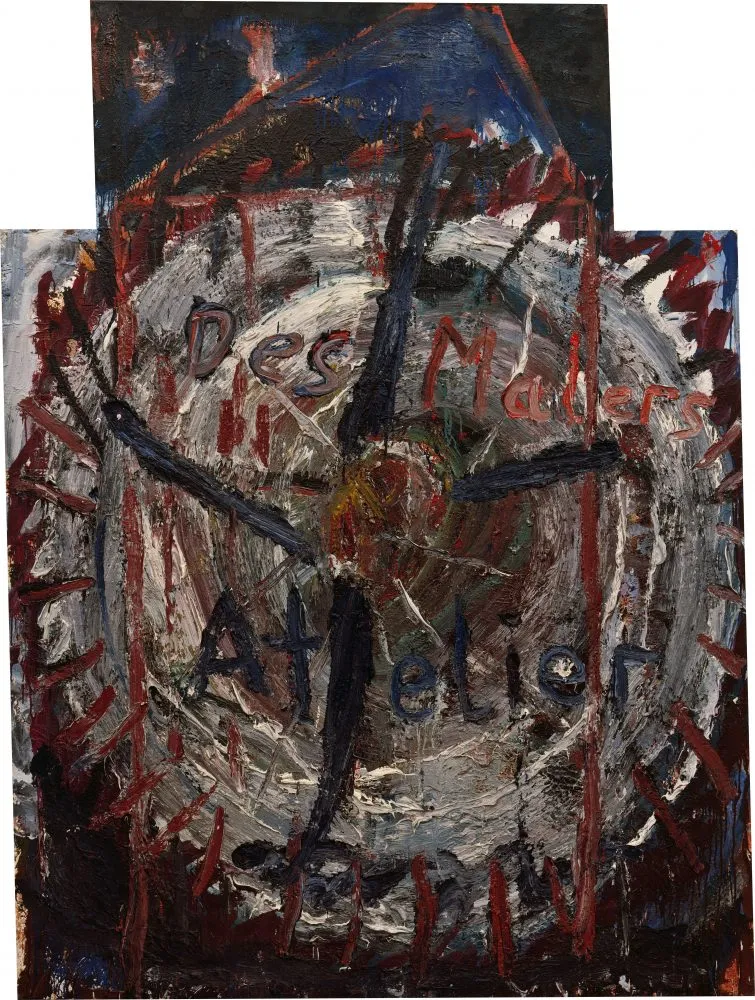
The paintings in the exhibition document the variety of tendencies in twentieth- and twenty-first-century painting from the 1980s onwards. The dominance of American artists characteristic of the 1950s and 1960s was no longer felt in this period. Other artists came to the fore. After Pop Art’s banal representations of the everyday, painters such as Anselm Kiefer opened the way for a new reckoning with the (German) past. In Kiefer’s work, Tachisme, Conceptual Art and Arte Povera combine in the form of monumental “history paintings”. The works of the Neue Wilde, whose creative activity opposed the intellectually oriented Minimal and Conceptual Art of the 1970s, are marked instead by an excess of imagery: expressiveness and powerful colour contrasts. In Martin Disler’s Rubbing an Eye Against of 1984, a massive figure is engulfed by a mighty deluge of colour. Walter Dahn’s Ohne Titel (Hand mit Kerze) (Untitled (Hand with Candle)) of 1982 presents an exaggerated hand closing around a candle in a space forcefully defined by colour. Other German artists, including Rainer Fetting and Salomé, display a similarly Neo-Expressionist style. The Italian Transavanguardia painters Sandro Chia and Enzo Cucchi, meanwhile, create surreal scenes using brilliant colours and a poster-like construction of pictorial space. As a representative of American New Image Painting, Julian Schnabel creates painterly collages: materials such as broken plates and old carpets become parts of the image, continuing the American tradition of “non-hierarchical painting”4.
Painting of the 1990s is represented in the exhibition by works by the British artist Fiona Rae. A member of the Young British Artists (YBA), she took part in Damien Hirst’s celebrated 1988 exhibition Freeze. Works such as her 1991 Ohne Titel (Grau mit Rechtecken) (Untitled (Grey with Rectangles)) are postmodern versions of Abstract Expressionism, although — unlike that historical movement — composition in her work dominates gesture even more decisively.
In the new millennium, painting has become increasingly diverse: some tendencies have returned to figuration, while the image remains abstract or photorealistic. This is the case in Zbigniew Rogalski’s Untitled (Kant) of 2003. The word “Kant” appears on a misted pane, adding a conceptual element to the photographically spatial representation. Other strands of contemporary painting emerge in the work of Wilhelm Sasnal and Eberhard Havekost. While Sasnal remains within the realm of abstraction, Havekost moves towards photorealism. Roman Lipski’s Romantic and mystical landscapes, meanwhile, combine idyllic forest lakes with socialist buildings, creating a mood of unease, alienation and abandonment.
© Galerie Thaddaeus Ropac, Salzburg
Twenty-first-century contemporary art displays an extraordinary diversity of painterly positions. As in the legendary 1956 London exhibition This Is Tomorrow5, which made a powerful case for the future, the boundaries between artistic media and everyday life are becoming increasingly fluid. Art forms within the individual media are likewise growing ever more varied, and painting is no exception. The question of painting’s tomorrow — whether because of the diversity of artistic positions or the range of tendencies, from realist, Romantic and Surrealist to expressive — must therefore remain unanswered. Observing contemporary painting is a fascinating adventure. Until the new millennium it was dominated by Western art marked by the legacy of the Cold War. It is already evident that new forces and other cultures will determine the balance among our societies — a development certain to become even more pronounced in the future.
*Translated from German into Polish by Anna Maziarz
- G. Hoffmann, “Die Malerei ist tot, es lebe die Malerei, Exkurs über eine Grundfrage der Kunst”, Neue Zürcher Zeitung, 21 November 1998.
- J. Meinhardt, Ende der Malerei und die Malerei nach dem Ende der Malerei, Ostfildern, 1998.
- J. Pollock said: “My painting is direct”, in F. V. O’Connor and E. V. Thaw, Jackson Pollock: A Catalogue Raisonné of Paintings, Drawings and Other Works, vol. IV, New Haven and London, 1978, p. 262.
- B. Schmitz, “Julian Schnabel”, in Sammlung Marx. Hamburger Bahnhof – Museum für Gegenwart – Berlin, ed. H. Bastian, Munich, 1996, p. 179.
- This Is Tomorrow, ed. L. Alloway, Whitechapel Gallery, London, 1956 (exhibition catalogue).