
‘I Am Just an Ordinary Collector’
Erich Marx in conversation with Aneta Panek
Aneta Panek: On 21 October, an exhibition of works from your collection, housed at Hamburger Bahnhof in Berlin, will open at Atlas Sztuki in Łódź. It will include works by Michael Beutler (1976), Ross Bleckner (1949), Sandro Chia (1946), Enzo Cucchi (1949), Walter Dahn (1954), Martin Disler (1949–1996), Tim Eitel (1971), Rainer Fetting (1949), Eberhardt Havekost (1967), Anselm Kiefer (1945), Roman Lipski (1969), Fiona Rae (1963), Zbigniew Rogalski (1974), Salomé (1954), Wilhelm Sasnal (1972) and Julian Schnabel (1951). A wild mixture, reflecting your love of contemporary painting while presenting two generations of artists from Europe — Germany, Poland and Britain — and the United States. What prompted this particular selection? Was it your personal decision?
Erich Marx: It was my choice, and I agree that the whole may seem somewhat haphazard. But that was deliberate and, I think, appropriate. These are all artists with entirely different roots, and consequently their inner worlds are entirely different too. The selection reflects this diversity, which is very important to me as a collector. So it is no accident!
A.P.: About five years ago, you became interested in contemporary art from Poland. During that period, works by Wilhelm Sasnal, Zbigniew Rogalski, Rafał Bujnowski and Roman Lipski entered your collection. They are artists of a younger generation who now play a leading role in both the Polish and international art markets, but when you began collecting them they were not yet so well known. What prompted you then? Where did your interest in these particular artists come from?

E.M.: Several years ago I visited Poland on business and had an opportunity to learn more about the Polish mentality. Poles possess a particular melancholy, a special weight. That alone interested me. I come from a very distant part of Germany, deep in the Baden provinces, where Poland is something unknown, almost exotic.
When I looked around the Polish art scene, I decided to supplement my collection with works by young Polish artists. I was offered, for example, an entire cycle of paintings by Zbyszek Rogalski. Such a solution is very advantageous for a collector. It offers insight into an artist’s work and an awareness of the direction it may take. What particularly interested me in Rogalski was that he poses questions through his paintings: there is always something mysterious and unsettling in them. Take, for example, the cycle depicting German philosophers — Kant, Nietzsche and Schopenhauer. It fascinated me because something within it compels one to ask “why”. Yes, Rogalski is interesting, although also very changeable and heterogeneous.
A.P.: You have a special relationship with another artist, Roman Lipski. You have accompanied him since the beginning of his career and supported him generously. What moved you in Roman’s painting? Where did your trust and confidence come from that this self-taught novice painter would amount to something? How did you meet?
E.M.: I met him during a rather difficult phase in his life and work, and decided that supporting him made sense.
A.P.: What do you think of his development in recent years?
E.M.: Naturally, I followed it with great interest. And he changed. There was a period, for example, when I had certain doubts about the direction he was taking. We talked about it a great deal, then he considered it and something changed. It was a very interesting experience for me.
There is no doubt that he can win people over; his pictures speak to them. He quickly found his audience, including influential collectors and friends such as Volker Schlöndorff, the current German Foreign Minister Guido Westerwelle, Dr Giuseppe Vita and many others. Something can be built on such a foundation.
His paintings, as I always pointed out to him, must contain something that arouses curiosity. And something mysterious. There was always something terrifyingly sad in his work — he went through such a period — and it ran through all his pictures. It was not even melancholy, but rather a deep sorrow lodged within him. That sorrow found moving expression in his painting, and he retained it for a long time — fortunately!
A.P.: Which contemporary artists interest you particularly at present? Have you discovered anyone recently? And what was your latest acquisition?
E.M.: To be honest, none recently. But that is connected with my having reached an age that constitutes a certain boundary. The last works I bought were by Daniel Richter — two paintings that simply fascinated me. But I am no longer set on discovering and understanding new things; after all, that also requires understanding the time in which they arose, doesn’t it? In many respects I lag slightly behind here. And thank God! (Laughs.) So at present I have no one in my sights whose work I would like to buy. I would rather wait and allow something to find me of its own accord.
A.P.: Joseph Beuys, Andy Warhol, Roy Lichtenstein, Robert Rauschenberg, Cy Twombly, Donald Judd, Dan Flavin… Your collection contains major works by the classics of modernism. In 1970, when you and Heiner Bastian — Joseph Beuys’s former secretary and later Dr Marx’s artistic adviser (AP) — established the collection’s concept, were you aware of the importance it would achieve? At the time, you were guided by three criteria: concentration exclusively on the best contemporary artists; only the finest works; pictures of museum quality.
E.M.: Quality was the most important thing. We wanted the collection to be distinguished by it. It goes without saying that one must begin by finding the right artists, and then be able to select the very best of their works. It helped me enormously then that I already had good relationships with artists and enjoyed their trust. They gave me pictures knowing they were placing them in good hands and that this would be a renowned collection.
A.P.: For you, collecting was never financial speculation. It was rather a love of art and artists, combined with a desire to share it. But you also spoke openly about your collecting mania: “If I like something, I want to own it. (…) It can turn into a dangerous obsession.” What kind of collector are you, and how did it all begin?
E.M.: It was that special attraction which, in fact, only another collector can understand… I discovered within myself a tremendous fascination with art, almost a possession. Whenever I found or discovered something that could become part of my collection, something that moved me deeply, I simply had to acquire it and show it to others, to share it with them. To this day, I regret paintings I once owned but sold. I once let go of a painting by Schönebeck, whom I met twenty or thirty years ago. I still have not come to terms with it. Those pictures still belong to me. I have a very powerful inner bond with my collection.
A.P.: It is like love affairs. After a separation, one cannot think about it or look. For a time, it hurts too much…
E.M.: Exactly! Certain things can never be recovered. Although love affairs may end better or worse, artistic fascinations generally end well — they last for ever. Pictures retain their power, and their expressive force remains intact.
A.P.: Where did this immense love of pictures come from?
E.M.: I ask myself the same question, because it is puzzling in a way. How did it come about when there was nothing to suggest it? I simply seem to have this predisposition. There is no other way to put it: that is how I am, in love with pictures.
A.P.: You have travelled a long road: from an ordinary worker from a poor family, through law studies and a doctorate in law, to an influential businessman who founded his own housing-construction company in 1967. Please tell us a little about your beginnings as a patron of art. Many people buy pictures, after all, but few become collectors. At what point was this decided in your case?
E.M.: One becomes a collector when one has a special, even intimate relationship with a work. That intimate relationship is always very powerful. I never wanted to deprive myself of it, of the feeling that appears when one acquires a work. That is the essence of a collector’s nature. To be clear, I do not buy pictures because some famous artist painted them, but because they attract me. A collector wants not only to look at a picture repeatedly, but also to become one with it. I have all my pictures before my eyes, even though by now there are quite a few!
A.P.: So, a passionate collector, devoted heart and soul to collecting works of art.
E.M.: Absolutely! Of course, there are also cool-headed collectors who subordinate everything to a concept and buy a picture only because it fits their collection. But that is a different species!
A.P.: Your curiosity about and fascination with art mean that you continually seek conversations with artists as well. What makes collecting so interesting to you: art or the artists themselves? Is it important to know them at all? You are friends with Anselm Kiefer, you shared a great deal with Cy Twombly, and now you support Roman Lipski…
E.M.: It is not indispensable, but I would say that it further strengthens the bonds. It is not absolutely essential, however. The pictures matter.
A.P.: Do you remember the first picture in your collection?
E.M.: Of course! Except that in fact there were two equivalent beginnings, and two first pictures. The very first picture, and my true first encounter with art — about which I knew nothing then — consisted of five works bought from Friedrich Meckseper, a painter from northern Germany. I saw them and they somehow overwhelmed me. They attracted me so much that I immediately bought five. They were prints. That was the beginning. Those works still hang in my office in Charlottenburg, Berlin. Some pictures — even if perhaps one would not buy them later — retain their significance, and one must remain faithful to them.
A.P.: And the second beginning?
E.M.: It was my first Cy Twombly. At the time, I did not yet know who he was. I saw his picture, it spoke to me, and I bought it. It was very expensive by the standards of the day. This was the early 1970s, and it cost 95,000 marks! That was a great deal of money then. I bought it and fell in love with those abstract structures. There was something incredibly light about the picture, and then those marks… It was simply beautiful. I hung it in my office. It marked a dividing line. From then on, I collected essentially only Twombly, Beuys, Warhol and Kiefer. But when I bought that Twombly, I exposed myself to the mockery of people who visited me. How could one buy a picture like that? And for so much money! They did not know that my eleven-year-old daughter could paint like that! (Laughs.) Yes, that was the first picture in the new collection.
A.P.: So you began systematically building your precious collection; there was the important encounter with Heiner Bastian, who later became your long-standing adviser, and the friendship with Twombly…
E.M.: Yes, a new chapter began. Previously, I had simply bought what I liked. From that point onwards, I developed the collection consciously and consistently. And yes, it was also the beginning of my friendship with Twombly! (Laughs.) We experienced a great deal together. I met him in Italy, in the clutches of Leo Castelli. At the time, Leo Castelli had all the most important painters in his grasp, including Andy Warhol. Every month he gave all those artists, already famous then, money — he simply gave them money. At a certain point, Twombly felt constrained by this and wanted to free himself from that dependency. So he asked whether I would be willing to give him the same amount as Leo Castelli until he could stand on his own feet — and even then he knew he would. I agreed, and in less than three years Cy Twombly was an established artist! It was then that he gave me the large picture that now hangs in Hamburger Bahnhof.
A.P.: From the outset, you thought of the collection you were building as a museum collection. How do you view its development from today’s perspective? You repeatedly emphasised the ambitions associated with placing it on deposit first at Museum Abteiberg in Mönchengladbach and later at Hamburger Bahnhof: “I want Hamburger Bahnhof to acquire international importance thanks to my collection.” How did it begin? Did you always want the collection to be accessible to the public?
E.M.: I am just an ordinary collector. At some point, every collector faces the following dilemma: lack of space. Pictures already hang everywhere — in every office, the kitchen and the bathroom. Eventually there is simply no more room, not a scrap of free wall, while the desire to buy more pictures does not diminish at all. That was precisely what happened to me when I began building the collection consciously. Of course, I rented storage facilities and moved pictures into them. But that was not the point — I do not buy pictures only to keep them in storage and derive satisfaction merely from owning them. That would make no sense. Pictures must be seen; that is how they live.
It happened that the first exhibition of my collection, which was already almost complete, was held at the Neue Nationalgalerie in 1982. The exhibition proved a major event. Four thousand people came! Incredible! Beuys was there; Rauschenberg and Warhol came to Berlin. Naturally, that drew the crowds; everyone wanted to see them — they were already great stars! An extraordinary story. The exhibition itself subsequently became extremely popular too. But as soon as it ended, I again had to find somewhere to put the pictures, so… back into storage they went.
I could not keep them at home; most were too large and, besides, there were too many. During the exhibition, however, a man came to me and introduced himself. He was Johannes Cladders, director of the Abteiberg Museum in Mönchengladbach. His first question was whether I could imagine presenting my collection in Mönchengladbach. It was already an excellent museum, and at the time a new space designed by Hans Hollein for contemporary art had just been completed. An agreement existed between the city of Mönchengladbach and a very famous and outstanding collector, Count Panza di Biumo, a Swiss resident of Varese. He truly had an excellent eye for modernism and modern art, and was certainly one of the most important collectors on the international scene. He worked extensively with the Getty Museum in Los Angeles, for example. He had signed an agreement with Mönchengladbach under which his collection was to be housed in the new building. To everyone’s surprise, shortly before the opening he withdrew his consent. They must have quarrelled about something. Collectors can be peculiar and often want to force through their position, even violently. In any case, he said no. Shortly before its opening, the newly built museum stood empty. They had a genuinely beautiful space but no pictures. That was why Director Cladders came to me. And I… had always quietly dreamt of making my collection accessible to a broad public.
Besides, the artists wanted it too. They did not want to go into storage; they wanted to reach the public. I agreed, and thus the agreement with Mönchengladbach was concluded. My collection remained there for the next twelve years.
A.P.: Until the proposal came in 1996 to move it to Hamburger Bahnhof?
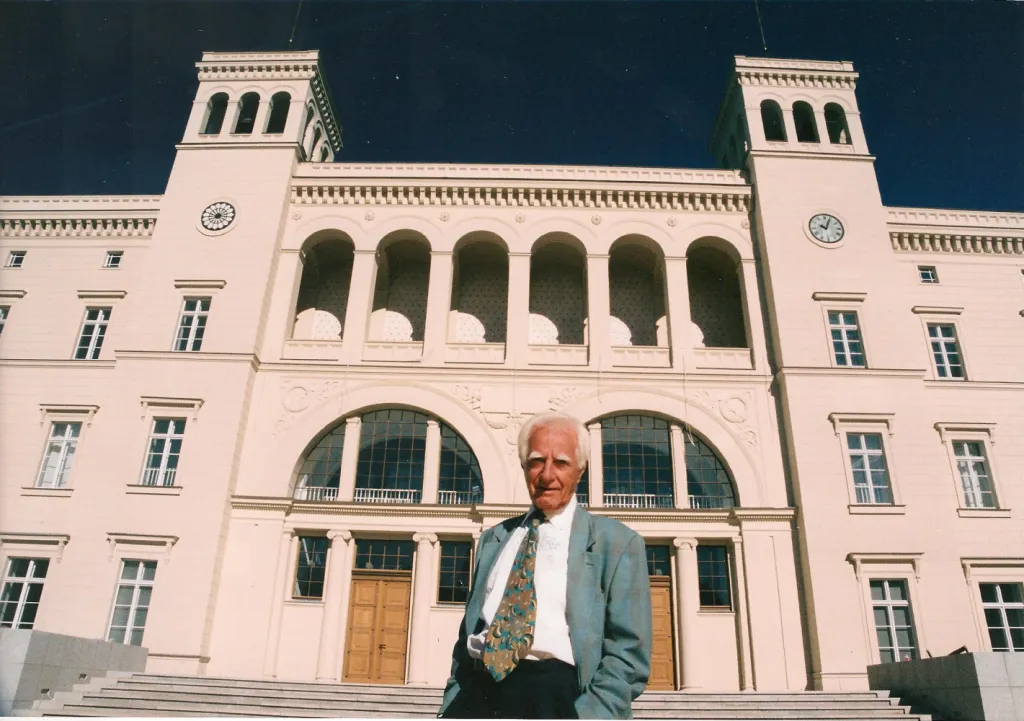
E.M.: Yes, and political change played a certain role — even before 1989. It is quite a mad story, and typical of Berlin! The site on which Hamburger Bahnhof stands belonged to West Berlin, but lay exactly on the border with East Berlin. On the other side of the Spandauer Canal was East Berlin, while Hamburger Bahnhof served as a controlled border crossing. Yet although the site lay in the western sector, the building itself was the property of East Berlin. It belonged to East Berlin for the following astonishing reason — which nota bene reveals the complete absurdity of politics. At the Potsdam Conference in 1945, it was decided that all Berlin transport would be handed to East Berlin. Since the site bore the name “station”, although it had long had nothing to do with a railway station, it was handed to East Berlin. This fundamental incompatibility meant that the half-ruined building stood in a deplorable condition because no one cared for it, and lay derelict for many years, until West Berlin finally bought it back — before 1989! This is what happened: trains ran between West and East Berlin, but no one boarded them; people boycotted the service. East Germany nevertheless had to maintain the stations. It was expensive and made no sense at all. Eventually, East Berlin sold Hamburger Bahnhof to West Berlin for a billion marks. The site then came under West Berlin’s jurisdiction, and the question arose: what should be done with it? Perhaps a museum — that was the first thought. So it was decided that it would become a museum. The Berlin Senate decided to rebuild it on condition that it house my collection. I had already agreed with Mönchengladbach that, should such an opportunity arise, I would terminate or not renew the agreement. Hamburger Bahnhof opened in 1996, with my collection forming the core of the new Museum for Contemporary Art. At the time, the works in my collection were genuinely fresh, contemporary art of the utmost currency. My collection and Hamburger Bahnhof became one.
A.P.: Over time, your collection acquired historical significance. Today it consists of classics of modernism.
E.M.: Exactly — that changed over time. Time moved on; the collection remained the same. Simultaneously, it acquired historical value. Yet Hamburger Bahnhof has a name: the Museum for Contemporary Art. As time passed, this constantly changing present increasingly marked the holdings, and today Hamburger Bahnhof is above all a museum of contemporary art. I understood very early that Hamburger Bahnhof had to accept art other than mine, because otherwise it would lack the element of the newest art.
A.P.: How has Hamburger Bahnhof developed over all these years? How do you assess the institution’s role on the cultural map of Berlin today?
E.M.: At first I had a vision of making Hamburger Bahnhof much more than an ordinary museum. I wanted to connect it with other major museums, outstanding scholars, collectors, curators and museum directors — all those who currently have something to say about contemporary art. I wished to build such a network and create an institution of supranational significance, providing favourable conditions for research in art history and enabling profound reflection on it. I even already had the money! A wealthy German businessman gave me a million for it — for the idea alone. The support was genuinely generous… Unfortunately, it did not come to fruition. Who knows? Perhaps I will take it up again?
A.P.: Have you considered creating your own museum for the collection, like François Pinault in Venice or Christian Boros and Thomas Olbricht in Berlin?
E.M.: No, no! It is far too expensive an undertaking, because if a museum is to remain alive, it requires continual investment. Frieder Burda’s case — the private Museum Frieder Burda in Baden-Baden (AP) — is a perfect example! But far greater financial means stand behind it. Besides, Frieder Burda also has an excellent eye for art! Christian Boros and Thomas Olbricht in Berlin are two very particular collectors, and how different they are! In their cases, the collector’s individuality comes very strongly to the fore. Something like that would not make sense as an official institution. The public demands museum quality and a functioning, living institution, but above all good art — from every field, not only something that demonstrates the collector’s taste. Hence the difficult relations between collectors and museum boards, and why collectors repeatedly withdraw their collections from museums. But private collections naturally enrich a city’s offer; Christian Boros’s bunker, for example, is genuinely special. As for Thomas Olbricht, he has his own vision for his collection and his own taste, which need not appeal to everyone. I, for example, have a great problem with it. (Laughs.) But I accept it.
A.P.: You once said of your collection: “When one makes something, one wants it to endure. I would very much like to attend to that.” What plans do you have for the collection’s future?
E.M.: Oh, that is quite simple: I have an agreement with the Stiftung Preußischer Kulturbesitz — the Prussian Cultural Heritage Foundation (translator’s note) — and that is an institution of the highest standing. I could not imagine a better place for my collection. It will remain with the Stiftung Preußischer Kulturbesitz. They have an idea to build a special museum for it: the Museum of the Twenty-First Century. Peter-Klaus Schuster, who originated the idea, envisaged moving the historic Gemäldegalerie — the Painting Gallery (translator’s note) — back to its original location beside the Bode Museum on Museumsinsel, “Museum Island” (translator’s note). The present Gemäldegalerie building would then house the planned Museum of the Twenty-First Century and my collection.
A.P.: This year you celebrated your ninetieth birthday. You remain active both as a businessman and as a collector and patron of art. You visit galleries, art fairs and artists’ studios. How do you do it? What gives you energy? And from today’s perspective, how do you view everything you have built?
E.M.: I was simply fortunate, because I was never someone who lived according to prescribed goals. Never! I tended to take things as they came and tried to make something of what I received. Without fuss. (Laughs.) For my ninetieth birthday, a short film was made about me, a kind of homage, and in it Peter Raue said something I realised for the first time in my life. Namely, he said that I am someone he has never seen looking back. He had never heard me say, “Do you remember how, once…” Only then did I notice it, and it is indeed true! I am someone who, somehow subconsciously, never looks behind but always ahead. I was certainly always ambitious. But earning money was never my goal; I always tried to believe in what I was doing. I always said: if it is something good, money will come of it in the end. You know, I come from a very ordinary, poor family. I had to achieve everything myself. Instead of waiting for something, I always simply set to work immediately. But to me, all this was always self-evident…
Berlin, 27 July 2011
Translated from German into Polish by Marta Skłodowska