
Pueri
Joanna Tokarska-Bakir
Within the history of Polish street games, a prominent place belongs to the group that Father Piotr Skarga calls pueri. The pueri are children, boys and schoolboys, participants in the pranks and riots of old Poland. These occurred on religious holidays – in Kraków, for example, on the Feast of the Ascension.

After vespers, in commemoration of the crushing of the devil by Christ ascending to heaven, a spectacle was staged in the church. In honour of Christ, an image or a living person was raised all the way to the church vault – while in order to represent the simultaneous subjugation of Satan, a dummy was stuffed; then this doll, this ‘villain’, was thrown down from the top of the church, after which the crowd of people would generally rush at Protestant churches and cemeteries, seize ministers [that is, Protestant clergy], and so forth. That stuffed ‘villain’ inflamed the imagination of the schoolboys: he was Christ’s enemy, Satan, the father of ‘heresy’… It was precisely in 1587, on the Feast of the Ascension, that a riot broke out1.

Father Skarga calls the above games ‘childish’ and intercedes on behalf of the ‘boys’ whom, in that particular year, the municipal authorities had not permitted ‘to play at the doors of the Protestant church’2. There were only a ‘small number’ of Protestants, while the anger of the ‘innocent people’ was many times greater. The role of the pueri in the wars of religion has been described in detail3. Although it inspired their actions, the Church never approved of them. It always benefited from them, however, as it did from the ritual violence of ‘tonsured boys’ on the border between the ghetto and Christian districts4. In Father Skarga’s eyes too, the pueri were combatants in a holy war against Difference.

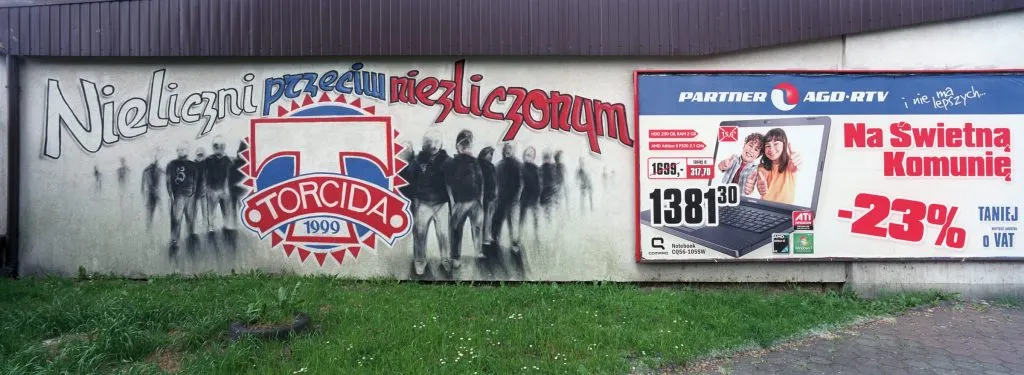
In a country without the stake, this war is periodically reborn. Photographing the walls of unattractive districts in Kraków, Zabrze, Chorzów, Bytom and Łódź, Wojciech Wilczyk documents its latest instalment. As usual, the pueri have little to lose and therefore bluntly articulate society’s persecutory mythopoetics. They publish its fear, low self-esteem and contempt for the weak. Its open secrets: something about which we know enough not to want to know more.
The most interesting inscription – WE SHALL AVENGE TROY! – unfortunately occurs only once in this album. There are incomparably more concerning Jews. JUDE RAUS on the footbridge over the railway tracks in Oświęcim: a Polish inscription in a language that is not foreign, near the German death camp. More often, however, JUDE WONT [JEWS OUT], or in home-grown form: TO THE GAS. TO THE OVEN.
HITLER COME BACK TO POISON JEWS – they write in Prądnik Czerwony5. AUSCHWITZ IS YOUR HOME – they shout in a stadium in Łódź6. Only under that condition will they attract the authorities’ interest, at least until a court rules that they offend no one, because they meant only the opposing team7. (No one asks whether there are Jews in it; by definition, there are none.) Once censored, they will switch to ‘fags’, ‘queers’ and ‘poofs’, ‘Gypsies’, ‘girls’, ‘communists’ and ‘enemies of the fatherland’, which no one will prosecute. Bearing these slogans, as part of the Sixth Patriotic Pilgrimage of Football Supporters, ‘Glory to the True Victors’, they will be received at Jasna Góra, which never turns sinners away8.
What the pueri speak about in Poland today may become comprehensible on condition that it is placed within a social context, to which society firmly refuses to consent. Society comes home after work and wants to read its newspaper in peace, but there in the newspaper are the pueri. Who cares what meanings they ascribe to their behaviour or what satisfaction they derive from it? People want to read that it is all gang activity or someone’s diseased ambition, and that one cannot see antisemitism everywhere.
And journalists even write that, but only up to a point. Because eventually even the worst journalist will look in their son’s notebook, and there on the last page: ‘Jews to the gas. Fuck the Jews’ – both ‘Jews’ misspelt in Polish9.
This is not merely a matter of spelling. Apparently, in Kraków the division into ‘Jews’ (Cracovia supporters) and ‘dogs’ (Wisła supporters) now applies to entire housing estates. ‘If someone crosses the wrong street, they may be stabbed or attacked with a machete. Killings take place by night and day, sometimes before the eyes of passers-by. Even children know which side they need to support to avoid getting a knife. They hear adults shouting at other adults on the housing estates and terraces: “Chop, chop, put them in the ground”, or: “We are hungry for more crimes” (…). Only in Kraków do young footballers hear adults say: break his leg, get the dog. Or: get the Jew’10.
The album Holy War proves that this occurs not only in Kraków.
On the side of the irresponsible elements, progress in this matter is expressed in the series: FUCK THE JEWS. FUCK THE JEWISH BASTARDS. FUCK THE JEWS WITH AXES. FUCK THE JEWS WITH MACHETES.
On the side of the responsible elements, progress is expressed through dialogue:
– Does the slogan JUDE GANG offend the Jewish nation?
– How could it offend, when the authors sign themselves that way, regard themselves as the ‘chosen nation’ and call themselves ‘Jewish bastards’?
Responding to the latter, Wojciech Wilczyk suggests that supporters of the hypothesis about Cracovia’s philosemitism take a closer look at the Celtic cross painted into its name11.

The use of the word ‘Jew’ as a grave insult is not confined to the rivalry between Wisła and Cracovia, although it is only in ‘magical’ Kraków that at almost every turn we encounter the inscriptions AJ (or, somewhat less frequently, written out as ANTY JUDE), accompanied by a crossed-out Star of David. The popular abbreviation JŻS (FUCK JEWS WITH AXES), visible on the walls of houses, shops, kiosks and schools, as well as on slides and swings in children’s playgrounds, is likewise a purely Kraków phenomenon. Interestingly, the aforementioned paintings can remain on walls for many months, even years. Graffiti depicting a fish painted in white and red stripes (Cracovia’s colours), with its head cut off by an axe and the inscription WISŁA CHRISTMAS EVE ’08 – COME FOR JEWISH-STYLE CARP, remained intact on the wall of Community Primary School No. 7 for two years! It was painted over only after, and then only partly, following the murder of ‘Człowiek’, when numerous football murals were removed in response to interventionist articles in the local supplement to Gazeta Wyborcza. A Star of David hanging from a gallows as an expression of hostility towards Górnik Zabrze or Ruch Chorzów – why not? This simple graphic solution, which incidentally refers to graffiti painted during the German occupation (in the ‘independence’ version, it was of course the swastika that hung), can evidently have universal application. It is enough to place the ‘G’ from Górnik’s logo inside the Magen David, or to hang the characteristic ‘R’ from the Ruch emblem upside down and paint a six-pointed star within the bowl of the letter. All of this occurs in Upper Silesia. In Łódź, meanwhile, the Star of David appears in place of the middle letter of the abbreviations RTS and ŁKS (Robotnicze Towarzystwo Sportowe, or Widzew, and Łódzki Klub Sportowy respectively), while the name of the former is habitually transformed into ŻYDZEW [Jew-zew]. When I visited the ‘Polish Manchester’ at the beginning of this year, I was surprised by the large number of inscriptions reading ŚŻK. Naturally I guessed that the abbreviation was insulting and concerned Jews (…), but I could not decipher it. So in the Retkinia housing estate, where there was a considerable number of such inscriptions, I approached a young hooded man, who answered my question in these words: ‘death to the Jewish whore, that’s what the abbreviation means, sir’12.

The anthropologist Claude Lévi-Strauss discovered that plants and animals regarded by different peoples as totems were good not so much to eat as to think with, to describe the world through the injunctions and prohibitions associated with them. Poland’s football totem is the Jews.
The pueri’s knowledge of archaic folklore is astonishing. The average person does not know what the ‘Jewish stink’ or Judensau is. But the supporter from Świętej Rodziny Street who dislikes Cracovia knows13. Perhaps he learnt recently?14
A chapter from a child’s Farbenlehre: a hooded boy is walking along Limanowskiego Street in Bałuty. When he passes a green pump dispensing non-potable water, a rebus formed from the letters ‘JP’ appears on the wall to the right, freshly primed as part of the ‘Paint Over Hate’ campaign. Unfortunately, this is not the autograph of the John Paul II generation. It is the equivalent of the far more popular CHWDP, in the older variant HWDP [both meaning ‘fuck the police’], which every Polish child understands. The papal initials are accompanied by the enigmatic ‘100%’, which according to Wilczyk ‘defines the determination not to obey the law and the attitude towards law-enforcement agencies’. A determination so great that football supporters from the Zaborze district of Zabrze estimate it at ‘110%’ and, to leave no doubt, expand the abbreviation as ‘FUCK THE SIDELOCK’. Given that Zaborze is a stronghold of Górnik Zabrze supporters, the slogan presumably refers to Ruch Chorzów.
The author now adds an observation of a historical character: ‘Before 1945, Zabrze lay within Germany. Górnik Zabrze football club was established in 1948. Ruch Chorzów, then Ruch Hajduki Wielkie, was founded in 1920 in a district of Chorzów whose original name was Bismarck Hütte. Interestingly, a swastika appears very frequently in graffiti by Ruch supporters, sometimes inserted between the “u” and “c”, while elsewhere the letters of the club’s name are painted in the embrace of a hooked cross’15.
HITLER RULES. The point is not even the Asian symbol of good fortune praised by prosecutors16, with which the walls of the Piast cities are strewn, nor the Hitler salute, recognised by some Polish courts as an element of the tradition of national independence17. The point is that slogans such as THE ARYAN HORDE APPROACHES or THE ARYAN ENTOURAGE RETURNS reveal shameless wishful thinking – after all, Slavs did not meet the criteria of ‘Aryanness’. No matter: WE ARE FROM THE THIRD REICH, WHOEVER KILLS DOES NOT SIN (Ruch Chorzów). LOYALTY is written here in Gothic script.
The political sympathies of the pueri resemble plant tropisms: they turn exclusively towards the strong. It may as easily be a shark as Vader from Star Wars, a Nazi, a Jew from Beitar18, a HAMAS fighter from the GAZA STRIP, a KU KLUX KLAN member, a hussar or a CURSED SOLDIER. But they must necessarily be very evil, because only such people survive. THE FEW AGAINST THE COUNTLESS.
*Prof. Joanna Tokarska-Bakir, cultural anthropologist and scholar of religion, author of numerous books including Rzeczy mgliste. Eseje i studia (Sejny 2004), Legendy o krwi. Antropologia przesądu (Warsaw 2008) and Okrzyki pogromowe. Szkice z antropologii historycznej Polski lat 1939–1946 (Wołowiec 2012).
1 Wacław Sobieski, Nienawiść wyznaniowa tłumów za rządów Zygmunta III, Warsaw 1902, pp. 40–41, after: Joanna and Dariusz Maleszyński, Nienawiść i literatura czyli nieznośna lekkość słów, [in:] Barbara Sienkiewicz and Barbara Judkowiak [eds.], Dwór mający w sobie osoby i mózgi rozmaite. Studia z dziejów literatury i kultury, Poznań 1991, p. 25.
2 This refers to the Bróg Protestant church in Kraków, completely destroyed during the 1580s. See Piotr Skarga, Upominanie do ewanjelików, 1592, quoted in: Mirosław Korolko, Klejnot swobodnego sumienia. Polemika wokół konfederacji warszawskiej w latach 1573–1658, Warsaw 1974, p. 179.
3 For example, the issue of the so-called Children’s Crusade: William F. MacLehose, Tender Age. Cultural Anxieties over the Child in the Twelfth and Thirteenth Centuries, Columbia 2007; also Natalie Zemon Davis, Rytuały przemocy, trans. Joanna Kurczewska, Reformacja i Odrodzenie w Polsce 1987, no. 32, p. 46.
4 David Nirenberg, Communities of Violence: Persecution of Minorities in the Middle Ages, Princeton 1996.
5 http://krakow.gazeta.pl/krakow/1,44425,14758865.html (accessed 10 March 2014).
6http://wyborcza.pl/1,75478,15249339,Antysemityzm_kiboli_to_nie_grzech.html#ixzz39iVFk MPz
7http://wyborcza.pl/1,75478,15249339,Antysemityzm_kiboli_to_nie_grzech.html
8 http://wyborcza.pl/1,75968,15242910,Moja_oferta_dla_Jasnej_Gory.html#ixzz-39ilCWfiq
(accessed 10 March 2014).
9 http://polska.newsweek.pl/szkolki-pilkarskiewojna-kibicow-cracovia-wisla-krakow-news-week-pl,artykuly,274241,1.html (accessed 10 March 2014).
10 Ibid.
11 See Wojciech Wilczyk, Holy War, Kraków 2014, p. 85, photograph Kraków (Pogórze Duchackie), Gołaśka Street, 23 February 2012. See also idem, Pokolenie JPII i nie tylko, Bez Dogmatu 2011, no. 89 (3).
12 Ibid.
13 See Wojciech Wilczyk, Holy War, Kraków 2014, p. 41, photograph Kraków (Bieńczyce), Świętej Rodziny Street, 27 August 2013.
14 See, for example, the answers to the question ‘What does Jude mean?’: http://zapytaj.onet.pl/Category/001,003/2,725988,co_znaczy_jude.html Answers: ‘Jude is a name, an American one. Jude means “Jew” in German, and judo is a martial art.’ See also on the website http://www.samosia.pl/pokaz/630298/co_to_znaczy the question: ‘Can you tell me what “JUDE RAUS” means? thanks in advance for the translation.’ Answers: ‘JEWS OUT!’, ‘Jews, get out quickly’, ‘down with the Jews’. A survey gives similar results: http://zapytaj.onet.pl/Category/015,009/2,16092577,Co_to_znaczy_quot Anty_Judequot_.html (accessed 1 August 2014). In response to the question ‘What does “Anty Jude” mean?’ internet users reply: ‘Not tolerating Jews. A good Jew is a dead Jew’; ‘Opponents of Jews’; ‘“I hate Jews”’ (original spelling throughout).
15 Wojciech Wilczyk, Pokolenie JPII i nie tylko, op. cit.
17 In Strzelce Opolskie, ‘in 2008 the district court issued the unprecedented judgment that performing the Nazi salute refers to the tradition of the pre-war Polish national movement’, http://wyborcza.pl/magazyn/1,140070,16450801,Nawet_aniol_ma_brud_pod_paznokciami.html (accessed 10 March 2014).
18 Wojciech Wilczyk, Pokolenie JPII i nie tylko, op. cit.