
Fighting Poland
Anna Zawadzka
Analyses of football-supporters' graffiti usually revolve around three issues: semantics, aesthetics and subculture. The keys to popular interpretations of supporters' wall paintings thus come, in turn, from linguistics, art history and the social sciences.
“Those who fight have their pride and honour and, above all, hate supporters of the opposing team, as in the inscriptions ‘I hate Jews’ and ‘Fuck Jews’, where ‘Jew’ is a derogatory term for a Cracovia supporter, or in ‘Anti-Wisła’ and ‘We will slaughter you, Wisła whores—dog hunters’, where the group integrates through opposition to its adversary,” writes the author of a pragmalinguistic analysis of inscriptions in urban space1. Although the Dictionary of the Polish Language states that pragmalinguistics is “a combination of knowledge about language and the civilisation in which it is used”, the author does not explain why the words “fuck”, “whore”, “Jew” and “dog” are “potentially the most offensive signs”2. Yet unless we deconstruct the symbolic universe from which they come, which they reproduce and in which they intervene, we do not know what makes those signs communicative. This results in claims such as: “‘I am from Podgórze and I am not ashamed of it I love Wisła I hate Jews’ [is a sentence] in which the individual expresses their bond with place (‘Podgórze’) and club (‘Wisła’)”3. Claims of this kind reveal more about the limitations of semantic analysis than about the meanings of supporters' graffiti.
Within analyses of graffiti as an element of stadium subculture, typologies vary: animals, troublemaker, official hooligan, ultras, scarf-wearer, supporter, fanatic (Radosław Kowalski)4. Or: scarf-wearers, sympathisers, ultras, hooligans—pseudo-supporters (kibole), militants (Andrzej Kamiński)5. Yet the contest is usually about one thing: distinguishing the “supporter” from the “pseudo-supporter”. “Pseudo-supporters are a degenerate, distorted form of supporters. The pseudo-supporter is the ‘bad’ person at the stadium, oriented, if not exclusively then at least to a considerable extent, towards destruction and the aggressive discharge of accumulated frustration and anger. In this sense, it is understandable that many pseudo-supporters do attend football matches, but the sporting spectacle is not what matters most to them. Instead, they merely use it as a backdrop for their primitive activity”6. And also: “Today's supporter is a person interested in sport, who reads the sporting press and follows broadcasts of sporting events on radio and television. A pseudo-supporter, by contrast, is someone for whom matches are a pretext to start a fight”7.
In Stadium Hooliganism: Symbols and Gestures in Polish Stadiums, every one of the signs described, without exception, refers to racist, nationalist or Nazi ideology: white power, the Celtic cross, the swastika, the Othala rune, 88, 14, BH, 311, white brothers, white pride, the white fist, the Confederate flag, white empire, white warriors, the crow or eagle, the SS Totenkopf symbol, the Iron Cross, the triskelion, the wolf's hook, the White Legion flag, the Ku Klux Klan cross, the life rune, the death rune, and so forth8. Even so, in the sometimes lengthy works on supporter culture, racism, nationalism and Nazism in and beyond Polish stadiums receive an average of two pages. A vaguely defined “youth” comes to the rescue of the sociology of sport and police expert reports as a category that obscures more than it explains. In this view, graffiti is an “expression of the existence of urban youth groups”9 or an “externalisation of the emotions of different youth groups on the walls of Polish cities”10. But why do young people need a machete, a “Jew” and a “fucking-up” to express their emotions, rather than, for example, a flowery Mexican skull, Maya the Bee and a turquoise square? We do not know. Or perhaps we know all too well.
Pathology, violence, dysfunction, aggression, deviance, desocialisation, mafia structures, tribalism and territoriality—one can read more about these, especially in the media.
In the eyes of experts, the “pseudo-supporter” is therefore not only an “inauthentic supporter”, but a kind of mistake altogether. An exception to some rule. The famous “dregs”, “element”, “fringe” and “social scum” we hear about whenever public discussions of Polish crimes against minorities take place. He belongs to “them”, not “us”; he comes from another culture, an exceptionally inelegant one. Andrzej Osęka calls people who write “Juden raus”, “Jews to the gas” and “fuck off, Jew” on walls “aggressive primitives” and precisely “scum”11. According to this philosophy, antisemitism is a matter of uncultured people. The art historian Kazimierz Piotrowski gave it expression when writing about Kamil Kuskowski's work Repressed Antisemitism: “in Western civilisation, as far as the great majority of cultured people is concerned, artists who address this theme [the Holocaust] can count on interest, understanding and profit”12.

While the distinguishing gesture in the social sciences is to separate supporter from pseudo-supporter, in the field of art analysis the distinction runs along the line between art and vandalism13. Some insist on calling supporters artists because they make stadiums beautiful, colourful and majestic, and because “Almost every member of an ultras group is a choreographer; many can also be called artists or artistically gifted, since not everyone is capable of painting an image of a historical figure such as Józef Piłsudski or Roman Dmowski on canvases tens of metres in size”14—but most art theorists do not regard graffiti highly. Successive editions (2010, 2012) of the album Polish Street Art, as well as the publication Between Anarchy and the Gallery. Polish Street Art, Part 2, present recognisable artists listed by name or nickname, according to the subject's preference. The artists themselves chose which works would be shown in the album and how they would be described. In the introduction to Polish Street Art the authors admit that they deliberately omitted the so-called New York style and stickers15. They did not even mention inscriptions of the kind discussed here. These remain outside the spectrum of those interested in art. They are “daubing walls” (Andrzej Osęka), “barbarism” (Eryk Lipiński) and “the Polish wilderness” (Jerzy Duda-Gracz)16. Especially when they appear on tenement buildings. For a tenement building comes from the culture of cultured people, and graffiti upon it therefore violates the principle of decorum. But if it “completes the ugliness of the places in which it is made”, namely Polish cities that are “devastated, exploited, degraded, half-dead, spat upon and drunken”17—then it is acceptable, and may remain. “A newly renovated old-town tenement densely covered with obscene inscriptions in black spray paint offends me. ‘Graffiti’ on the wall of a dilapidated ruin, a fence or a dirty, littered underpass do not bother me”18, Edward Lutczyn confesses. Perhaps because he does not pass through such places. He is not interested in the spaces surrounding people who will not encounter a “little tenement” within many kilometres of their homes. He is not interested because he need not be. It is not his culture, after all.
In the culture of cultured people, the “little tenement” is a value, but the quality of life of people living beyond the gentrified districts of Poland's wealthiest cities is not.

There is, however, a kind of graffiti that deserves to be defended even by cultured people: “fighting graffiti”19. It includes anti-occupation inscriptions from the Second World War and the inscriptions of “Solidarity” enthusiasts.
In these two cases, “great scribbling” (Andrzej Osęka's term)—even on “little tenements”—is legitimised as a tool of just resistance, which moved smoothly from one era (Hitlerism) to another (communism), to serve the anti-communist opposition in expressing “society's” resistance to the new authority. Graffiti experts treat such paintings with reverence, repeating the Polish mantra about replacing one occupation with another. The authors of Graffiti in the Polish People's Republic, an album published by the Institute of National Remembrance, exemplify “fighting graffiti” with photographs of “Anchors”: the one described in Stones for the Rampart; one painted in Świdnica in 1973 beside the inscription “GrunVald” (where “V” replaces the letter “w” and symbolises the victory gesture); one made in Warsaw in 1986; and an undated one from Wrocław beside the inscription “death to the Russian murderer”20.
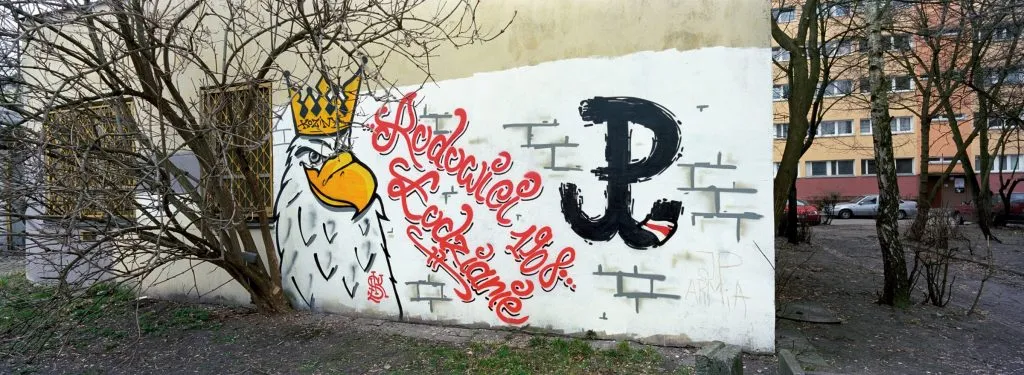
The problem is that the authors of the graffiti photographed by Wojciech Wilczyk would subscribe to all the symbols of Fighting Poland mentioned above. For while, in the early 1990s, graffiti artists sometimes still painted the “Anchor” for provocative and iconoclastic purposes—incorporating it, for example, into the Polish words kupa [shit], dupa [arse] or the abbreviation PZPR21—contemporary painters of the “Anchor” treat the sign exclusively with piety and deadly seriousness. This is hardly surprising, given the mood among Poland's elites.

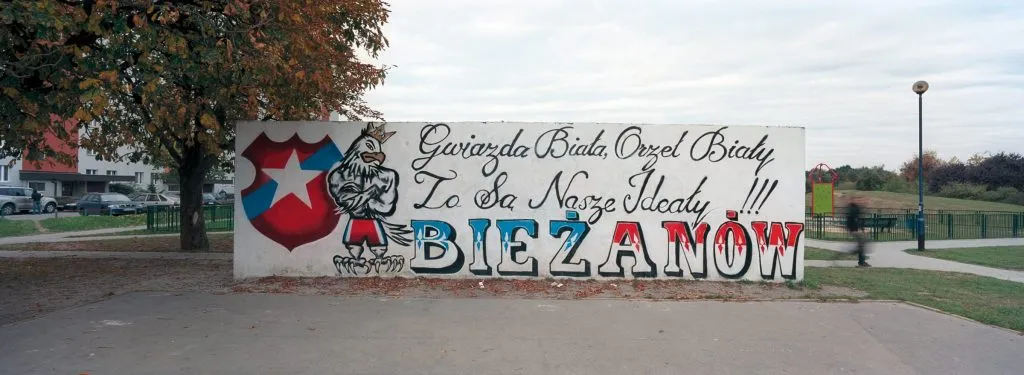
In Warsaw alone, several hundred monuments marked with the Fighting Poland emblem stand, and their number grows every year. Anchors abound in Wilczyk's photographs, as do the “Cursed Soldiers”, whose memory has in recent years been systematically cleansed of everything that might contradict their glory, until on 3 February 2011 the Polish parliament—then dominated by a coalition regarded as centrist and liberal—honoured them with their own day in the calendar of national commemorations. Supporters, who also revere them, merely join a choir whose tone is set by the world of cultured people. The same is true of supporters' cult of General “Nil”, Cavalry Captain Witold Pilecki, the Warsaw Uprising and the Greater Poland Uprising. All these hagiographies form a single general one, which supporters aptly and affirmatively recognise as the ideology of a “Great Poland”. For everyone—from a journalist at the largest commercial television station to a supporter who sets that station's van alight during a demonstration—was raised in the ideology of Great Poland: by schools, media, churches and families. A fondness for history (the names and faces of club footballers from “Legendary Polonia Bytom”), important dates (“Widzew 1910”, “Łódzki KS 1908”, “19G48”), local patriotism (“Native Łódź People”, “the Duchy of Bytom”, “Wisła patriots”), love of the homeland (“Patriots”, “White Star, White Eagle, These Are Our Ideals”, “Glory to Great Poland”), valour (“warriors of Silesian streets”), loyalty to one's own group (“death to those who killed our brothers”) and readiness to die in defence of its honour (“faithful until life's end”, “death to the city's traitors”)—these are taught by school textbooks on history, civics and Polish language and literature; children's books available in every self-respecting historical museum; colouring books and rhymes for the youngest; numerous publications of the Institute of National Remembrance; and state celebrations of national holidays. Not only the iconography but also the elevated, pathos-laden tone of supporters' graffiti comes from there. Even the vocabulary supporters draw upon does not always differ from the official one. Toy manufacturers put uprising-themed gadgets for children on the market; why, then, should we be outraged by Ruch Chorzów supporters who paint a baby whose building blocks spell “RUCH” (“from childhood we know what's best”)? It is difficult even to determine who inspires whom. The fence of Warsaw's Polonia stadium, the pillars of Warsaw viaducts, bridges in the capital, the wall surrounding the Warsaw Rising Museum and even a “little tenement” in the New Town are decorated with mostly commissioned, “legal” uprising murals teeming with Anchors, weapons, little eagles and blond youths straight out of the Hitler Youth, waving white-and-red flags. ŁKS supporters drew almost identical “Aryans”, captioned them “age does not matter, fanatics from birth” and thrust into their hands another white-and-red flag, only this time a club flag. Why call the former art and the latter vandalism? In the children's room of the Warsaw Rising Museum stands a monument to the Little Insurgent; bloodstained children's clothes can be seen in a display case; and books for the youngest sold in the museum shop ask, more or less openly: would you, too, be prepared to sacrifice your life for the cause? The supporters answer with top marks: “There Are Things in Life That Matter Most!!!”

The war waged by supporters is another instalment of the war under the white-and-red flag about which Dorota Masłowska wrote. Poland's war against everyone over everything. Above all, over recognition that Poland—in its micro- and macro-dimensions, in its history and present—is great, is most important, is noble, innocent, valiant and eternally wronged, and will therefore forever demand that the wrong be avenged, recompensed and acknowledged. And so it goes on. These are virtues inculcated by Polish culture—collectivism, militarism and patriotism—perfectly absorbed, embodied and internalised. A continuation of the story according to which Poland's history is a hagiography of chosen people continually fighting against a treacherous world that covets their possessions and spirit. Another chapter in the legend in which history has no meaning whatsoever but which, in Poland, is called precisely history: about the “Polish nation”, which existed a thousand years before the concept of the “nation” was invented; about the “Polish state”, already a power when no states yet existed; about the eternally Christian “identity of all Poles”, when some of those “all” hated the others, and had reason to do so because they were held by them in serfdom. Another variety of the chivalric ethos with which Maria Ossowska could supplement her book, adding a chapter entitled “supporters” somewhere between the Spartans and the nobility.

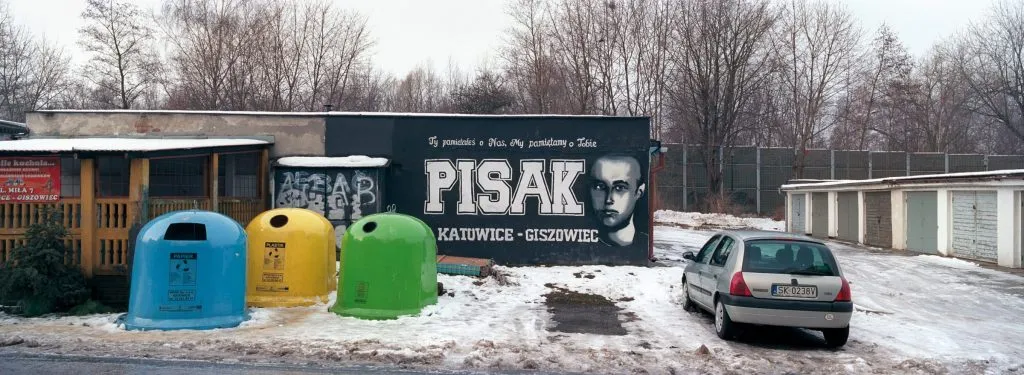
For supporters portray themselves as knights straight from Jan Matejko's pictures: on horseback, in armour, with banners, lances and flags. Combat sports in supporters' murals are the present-day form of knighthood. Fists, training halls, boxing gloves, bare muscular male torsos, shaved heads, covered faces, Molotov cocktails, gallows, fighting dogs, exhortations to “fight train Ruch must reign”, equipment used by supporters during league matches (knives, cleavers, razors, axes, machetes, chains, baseball bats, flammable substances, corrosive substances, flares, knuckle-dusters, metal bars, and improvised paving stones, fence rails, paving slabs, bench boards and so forth22)—these are contemporary weapons in the same continuing struggle. The boys who take part have read and understood that they are merely stones thrown onto the rampart. That their lives have no value, because value belongs only to the cause to which they can sacrifice and subordinate themselves, for which they will allow themselves to be mutilated and killed. Only in the context of Polish militarism can inscriptions such as “Wisła Murders”, “Murderers with Weapons in Their Hands. Wisła Killers”23 and “Wisła—the Zone of Darkness and Violence”24 be understood. Contrary to appearances, these are not insults hurled at adversaries, but proud self-presentations. Supporters' graffiti contains more subversions of this kind. “Hooligans”, “fanatics”, “juiced-up lads”, “locusts”, “psychofans”, “ghetto”, “welcome to hell”, “bandits”, “possessed”—all these descriptions have been reclaimed by supporters. They have been recovered as positive self-identifications because they define the degree of boundless devotion to the cause and pride in belonging to the community. 1991–2011, 1986–2002, 1978–1997, 1986–2011, 1986–2002—these are dates on the urban gravestones of supporters. In accordance with what are regarded as the finest models in Polish culture, some of these boys died for the colours of their flag: in fights with supporters of an opposing team or with the police. The walls photographed by Wilczyk teem with commemorations of those fallen or distinguished in service to the club: graffiti shaped like gravestones, in shades of grey or black, decorated with portraits and adorned with maxims: “death interrupted the film of your life”, “You Remembered Us, We Remember You”.

The sentimentality of these phrases contrasts with the ubiquitous destroy, kill, rape, grind into the pavement, kick in the head, hang, eat alive—declared against enemies first by those who died, and then by those preparing moving memorials to murdered comrades. But the contrast is superficial. Once again, supporters reveal what official culture pushes into the shadows but retains: war means killing, maiming and wounding; unceasing tension and life under continual threat; the irreversible loss of health; adrenaline, humiliation, the humiliation of others and death. And supporters regard themselves precisely as soldiers: “Army of the White Star”, “warriors of the Silesian streets”, they write about themselves. They announce violence (“fuck up”), commit violence (Grim Reapers, skulls, “death is the beginning of a new life”) and commemorate violence (symbolic graves) in the name of their team. The one thing that never changes is the legitimacy of violence. Just as in school textbooks, which instil a collective identity and, with it, the conviction that an individual life has no value; only dignity possesses value, and it is not given to everyone but must be proved, fought for and obtained, most often by depriving others of dignity.
It is not the graffiti that fights; all of Poland is fighting. Supporters may loaf around at school, but for participation in culture they deserve a report with honours. They participate fully, for example, in the ethos of opposition. “In one respect, our fate closely resembles that which befell the indigenous inhabitants of North America when Europeans colonised their continent,” writes the author of the supporters' blog Fanatyczny25. “Two completely different civilisations met. There was no question of both being able to function together. Our white forefathers regarded Native Americans as savages and their customs as barbaric rituals—beginning the gradual conquest of the whole continent. In the same way, supporters' bridgeheads in Polish stadiums are slowly being conquered today.
Does inevitable death therefore await us as well? I believe not. Even in England, continually held up as a model by the media and pseudo-experts, an example of a country where they ‘dealt with it’, the hooligan spirit has not yet collapsed completely. Despite thousands of cameras and listening devices—despite ubiquitous surveillance—they still manage in the West. Everything is therefore in our hands. If we do not lose our supporters' creativity, ingenuity and, above all, spirit, we shall manage too”26. Following the model of the anti-communist opposition, which in the dominant historiographic narrative grows into a moral elite; the contemporary right, which presents its voice as the stifled howl of truth against all-powerful liars; the hierarchs of the Catholic Church, who proclaim themselves David entering unequal contests with successive Goliaths (genderism, the civilisation of death, the homosexual lobby and so forth); and even oppressed minorities (“Native Americans”), supporters have chosen the identity of outcasts who, regardless of the cost (“Greetings to Prison”), will fight the enemy. The identity of a handful attacked from all sides who, in defiance of conformity, remain courageously and selflessly faithful to their ideals (“We Are the Elite, Not the Crowd, We Carry Pride in Our Hearts. Hooltras”, “The Few against the Countless”).

One of those ideals is masculinity. The world portrayed in supporters' graffiti is a world without women, and this fact is almost as striking as the fact that none of the experts on “kibole” appears to find it striking. Supporters form a community of men, established by men and in relation to men, whose horizon of important matters and points of reference—positive and negative—contains men alone. And here again, supporters deserve top marks for Polishness, because in Polish culture a man—unlike a woman, who is regarded as a being limited by the characteristics of her own sex—is a universal subject, independent of his own sex, the model of the human “in general”. Witness the fact that media reports about supporters' actions contain no information about their sex for as long as it is men who commit acts of violence and vandalism. Then the perpetrators are “simply” people. In seeking explanations of supporters' identities and practices, experts do not turn to the cultural construction of masculinity. Yet masculinity is a crucial category for understanding supporter culture, if only because, within Polish culture, a man is a human being socialised from birth both to inflict and endure violence. Masculinity is a quality that a person identifying with it must continually prove. He does so by stigmatising those who fail to meet the cultural definition of masculinity. This is precisely what a “faggot” is in supporters' language: an inauthentic man, by pointing him out and hounding him, the pointer and hounder can feel secure that he himself will not be pointed out and hounded. For the time being. Because gender identity requires constant training, performance and confirmation. According to this logic, whoever writes “faggot” on a wall is not one. This is how the homophobic gesture works, and its persecutory power can be sustained only within a culture that approves the gesture and teaches people how to read it. “Faggots”, “RUCHani”, “Górnik queers”, “you take it in the mouth”, “all Piaski give blowjobs”, “Pasy Gay Club”, “Fuck Wisła with axes and the Polish Football Association with cocks”, “Why does riot police still defend homo? Because the authorities like a man sticking it in them”—supporters write about their enemies. In a male world where intense feelings towards other men are cultivated (love for supporters of one's own team and hatred for those of the opposing team), where other men are very frequently touched in gestures of friendship or aggression27, and where there is a great deal of male-male intimacy, a man must present his credentials as a homophobe.

The language developed by supporters captures the intimacy of their circle well. ŚŻK (Death to the Jewish Whore), JŻS (Fuck Jews with Axes), AJ (anti-Jude), PF (Psycho Fans), JP (Fuck Sidelocks or Fuck the Police), H (Hooligans), an inverted R (the sign of Ruch Chorzów's adversaries), an inverted G (the sign of GKS Katowice's adversaries)—supporters' language has achieved autonomy. It is a code of intimate bonds: incomprehensible to outsiders, transparent to initiates, exclusive, elite, accessible to the few, for whom decoding the abbreviations JŻS, H and AJ is as easy as decoding ZUS, ABW or PO is for the average citizen.
Yet one sign in this language is universal. A sign that everyone throughout the length and breadth of Poland can read without error: the Jew. Sometimes replaced by “Jude”, “Jews”, “sidelocks”, “stinkers” or the Star of David. Sometimes accompanied by verbs: “fuck Jews”, “we shall cleanse Kraków of Jewishness”, “Fuck a Jew with a machete”. Sometimes inserted into rhymes: “sidelocks' mothers are whores, fuck Jews with axes”, “Hitler return to poison Jews”. In every variant, the Jew is the opposite of familiarity, the antithesis of everything positively connoted. Alongside “queers”, “faggots”, “whores” and “Gypsies” (“fuck Gypsy shit”, “Gypsy Hunters”), he is the most numerous inhabitant of the land of non-humans. There are so many Jews that, like the “Jew with a Coin” figurine, they turn cities without Jews into cities with the Jew, transformed into a little sign upon a wall. A sign stamped so densely and frequently that Monty Python could make a film here about Jews who return to Łódź and, believing every house marked with a Star of David to be Jewish, end up occupying the entire city.
Unlike club letters, nobody even inverts the Star of David. Sometimes somebody hangs it from a gallows, but not always. There is no need. Symbols associated with Jewishness possess insulting power: that power lies in the fact that they need be explained to nobody, because they belong to the Polish cultural code. The code's primary function is to connect. It incorporates into a single community of understanding the respectable citizen who passes the inscription “Juden raus” and the person who painted it. It creates a bond of understanding among the residents of a block upon which “Death to Jews” is painted. It integrates children from an estate at whose entrance a mural reads “anti-Jews”. If the concept of dialogue that successive initiatives place in their names (the Marek Edelman Dialogue Centre, Polish-Jewish Dialogue Platform, Forum for Dialogue among Nations and so forth) can still be useful for anything, it is precisely for describing antisemitism. Dialogue occurs only when a balance of power exists between the participating parties. Where one side imposes the conditions of conversation upon the other, we are dealing not with dialogue but with violence, through which some decide what may be said while others either repeat it or lose the possibility of speaking. If, therefore, there is any dialogue in Poland, it is not Polish-Jewish but Polish-Polish: intergenerational, interclass and between neighbours, in which the slogan “Jews” is important because it forges a community of self-evidence across divisions.
Arguing against penalising hate speech, Judith Butler writes that such speech is an interpellation of the subject, and that “interpellation defines the categories through which recognition of existence becomes possible at all”28. This can be understood in two ways. On the one hand, hate speech condemns the individuals it defines to a particular mode of social existence, in a sense closing off the possibility of functioning alternatively—for example, without stigma. On the other hand, however, it offers the possibility of existing in the political sense, because, firstly, it renders visible and, secondly, calls for a response. In a sense, therefore, it produces a subject—in the sense in which Louis Althusser wrote about subjectivation: as summoning individuals into identifications defined by state ideologies and, with those identifications, practices and beliefs29. The problem is that if supporters' graffiti interpellates anyone, it is not the Jew but a supporter of the opposing team, occasionally a member of the uniformed services, and still more rarely a representative of local or state authority. Unlike the insults about which Butler writes, supporters' mural speech de-subjectivises on an enormous scale, because it speaks neither about nor to “Jews”, “faggots”, “Gypsies”, “whores” and “queers”, but uses the “Jew”, “faggot”, “Gypsy”, “whore” and “queer” as self-evident insults directed at a supporter of the opposing team. If, therefore, anyone is interpellated here, it is that supporter, not the “Jew”, “faggot”, “whore”, “Gypsy” or “queer”. Nobody calls upon the latter to respond; quite the contrary. They have long been frozen into a form that need only be used. Polish culture is an excellent storehouse of these forms: a centuries-old freezer whose supplies supporters draw upon.

Supporters' inscriptions are therefore not “against Jews”, which by no means makes them non-antisemitic. Polish law on hate crimes cannot resolve this paradox. For the provisions state that “whoever insults another person in that person's presence, or even in their absence but publicly or with the intention that the insult should reach that person, shall be subject to a fine or restriction of liberty” (Article 216 of the Criminal Code); “whoever threatens another person with committing an offence to their detriment or that of a person close to them, if the threat gives the threatened person reasonable grounds to fear that it will be carried out, shall be subject to a fine, restriction of liberty or imprisonment for up to two years” (Article 190 of the Criminal Code); and “whoever publicly insults a population group or an individual person because of their national, ethnic, racial or religious affiliation or lack of religious belief, or for such reasons violates the physical integrity of another person, shall be subject to imprisonment for up to three years” (Article 257 of the Criminal Code)30. Thus, either you insult somebody because they are Jewish, in which case you commit an offence, or that person is not Jewish, in which case, by addressing them as “you Jew”, you do not insult them at all. Full stop. The law provides no third option: that you insult not a Jew, but with the Jew.

Curious court judgements in hate-speech cases illustrate that Polish law—like the Polish culture of which law forms a part—is governed by the paradigm of identity. It also governs research on antisemitism, whose designers assume that antisemitism is an attitude towards the Jew. Potential or implied, but an attitude towards. Yet supporters' graffiti demonstrates that antisemitism is rather a code of Polish culture in which the Jew is “merely” a tool of communication. He is its material, but neither its purpose nor its addressee. Antisemitism is an integral element of Polish culture: a part without which that culture would become incomprehensible; a language in which words have nothing to do with their referents but allow those who use them to communicate. This is why Butler's category of interpellation cannot work here. Supporters do not say, “Jew, you are this, that and the other”, but “Franek, you Jew”, “Mietek, your mother is a Jewess”, “Paweł, you stink like a Jew”. What matters here is therefore not the Jew but Franek, Mietek and Paweł, every supporter of the opposing team and every resident who sees the inscription and knows who has been insulted and how profoundly. If, in view of Polish law, anyone were to take anyone else to court here, it would be Franek, Mietek and Paweł, denouncing the suggestion that they are Jews and their mothers Jewesses. Once again in Polish history, the Jew—and anyone who might defend him—has nothing to seek in a Polish court today.

The identity paradigm produces an interpretative shift that conceals more than it explains. As long as we remain within this paradigm, we shall remain within the same logic that governs supporters' graffiti. For as long as we focus on who the supporter is and how thoroughly he does not come from our neighbourhood, instead of examining what his supporter identity is woven from, which tools he employs in this struggle, which weapons he uses and from which fantasies he constructs an ally and from which an enemy, we repeat an analogous gesture of exclusion. The supporter excludes the “Jew”, “faggot”, “Gypsy”, “whore” and “queer” from his community, while researchers, politicians, experts and journalists use no less pathologising a vocabulary (“kibole”, “pseudo-supporters”, “hooligans”) to cast the supporter out of theirs. Both sides thereby preserve their sense of well-being, because they have defended their worlds against intruders. Between those worlds there is neither symmetry nor rupture. The first is a child of the second, not the other way round. The transfer of meanings, forms of capital and significations remains governed by the law of social gravity. The substance of that transfer is the meaning (and destiny) of the “Jew”, “faggot”, “Gypsy”, “whore” and “queer” within Polish culture. Because of the identity paradigm, these third parties—the “Jew”, “faggot”, “Gypsy”, “whore” and “queer”, all who by choice or necessity do not fit the definition of the white Polish Catholic man or his white, Polish and Catholic wife—remain where they were: exposed for use, condemned to the status of subtenants, deprived of the possibility of articulation, agency and protection.

At each successive election—most recently the 2014 European Parliament election—Poland's public sphere fills with experts lamenting low turnout. Poles are not interested in politics, political scientists, sociologists and moral authorities conclude. But supporters' graffiti contradicts them. The signs used in it—consciously, with understanding, often subversively and sometimes humorously—are thoroughly political: the swastika, the Anchor, the cross, the sword, slogans such as “you'll never walk alone”, calls to attend fascist marches on 11 November. Poles are indeed interested in politics; it is merely that their politics happens and finds expression elsewhere. It is practised differently from the way the Polish intelligentsia would wish. Available only on the television screen, abstract and remote, power residing somewhere in the capital is surprisingly rarely the subject of supporters' commentary, criticism or jokes. Even the police feature little in Wilczyk's photographs. CHWDP appears here and there; Cracovia does declare “We Shall Never Go to the Dogs”, but only to reproach Wisła for having been a police club; the Polish Football Association appears perhaps once—as a “Voodoo doll” pierced with pins. For the most part, however, supporters speak with one another, make arrangements among themselves, form alliances within their own circle and wage war within that circle. The authorities—state or local, legislative or executive—are not part of it. Sometimes they merely interfere with its conduct. As if mobilised by calls for Polish society to become more civic-minded, supporters take matters into their own hands: their democracy is the most direct possible; their politics is more than self-governing; their courts are vigilante justice.
The political dimension of supporters' graffiti also lies in its accession to urban space. Nobody pursues the “right to the city” of which urban activists speak with the persistence, consistency and dedication shown by supporters. The effort invested in preparing and painting a graffiti design, the money spent on paint, the time devoted to supporter activity, the risk of punishment for “vandalism” and of injury while painting at height or in difficult-to-reach places—all of this is unpaid work for the community, changing urban space and caring for the immediate surroundings. Graffiti artists painting for GKS Katowice created the LArMO “Painters” group (the small or upside-down “r” in the name symbolises hostility towards Ruch Chorzów, whose emblem is the letter “R”). “We Bring Colour to the Grey Walls of This District. Official Graffiti Giszowiec LGM,” they write about themselves. Supporters' graffiti is therefore the conscious decoration of the city, the considered management of space, disinterested social activity, genuine volunteering that cannot be entered on a CV because it will not improve one's employment prospects even in the third sector.
Wojciech Wilczyk's photographs can be read as an unveiling of an alternative city: the underground circulation of Polish districts, housing estates, courtyards and streets. Here are supporters and their world: their concerns, ideas, saints, enemies, histories, views, way of life, means of expression, ethics and aesthetics. But life in Wilczyk's photographs is by no means limited to supporters. The graffiti he photographed is a backdrop. The scenery of daily life for millions of people. A decoration passed on the way to the bus stop, the supermarket, home from school, to collect the car, while walking the dog or taking soup in a thermos to grandmother. A girl goes to school, death to the Jewish whore, a woman carries bread and milk from the shop, fanatics from birth, a man takes his dog for a walk, Poland for Poles, children play football in the courtyard, Anti Jude, portable toilet, swastika, flowers on a balcony, swastika, net curtain at a window, Celtic cross, Lewiatan special offer sweets, Fuck Jews with Machetes, photocopying, fuck Jews, tights, Death to Jews, health food, fuck Cracovia the whore, forsythia bushes brown in winter. On the MSM Wielka Skotnica estate, fuck Gypsy shit; at Skowronków 2–2c, Widzew—Żydzew and two Stars of David; at Korfantego 21, a Star of David on a gallows; at Nowohucka 41, anti-Jude. Killing Jews blends into the landscape smoothly and harmoniously. In time, you stop seeing what you are looking at. In time, “fuck Jews with machetes” becomes as commonplace as a billboard advertising cheap products at the local supermarket. By the authority of Polish culture, antisemitism becomes part of the landscape. One might say: the complete assimilation of (the killing of) Jews.
The Anchor and the swastika, the Polish flag and the club flag, the cross and the Celtic cross, glory to Great Poland and death to Jews, Poland for Poles and Anti-Jude—Wojciech Wilczyk gathered the jigsaw pieces scattered across Poland. In isolation, they are illegible. Only when collected and assembled do they allow us to see the picture they form. That picture is the landscape of Polish culture. Supporters' graffiti is its mirror, far less distorted than the world of cultured people would like. The supreme value of contemporary Polish culture—anti-communism—is reflected in it with particular clarity. As in the once-popular “join the dots” puzzle, anti-communism is the line that connects the graffiti photographed by Wilczyk. The identity signs used in it—from the cross, through Fighting Poland, to the swastika—are symbols of anti-communist ideologies that supporters do not allow to fade. The politics of history practised by supporters on walls today is a true daughter of the official politics of history of the contemporary Republic of Poland. Over the last twenty-five years, the phantasm of the communist as public enemy number one in Poland's public sphere has gathered strength. It has become a bottomless sack into which everything with which contemporary Poland—including its local, particular manifestations—does not wish to identify can be thrown.
Through the increasingly topical stereotype of “Judeo-Communism”, the Jew, too, has long been in that sack. Anti-communism is the fulcrum that determines the golden mean, through which everyone—from the radical extreme to the mainstream—knows whom to praise and whom to insult, what to elevate and what to ridicule, for whom to erect monuments and whose monuments to desecrate. With all due respect to supporters, they did not invent this. They are merely diligent pupils of Polish culture. They listen carefully to Polish historians, politicians, moralists and experts. They take their words seriously and to heart. As Polish culture travelled from the heights to the tower blocks, it did not lose its character; it merely became literal. Abandoning good manners, it revealed the sources from which it draws its identity and the identity it offers.
*Dr Anna Zawadzka, a sociologist, works at the Institute of Slavic Studies of the Polish Academy of Sciences and directed the documentary film Żydokomuna.
1 Anna Chudzik, Inscriptions in Urban Space: A Pragmalinguistic Study (Based on Kraków Inscriptions from 2003–2005), Sanok 2010, pp. 148–149.
2 Ibid.
3 Ibid.
4 Quoted in Andrzej Kamiński, A Typology of Football Supporters, in Stadium Crime: Diagnosis and Prevention, ed. Wiesław Pływaczewski and Bernard Wiśniewski, Szczytno 2012, pp. 8–22.
5 Ibid.
6 Tomasz Sahaj, Football Fans: A Historical and Social Study of Supporting, Poznań 2007, p. 92.
7 Jerzy Dudała, Fans and Hooligans: On Polish Kibole, Warsaw 2004, p. 65.
8 Justyna Jurczak, Stadium Hooliganism: Symbols and Gestures in Polish Stadiums, Szczytno 2011.
9 Marian Golka, Graffiti in Search of Identity, in From Counterculture to Popular Culture, ed. Marian Golka, Poznań 2002, p. 139.
10 Jacek Waloch, From the Publisher, in Polskie mury/zmory, Toruń 1991 (unnumbered album).
11 Andrzej Osęka, Street Confession, in Polskie mury/zmory, op. cit.
12 http://kwartalnik.exit.art.pl/article.php?edition=34&id=605&lang=pl (accessed 4.08.2014).
13 See Zbigniew Bartkowiak, Graffiti—Art or Vandalism, Zielona Góra 2008.
14 Piotr Pałaszewski, Polish Ultras: Artists or Stadium Bandits?, in Stadium Crime: Diagnosis and Prevention, ed. Wiesław Pływaczewski and Bernard Wiśniewski, Szczytno 2012, p. 61.
15 Elżbieta Dymna and Marcin Rutkiewicz, Polish Street Art, Warsaw 2012, p. 6.
16Polskie mury/zmory, op. cit.
17 Jerzy Duda-Gracz, in Polskie mury/zmory, op. cit.
18 Edward Lutczyn, in Polskie mury/zmory, op. cit.
19 Tomasz Sikorski, Graffiti on the Vistula, in Obieg, 1991–1992, nos. 11–12, p. 10.
20 Ewa Chabros and Grzegorz Kmita “Patyczak”, Graffiti in the Polish People's Republic, Wrocław 2011, pp. 24–39.
21 See photographs in the album Polskie mury/zmory, op. cit.
22 Tomasz Sahaj, Football Fans: A Historical and Social Study of Supporting, op. cit., p. 126.
23 Quoted in Anna Chudzik, op. cit., p. 247.
24 Ibid., p. 148.
25http://fanatyczny.wordpress.com/2012/03/17/liberta-per-gli-ultras-rozkminy-przemyslenia-refleksje/
26 Ibid.
27 See, for example, the documentary film The Cage, dir. Sylwester Latkowski, Poland 2003, and the music video for Hundreds of Kilometres from the album Definition: Kibol (2012).
28 Judith Butler, Fighting Words: Excitable Speech and the Politics of the Performative, trans. Adam Ostolski, Warsaw 2010, pp. 13–14.
29 Louis Althusser, Ideology and Ideological State Apparatuses, trans. Artur Maroń, Nowa Krytyka, 20.04.2010, http://www.nowakrytyka.pl/spip.php?article374 (accessed 4.08.2014).
30 Criminal Code—Act of 6 June 1997. Source: http://www.mowanienawisci.info/post/kodeks-karny-ustawa-z-dnia-6-czerwca-1997-r/