
Holy War
Adam Mazur
Wojciech Wilczyk is one of the most outstanding contemporary Polish artists. Through photography, he addresses socially important problems. During the 1960s, a saying circulated in photographic circles: ‘from Jan Bułhak to Zbigniew Dłubak’, describing the revolutionary leap in the two artists’ understandings of the medium. Jerzy Lewczyński may also be added to the figures important to art because of their artistic, organisational and theoretical activities as well as their polemical stance. Wojciech Wilczyk is next in this line.
Wojciech Wilczyk’s photographs, made since the 1990s, can readily illustrate the retreat from art photography trapped at an impasse towards a documentary record focused upon capturing the image of Polish reality at the turn of the century, undergoing a profound social, economic and cultural transformation. Wilczyk’s latest project, entitled Holy War (2009–2014), stems from the experience he gained while realising such well-known series as Black and White Silesia, There Is No Such Thing As an Innocent Eye and The Other City (with Elżbieta Janicka), shown at Zachęta. On the one hand, Wilczyk continues the theme of the urban landscape framed in the panoramic format characteristic of the veduta tradition.
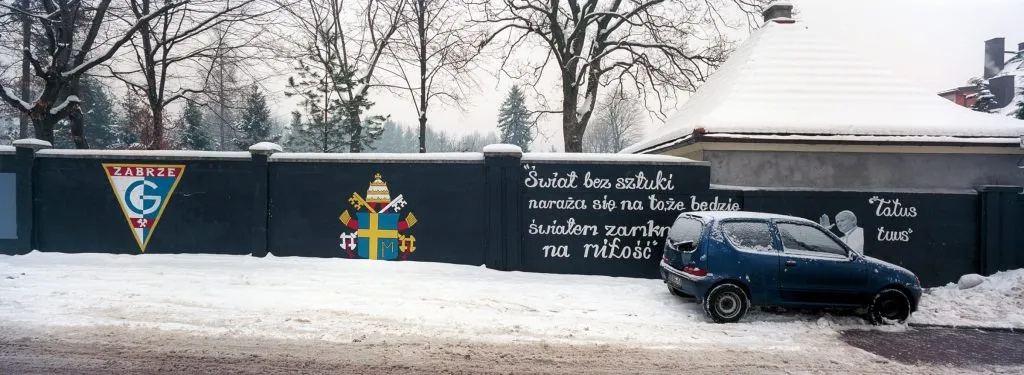
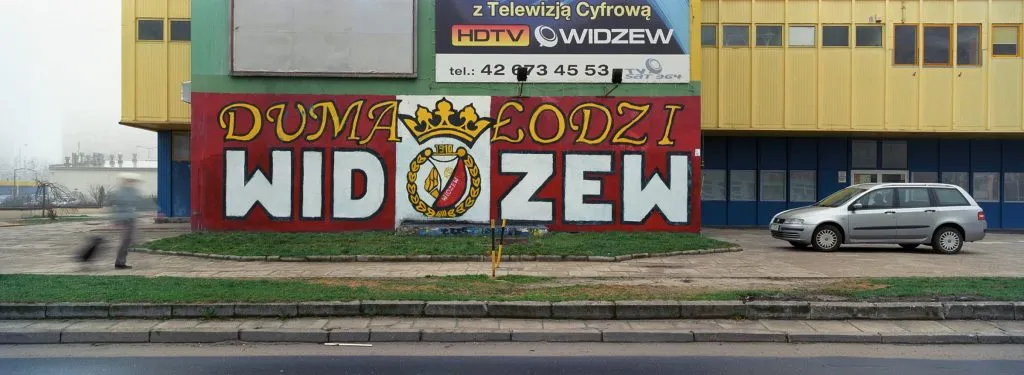
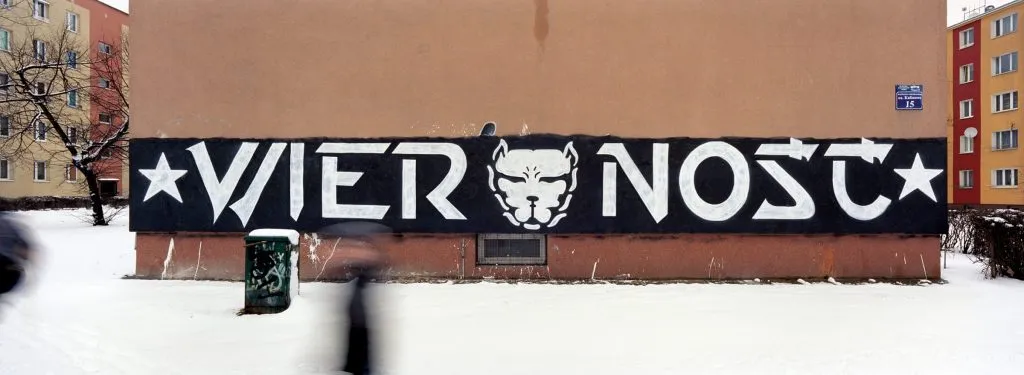
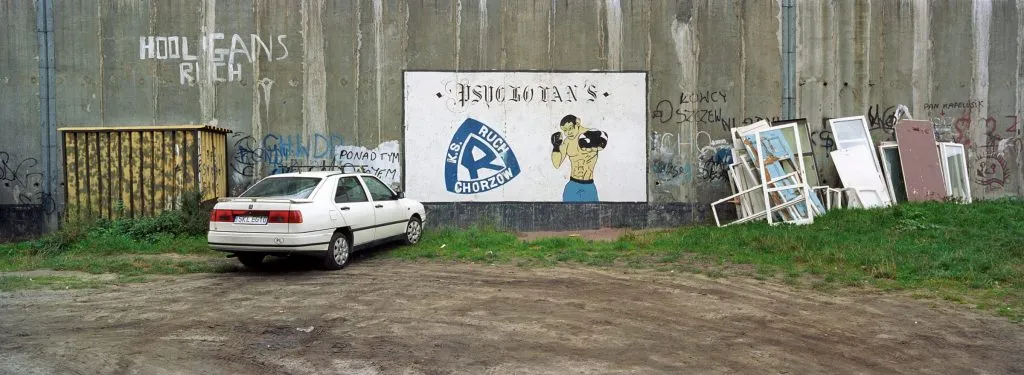
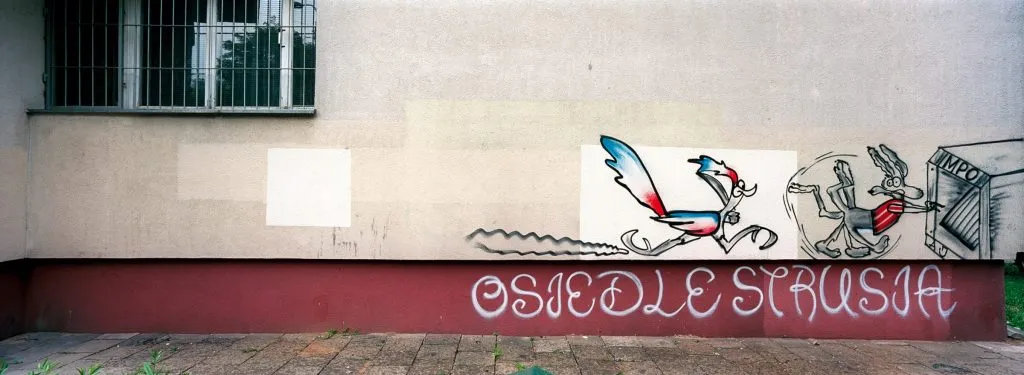
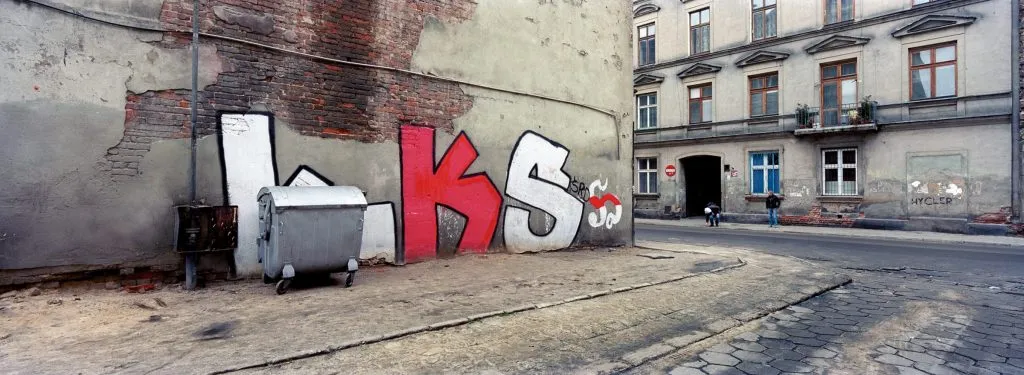
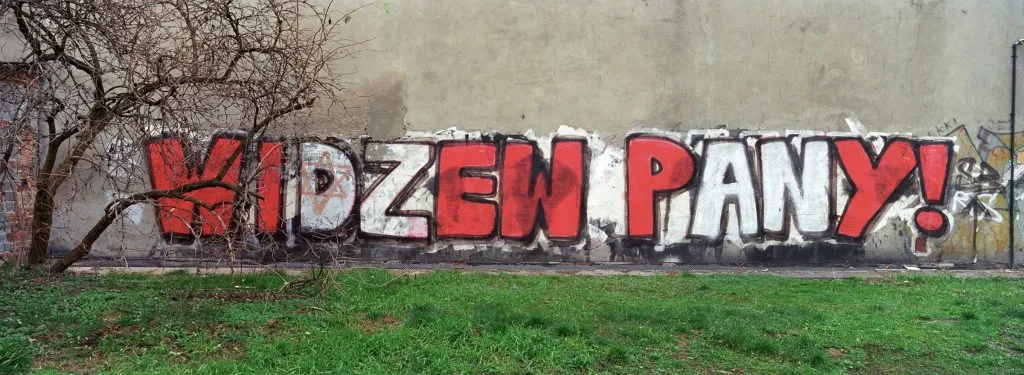
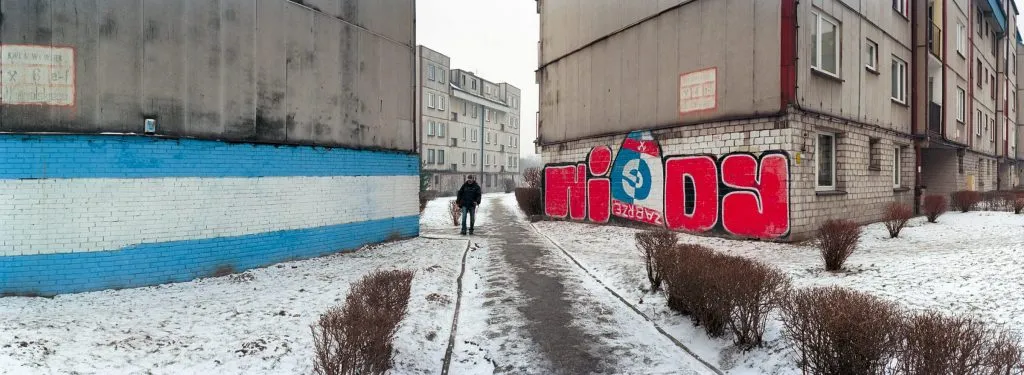
On the other, the colour photographs revisit motifs of grassroots creativity and violent tensions that define contemporary Poland. Wilczyk looks closely at manifestations of football-supporter culture that are ignored by urban activists and given a wide berth by anthropologists. Its role has grown immeasurably in recent years, even influencing mainstream politics (something particularly palpable before and during the 2012 UEFA European Football Championship). The aggressive and frequently bloody rituals at the core of fanatical hooligans’ identity can—and perhaps, as Wilczyk suggests, should—be analysed within a broader anthropological and social perspective. They can also become the subject of artistic practices. Most supporters’ watchwords and slogans refer not only to rival football teams and their adherents but, through the use of a distinctive symbolism, also touch upon religious, political and historical questions. It is no coincidence that the axis of the titular Holy War is formed by openly antisemitic and fascist slogans propagated by hooligans.
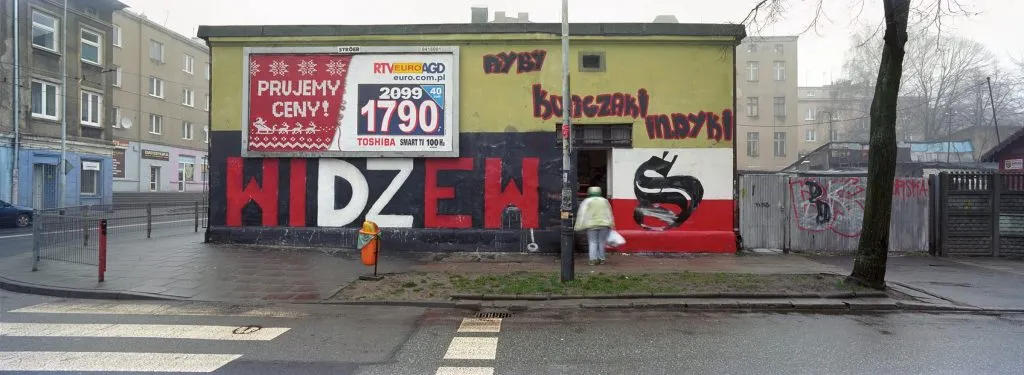
As in the series There Is No Such Thing As an Innocent Eye, devoted to former synagogues and houses of prayer, in Holy War Wilczyk likewise addresses memory, although he does so differently. Instead of an atlas of surviving but neglected buildings, he depicts places indeterminate in their blandness yet significantly involved in organising the lives of particular communities. The topography of murals filled with antisemitic aggression marks divisions between supporters of individual teams, but also bears witness to Poles’ mutual hostility and hatred.
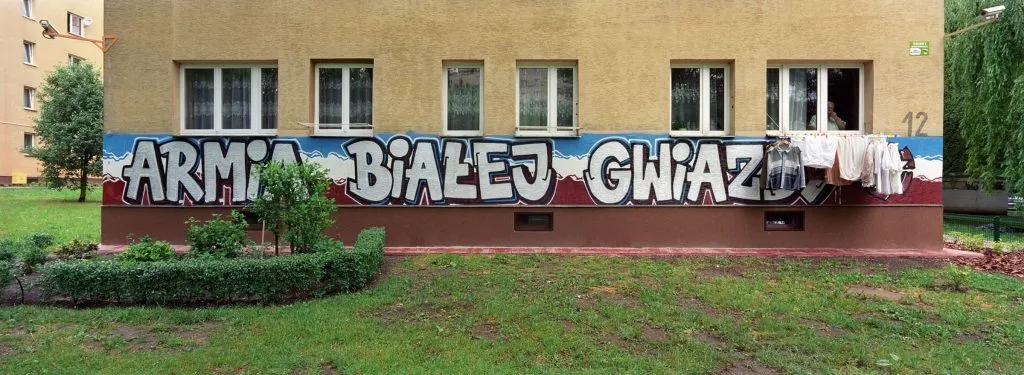
Wilczyk’s atlas of murals impresses and, at the same time, appals the outside viewer. The volume of obscenities, the repulsiveness of the hate speech and the social scale of the phenomenon prompt a question about the complicity of the silent majority, which tolerates what appears on the walls of housing blocks, tenements and public buildings not only in cities waging a ‘holy war’, but throughout the country. Unlike newspaper columnists, however, Wilczyk does not moralise. In his artistic interpretation, what is visible on the surface of the plastered walls appears to arise from deeper layers of collective consciousness. In this sense, no occasional campaign to paint over murals across the length and breadth of Poland will produce more than a temporary effect. A more fundamental change is needed. Otherwise, the next day will bring further slogans such as ‘Fuck Jews with machetes’ and murals more beautiful and larger still—not only in dark alleyways, but also on prominent façades. In a certain sense, the ephemeral contemporary murals photographed by Wilczyk can be compared to the discursive fossils Joanna Tokarska-Bakir describes in Blood Legends. Football supporters use a language that is childish yet menacing. Their use of antisemitic slogans appears ritualistic. ‘Yet “ritual”,’ Tokarska-Bakir observes, ‘does not mean “superficial” here, but only “requiring no conscious belief and subject to no verification”. Something is not superficial when, despite appearing useless, it does not die away; when it reproduces itself according to a pattern located beyond conscious memory and will. Although antisemitic content is absurd, its persistence cannot be explained solely in terms of obscurantism and insufficient knowledge. It is a problem similar to the question of why people dream.’ She adds: ‘The absurdities of dreams cannot be combated through persuasion and public enlightenment’1. Wojciech Wilczyk does not use art to fight reality. He engages coolly: he notices the phenomenon, examines it, draws it to the surface and composes his photographs carefully, devoting time and energy to the murals. It is as though he wishes to describe and recognise the symptom more fully. Wilczyk therefore neither rails against the ugliness of the Polish landscape as Filip Springer does (Wanna z kolumnadą [The Bathtub with a Colonnade], 2013), nor produces a careless collection of indifferent snapshots for a noble purpose like Elżbieta Dymna and Marcin Rutkiewicz (Polski outdoor. Reklama w przestrzeni publicznej [Polish Outdoor Advertising: Advertising in Public Space], 2009). Instead, his practice recalls the sympathetic attitude towards vernacular forms adopted by Robert Venturi, Denise Scott Brown and Steven Izenour, the authors of Learning from Las Vegas. With an understanding of Wojciech Wilczyk’s method, which combines iron consistency with uncompromising commitment, it is worth briefly reconstructing the path that led to Holy War.
The Barbarian
Wojciech Wilczyk was born in Kraków in 1961 and, whether he liked it or not, learnt photography from his father, Eugeniusz Wilczyk, an art historian whom he assisted in the darkroom. During the 1980s, driven as much by passion as by his aversion to military service, Wilczyk studied Polish philology at the Jagiellonian University. He graduated in 1986 with a dissertation on the ‘accursed poet’ Kazimierz Ratoń. After completing his studies, he took casual jobs, wrote poems and, from 1988, photographed independently. Wilczyk’s poetry of the late 1980s and early 1990s belonged to the current of the ‘barbarians’, to invoke the title of the anthology The Barbarians Have Arrived, compiled by Marcin Świetlicki and Paweł Filas in 1991. In retrospect, the young poets’ ‘barbarism’ seems to have consisted mainly of references to popular culture and Pop Art, something difficult to conceive within the cultural paradigm of the time. Alongside Wilczyk, the group of barbarian poets born in the 1960s included Marcin Świetlicki, Jacek Podsiadło, Grzegorz Wróblewski and Krzysztof Jaworski. In 1997, Wilczyk published the poetry collection Steppenwolf, which was originally to have been entitled Hyperrealism, as publishing announcements in bruLion attest. Wilczyk’s activities, however, were not limited to writing and publishing his own works. One of his first mature projects, both photographic and editorial, was Anthology, edited in the second half of the 1990s and published by Oficyna Literacka in 1999: a selection of excerpts and poems by twenty-one writers, accompanied by photographic portraits (including Marcin Baran, Darek Foks, Manuela Gretkowska, Krzysztof Jaworski, Andrzej Sosnowski, Andrzej Stasiuk, Jacek Podsiadło, Marcin Świetlicki, Olga Tokarczuk, Krzysztof Varga and Grzegorz Wróblewski). In his introduction, the author himself wrote that the portraits—unusual within Wilczyk’s work—as an integral part of Anthology were intended to reveal ‘the “true face” of this generation, but also—in view of photography’s documentary aspect—to establish a dialogue with the tendency, typical of the written word, to play games, construct fictions and multiply mystifications’2. Even in describing portraits of writers, Wilczyk reveals his philosophy of photography. ‘The photographs included in Anthology are not intended, however, to “expose” the people portrayed (a frequent device among photographers seeking the so-called “capture of the subject’s character”), but aim to record the moment of posing, in which the people photographed assume “masks” and “roles” that may be regarded as a completely natural (and authentic) form of behaviour’3. Many of Wilczyk’s black-and-white portraits later appeared on the covers of poetry collections and in writers’ publications, forming the media image of the ‘bruLion generation’. Although Wilczyk withdrew from literary life around the turn of the century, contemporary poetry remains a constant point of reference for him.
Kalwaria
Although portrait photography does not define the distinctiveness of Wojciech Wilczyk’s practice from today’s perspective, between 1995 and 2004 the artist produced a record devoted to participants in religious ceremonies at the sanctuary in Kalwaria Zebrzydowska.
Published in 2010 by Kropka of Września, the album contained photographs taken during Holy Week observances and the Marian celebrations held in August. Wilczyk’s black-and-white photographs, made with both small- and medium-format cameras, focus upon the faces and gestures of ordinary people who come to the sanctuary mainly from south-eastern Poland. Ten years of systematic work resulted in a portrait of a community that numerous photographers had previously viewed through spectacular, superficial frames, almost invariably depicting scenes from the quasi-theatrical staging of the Mystery of the Passion. Wilczyk’s attention was drawn instead to ‘the physiognomies of pilgrims ravaged by hard physical work, immersed in genuine religious exaltation, in the experience of the New Testament account of the death of the divine son, or in grief after the death of his mother’4. At first, the photographer used a telephoto lens, but he quickly realised that, to obtain the most authentic images possible, he simply had to come closer.
The collection of around one hundred photographs published in the album (selected by the author from more than five thousand) is notable for its recurring faces—a girl growing up, or a woman ageing with each passing year. Despite this formal device, the series contains nothing of the press photo essay. Instead, it resembles the photographic atlases the artist created later, with the difference that Kalwaria is ethnographic, while subsequent series would be decidedly more topographical. Although many portraits of Catholic pilgrims remain arresting today, the search for interesting physiognomies did not become Wilczyk’s vocation. He pursues his interest in social issues, rituals and existential themes differently.
Silesia
When recalling the beginnings of his fascination with photography, Wojciech Wilczyk mentions a 1986 visit to the Association of Polish Art Photographers gallery on Świętej Anny Street in Kraków, where he saw an exhibition by Michał Cała (born 1948). Cała’s black-and-white photographs, produced since the mid-1970s, depict the industrial landscape of Silesia in an expressive and visually compelling manner. What attracts attention is not only the sweeping, apocalyptic imagery of smoking chimneys and rows of dirty familoki workers’ tenements, but also staged portraits of children and young people against neglected municipal housing. Cała’s influence can be sensed in Wilczyk’s first Silesian series, Symbolic Landscape (1992–1996).

I first saw the Walenty coking plant in the early spring of 1992. At the time I was driving through the seemingly endless Ruda Śląska towards Bytom when, suddenly, enormous concrete structures began to emerge on the left-hand side of the road from behind a tangle of industrial pipelines. A fine early-spring rain was falling; it was early afternoon, which meant grey and dark, and the rain-soaked concrete buildings visible through the side window resembled a set from one of those science-fiction films whose action takes place at the moment of civilisation’s inevitable collapse5.
The opening sentences of the text in the catalogue accompanying the Black and White Silesia exhibition at Zderzak Gallery in Kraków precisely convey the beginning of a fascination with a region that became a point of reference for Wilczyk for the next two decades. While Symbolic Landscape, which premiered in 1997, concerned a single site—the Walenty coking plant (formerly Wolfgang) being dismantled in Ruda Śląska—the consistent documentation of the disintegration of industrial architectural forms, undertaken immediately after the series was completed, encompassed numerous sites across Upper Silesia. Realised between 2003 and 2006, the Postindustrial project expanded further to include sites beyond Silesia. In his early black-and-white works from Silesia, Wilczyk effectively omits people. If they appear in the photographs, they serve as staffage, performing simple activities—for example, the man taking out the rubbish in Siemianowice Śląskie, Piastowska Street, 27 January 2001, or the women talking in the street (Bytom, Korfantego Street, 9 February 2000). They virtually never look into the lens, making contact with the photographer and, indirectly, the viewers. The photograph depicting two boys with a dog (Zabrze-Biskupice, Kempki Street, 4 February 2001) is the exception that proves the rule. People are present through architecture, inscribed within the urban and industrial landscape—a landscape they made. Their lives are synthesised in juxtapositions of residential tenements, industrial buildings and cemeteries. Life, work, death. Some frames may bring to mind Walker Evans, an important figure for Wilczyk; above all, his 1935 photograph Pittsburgh, Bethlehem: Graveyard and Steel Mill. This iconic image, repeated by Bernd and Hilla Becher, among others (Pittsburgh, Bethlehem, 1986), invokes a way of thinking about image, architecture and society.
The book Capital in Words and Images, published with Krzysztof Jaworski in 2002, occupies a special place in Wilczyk’s work. The small publication is a montage of poetry and black-and-white photography, a montage extending beyond the conventions of illustrated editions of poetry collections or artistic photobooks embellished with quotations and poems. The melancholy of Wilczyk’s images—a kind of evidence in a historical process—arises from reflection upon the irreversible nature of changes compelled by the titular capital on a scale extending beyond the boundaries of a single region of Poland (as in the cover photograph of Capital, which depicts the words ‘KWK Polska’ rising from the mud).
When viewing and reading Capital, a seminal publication in Polish photography, one must remember a particular mistake or displacement in Wilczyk’s work that led him to publish the book. At the end of 2011, the author described the origins of Capital as follows:
In the autumn of 2000 and spring of 2001, I worked extremely intensively on the Black and White Silesia project. Travelling through the towns of the Upper Silesian conurbation, I began noticing the shop windows of small businesses characteristic of the region’s impoverished residential districts. Recording motifs of this kind using monochrome materials did not particularly convince me, so in the summer of 2001 I decided to photograph them in colour. At an early stage of the work, I thought of the title ‘Capital’ for this undertaking, which was intended as an ironic reference to the neoliberal version of free-market capitalism trumpeted by the media and economic authorities. Like almost every artist working within the economic realities mentioned above, I did not have a penny to my name, so although I developed the films exposed during the summer of 2001 at once, I did not make contact sheets or proof prints from them.
And perhaps that was ultimately just as well, because if I had immediately seen the results of my work, I would probably have abandoned the monochrome Black and White Silesia at once, and there would have been no exhibitions or album… Krzysztof Jaworski and I instead used the title of the abandoned series, ‘Capital’, to produce a little book in 2002 containing his poems and my Silesian photographs from the ‘Black and White Silesia’ project.
Wilczyk’s monumental body of work focused upon Silesia overlaps and interpenetrates, demanding careful study. Understanding the work, the authorial intention and the sequence of images may require far-reaching reinterpretations, as can be seen in the artist’s disclosure of the colour photographs of Silesian shop windows. He did not show these images until 2012, at the exhibition The Unrepresented World at the Centre for Contemporary Art Ujazdowski Castle in Warsaw. Made in the margins of the principal black-and-white series, the photographs indicate another dimension of the region’s material culture: not a magical fascination, by any means, but a coolly photographed fascination with small business, maintained within a formal rigour. In other words, these are not so much ‘Cinnamon Shops in Silesian style’ as the small-time currency dealing of people on the make—also poetic in its own way—worthy of the protagonist of Michał Witkowski’s novel Barbara Radziwiłłówna z Jaworzna-Szczakowej.
Silesia is also present in the artist’s biography through his curatorial and research work. For Wilczyk, the inspiration of Michał Cała marked the beginning of a friendship with the photographer, but also of a continual search for points of reference in forgotten and neglected areas of the history of Silesian photography. Wilczyk pursued a programme of photographic archaeology in his own way, not only publishing texts in magazines such as Fototapeta, Opcje, Herito and Obieg, but also organising significant exhibitions. One example is the exhibition Photorealism, presented at Zderzak in Kraków, which mainly brought together work by photographers connected with Silesia: Sławoj Dubiel, Piotr Szymon, Andrzej Ślusarczyk and Ireneusz Zjeżdżałka, who worked in Września. Work within the artistic community and art criticism became hallmarks of Wilczyk, whose polemical zeal earned him both implacable antagonists and devoted supporters. In addition to publishing texts—including in Tygodnik Powszechny, Gazeta Wyborcza, Gazeta Antykwaryczna, FA-art and SZUM—Wilczyk founded and edited the online magazine Hiperrealizm with Krzysztof Jaworski in 2002–2003. Since 2009, he has run his own almost-daily blog of the same name. hiperrealizm.blogspot.com is one of Poland’s most influential photography blogs.
Life after Life
While the architectural photography projects realised after 2000—from the black-and-white Copenhagen of 2000, through the colour series Cities on the Edge, and then There Is No Such Thing As an Innocent Eye and The Other City—can be viewed as derivatives of his Silesian experience, the photographs in the series Life after Life are something entirely different.
‘In truth, this is a series about death’6, Wilczyk explains when asked about its subject. The series depicts car wrecks and fragments of bodywork converted into roadside advertising supports, flower beds and decorations. If they encourage us in any way to contemplate transience and the fleeting nature of existence, they do so in an emotionally neutral manner. Wilczyk invokes neither sensation nor nostalgia; his project resembles a medical atlas in which one can trace successive stages or variants of a disease. The use of a simple square frame, central composition and complete absence of staging gives the project an almost scientific character. What distinguishes Life after Life from the many portentous attempts to visualise death is the withdrawal of the artistic subject and the surrender of the field to the reality photographed. Paradoxically, colour—used here by Wilczyk for the first time (with the sole exception of Capital)—gives the project a documentary sublimity and admits no note of sentimentalism. Car wrecks naturally arouse nostalgia and melancholy. Yet in resisting these feelings, which overwhelm more than just the once-happy users of two-stroke vehicles from East Germany, Wilczyk proposes something more than an extended metaphor for the collapse of modern technological civilisation. Life after Life speaks equally of the death and resurrection of things. It bears witness not only to the photographer’s powers of observation but also to the spontaneous creativity of ordinary people, who have managed to transform industrially manufactured vehicles into Surrealist works of art. Colourful objects of twisted sheet metal suspended above the ground burst apart and revolutionise capitalist everyday life. Automotive fetishes from which their owners find it difficult to part become roadside monuments, poetic bricolages, poor relations of the stylised advertisements of the motor trade, objects that are utterly magical yet serve both capitalist society and individuals’ creative ambitions.
The series, realised between 2004 and 2006, was shown in a solo exhibition at Ujazdowski Castle. After a brief interval, however, Wilczyk returned to documenting vernacular automotive constructions placed beside roads in Poland and elsewhere.
Shoah
Bogusław Deptuła ended his review of the exhibition New Documentarians, shown at the Centre for Contemporary Art Ujazdowski Castle in Warsaw in 2006, in which Wojciech Wilczyk participated as a photographer and the author of one of the catalogue texts, with a remark that has since become significant: ‘And if anyone asks me,’ he wrote in Tygodnik Powszechny, ‘whether this is socially engaged art, as it might appear, I shall answer firmly: no! It is artistically engaged art, treating reality as a kind of springboard from which it would like to leap high—towards an international career.’ Deptuła’s diagnosis was an impetus for Wilczyk, who used the title of the press review as the name of a monumental series devoted to former synagogues and houses of prayer. Refuting the claim of careerism, Wilczyk demonstrated the potential for social engagement inherent in documentary photography by realising the series There Is No Such Thing As an Innocent Eye. The contemporary photographs addressed the memory and remains of the Shoah—a subject difficult for everyone: Jews, Poles and Germans.
In the photographs from this series, first shown at Atlas Sztuki in Łódź and, thanks to the gallery’s commitment, also exhibited abroad, Wojciech Wilczyk consistently invokes the history of the topographical documentary record in an attempt to represent the memory of places in his own way. He photographs synagogues, batei midrash and Jewish houses of prayer, of which just over three hundred lie within the present borders of Poland. The architectural landscape of different periods in the history of Jews in Poland intersects with the buildings’ current functions as public libraries, fire stations, wholesalers and depots, supermarkets, and abandoned and decaying warehouses of former agricultural cooperatives. This distinctive atlas of views ‘supplements’ what had previously been repressed from the landscapes of so-called Polish ‘native photography’, whose practitioners ultimately modelled themselves upon German Heimatfotografie. Avoiding both pathos and the motif of a calendar-style memento from a journey to Poland, Wilczyk creates a record of forms from the past that have apparently grown into the contemporary landscape. Apparently, because they still stand apart from it, evoking the memory of a tangled past. Photography becomes a vehicle for memory; the photographer’s eye examines what usually remains hidden, what becomes invisible through its everyday familiarity. At times, buildings returned to Jewish communities and former owners are adapted to new, surprising purposes, and are therefore not only ‘used’ but revived. The artist’s attentive and sensitive gaze records the shimmering, present architectural and social form through which history manifests itself. There are no fireworks here, and no theme park for tourists from Israel, Germany and America.
‘Was there a synagogue here?’ The question asked of the artist by local residents, and of residents by the artist, is also directed at an audience that rubs its eyes in disbelief at the sight of a window wholesaler, local pub, funeral home or warehouse of Dutch furniture. Asked by anonymous passers-by shaken from their daily routine by the photographer’s appearance, the question simultaneously denies and confirms knowledge of history—of what everyone has heard but seems to have forgotten, or, better still, does not wish to remember. Yes, there was a synagogue here. If we cannot believe our own eyes, we must believe the camera directed at these buildings by a quiet yet importunate photographer. A photographer who, paradoxically, might be called a landscape artist—or rather, a revisionist landscape artist. In his project, Wilczyk advances a very different vision of the Polish landscape from the one stubbornly promoted by propagandists before and after the war. The native landscape proves more diverse than we might suppose today, in a Poland more ethnically homogeneous than ever before. The incompatibility between the image of the remnants of a multicultural society and our conception of what Poland should look like today is troubling.
Compared with projects by other artists concerned with memory and the Holocaust, Wilczyk’s photographs of synagogues in Polish cities and towns constitute an analytical and dispassionate attempt to perceive a legacy that—more or less ruined, adapted or left unchanged—has survived into our time, often as the only trace of entire communities that created this architecture and culture.
Wilczyk’s gigantic undertaking was given concrete form as a touring exhibition and an atlas-book. There Is No Such Thing As an Innocent Eye further strengthened the historical context present in Wilczyk’s Silesian work. Photography proved a medium that precisely records the past concealed beneath the lining of the present.
While working on the catalogue, Wilczyk met the artist and researcher Elżbieta Janicka. Together they began collaborating on the topographical project The Other City. In a sequence of large-format colour photographs accompanied, as in the series There Is No Such Thing As an Innocent Eye, by precise descriptions, Wilczyk and Janicka addressed the landscape of the Polish capital. The artists were interested in Warsaw as a space cruelly marked by war and as a place that remembers past events in a distinctive way. Referring to the perspective characteristic of the series of Silesian photographs presented in the 2001 exhibition From Above, The Other City makes it possible to view Warsaw almost from a bird’s-eye perspective and understand the historical context of contemporary spatial relationships. The photographs depicting the area of the Jewish district and the ghetto document the process of building upon urban quarters through successive post-war decades, up to the present day. In a certain sense, The Other City can be interpreted as the reverse of the history of the disintegration of the last formerly Jewish buildings, with the difference that in Warsaw, memory continues to be levelled through construction upon the ruins of the ghetto.
Holy War II
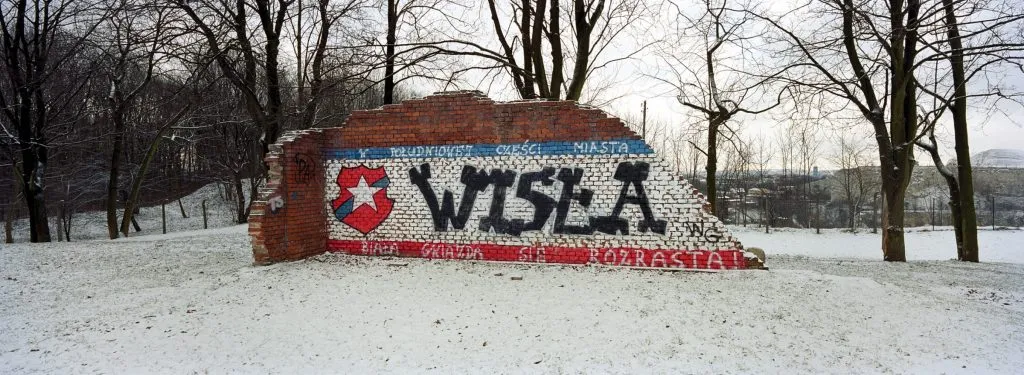
After the nationwide project There Is No Such Thing As an Innocent Eye and the Warsaw-based The Other City, Wilczyk completed work on Holy War, which combines veduta and historical themes while also referring to the antisemitism that has proliferated in contemporary Poland. Sensitive to hate speech and its consequences, the artist turned his attention to the titular Holy War waged by football hooligans across urban agglomerations. Wilczyk does not photograph men fanatically devoted to one team or another, nor does he photograph arranged fights, stadiums, matches or lit flares. Instead, he focuses on the carefully designed and executed murals present in the spaces of Kraków, Łódź and the Upper Silesian conurbation, which mark the boundaries of each team’s distinctive sphere of influence. The panoramic colour frames can be compared with certain photographs, likewise depicting football-supporter inscriptions, made for Black and White Silesia. What a decade earlier appeared to be local folklore establishing a place’s distinctive atmosphere, the crude output of unsupervised minors, becomes a key that allows one to penetrate the imagination and reconstruct the state of consciousness and identity not so much of urban tribes or aggressive football supporters as of entire communities. Whether they wish it or not, even if they do not participate directly in this war of symbols—and sometimes of blunt or sharp instruments—they tolerate it. The Kraków, Łódź and Upper Silesian conurbation of Wilczyk’s photographs are places in which—as the author himself would probably put it—a ‘thought process’ is under way. It is a process of reflecting upon identity and history, a process whose direction has not yet been fully defined, in which supporters’ emotions crystallise into texts and images that revive historical hatred and confirm the worst stereotypes and prejudices. Holy War interlocks with Wojciech Wilczyk’s preceding photographic projects and is, in a sense, their inevitable consequence.
*Dr Adam Mazur (born 1977), critic, art historian and scholar of American studies, graduated from the Graduate School for Social Research at the Institute of Philosophy and Sociology of the Polish Academy of Sciences and lectures at the University of the Arts Poznań. From 2002 to 2013 he was a curator at the Centre for Contemporary Art Ujazdowski Castle, where his exhibitions included New Documentarians, Red-Eye Effect, Schism: Polish Art of the 1990s and The Unrepresented World. His books include I Love Photography (2009), Histories of Photography in Poland, 1839–2009 (2010) and The Decisive Moment (2012). From 2004 to 2011 he was editor-in-chief of Obieg; since 2013 he has been editor-in-chief of Szum.
1 Joanna Tokarska-Bakir, Legendy o krwi [Blood Legends], Warsaw 2008, pp. 46–47.
2 Wojciech Wilczyk, ‘Intro’, in Antologia [Anthology], ed. Ewa Rakowiecka, Kraków 1999, p. 3.
3 Ibid.
4 Idem, Wokoł Kalwarii [Around Kalwaria], in Kalwaria, Września 2010, p. 114.
5 Idem, foreword to the album Czarno-Biały Śląsk [Black and White Silesia], Kraków 2004, p. 7.
6 See Adam Mazur, ‘Wojciech Wilczyk’, in Nowe zjawiska w sztuce polskiej po 2000 roku [New Phenomena in Polish Art after 2000], ed. Grzegorz Borkowski, Adam Mazur and Monika Branicka, Warsaw 2007, p. 396.