
The Train Must Arrive
Katarzyna Bojarska talks to Anna Baumgart
Katarzyna Bojarska: At various points in your career and in different forms, you have collaborated with other artists, or more broadly with other creative practitioners. In a sense, the project Fresh Cherries opened another chapter: this time you invited scholars to work with you—Joanna Ostrowska, a researcher into the history of forced prostitution in Nazi concentration camps, and now, for Conquerors of the Sun, Andrzej Turowski, a historian of the avant-garde and art critic. Could you explain what this collaboration involves?
Anna Baumgart: These last two projects required specialist knowledge. I needed experts; I was looking for someone who could introduce me to the working methods used in academic research.
K.B.: That is understandable. But you could have treated them purely instrumentally, as specialists in a particular field or consultants, and thanked them briefly in the closing credits. Instead, you went much further—you incorporated them, in a very powerful sense, into your work, bringing them into the world you had created.
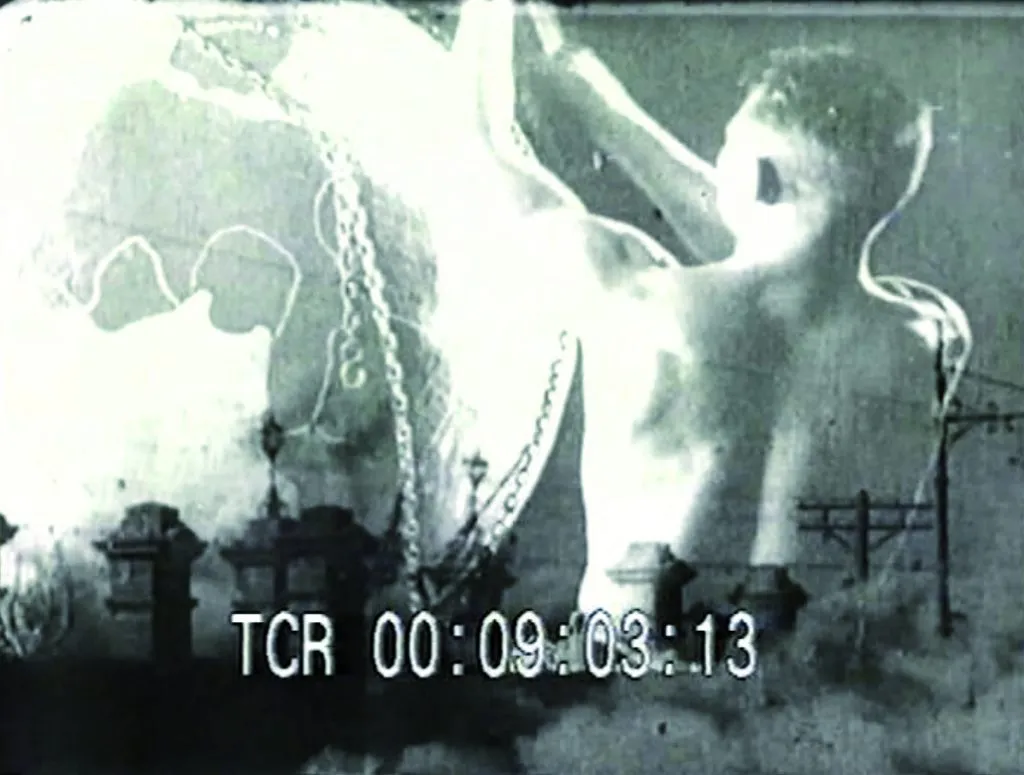
A.B.: That is true. With Fresh Cherries, I had planned to do so to an even greater degree. I wanted Joanna to guide me sensually as well as intellectually through this difficult subject. But she hid inside a safer costume: the costume of the historian. I remember taking offence when, at the film's premiere, I was asked how much influence she had had on the formal shape of Fresh Cherries. Today I know that Joanna guided me through the subject not only intellectually; the form of my film also emerged through her retreat and through the collision with the mask she put on. When I was preparing to make Conquerors of the Sun, I wanted to read all of Andrzej Turowski's books, and then realised that some were completely unobtainable—Polish Constructivism was positively a rare collector's item. You could not buy them, and borrowing them was harder still. I remember running through the rain to photocopy a chapter from a book belonging to an art-historian friend, because I knew she would not agree to lend it. I realised then that this body of literature and this figure were surrounded by a particular cult. That provoked me to approach Andrzej directly. I decided he would be the best guide through this ‘forest of fiction’.
K.B.: Anna Baumgart the artist is no longer visibly present as a character in Conquerors of the Sun. Would you therefore say that Andrzej Turowski leads this story, that he is in command?
A.B.: Yes, I have withdrawn, but I am not absent. I devised the intrigue; I edit the threads and assemble the constellations. Andrzej Turowski drove this train through. I could not have done it so convincingly—and who, if not HIM, could have done it best? The fact that it is Andrzej Turowski has a special significance.
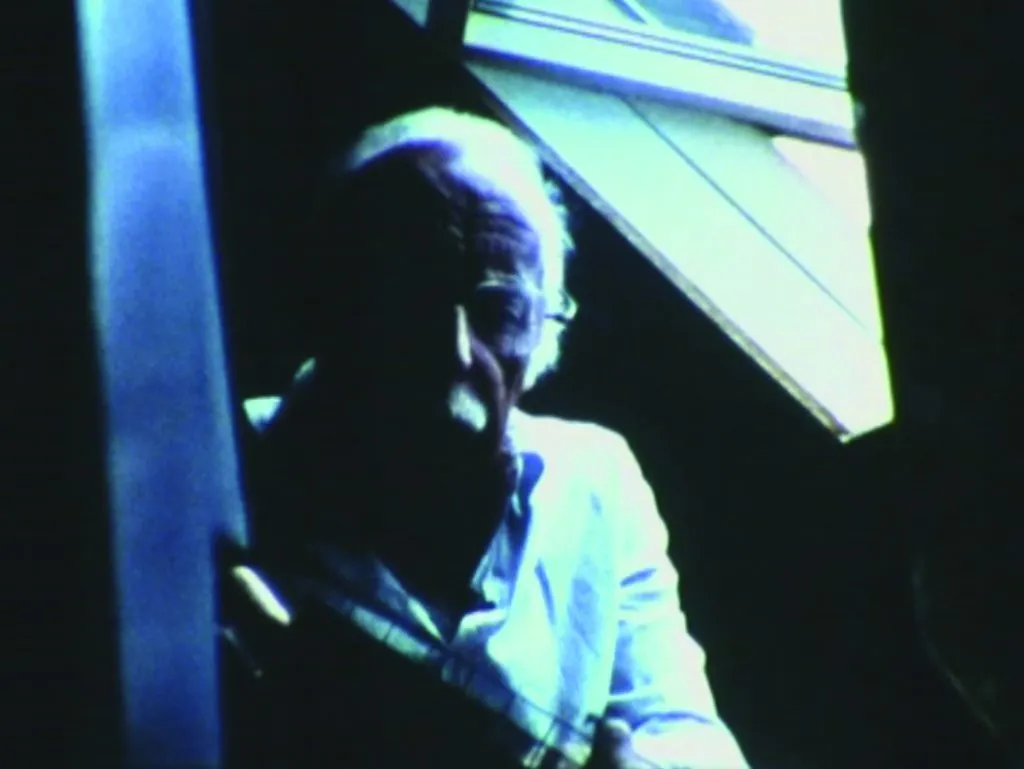
K.B.: Moreover, the way you film Andrzej Turowski, the historian and expert, introduces a certain dissonance. He is not seated at a lectern but shown in the intimate surroundings of his home, walking through his garden, and filmed in a distinctive colour palette. As a result—I would even say—an atmosphere of suspension and distance is created.
A.B.: I wanted to create the character of Andrzej Turowski the spy—to introduce a detective thread and an atmosphere of the uncanny and the mysterious into the story. I remember a Soviet television series from my childhood entitled Seventeen Moments of Spring, whose main character is Stierlitz, a Russian spy in Germany. It is set during the Second World War. I drew on the poetics of that series to construct the professor's film persona.
K.B.: And where did the impulse for this historical turn come from?
A.B.: I find it difficult to speak of a turn. Historical questions, the construction of histories and the problematic nature of history as such have always interested me. It is understandable that, because my works emerged in parallel with critical feminist discourse in Poland, they were perceived almost exclusively through that lens—not so much as illustrations as statements on the same subject in another medium. I do not resent that; it gave me strength. But I can now see the limitations of a single critical perspective, of interpreting an artist's entire body of work through biographical experience or gender. I hope the field of criticism surrounding my work will expand so that its overlapping threads and subjects become visible: the interpenetration and recurrence of certain questions, the ambiguity of its approaches. I am glad my work accompanied feminist criticism, and I hope it will continue to do so, but I would also like to enter other spaces of discussion.
K.B.: That is interesting, because your case clearly illustrates the changes in the paradigms of art criticism in Poland and the tensions within the very language, concepts and signs used to decode the forms and content of the visual arts. Looking today at your videos and sculptures—both earlier and later works—one can clearly see how an interest in corporeality and gender intertwines with an interest in the historical formation of individual and collective identities, social roles and tasks. So when does the train appear?
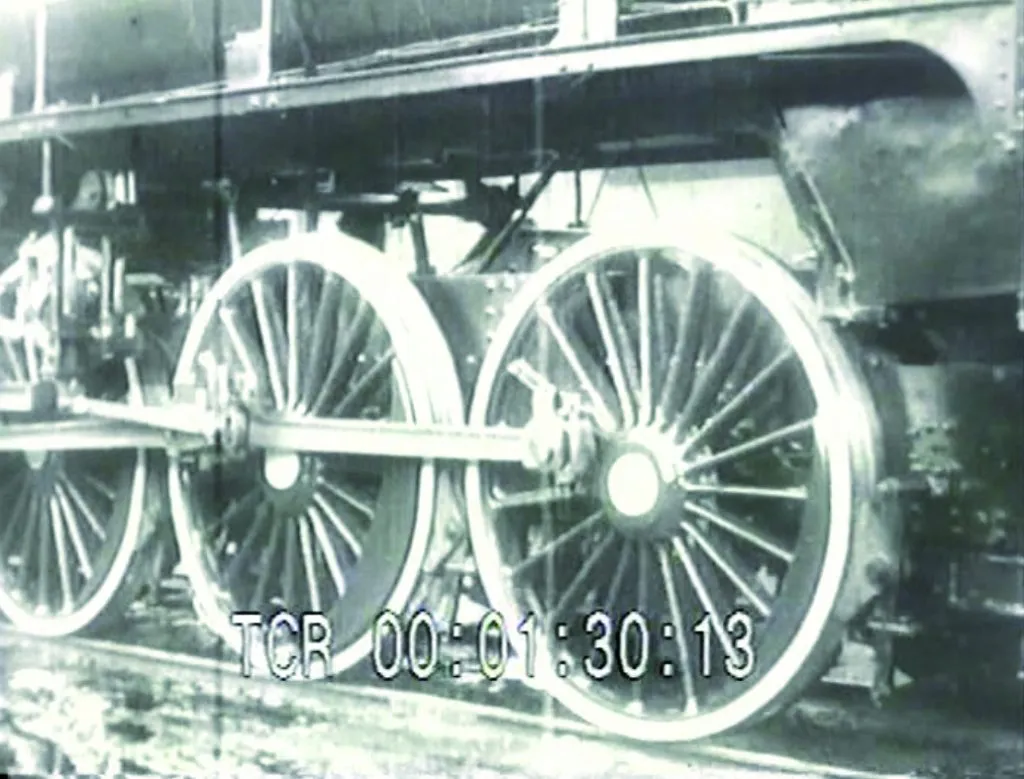
A.B.: Agitprop trains had been on my mind for a long time. It began with the project Revolution Is Not a Dinner Party. I was then thinking about the visual signs of emancipation and revolution and where they had come to us from. I made a series of sculptures inspired by Jean-Luc Godard's La Chinoise and wondered whether we in this geographical region had developed a sign of our own. One could say that the Solidarity logo fulfilled this role, but in my view the Solidarity revolution was nevertheless appropriated by the cross and church iconography. The iconography that came from Russia after the October Revolution, in turn, was something foreign and hostile to us. Following these trails, I formulated my questions about the source. Around that time I spoke to Michał Suchora, who had learnt about agitprop trains at a lecture at the Institute of Art History. I very much wanted to see that train—to find more reproductions and materials. But I found only two or three photographs and drawings. Even then I knew that I would have to travel to the Moscow film archive and search there for traces of the train. As I continued studying the subject, I wondered which medium to choose for my project about the movement of revolutionary ideas into Poland, with the train as their embodiment. I had many conversations with art historians and curators about my new idea. During one of them, the suggestion arose that this agitprop train should come to Łódź. That finally determined that film would be the medium in which I presented the story. At that stage, of course, I did not yet know how it would be constructed or which film genre it would eventually inhabit, and I did not even dream of working with Andrzej Turowski. Preparations for the project—building alliances around the trains—lasted two years. The train travels to Berlin and ends up in Koluszki. The basis for the screenplay is Andrzej Turowski's The Locomotive of History, a book he wrote after being invited to participate in the project. The screenplay was also co-written by Florian Nowicki, Marcin Kowalewski and Wiktor Rusin.
K.B.: Did you decide on a documentary format from the outset? How did you arrive at the form?
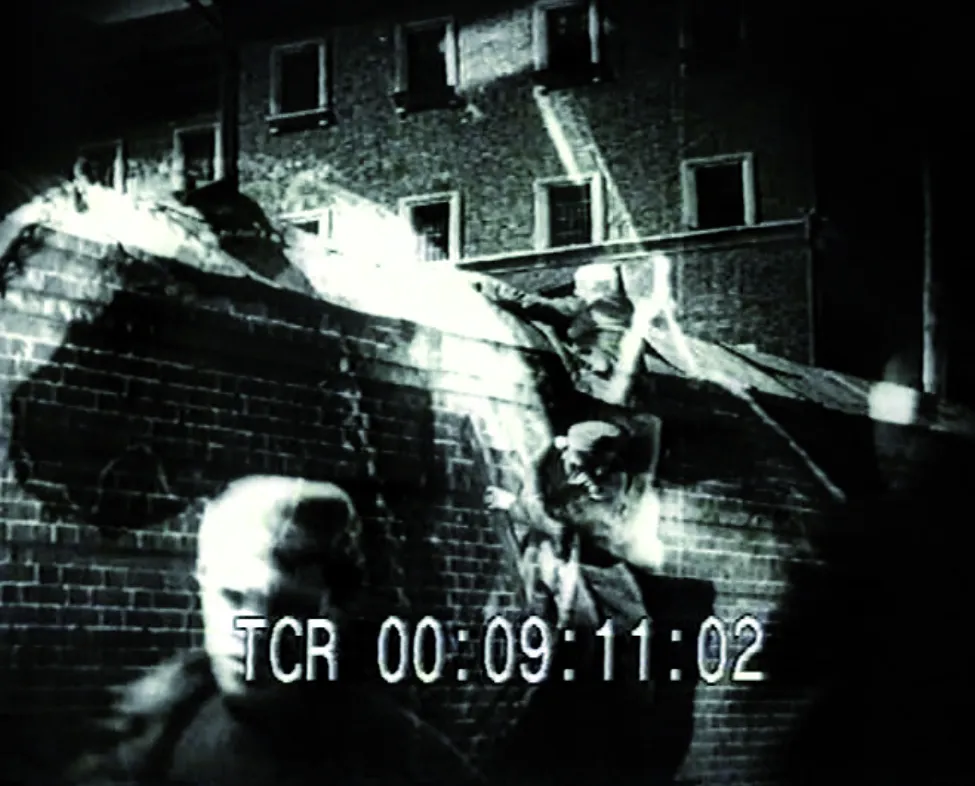
A.B.: I knew I had to see this train and that I should look for it in Russia. I therefore went to the archives in search of documents. The experience of being in an archive and watching films from the period shaped my imagination. I found unique films directed by and starring Vladimir Mayakovsky, completely unknown in Poland—agitprop films incorporating elements of animation. I was moved by the enthusiasm and exhilaration of those years, not yet tainted by terror. Contemporary Moscow itself—oversized and hostile to pedestrians—also had a considerable influence on the form of the work. I knew it would be a story of a historical defeat that might bear fruit as a victory in the future. As always when working on a project, I searched especially in places where I found gaps and things left unsaid.
K.B.: Indeed, Conquerors of the Sun is a genuine exercise in imagination. You hook your story onto precisely those gaps, creating a chain of images and meanings that forms a potential, truly alternative history. I wonder by what route you arrived at this deconstruction or pastiche of documentary—to a much more narrative form, in some sense more serious (even if entirely unserious), and finally more distanced because ostensibly less emotional or personal.
A.B.: I have never been particularly attached to defining what I do. It seems to me that the films I made in the 1990s are also documentaries, but very rough, raw ones, unfettered by the rules that govern documentary. I filmed them myself, practically without a budget, in my kitchen and bathroom. Their protagonists were women from the neighbourhood. Conquerors of the Sun, by contrast, is a fake documentary highly conscious of its form. In a sense, it is also a statement about the artistic and political significance of form as such. I edited the film with the well-known documentary maker Grzegorz Pacek, and he kept me in line by repeating: in a documentary, you must present this in such-and-such a way. If you do it differently, you will break the rules governing the genre. I usually mock such rules by mixing styles and conventions, but this time I concentrated on the language through which particular content is instilled in us. I was interested, for example, in the monotonous voice of a narrator who presents selected information as objective, and in the conditions under which we fail to ask who is speaking, from what perspective and to what end.
K.B.: As I have already mentioned, you have largely withdrawn from Conquerors of the Sun. It is much harder to follow personal threads here, let alone derive them from your experience. And yet, as you yourself said, you are almost omnipresent. It is you who powers this historical and documentary (mock-documentary) machine; it works thanks to you. This is an extraordinarily subtle presence of the artist's gesture, rearranging the pieces in a public discussion of matters that are by no means important only to our knowledge of art. Do you not feel that your chosen format places you in a somewhat different company? In the order of a different debate? After all, the avant-garde, the collection of the Muzeum Sztuki in Łódź, Strzemiński, Kobro, and the existence or non-existence of the Museum of Modern Art in Warsaw are fundamental questions for the shape of this culture and the identity of its community, not only its artistic community.
A.B.: What mattered above all was getting this train through. Only making the work enabled me to pose all the questions and issues I had so wanted to formulate—to begin a conversation about revolution. I regard Conquerors of the Sun as a very personal statement on the evolution of egalitarian emancipation and a profession of faith that revolutions which end in failure always lead us towards self-knowledge and social freedom. I believe in this history—above all, that it is some kind of history. That is also why I introduce contemporary threads into the film, including footage from Occupy Wall Street demonstrations.
K.B.: It seems clear that what is at stake for you is not some episode in art history, but the present and the place of art in today's world. Because above all this is about art.
A.B.: But not only art. My statement is not self-referential. Above all, I am concerned with social processes.
K.B.: How, then, do you see your role?
A.B.: I am attached to this kind of expression. It is closest to me, and I think it is what I do best. I do not know whether I could be a politician. That does not mean I am indifferent to art's political efficacy. In the 1990s, I made a conscious decision not to concentrate particularly on form; only the message interested me. That now seems rather naïve, because clearly I was making a choice of artistic language. Today I do so not only more consciously but also with greater demands on myself. I express my political engagement through my art. I do not have the temperament of a political activist or campaigner. That is also why I resigned from the Green Party, which I had joined because I believed the party needed support and that doing so mattered. But in that kind of activity I do not entirely feel like myself.
K.B.: Have you experienced a crisis? What one might call a crisis of efficacy? A moment, that is, when it turns out that everything you do is meaningless or does not work as you would wish—that the language of art does not work, does not lead to real change, and creating is just playing in a sandpit, a party for a small circle of friends.
A.B.: No, not especially. It seems to me that the change is very clearly perceptible. The consciousness of this community has undergone far-reaching transformations. Who women were—take the protagonists of my films from the 1990s—and who women are and are becoming today, how they perceive and define themselves: that is evidence of an extraordinary change. After all, not so much time has passed since the 1990s.
K.B.: That is true. Perhaps the problem, then, is our impatience.
A.B.: Perhaps. When I made Ecstatics, Hysterics and Other Saints, the response and reactions of women who saw the film far exceeded those of institutions in Poland. I think they considered the problem had been addressed too directly, too explicitly. It was not a great success (apart from the exhibition Global Feminisms at the Brooklyn Museum in New York, where it was shown alongside works by artists including Tracy Emin, Elke Krystufek, Kara Walker and Pipilotti Rist). Socially, the film was quite successful. I received numerous letters and proposals for meetings and conversations. Women who had self-harmed wanted to show me their scars. Many of them took me by surprise; I was unable to meet their needs. On the other hand, critics such as Iza Kowalczyk found the film too formal and, in that sense, insufficiently blunt. I agree that it was ‘pretty’ or formally refined, but that does not mean it aestheticised the problem.
K.B.: A problem, let us stress, that presents an artist with a considerable challenge—difficult if not impossible to meet—and at the same time compels a confrontation with the problem of direct engagement and with a certain utopia of liberation from dominant cultural forms and conventions. How does that utopia relate to Conquerors of the Sun?
A.B.: In his latest production, René Pollesch advanced the thesis that every success story is a capitalist story. I nevertheless believe that this accumulation of defeats and failures leads us somewhere. I deliberately constructed the film in such a way—and I hope this will be legible—that it is not only an endless story but also an inevitable logic of events that in some sense saves us. This is not, of course, a redemptive narrative. I always undermine myself to some degree; I make jokes not only about the lofty subjects of culture or art, but also about my own faith or naïveté. That always tempts me. After all, Conquerors of the Sun as a mockumentary is a truly camp film, which does not mean that it is not a serious statement. I am extraordinarily curious to see how the project will be received by critics and art historians as well as by the guardians of the avant-garde and revolutionary treasure. I hope we shall have plenty to discuss.
Warsaw, 11 January 2012