
Glory to the Engine Drivers! (On Andrzej Turowski’s Subversive Book)
Ewa Domańska
Władysław Broniewski
A Word on Stalin
‘Revolution—the locomotive of history’…
Glory to its engine drivers! […]
The train of history rushes on,
the century-semaphore flashes.
Revolution needs no glory,
no grandiose metaphors.
What it needs is an Engine Driver. […]
The victorious people create history.
Glory to facts!
‘Although my book has the word steam locomotive in its title, it is not a locomotive. It is more like a train of carriages deprived of motive power and, through various “laws” and accidents of history, shunted onto a siding.’
Andrzej Turowski1
In a conversation with Adam Mazur, Andrzej Turowski describes his book in the following terms: ‘Parowóz dziejów is a metaphor for international revolution, a historiosophical vision of a victorious future, a political utopia burnt out on a railway siding in Koluszki. Thus, it is also a critique of this tradition’2. In fact, the work is at once a symptom of this well-known art historian’s earlier lapse into mythologising knowledge about revolution and an effect of his active participation in creating the myth of revolution in historiography, as well as an attempt to demystify that myth with the same mythologising strategies that created it. This process is marked by Turowski’s declared turn, in the aforementioned conversation, from revolution to revolt (that is, from an interest in revolution that changes reality to rebellion and dissent as strategies of crisis that stave off the catastrophe of democracy); from the battlefield to spectacle; from paradigm to performance3. One might therefore say that Parowóz dziejów is a book of reckoning, offering a critical, detached and not unironical view of the author’s position to date. It is also a book about the meaninglessness of history, no longer permeated by any utopia.

Turowski’s approach is characterised by a subject-centred view of history. This is manifested not only in presenting historical phenomena through the prism of their agents (the protagonists of events), but also in understanding the historian as an active subject of historical research. Edward H. Carr, author of the classic work of historical reflection What Is History?, believed that ‘when we begin to concern ourselves with history, our first concern should be not the facts which it contains, but the historian who describes them’, because ‘the historian is part of history’4. This article will therefore be concerned primarily with Andrzej Turowski—the historian (of art) and author. His book, I believe, allows us to reconstruct the philosophy of history and research approach of this expert on the avant-garde—as they emerge from the publication under discussion against the background of his earlier works on the subject—and it is this challenge that I shall undertake here as a methodologist of history. In the approach proposed here, the titular ‘Parowóz dziejów’ and its fortunes become a metaphorical representation not only of the history of the revolution in Russia and of the art history of that period considered from a political perspective, but also of its creator, Turowski himself, and perhaps even an allegorical representation of human life.
The Myth of Revolution
Viewing the world through the myth of revolution makes it possible to see the historical process in terms of radical changes and upheavals. It is worth noting here, however, that revolutions understood as turning points not only allow time to be divided into a clear ‘before’ and ‘after’ an event, but also introduce a certain cyclicality into historical thinking (Latin revolutio—rotation, cyclical change), as well as evaluation and a hierarchy of importance among the facts associated with it. Historians like revolutions because they help them to periodise history, select and organise facts, introduce narrative tension and a sense of things happening, and enable them to interweave strands and identify historical agents, who are represented as particular figurations of subjectivity (the tyrant, hero, assassin, traitor, victim, ‘children of the revolution’, bloodthirsty people and so forth)5.
Turowski has always been interested in revolution and the revolutionary potential of art—that is, whether and how art can change history. When the author points out in his statements that he omitted the word ‘revolution’ from the book’s title, ‘because it is not the subject of my reflections’, he does so because, in his view, it no longer possesses its former potential to propose a new utopia and thus to renew social life. Instead, the author of The Great Utopia of the Avant-Garde proposes concepts less charged with transformative potential, such as dissent, indignation, disobedience, rebellion or revolt. Turowski nevertheless presents a particular understanding of revolt, one closer to Julia Kristeva’s approach than to Albert Camus’s. Drawing on Sigmund Freud, the author of Sens et non-sens de la révolte proposed three figures of revolt: as transgression of a prohibition, as repetition and working-through, and as displacement and play6. Kristeva doubts the potential of revolt. In her view, neither authority (given the crisis of authority) nor a law for revolt to transgress exists any longer. What remains, therefore, is spectacle, performance. From this diagnosis emerges the French scholar’s idea that the ‘culture of revolt’ (une culture-révolte) and revolt itself as a factor stabilising the subject must be rethought. Similarly, for Turowski, rebellion and provocative resistance are effects of crisis and become a strategy for the survival of democracy. The scholar no longer believes in revolution (radical change), but leaves room for resistance to the forces constraining the reality around him. Art is no longer meant to change the world, but to provoke unease and, above all, to be disobedient towards dominant power.
In fact, Turowski defends the right to rebel against a revolution that no longer fulfils its function in the contemporary world.
If one were to identify the keywords defining Andrzej Turowski’s interests and philosophy of history, they could be encapsulated in the concepts of utopia—revolution/revolt—the avant-garde/disobedient art. Underlying this vision of history is the idea of conflict as the driving force of the historical process and, consequently, a teleological course of history, its purposiveness directed towards a particular utopia. For the Russian avant-garde studied by Turowski, that utopia was international revolution achieved through art, which was to lead towards the radiant future of communism; for Turowski himself, it is now revolt, which builds democracy—understood as an open process—and protects it from catastrophe. In both cases, artists play a significant role: in the first, it was the avant-garde; in the second, ‘radically disobedient art’. This confirms Hayden White’s theory that ‘historical stories are always moral allegories’, woven around various kinds of literary plots, such as tragedy, comedy, irony, farce and satire. The events they present are narrativised in such a way as to invest them with a meaning corresponding to the plot. In this way, a set of events that is chaotic in reality acquires coherence and meaning7. The more coherent a narrative and the more saturated with meaning, the more plausible it is.
The Reality Effect
The charm of Andrzej Turowski’s book lies in its plausibility; in the fact that it produces what Roland Barthes would call the ‘reality effect’ (l’effet de réel)8. In keeping with traditional principles for constructing historical narrative, facts in the book under discussion are linked through logical relationships of cause and effect; genetic explanation predominates; it is characterised by a documentary approach—the scholar constantly stresses his command of facts supported by archival research—and the whole is governed by a desire to discover ‘what really happened’ to the alleged agitprop train which, the author claims, was called ‘Parowóz dziejów’9. The narrative is positively crammed with credible facts and photographs documenting them. The fact that the ‘Parowóz dziejów’ strand is Turowski’s invention is indicated by the absence of any mention of this train in his well-known and highly regarded book on Malevich, based on exceptionally rich archival material, even though the author states that the documents concerning it came into his possession in the late 1990s, precisely when that book was being written. The two books share protagonists and situations. In Parowóz dziejów , for example, Turowski mentions that, during his stay in Warsaw in March 1927, Malevich received information about the train’s fate from his brother Antoni10; the book on Malevich, which meticulously reconstructs his life and work, also mentions the meeting with his brother, but says nothing at all about the train11. There is much other overlapping information, making the whole plausible, although the story of a mysterious folder containing documentation of ‘Parowóz dziejów’ arouses suspicion from the outset. It contained, for example, a photograph captioned in the book Train Disappearing into the Mist of an Autumn Morning12, allegedly showing the departure of the train that was the subject of the historian’s investigation. The photograph, which Turowski writes was taken by ‘an unknown author, probably some intelligence officer’, can in fact be found on a Czech website—cited, incidentally, in the bibliography—which contains landscape scenes photographed in 2008. Similarly, the photograph showing carriages of the supposed ‘Parowóz dziejów’ on fire in a railway siding at Koluszki in 193013 appears on the website of the Polish State Fire Service Headquarters—the site’s address is also given in the bibliography—and indeed depicts a fire in a siding, albeit in a different place and at a different time. The fabrication of sources is thus documented. The author therefore gives readers the opportunity to verify the information provided. This indicates that his aim is not to deceive them, but rather to draw them into a detective’s investigative work. Turowski knows that every professional historian will want to examine sources deemed suspicious, and gives them the opportunity to check which sources are credible and which are not.
In light of Turowski’s declared purpose for the book, however, the production of facts is of no great consequence, because what matters most is not so much the truth of individual sentences as the truth of the historical image—a certain whole revealed in generalisations, topoi and plot—and the cognitive truth of metaphor, with the fate of ‘Parowóz dziejów’ serving as a metaphor for human life. The historian and theorist of history Jerzy Topolski observed that historical narrative is not governed by the rules of classical logic, according to which a proposition can be true only if all its components are true. He formulated a principle that he called the ‘paradox of historical truth’. It states that ‘1) the truth of all the sentences composing a historical image (…) does not guarantee the truth of that image; 2) a historical image may remain true even if some of its constituent sentences prove false; 3) a proportionally greater share of true sentences in a historical image does not guarantee that it is more truthful’14. Contrary, then, to Turowski’s intentions—by introducing fictional characters and producing sources he wished to expose the ruin of modernist myths, including the myth of scholarly history based on ‘hard facts’—in light of tendencies in contemporary theory of history that emphasise the constructivist foundation of historical knowledge, and given academic history’s absorption of unconventional histories experimenting with various modes of literary representation, the author has done nothing to undermine his scholarly authority, although he himself claims that ‘this essay (…) will certainly weaken my position in the field of “hard” knowledge’15. Instead, by acting in this way he aligned himself with a current characteristic of sceptical postmodernism: reflexive or interpretative history, which—like reflexive anthropology—critically examines how knowledge is produced within its field, reveals the social context of its production and its ideological entanglement, exposes the laboratory of research with all its imperfections, and experiments with various ways of representing the past (microhistory, the historical novel, comics and fictional historical film).
A theorist of history, guided among other things by the arguments in Charles Langlois and Charles Seignobos’s French textbook Introduction to the Study of History (1898), a classic of historical reflection, knows that, as its authors write, ‘scientific truth cannot be established by testimony’, ‘an abundance and precision of detail (…) does not prove that facts are true’, and ‘[c]riticism [of a source—ED’s note] cannot prove any fact; it provides only probability’16. In referring to non-existent sources and writing about the problems associated with studying them, Turowski invokes the topos of ambiguous historical sources from which historical facts—that is, events subjected to description—are reconstructed. He writes: ‘The texts contained in the folders held many mysteries and omissions, making it necessary to read them “between the lines”, search for contexts, speculate, exercise the imagination and construct interpretations. Nor were they complete; they were often one-sided and full of gaps, and lacked temporal continuity. I quickly realised that they provided no unequivocal answer either to the questions that arose during reading or concerning the course and success of the mission. They did, however, reveal an unknown side of the history of the Russian and international avant-garde, making it possible to view its history from another angle and verify a number of events about which so much has been said. Material traces emerging from the documents, or perhaps merely literary inventions, thus became a critical method both for a historical reality reconstructed on the basis of facts and for fictional narratives created about it’17.
As the passage quoted above shows, although the reflection concerns non-existent sources—the basic information about them is untrue—the topos of the historical source that emerges from it, along with its ambiguity and incompleteness, meaning the image of the phenomenon, is widely shared by historians; that is, it is true in the consensual sense. Likewise, the image of the revolution in Russia and the involvement of artists in propagating its ideas is true—that is, confirmed by sources and the available literature—even though individual factual statements are false. Also true, in the sense of existential truth, is the moral arising from the fate of ‘Parowóz dziejów’: once a powerful force driving history, it became a train of carriages deprived of motive power, exposed to forces beyond its control and shunted onto a siding18.
Of course, the stereotypically invoked distinction between historian and writer remains in force: a historian may not invent facts, as Turowski permits himself to do, while stressing that his book is not a scholarly work but a historical tale, an essay. One might therefore say that the truth of a historical narrative lies not only in the mechanisms by which it is verified, but also—and perhaps above all—in the researcher’s intellectual virtues. Their professional approach, technique, reliability, thoroughness, critical judgement and measured conclusions, as well as openly situating themselves within the narrative—and revealing the social and political conditions under which knowledge is produced—together with openly identifying the shoals encountered in the course of research, fundamentally affect their ability to create both true images of the past and true individual factual statements. The truth of a narrative is therefore conditioned not only by its correspondence with past reality as that reality appears in various representations based on the available sources, but also by the historian’s correspondence with themselves. Indeed, the history reflects the historian.
‘Parowóz dziejów’ and ‘the Locomotive of History’
In the context of the premises of the ‘subversive’—as Turowski calls it—book Parowóz dziejów19, there is another reason to argue that it is not so important whether certain events took place or not, whether the author invented the existence of an agitprop train called ‘Parowóz dziejów’ and the character of Yuri, or whether he ‘fabricated’ the many documents that came into his possession. What matters, rather, is the manner in which the past is represented: the author’s balancing on the boundary between fact and fiction, and his creation of a ‘reality effect’ that replaces the ‘hunger for reality’ characteristic of modernist history. Crucial here is the use, mentioned at the outset, of the myth of revolution as the foundation of the historical tale, together with the introduction of ‘Parowóz dziejów’ as its leading symbol. Its history portrays the fate of revolution, which—like other great ideas, such as love—begins with metaphor and ends in irony. It is worth recalling here Karl Marx’s famous statement that historical facts and figures occur twice: the first time as tragedy, the second as farce20. For Marx, revolutions are tragicomic.
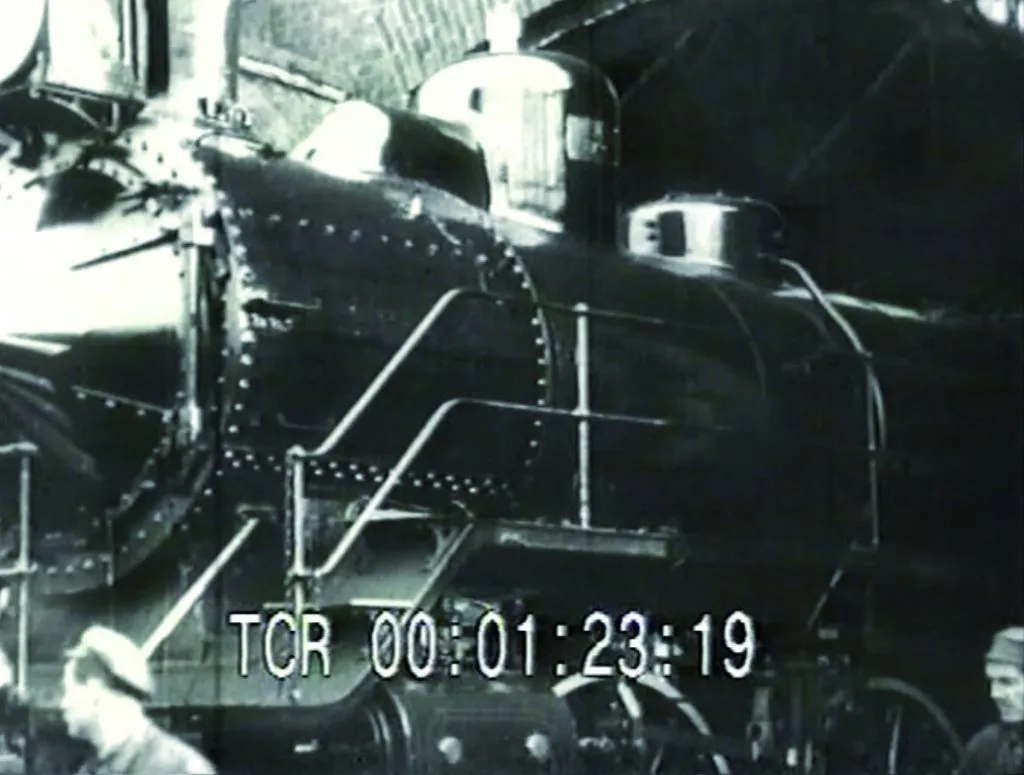
It was Marx who, in The Class Struggles in France, 1848–1850 (1850), compared revolution to the locomotive of history (Die Revolutionen sind die Lokomotiven der Geschichte)21. Andrzej Turowski appears to follow this line of thought in his book, where revolution becomes merely a ‘political spectre’, present in the non-existent documents of a certain Yuri; it is transformed into a ‘fallen myth’, a ‘dead metaphor’, a ‘non-operational concept’ that does not fit the present day. This understanding is also suggested by the seemingly insignificant translational shift through which Marx’s original formulation, ‘the locomotive of history’, becomes the titular ‘Parowóz dziejów’. A locomotive is a broader concept than a steam locomotive—locomotives are divided by their source of power into steam, diesel and electric locomotives, among others; moreover, replacing the concept of the locomotive with the steam locomotive also changes the grammatical gender in Polish (lokomotywa is feminine, parowóz masculine). Thus, if we employ the translation ‘revolution is the locomotive of history’, in Polish we remain exclusively within a feminine gender reference, excluding the masculine linguistic element. The choice of the translation ‘revolution is the steam locomotive of history’ is entirely understandable in the context of Turowski’s philosophy of history. Such a translation disperses what had previously been an unambiguous gendering: in Polish, parowóz is masculine, while dzieje is neuter.
Intellectual speculation suggests the following interpretation: revolution, as the feminine element—femininity understood here, for example, in the sense of cyclically beginning anew, of a fundamental change of order through the creation of new principles of being—must be masculinised, must assume a masculine role; the locomotive must become a steam locomotive, in order to become the driving force of ambivalent history, which in itself is neutral, disordered, inert, devoid of immanent agency and meaningless. In this way, however, the feminine life force (zoe) inherent in revolution is transformed into masculine life in culture (bios) and thereby condemned to the processes that permeate culture. Revolution understood as an instinct for survival—cyclical self-renewal—cannot be fulfilled, because it is blocked by culture, whose interest lies in permitting only those changes that result in progress in the cultural sense. In this way, revolutio becomes evolutio. Revolution is transformed into revolt, rebellion, disobedience and indignation.
Positivist Atavism
Also interesting is the substitution of the apparently synonymous Polish concepts historia and dzieje. For this conceals the very essence of the constructivist foundation of historical knowledge, encapsulated in the relationship between res gestae (dzieje, past reality) and rerum gestarum (a tale about events; history understood as historiography). In what I believe to be the more or less intentional use of the concept dzieje rather than historia in the title—and in the fabricated name of the train—there nevertheless remains the ‘hunger for reality’ that Turowski disavows.
Contemporary historiography contains many unconventional works by well-known academic historians that flirt with the literary dimension of historical writing. In this context, it is worth mentioning, for example, the intriguing version of the historical novel offered by Simon Schama, who, like Turowski, introduces invented characters into his narrative and ‘fabricates’ sources22. This allows the authors to confirm that history is ‘second-order’ knowledge and is, by its very nature, burdened by ambiguity, equivocality and cognitive relativism. Although Turowski refers to non-existent sources, his ‘historical tale’ or ‘historical detective novel’ is nevertheless marked by a documentary approach and an attachment to professional historical research, for which there is no history without sources and the entire scholarly apparatus that makes it possible to verify the facts presented, and which appears in the text in the form of notes, references to archival materials, a bibliography, a discussion of the literature and so forth.
It is clear that Turowski respects sources and has an excellent command of the historian’s research methods; that is precisely why he can afford this frivolous provocation, which is a kind of artistic performance. This probably one-off ‘prank’ will not undermine his position as an internationally respected specialist among art historians, whose knowledge is firmly grounded in the archives.
As I mentioned above, the book Parowóz dziejów embodies the author’s declaration, noted at the outset, that his approach has changed; it is therefore a sign of transformation. Turowski, for whom scholarly activity was an ideological battlefield, turns it into spectacle, while the change in attitude entails a change in style and form of expression. Even so, the mass of corroborated facts cited in the book indicates that Turowski continues to attach great importance to basic information (what? who? where? when?), which—as Topolski once wrote—constitutes the historian’s ‘realist alibi’. The Poznań methodologist stressed, however, that basic information, which in some sense enables access to past reality, constitutes a realist alibi but should not be confused with realist reference23. This attachment to basic information testifies to a ‘hunger for reality’ satisfied by the ‘reality effect’ produced in the narrative. In this way, the hunger for being is replaced by a compensatory hunger for knowledge.
Turowski’s aim is ‘to challenge the modernist belief in the need for reality and postmodern nostalgia for a non-existent world’24. As an experienced and adept tracker of facts and a renowned scholar of the Russian avant-garde, he knows perfectly well that historical research does not lend itself to a clear distinction between facts and fictions25. He also writes that the history of ‘Parowóz dziejów’ is full of ‘melancholy in the face of the non-existence of its founding source and ultimate purpose’26. In doing so, however, he contradicts the premises of the ‘poetics of historical writing’ to which he himself refers27. According to those premises, it is the historian who, in creating a narrative, decides which events to recognise as the origins of the phenomenon or process under discussion and which to identify as giving it meaning—facts that change the course of events. The non-existence of a source founding a history and of its ultimate purpose is, after all, not a problem of the past, which in itself is a chaos of events, but of the historian’s attitude: the historian who does not wish, does not know how, or is unable to find meaning in it and identify the key facts that construct the plot.
Turowski’s problem is the ‘black hole’ between past and future, which he also describes as ‘absence’ or ‘loss’28. This feeling of being suspended in the gap of the present, between a demythologised past—the loss of revolutionary utopia—and fear of an uncertain future—the possible catastrophe of democracy, against which an attitude of rebellion as an expression of crisis is meant to protect us—results in the adoption of a position full of doubt: resistance that may express a sense of lacking agency, an inability to influence the course of events. If we cannot create reality, we can always create stories about it. Turowski therefore stages a performance: through his book, he provokes, wishing to test once again whether a scholar—and also an artist—can change the world, including that of art historians, by inducing a crisis and arousing unease. I hope that the author’s performance will prove performative.
Glory to the Engine Drivers!
Glory to Facts!
Dr hab. Ewa Domańska, professor at the Institute of History, Adam Mickiewicz University, and, since 2002, Visiting Associate Professor in the Department of Anthropology at Stanford University in the United States. Her work concerns contemporary theory and the history of historiography, as well as the comparative theory of the humanities.
1. Dziura w całym. On Parowóz dziejów, art history and contemporary institutions: Adam Mazur in conversation with Andrzej Turowski, [in:] Anna Baumgart Conquerors of the Sun/Andrzej Turowski Parowóz dziejów, [exhibition catalogue] Atlas Sztuki 2012, No. 56, p. 12.
2. Ibid., p. 11.
3. Ibid., pp. 11–12.
4. Edward H. Carr, What Is History?, translated into Polish by Piotr Kuć, Poznań 1999, pp. 33 and 49.
5. Cf. Jerzy Topolski, The Myth of Revolution in Historiography, [in:] idem, How History Is Written and Understood: The Mysteries of Historical Narrative, Warsaw 1996, p. 217 ff.
6. Julia Kristeva, Sens et non-sens de la révolte: pouvoirs et limites de la psychanalyse I, Paris 1996.
7. Hayden White, Historiography as Narrative, translated into Polish by Arkadiusz Żychliński, [in:] idem, Historical Prose, ed. Ewa Domańska, Kraków 2009, p. 143 ff.
8. Barthes argues that history is a self-referential discourse, a false performative discourse that creates a ‘reality effect’. ‘The prestige of formulations such as it happened is endowed with truly historical weight and grandeur. Our entire civilisation has a weakness for the reality effect, documented by the development of particular genres such as the realist novel, the private diary, documentary literature, the press brief, the historical museum, displays of objects from the past and, above all, by the mass development of photography, whose sole distinguishing feature in relation to drawing is its attestation that the represented event really took place.’ Cf. Roland Barthes, The Discourse of History, translated into Polish by Krzysztof Jarosz, ‘Er(r)go’ 2001, No. 3, pp. 113–114. Similar ideas can be found in Michel de Certeau, who drew on Barthes, The Writing of History, translated into Polish by Krzysztof Jarosz, ‘Er(r)go’ 2001, No. 3, p. 132 ff.
9. Andrzej Turowski, Parowóz dziejów, [in:] Anna Baumgart, Conquerors of the Sun, Andrzej Turowski, Parowóz dziejów, Warsaw 2012, p. 39.
10. Andrzej Turowski, Parowóz dziejów, op. cit., p. 85.
11. Andrzej Turowski, Malevich in Warsaw: Reconstructions and Simulations, Kraków 2002, p. 130.
12. Andrzej Turowski, Parowóz dziejów, op. cit., fig. 48, p. 70.
13. Ibid., fig. 58, p. 12.
14. Jerzy Topolski, Truth and Objectivity in History, [in:] idem, Theory of Historical Knowledge, Poznań 1983, p. 480.
15. Dziura w całym, op. cit., p. 11.
16. Charles V. Langlois and Charles Seignobos, Introduction to the Study of History, translated into Polish by Wanda Górkowa, Lviv–Warsaw 1912, pp. 176, 179 and 214.
17. Andrzej Turowski, Parowóz dziejów, [in:] Anna Baumgart, Conquerors of the Sun, Andrzej Turowski, Parowóz dziejów, op. cit., p. 17.
18. Dziura w całym, op. cit., pp. 11–12.
19. ‘This summer I have been concerning myself somewhat with historical fact (and fiction), and I have even written a subversive little book. (…) My historical tale is a kind of provocation, directed not only at myself but also at the art-historical community.’ Andrzej Turowski to Ewa Domańska. Email dated 4 September 2011.
20. Karl Marx, The Eighteenth Brumaire of Louis Bonaparte (translator not named), Warsaw 1980, p. 11.
21. Polish editions of Marx’s book Die Klassenkämpfe in Frankreich 1848 bis 1850 offer different translations of the phrase Die Revolutionen sind die Lokomotiven der Geschichte: either ‘Revolutions are the locomotives of history’ (1948) or ‘Revolutions—they are the locomotives of history’ (1979)—italics in the original. Cf. Karl Marx, The Class Struggles in France, 1848 to 1850 (translator not named), Warsaw 1948, p. 117, or idem, The Class Struggles in France, 1848–1859 (translator not named), Warsaw 1979, p. 146. Interestingly in the context of the present discussion, Marx begins his chronicle by noting that ‘With the exception of only a few chapters, every major section of the chronicle of the revolutions from 1848 to 1849 bears the title: Defeat of the Revolution!’ He nevertheless stresses that ‘[i]t was not the revolution that perished in these defeats: what perished were the survivals of pre-revolutionary traditions.’ Cf. Karl Marx, The Class Struggles in France, 1848 to 1850, op. cit., p. 29.
22. I analysed Schama’s approach in: Simon Schama: History as Reality in the Realm of Imagination, [in:] Ewa Domańska, Microhistories: Encounters in the Interworlds, Poznań 2005, p. 222 ff.
23. Jerzy Topolski, Basic Information as the Realist Alibi of Narrative, [in:] idem, How History Is Written and Understood, op. cit., p. 383.
24. Andrzej Turowski, Parowóz dziejów, [in:] Anna Baumgart, Conquerors of the Sun, Andrzej Turowski, Parowóz dziejów, op. cit., p. 17.
25. Ibid., p. 10.
26. Ibid., p. 101.
27. Ibid., p. 10.
28. Ibid., p. 101.