
The Imperative
Anna Baumgart in conversation with Adam Mazur
Adam Mazur: In recent years, a great many theoretical texts have been written about your work, while sources concerning your artistic biography have remained scarce. I would therefore like to take this opportunity to fill that gap and ask you about the key events in your artistic life and the facts of your private life that have been significant for your art. I hope this will allow me to understand your art and your position better. Let us begin at the beginning. Was anyone in your family an artist?
Anna Baumgart: People spoke of artistic talent on my mother’s side of the family. Uncle Jerzy was apparently an excellent draughtsman, but he was a doomed soul whose life spun out of control. He never married. He wore a leather jacket and rode a motorbike. My aunt Jagódka and Grandmother Anna embroidered beautifully, grew flowers and sewed. Apart from them, there were no artists or people in the liberal professions in my family. There were teachers, librarians and railway workers… That is probably why I struggled for a long time with a sense of guilt about not having a regular job. It is a terrifying feeling to be responsible for every hour of your life, when no one but you organises it.

A.M.: So how did you come to be an artist?
A.B.: I went to an art secondary school without being aware of what that entailed. I did not think of it as choosing a particular path. The school was in Bydgoszcz, and there we immediately turned into artists. I remember it fondly. We held the humanities and sciences in contempt. Only art mattered: the obligation to show that one was an artist, to manifest it with one’s entire being. We spent hours talking about art and Dostoevsky as we wandered the streets of Bydgoszcz, which was a rather gloomy city at the time. We felt like bohemians. I was in the same class as Cezary Bodzianowski, who was painting intensively then. He was also the best in the class at German and wrote essays in that language for all of us. Once he wrote exactly the same sentences for every one of us. The teacher gave us failing marks. From today’s perspective, I can see in this the beginnings of his performance practice. Other artists I met at school who now form part of the art scene include Robert Kaja, Krzysztof Izdebski and Krzysztof Różański.
A.M.: Do you remember what you were best at then? Did you draw or sculpt?
A.B.: I drew, painted and sculpted, but I did not really know what I ought to devote myself to. I lived in the shadow of my — as I thought at the time — more talented male classmates. The clinching argument used then to prove that girls were worse at art was the negligible number of famous women artists.
A.M.: Did your parents support your decision to attend an art school and, more broadly, to choose art as a way of life?
A.B.: Yes, certainly. They had to accept my choice, but no great fuss was made about it.
A.M.: Did you live in Bydgoszcz or commute to school?
A.B.: I moved to Bydgoszcz and had to live in a boarding house. My parents were living in Olsztyn then. I come from a family that was constantly on the move. My maternal great-grandmother, Angelika, came from Riga. My grandmother Anna was also born in Riga; fleeing the Russians, they ended up in Królewszczyzna. That was where Anna met my grandfather Antoni. He was a handsome civil servant. He received his post from Marshal Piłsudski. Anna fell in love with Antoni and, although her parents objected, married him and went with him to Woropajewo, where he was appointed stationmaster. And so they moved from place to place along the railway. The Second World War happened along the way, and my mother was born. Twenty-six years later, I was born in the provincial hospital in Wrocław. My father’s mother spoke Lithuanian to her sisters, but my father did not know the language. As an adult, climbing the career ladder, he changed jobs along with the cities to which he was posted, and my mother travelled with him. Only later did I realise what my family’s nomadic existence actually meant. I understood that I have no family graves in one place and no family keepsakes. It is difficult for me to say unequivocally where I come from. No city is truly my city.
A.M.: Bonds between women and the idea of sisterhood play an important role in your later work. In this context, your relationships with those closest to you seem significant. How would you describe, for example, your bond with your mother?
A.B.: My mother was my friend. I remember the first gesture that singled me out and may have shaped who I am. I was perhaps three when Mum hung one of my drawings on the wall. It showed a woman from Kraków in traditional dress, drawn in crayon on grey card. It hung on the wall for a long time afterwards and became completely speckled with fly droppings. But I remember that gesture of recognition to this day. Later, once I was at secondary school, our paths gradually diverged, but Mum had been my confidante and closest companion through childhood. Although she worked a great deal — she was a Polish teacher — she also played with us a lot: with me, but also with my sister and brother. She drew for us and staged plays at home in which we played the leading roles. And it is precisely sisterhood that defines me most strongly — I was, and remain, the eldest sister.
A.M.: Are you still close to your mother? Do you talk about art, your exhibitions and films?
A.B.: My father was more interested in my professional life, and my mother in my personal life. But they quickly acknowledged my independence and did not concern themselves with me unduly — at least not in a way I found burdensome.
A.M.: As I mentioned, I am interested in this because of the film “Ecstatics, Hysterics and Other Saints”, works such as “I Got It from My Mother”, and also more recent films such as “Fresh Cherries”, which are strongly feminist, indeed fundamental to that strand of art.
A.B.: When it comes to “Ecstatics, Hysterics and Other Saints”, I must disappoint you. No one in my family performed any spectacular acts of bodily mutilation. If you watch the film carefully, however, you can see that its author is present in it too. I put myself in the film precisely to emphasise my sisterhood with the women appearing in it. I left home very early, moving into a boarding house when I was only fifteen. My field of observation broadened enormously then. At first I lived in a girls’ hostel. It was a tower block full of girls from different schools, towns and villages, with one supervisor for several floors. We lived our own lives, free from adult control: shared rooms, communal showers, constant truancy. Then, during my first year there, martial law suddenly broke out. Contact with our parents was severed. No one knew what would happen next. We ran to one another for help, and then went sledging. In a way, I also owe the film “Ecstatics, Hysterics and Other Saints” to Joanna Turowicz and Agata Araszkiewicz — to their commitment and support.
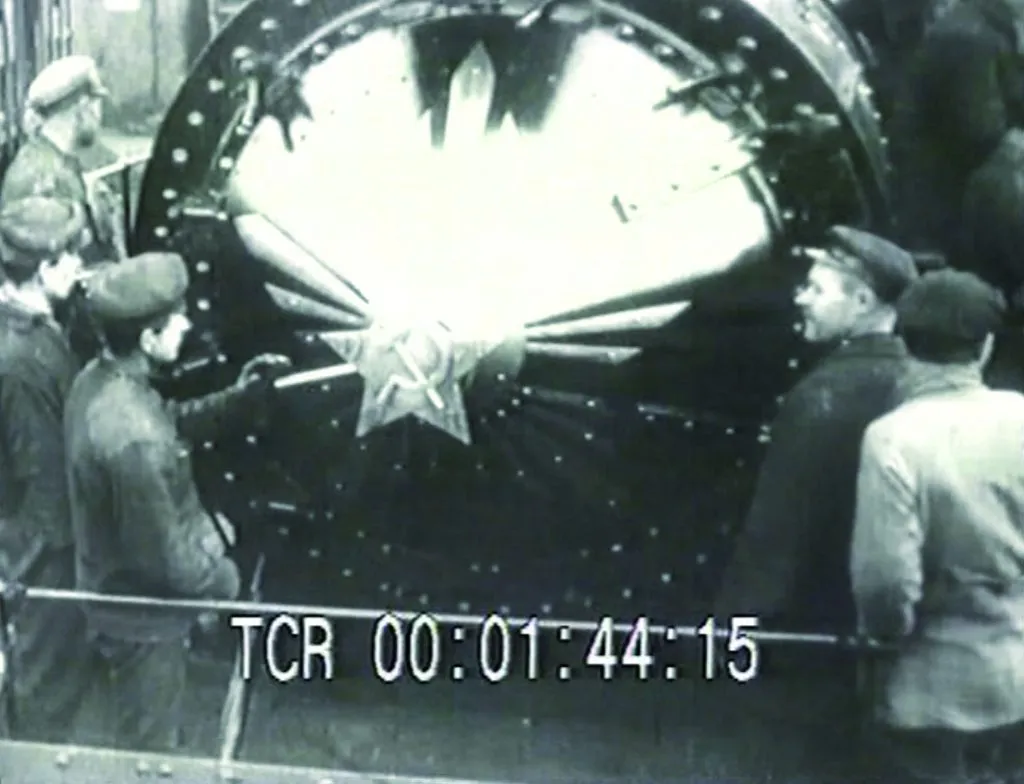
A.M.: “I Got It from My Mother”?
A.B.: Aren’t you afraid that reading women artists’ work so biographically might narrow the field of interpretation?
A.M.: The example of such readings of works by Zofia Kulik or Zbigniew Libera suggests otherwise. In your case, I think it is the lack of information with which to attempt such an interpretation that restricts the reception of your art. Let me frame the issue differently. For the canonical figures of critical art, studying in Professor Grzegorz Kowalski’s studio was an important point of reference. Might your period of study at the Academy of Fine Arts in Gdańsk have had a similarly profound significance for you?
A.B.: I did not study with Grzegorz Kowalski; I studied at the Academy in Gdańsk. There I worked with people such as Franciszek Duszeńko, under whom I completed my diploma, and Grzegorz Klaman, who was then an assistant in Wojciech Mokwiński’s studio. My studies were wonderful: a carefree engagement with questions of form. Pure pleasure. At the Academy I founded the group Turtle Tails with Norbert Walczak, who is now active on Berlin’s underground music scene. We worked at Robert Knut’s Avant-Garde Delicatessen. I missed the opening of our first joint exhibition as a two-person group because I had to collect my young daughter from nursery; by the time we dragged ourselves to the gallery two hours after it began, everyone had gone. Walczak and I made several good works as a duo, but I do not even have any documentation of them.
A.M.: Did you work with Grzegorz Klaman?
A.B.: He was — and probably still is — a powerful and highly controversial personality. Relations with him were not easy. He was very demanding. We took his opinions seriously, but his authoritarian view of art also provoked strong resistance. My first solo exhibition was held with him at Wyspa Gallery, and Aneta Szyłak curated it. The Szyłak–Klaman partnership began with that exhibition. But the artist I identify with today only really began with Films about Love.
A.M.: When you graduated, were you determined to continue working and making art?
A.B.: We were tremendously determined. I made objects and installations, and performances with Norbert Walczak. That involved travelling around Poland, for which we often had no money. In such cases we would pawn things — a television, for example — anything to raise the fare to Lublin or Kraków. Only after receiving our fee could we redeem the television from the pawnshop. It was a powerful imperative to create, to be in art and to live through art.
A.M.: When did you begin making video?
A.B.: In 1997. That was when I made the film Winter. I showed it for the first time at WRO, with Piotr Krajewski. I could not find myself in the form and materiality of the object. Film alone liberated me. Everything depended on me and I had control over the medium.
A.M.: Did anyone teach you filmmaking at the Academy?
A.B.: No one taught me. There were people at the Academy who worked in the field, such as Witek Czerwonka and Wojtek Zamiara, but I was not working with them then.
A.M.: I remember a meeting with you, very important to me, organised by Ryszard Kluszczyński at the Ujazdowski Castle Centre for Contemporary Art in Warsaw.
A.B.: That was in 1999. It was the first serious solo presentation of my films. Kluszczyński was the first to bring my works out of the abyss of non-existence.
A.M.: When did you move to Warsaw?
A.B.: In the summer of 1999. Gdańsk was very parochial, but I left for personal reasons. I was not particularly set on Warsaw, but my partner at the time said he could not live in any other city. I liked Gdańsk. The sea was close; every day I walked or cycled along the beach.
A.M.: How did you come across Zbigniew Libera?
A.B.: In 1998 I founded the Office of Artistic Initiatives and devised an educational project — Multimedia Art and Improvised Music Workshops in Sopot, Elbląg and Zielona Góra. It was a way to earn money, but also to meet the country’s most interesting artists: an opportunity for contact with people I cared about. I invited Jarosław Kozłowski, Józef Robakowski, Przemysław Kwiek and, finally, Zbigniew Libera.
A.M.: What did your collaboration involve?
A.B.: At first we ran workshops together. I placed a spot on Radio Station advertising the workshops: Long Live Art and Those Who Seek It. The line was written by Oskar Dawicki, who was just starting out then. Later, we founded the Baumgart–Libera café together at the Ujazdowski Castle Centre for Contemporary Art in Warsaw.
A.M.: I remember the two of you as a crucial duo in Warsaw’s bohemian circles. Your café was a centre of artistic and social life, one of the first places in Warsaw where something began to happen.
A.B.: The café, our joint artistic project, immediately became one of the hottest places in Warsaw at the time.
A.M.: Contrary to appearances, it was extraordinarily important. Chronologically, it came well before Paulina Ołowska’s Nova Popularna.
A.B.: Yes, it was a pioneering place established in 1999, although, to be honest, Libera withdrew from the café’s activities very quickly and the name Baumgart–Libera remained largely for sentimental reasons. Every evening crowds poured in to see me — that is, to Café Baumgart. I achieved enormous media success: Dorota Masłowska held her first author evening there; the anarcho-feminists Duldung, Maria Janion’s doctoral students at the time, performed there — the professor herself attended their concerts. The walls displayed works by Twożywo and Radziszewski, but also a rainbow flag hung by someone. Meanwhile, I was summoned almost daily to the director’s office and presented with a list of allegations, ranging from someone having left footprints on the corridor walls to claims that feminists had offered the caretaker sex in the lavatory or that Engineer Kowalski had seen someone having sex on the café stairs. Normally I would have laughed in the face of such accusations, but the director constantly threatened to terminate my lease. Eventually he did exactly that, handing my café over to a barman who had worked for me for three years.
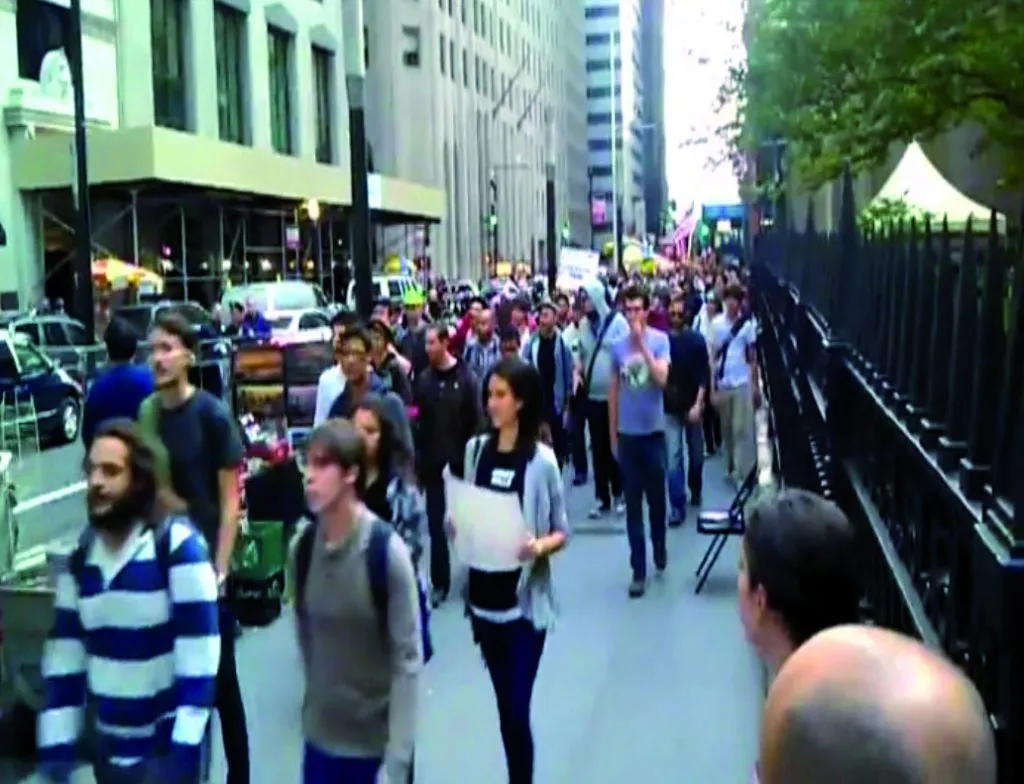
A.M.: I am interested in the way you work with other artists. You distance yourself from the early stage of your practice, but what did working with Libera give you?
A.B.: I do not distance myself from my early work; I simply know that it was only from a certain point onwards that I found my proper language and expressive power. As for Libera, he certainly believed in the ethos of being an artist. I did not attach the same importance to it. I was an artist, but I was also a mother and had to think about my daughter’s financial security. I had to think about paid work. I separated art and work. I made notes and wrote down what I had to do in the following areas: art/work. I remember that when Zbyszek saw those notes, he was appalled and shouted furiously about how I could separate those two spheres of life — because, as everyone knows, Libera never sullied himself with any paid employment. He only made art and lived without money, wore the same old trainers and could not afford to travel to workshops he was meant to conduct. And by then he was already the Libera who had made his famous Lego. Eventually the time came when I, too, stopped separating those two spheres and began earning my living from art.
A.M.: Did you and Libera talk about art?
A.B.: We were friends, and art was the substance of our lives, so we talked about it constantly. At the time I gave a series of lectures or screenings entitled How Trained Girls Make Films about Love. I showed Libera’s film How Little Girls Are Trained alongside my Films about Love. A very interesting context emerged between Polish video of the 1980s and 1990s, as well as a gender context.
A.M.: You have already mentioned two important exhibitions — your diploma presentation at Klaman’s gallery and the screening of your films organised by Kluszczyński at Ujazdowski Castle. We might add the exhibition at Zachęta’s Small Salon. Were there any other institutionally pivotal projects that you would like to mention?
A.B.: Scene 2000, organised by Stach Szabłowski and Ewa Gorządek at the Ujazdowski Castle Centre for Contemporary Art, was certainly an important, breakthrough exhibition.
A.M.: Why do you think “Scene” was important?
A.B.: It was a kind of manifesto of its time, a fairly broad exhibition ranging from artists such as Zbigniew Libera to Wilhelm Sasnal, who was a complete newcomer then. But Adam, I measure time not by exhibitions but by my projects. They are rarely commissioned by exhibition curators. I almost never work that way. I live to the rhythm of successive works, and my life is reflected in them.
A.M.: Were critics and curators important to you then?
A.B.: Certainly. Iza Kowalczyk, for example, was an important figure for me. She was the first to write about my films in a feminist context. In a sense, those films were taken over by that discourse.
A.M.: Is that how you see it now, or how you thought about it at the time?
A.B.: I do not mean it pejoratively, but what I was doing in art, they were working through in theory. It happened in parallel.
A.M.: Łukasz Gorczyca and Raster were probably points of reference too? They wrote about you, and you responded to their texts through actions, for example with Agata Bogacka. The project was called “The Art of Beautiful Women Artists”.
A.B.: I spent a lot of time with Agata Bogacka then. She came from a generation that made its debut ten years after mine. I was fascinated by those young women, so different from the women artists of my generation. Bogacka, Endo and Zuza Krajewska were very glamorous: heels, lipstick, formally light works. The Art of Beautiful Women Artists was an urban project consisting of photographs of two young women — Agata and me — pictured amid crowds of strangers in Warsaw clubs during nocturnal wanderings. I took the title from an article by the Raster writers published in Machina, probably in 1998. It described how certain women artists, because they were too beautiful, failed to achieve the careers the quality of their work merited. The article’s protagonists were Zuzanna Janin, Joanna Rajkowska and me.
A.M.: Among the people you worked with was Sławomir Belina. Was his invitation to take part in an exhibition at Zachęta important to you, for example?
A.B.: It was a very interesting but one-off project.
A.M.: So how do you regard such episodic encounters?
A.B.: I think of myself as a director who selects a team so as to realise her creative intention as well as possible. Although in this particular exhibition it was Belina who selected the team. Mirosław Bałka and Jadwiga Sawicka were among those involved… As far as my collaborations are concerned, I can say that people inspire me and that I experience my relationships with them profoundly. Because I do not divide life into the private and the professional, certain projects take the form they do precisely because I am part of an intellectual or artistic duo with someone I find interesting.
A.M.: One of your works created with another artist is “Ellipsis”…
A.B.: Ellipsis would not have taken that form had I not been friends and working with Agnieszka Kurant at the time. My first impulse in this case was to reconstruct the footbridge on Chłodna Street. The footbridge followed directly from the previous work, Escapes through the Berlin Wall. Kurant was very keen to make the project with me. The reconstruction met with resistance from city officials. It divided intellectuals and journalists. Several years earlier, Kurant had contacted members of the ART&Language group, who sent her a photograph of the sign (…). This sign of absence in language — an omission in a text, something left out or passed over in silence — seemed to us a perfect embodiment of the footbridge. We conceived it as a travelling installation for places where unresolved issues, problems and cultural taboos occur within societies’ collective subconscious and language. Its production was an ordeal. The Museum of the History of Polish Jews, which had obtained funding from the city to realise Ellipsis, effectively squandered the project by postponing it until December for reasons I could not understand, even though the Mylar sculpture could not withstand frost and the balloon manufacturer had warned them about the material’s limitations from the outset. The city demanded completion by the end of the calendar year on pain of having to return the grant. The Museum delayed, then finally hung Ellipsis knowing it would lose its air after a few hours. No one cared that I objected loudly to that solution. It revealed very clearly the differences in standards of working with artists. When Monika Sosnowska rejected a project at Frieze Art Fair because it had been poorly made, the organiser respected her decision and the structure was not exhibited. Here, only the year-end accounts mattered. Articles about Ellipsis appeared in Polish, German and Swedish newspapers, London’s Frieze Magazine, and elsewhere. It was a media success and an excellent project, also because it exposed relations of power, the mechanisms of cultural funding and the artist’s position within all of it.