
Joseph Beuys’s Works in Film: The Joseph Beuys Media Archive at the Nationalgalerie in Hamburger Bahnhof – Museum für Gegenwart, Berlin
Eugen Blume
Several years before Hamburger Bahnhof opened its doors as the Museum für Gegenwart (Museum of Contemporary Art) following a lengthy reconstruction, inspired by Wulf Herzogenrath and working closely with Beuys’s wife Eva and his children Wenzel and Jessyka Beuys, I began collecting and studying the film materials relating to Joseph Beuys that were still available. I was interested both in films made by the artist himself and those in which he appeared.
It was an adventure of a special kind. Some films were easy to find thanks to numerous traces and clues, while fragmentary factual material pointed to the existence of others. The work therefore consisted principally in locating individual films, then gaining access to them and finally viewing them. For weeks, in every public-television archive, I tormented archivists—whose patience knew almost no bounds—with my questions. Despite their daily duties, which demanded the constant haste so characteristic of the television industry, they patiently searched for answers.
During my searches—first through card indexes and later along the long corridors of the television archives themselves—I sometimes came across astonishing finds. One of these was the film Art and Anti-Art, which, to my great disappointment, was considered lost when I searched for it in 1993. The reason proved to be a small, entirely banal error in its reference number. Given the size of the archive, however, this was tantamount to its loss. In this case I succeeded only thanks to a persistence comparable to that of a gold prospector.
I managed to unearth many treasures. Others, however, still await rescue, lying somewhere unsecured. Sometimes only chance can lead us to film documentation of this kind. It benevolently offers us small clues and traces that we must then continue to follow.
Altogether we collected more than 350 hours of film. In addition, there are countless hours of audio recordings. At the same time as the Museum für Gegenwart opened, we began creating a pilot project for the Joseph Beuys Media Archive at Hamburger Bahnhof. Our priorities were, first, to archive the audiovisual material we had gathered and, second, to make it accessible. No twentieth-century artist was filmed as often as Joseph Beuys.
The greater part of these recordings consists of interviews and lectures—material in which the spoken word plays the leading role. Yet Joseph Beuys’s theory of art entailed that he also saw language as a sculptural work of art. For him, processes of thought and speech were creative processes to which form must be given responsibly. In turn, this form bore a significant imprint of what Beuys called “Richtkräfte”, or “directing forces”. The meaning of this expression, which he coined, cannot be explained better than Beuys himself explained it. He has to be seen and heard. In a sense, the films make the artist’s return possible: they allow us to experience his facial expressions, physical appearance and gestures.
In 1995, we began considering how to present the films using digital technology. The aim was not only to make selected materials available to the public, but also to find an interactive way of providing access to them. The rapid progress of technology, which unfortunately we did not foresee, means that what we developed at the time with a computer company is now completely obsolete. The central idea—making source materials available to visitors—has survived, however. We now need only adapt it to current technical standards.
We opened the Joseph Beuys Media Archive on 5 November 1996. It was a great success: 1,200 visitors, predominantly young, and two world premieres.
The first was a video showing the Coyote III action performed jointly with Nam June Paik in Tokyo in 1984. In turn, as part of a small John Cage retrospective prepared by the Ensemble Modern Academy, Takehisa Kosugi performed for the first time a score that musicologists had previously considered unplayable: a musical work Beuys had received from Cage for his sixtieth birthday.
In the meantime, we are trying to make selected items from the extensive film material we have collected accessible to the broadest possible audience. A series has been created in which ten films on DVD are planned. Each is to be accompanied by a publication containing commentary and extensive source material. Seven books and eight films have so far been prepared, allowing us to present them at this exhibition. The whole project is being developed in close cooperation with Eva and Wenzel Beuys, who oversee both its substantive and artistic aspects. The graphic design of all the publications is by Wenzel Beuys. We in Berlin are principally responsible for organisation. The first work published in the series was the sound composition Ja Ja Ja Ja Ja Nee Nee Nee Nee Nee (Yes Yes Yes Yes Yes No No No No No), accompanied by the first DVD, containing the 1970 film Joseph Beuys. Provokation Lebensstoff der Gesellschaft, Kunst und Antikunst (Joseph Beuys: Provocation as the Lifeblood of Society, Art and Anti-Art).
The debate held at the Düsseldorfer Bildungsforum on Tuesday, 27 January 1970, with Joseph Beuys, Max Bill, Max Bense and Arnold Gehlen, chaired by the art historian Wieland Schmied, may be called an unprecedented and risky undertaking. The discussion took place before a packed auditorium and was filmed with the intention of broadcasting it on television, thereby multiplying the number of direct witnesses to the event. A brief introduction opening the debate announced that the complex situation of art would be discussed, since developments in the latest art certainly required explanation—necessary in order to use language to assign new meanings to what flowed from art itself.
The art-interested public wished to move closer to an answer to the question of whether a creative practice that invoked art while simultaneously breaking with all its conventions could still be described by that traditional term.
The theorists taking part in the discussion, Arnold Gehlen and Max Bense, had each attempted in their own way to answer this question in various writings. As artists, Joseph Beuys and Max Bill offered answers by presenting their contemporary—and mutually opposed—artistic positions.
The educated audience, familiar with the writings of Bense and Gehlen, expected these two figures, who enjoyed the status of leading authorities in the German art world of the time, to provide an intellectual and theoretical explanation of the complex and heated question identified by the organisers as the discussion’s subject: had provocation through art, or “anti-art”, irrevocably become the lifeblood of society?
Naturally, given the watchword “provocation”, the moderator asked Joseph Beuys to speak first. In the 1960s, Beuys not only gave a new, anthropological dimension to the activity of the Fluxus group, but fundamentally revolutionised the concept of art. As the film reveals, however, he was treated to some extent as a charlatan, even though as early as 1964, at the invitation of the conservative art historian Werner Haftmann, he had taken part in Europe’s largest and most important exhibition of contemporary art, documenta 3 in Kassel.
The organiser had selected participants whose temperaments and views of art could scarcely have differed more. Arnold Gehlen and Max Bense presumably expected an easy contest. They regarded Beuys as a kind of anomaly that they could readily comprehend with a few theoretical formulae. Joseph Beuys—an artist who later fought countless brilliant verbal duels, took part in numerous discussions, lectured and spoke in public—here found himself before a broad audience and under the spotlights for the first time. At the beginning of the discussion, few suspected that they would witness, as Wieland Schmied later wrote, the “eruption of a volcano”: the performance of this “young” artist during the debate.
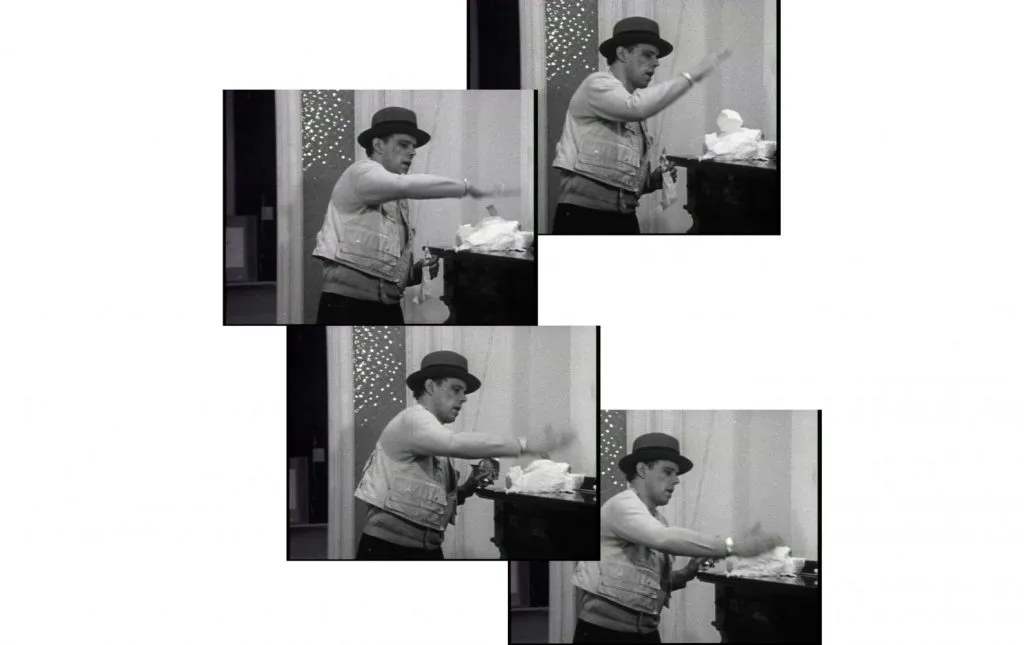
Beuys began by presenting his idea of expanding consciousness through an art that was itself an expansion of what had hitherto been valid within art. Called upon by the moderator Wieland Schmied to respond to this idea, Bense repeatedly tried, in academic fashion, to force Beuys to explain the terms he had used.
The moderator then gave the floor to Arnold Gehlen, who began with his proposition concerning contemporary life in a post-historical society. According to him, especially in the sphere of art, nothing more could happen: nothing provocative and nothing genuinely new. Gehlen discussed this terminal phase of art in detail in his 1960 book Zeit-Bilder (Time-Pictures): “Development has come to an end, and what will follow can already be observed: the syncretism of a jumble of all styles and possibilities—post-history.”
Had the discussion concerned not art and its capacity to provoke, but questions such as Gehlen’s propositions about the human being as a “deficient creature” (when compared with the animal world) and their social consequences, Arnold Gehlen might perhaps have proved an interesting interlocutor for Joseph Beuys. Philosophical anthropology, Gehlen’s field of scholarship, would certainly have interested Beuys, to whom an anthropological conception of art was close.
During the discussion with the two philosophers, a misunderstanding arose that resulted in attempts to reduce Beuys’s propositions to a conventional plane. Both Bense and Gehlen understood only partially what Beuys passionately tried to explain. Yet Beuys’s equation of the terms “provocation” and “production” was far more significant than their own contributions to social theory. Beuys conceived the essence of every creative activity as a spiritual provocation that also increased knowledge of the modes by which production operated—regardless of what was being produced.
Gehlen not only failed to understand that Beuys conceived art as production and regarded each individual as free in relation to the freedom to choose a mode of production; he fundamentally refused to discuss the subject further. Holding to his dictum about the end of art, the theorist wrote Beuys off. He may also have believed that he had found in him yet another par excellence proof of his proposition. Gehlen thus entirely disregarded a quality that did not fit the criteria deemed valid, succumbing to a prejudice so often deployed against new phenomena in the history of art.
Gehlen could not understand that the essence of creativity—which Beuys explained through his fat corners (the so-called Fettecken)—was realised independently of material; that so-called “poor materials” were fundamentally better able to express it than conventionally used and already sanctioned materials such as stone or bronze in traditional sculpture.
Max Bense took a less pessimistic view of the (im)possibility of cultural development. Unlike Gehlen, he proceeded from the premise that in a technologised society “the patterns of aesthetic and technical communication draw closer to one another”. In this he was an adherent of Max Bill, to whom he had, moreover, dedicated his early writings.
During the discussion, Bense spoke about art’s influence on sets of forms used in urban and architectural contexts and thereby introduced into social space. In this way, he proposed an already established version of expanding the concept of art, understanding it as an aesthetic schema carrying certain information. This informational schema, regarded as interactive in a technologised society, obliged the artist to create formal systems responding to current needs. In adopting this viewpoint, Bense retained a traditional conception of artistic work.
As a pupil of traditional modernism, Max Bill continued to work on the development of abstract-Constructivist painting. As the embodiment of an entirely different approach to art, he was invited to the discussion as a counterweight to Beuys. Bill insisted that it was impossible to attempt to consider his own art through any criteria of quality. Unlike Beuys, he denied that one could state unambiguously whether what he did was art at all. This was undoubtedly the artist’s “understatement”.
Although Bill, like Beuys, understood art as a space of freedom, unlike Beuys he conceived this freedom as unlimited formal possibilities rather than as the artist’s cognitive position flowing directly from modes of production. Yet it was precisely this consciousness-changing dimension of creation that Beuys wished to transfer to society, while Bill denied that these processes could be named or made concrete at all. Like Bense, Bill insisted that only the work itself, and perhaps the processes of reception associated with its effect, possessed any social significance.
In essence, irreconcilable opinions clashed around this table, both theoretically and artistically (Bense’s links with Bill aside), while the core of Beuys’s message remained entirely undiscussed. Although Arnold Gehlen and Max Bense were capable theorists, they strangely fell far short of what one might reasonably have expected of them: a critical engagement with Beuys’s persistently stated demands “to derive from art the question of processes taking place in human beings”, or a discussion of an opinion he had not previously expressed, namely that “(art) must present thought in the process of arising as a plastic process”.
This discussion demonstrates how difficult it was for Beuys to introduce into official discourse his radically new concept, derived from the field of art, of using creativity’s influence upon social processes—a concept publicly rejected as marginal by two sociologists or philosophers.
At the end, Beuys and Bense became embroiled in a combative exchange during which Bense asked about the relationship between the human being as part of society and Beuys’s postulated role of the “individual creator”. At this interesting moment, when Beuys’s most important propositions were finally addressed directly, the discussion was cut short for lack of time.
The conversation is an extremely important document not only from the perspective of Joseph Beuys’s biography—in it he appears as an implacable defender of his convictions—but also because it conveys exceptionally well the mood prevailing in Germany at the time. Following the student revolt, after 1968 it had entered a political current quite different from that which preceded it.
The fact that an artist wished to penetrate so deeply into socio-political processes, and had even begun to found his own party, was a provocation that for Arnold Gehlen and Max Bense entered territory entirely unimaginable within art. They stubbornly refused to consider anything that allowed for the possible existence of art beyond the immanent qualities associated with the work itself. For all three other participants, art could be defined only through the work. No one was prepared even to contemplate Beuys’s position.
The remaining documents in the Joseph Beuys Media Archive show fragments of his actions, and the value of this film material goes beyond photographic documentation by preserving the unfolding of events in time, as well as their participants’ gestures and speech. The latest film shows one of Beuys’s actions in its entirety. Shot in Japan in 1984, it is a unique document of a double action performed in Tokyo by the famous Korean artist Nam June Paik and Joseph Beuys.
Like Beuys’s other activities, this event was also a critique of society, principally addressing the complete estrangement between human beings and animals as an expression of humanity’s separation from nature. As a co-founder of the Green Party, Beuys made this one of the more important subjects of his art. The eight films shown at Atlas Sztuki make a profound impression, but also offer insight into the incomparable work of one of the twentieth century’s most extraordinary artists.
*Translated from German into Polish by Marta Skłodowska