
In Conversation with Tatiana Czekalska and Leszek Golec
Interviewed by Krzysztof Cichoń
Krzysztof Cichoń: I have read so much about Avatars, which serve to protect and save other beings, that now, somehow involuntarily, I see the necessity of interviewing you about the essence of what you do as an Avatar. (The three of us are sitting here; I think you once made a three-fingered Avatar like that?) Let us begin with something to relieve the stress—perhaps food? It is already after lunch. What have you eaten today?
Leszek Golec: Just breakfast…
K.C.: Then we are evenly matched…
L.G.: I hoped I would get tofu, but my wife did not make any.
T.C.: It will be for lunch…
L.G.: Lately I have been buying dried vegetables. They cost pennies. I pour balsamic vinegar over them, or the vinegar from pickled gherkins… I add raisins and let it all soak, then pour in oil and the spices I like—cayenne pepper, rosemary… You can eat it with bread, pasta or potatoes. A-ma-zing!
K.C.: Lately I have been growing vegetables as a condition for passing a course. Some very likeable archaeology students had, for some reason, failed to fulfil their obligation to compile an index to Benjamin’s rather chaotic texts. Since the cosmos would collapse if credits were awarded for nothing, we agreed in February that, as experts in digging in the ground, they would grow something on the lawn across the street. Cultivation requires regularity. These were therefore classes in the practical cultivation of culture, which, after all, derives from the Latin colo, colere, colui, cultum. We agreed that if their crop had not withered by June, they would pass. They grew touching three-centimetre carrots and one-centimetre Egyptian beetroots in homage to their alma mater. I now keep them on my desk in a jar of spirit because, unfortunately, it is difficult to learn anything online about preserving carrots. They can probably be eaten…
L.G.: Sebastian Cichocki told us about such actions in the city. I sometimes see photographs online too, but I have not read about them closely. I did not regard them as entering the field of art…
T.C.: They are not artists, but activists.
L.G.: People with different kinds of education who throw seed bombs, for example.
K.C.: Garden bombing…
L.G.: I liked that very much. Then some time passed and I began to analyse it. I throw it—call it what you like, let it be called a bomb—but there are living beings inside it. I throw them and walk away. It is as though I blasted half a village full of people into space and then flew on.
K.C.: Well, there is probably no shortage of people convinced that space is full of such villages and that our present situation is something of a hardship. A desperate, but possible, anthropogenesis.
L.G.: That would take a long time, and we would have to consider why we found ourselves in this situation. As far as I know, however, we are where we wanted to be. Everyone has what they deserve, and that is what makes us different from seeds.
K.C.: And what do we know about seeds and their possible pre-existence? Nothing.
L.G.: They might have been minerals… It is a very slow process. In any event, I realised that someone who throws them in the city is not interested in what will happen to them; only the gesture matters: I threw it, I am brave.
K.C.: That is true. What matters most is that “I threw it onto someone else’s land”, altered the structure, and that is rather destructive, although I think the seeds will manage…
L.G.: Seeds are not commandos… and this is not some brilliantly planned landing behind enemy lines… I would prefer to check.
K.C.: Do you feel a need to distinguish whether actions of this kind are art or not art? Do such distinctions interest you at all?
L.G.: We do not give a damn about labels; intentions are what matter… Responsibility. It could equally well be the owner of a gas station standing far out in a field, where almost nobody ever turns off the road. He is bored… sitting in a little kiosk, with a little dog, a little television and surroundings polished like a military base—a fountain, ponds, some installations, ornamental insanities—and he looks after it all.
K.C.: I think that in those petrol-station hermitages almost all of them write furiously, and that this is where the great secret current of Polish literature is being created. You do not live in the city?
T.C.: We do, right in the centre.
K.C.: Since art entails responsibility, who will take the sheep home after the opening?
L.G.: She will arrive at around five, before the opening, and have a walk. She will do her job, for which she is paid. The money goes to her company, of course—the zoo. We will take photographs, perhaps make a film, so that something remains after the opening; otherwise there would be an empty space. She is brought in a vehicle provided by Atlas Sztuki, but accompanied by a keeper from the zoo, who will also remain in the gallery.
K.C.: So the sheep will have a companion…
T.C.: That is correct.
L.G.: More of a bodyguard.
K.C.: She is the star of the evening, after all.
L.G.: We gathered information about her. Melania was raised at the zoo from an early age. She is very trusting and will approach people. She has had two children, a son and a daughter…
T.C.: Bottle-fed…
L.G.: She is six years old and a native of Łódź.
K.C.: We shall have to ask whether she sees an important difference between a nativity stable and a “white cube” gallery. I suspect artists of the worst, so presumably you too have some evil intentions and want to exploit the “poor animal”. Why do you need Melania in the gallery? All that effort—arrangements, transport, lowering the temperature—what do you want to achieve?
L.G.: As I mentioned, the sheep goes on trips every year. She is accustomed to them. I do not know whether she enjoys them; one can see that she is not afraid.
K.C.: For her it will be another red carpet, and from her point of view it will probably be fine. I am asking about your point of view…
L.G.: People often attack me, asking whether it will harm her or whether something might happen. Nothing of the kind.
K.C.: Well, the audience here can be fairly aggressive…
T.C.: There will be glass; she will be separated from them.
L.G.: Besides, apparently there are always heavily armed security guards here because of expensive paintings, for example. This time they will be here because of a life. The idea and the title itself, Contract Killer, are of course the most important things. That was our starting point. Research shows that eating meat causes the largest number of deaths; only then come alcohol, cigarettes and drugs. The information will be displayed on the wall beside Melania’s biography. That killer—the meat—will be walking around there.
K.C.: A similar panel once appeared in the exhibition Fauna—Animals in Contemporary Art. That was at Zachęta in 1999.
T.C.: It contained information about substances tested on animals and substances of animal origin.
L.G.: All food products must list the substances we ingest. The labels are coded as E-something: cochineal, for example, is E120, a dye made from insects. To obtain the dye, the insects or their eggs are subjected to high temperatures, for example by being immersed in hot water. Producing one kilogram requires more than 150,000 living beings… We use it in yoghurt, jelly, fizzy drinks and boiled sweets…
K.C.: To add colour to our lives…
T.C.: Those insects belong to the order of true bugs. I think the people consuming them might be less than delighted if they were aware that by eating a little apricot yoghurt they were eating bugs…
K.C.: Let us return to the question: why the sheep? Not to add colour to the message? Is she an addition to the idea, a compositional element, the subject of this exhibition?
T.C.: She is the subject.
* * *
K.C.: Atlas Sztuki has an excellent tradition: when it interviews an artist, Atlas Sztuki asks, “And what do you live on?” It is a beautiful question because it simplifies matters and also allows us to compete with the commercial media for readers’ attention. Do you live from what you do as artists, from these projects?
L.G.: Nooo… Perhaps the nicest answer would be that I make a living by helping artists. I work at the Centre of Polish Sculpture in Orońsko, make video documentation and curate exhibitions. For five years I have been responsible for the artistic programme of the Jerzy Busza Festival.
T.C.: I am a fashion designer and freelancer, and that is how I support myself…
K.C.: I get a little over two thousand for forcing students to grow beetroots on a lawn. Finance is the salt of an interview, but let us risk talking about art. Is what you do as artists connected with your moral and religious convictions? Are your projects a manifestation of something that is perhaps no longer art because it is too private, too personal?
T.C.: It certainly relates to our worldview and way of life.
K.C.: Is that your private, individual worldview, or can it be connected with a system of principles—Hinduism or yoga, for example?
L.G.: It can be connected, but today I am a Christian who observes health and safety regulations. At work—meaning in life. A Christian says, “Thou shalt not kill.” I do not kill…
K.C.: Is that the Fifth Commandment, or is it more what is known as ahimsa?
L.G.: Call it what you like. We have already discussed the insignificance of labels…
K.C.: The idea is to build a way of life one will not have to be ashamed of…
L.G.: Yes. If we look at the laws laid down by spiritual leaders, they always say, “Thou shalt not kill”… And nobody added “people”, so…
T.C.: I think that even if it had not been said, you would probably behave the same way? Without reading it.
L.G.: We have to communicate somehow; you do not know how I live from day to day. That is why I refer to the Bible: “By their fruits ye shall know them.” If you observed me, you would know that I try to do everything possible to avoid killing. Of course, while driving here I may have run over a fly that had just woken up. I know where I am; I know that we are not in heaven.
K.C.: We are not; accidental deaths happen. Have you never found yourselves in such a situation? It is not so difficult to run over even quite a large fly in fog. I ask because a common European way of tracking an artist is to search for traces of some trauma that can subsequently be used to explain “the entire oeuvre” to everyone, as happened with Joseph Beuys.
L.G.: Thank God, no.
* * *
T.C.: The question was whether you are guided by some external religious principles or by your inner worldview.
L.G.: But they are one and the same!
K.C.: True. Religion is usually carried inside, not in a plastic bag, although some people can carry it in one.
L.G.: But in a biodegradable bag.
K.C.: Apparently, beyond the mountains in the East, there is something called santosha: a sense of contentment with one’s life and refraining from the desire to achieve and possess more. I ask because we can return to the fundamental financial theme of our conversation. Do you have anything like that? And is it necessary when one is an artist?
L.G.: Contentment? I am content sometimes…
K.C.: Do you feel a need to do something more intensely, to do more? To bring three killers into the gallery instead of one?
T. C.: Well, no.
K.C.: I do not mean quantity, of course, but the need to do something “more”…
L.G.: Of course.
K.C.: Without that, you would be very strange European artists. Without a need to display your own ego.
L.G.: But is that ego?
K.C.: What is wrong with having an ego?
L.G.: Ego is the last thing keeping us here. It is “I” who am spiritual, “I” who am brilliant, “I” who do not kill. “That one” ran someone over; “that one” ate a pork cutlet today. That is ego, and that is all right? Ego holds our soul here, and it will not finally depart as long as ego and karma remain—the law of cause and effect, of course.
K.C.: We can either use the European distinction between spirit and soul, pneuma and psyche, or speak in a more Eastern fashion of purusha, which is merely reflected in our imperfect intellect, through which we remain stuck here. Either way, call it what you like: without it we do not exist, and it will be difficult to finish this interview. In your view, is suffering an organising principle of the here and now? Can it be avoided?
L.G.: It can be minimised; it cannot be avoided.
K.C.: For me, suffering is one of the principles that construct the cosmos. I am not happy about it, but I have no influence over it; I was thrown here…
L.G.: That is how you put it: “I am not happy; I was thrown here.” I believe this is a place in which I can learn what to do so that I no longer have to be here. Avoiding suffering will teach me nothing… It is said that the earth is like a bridge… Be a good guest on earth… A good guest should clean up after himself and not cause trouble. That is how I understand my stay on earth: to pass through, learn something, understand that this is only a passage, and disappear as quickly as possible.
K.C.: Why engage in art once you have understood that one must “disappear from here as quickly as possible”?
L.G.: A good guest leaves a tip…
* * *
K.C.: What use is art school to an artist?
L.G.: I did not graduate from one. Thank God!
T.C.: Self-taught. I have a Master of Arts.
K.C.: So what is the relationship between five years at the Academy of Fine Arts and what one does afterwards? Your practice cannot readily be related to any course of study.
T.C.: I cannot say it is not useful. It gives you a great deal… Some technique and a certain awareness.
K.C.: Does it amount to a kind of “training of the eye”?
T.C.: Yes, I think so. I do not know what I would be like if I had not studied…
L.G.: Oh, come on… When your mother designed the costumes for Pharaoh, your father wrote Do You Remember, It Was Autumn… or There Was Always Some Madman at Home, and even Polański visited your grandmother; when, as a child, Tatiana had to attend Warpechowski’s performances, spent holidays in Chałupy with Kalina Jędrusik, and Rybczyński hung around at her father’s… Home, where films were sometimes shot, was more interesting than school
and during filming, probably of Pigs, Linda shot down Tatiana’s mother’s beloved chandelier…
K.C.: Yes… That can alter a young mind.
T.C.: Oh yes… Kalina Jędrusik was the most wonderful. I loved it when she took me to the beach in the evening and we went swimming—she naked, of course, and little me in full uniform… And her meat-free salad is still the number-one dish at every party in our family.
L.G.: Someone from outside that world might find it fascinating. Tatiana was indifferent to it; it was everyday life.
K.C.: Speaking of Pigs and other domestic creatures, were there cats at home?
T.C.: Yes, there were always cats.
* * *
K.C.: Does what matters in art happen in the material or the immaterial sphere?
T.C.: It is born not in the material sphere but the spiritual one, and must subsequently find some outward expression. An object or situation has to be created; the idea has to be recorded.
K.C.: And why is that done? In order to create an object or situation that will remain in this world, or for entirely immaterial, spiritual reasons and in the hope of such effects?
T.C.: In our case, for spiritual reasons.
K.C.: Then why do you make such precise, jewel-like Avatars?
L.G.: To attract attention, so that we can tell people about them. You will remember them more clearly then.
T.C.: It was also important that they were made of antiseptic materials. It was not only a matter of aesthetics, but of matching the idea.
K.C.: When you went to New York, the Avatar shown there became very democratic, very pragmatic—one might say very American. No gold; instead, disposable biodegradable gloves designed for carrying insects. Do you adapt the material to the exhibition venue? I take it that if it were somewhere closer, in the East, the platinum and gold would return.
T.C.: We had three months to work there, in an empty space. It would have been difficult not to adapt and refine it. We brought the finished glove with us, but special openings were made there…
K.C.: I became very fond of the openings, because they fit perfectly with what meditators say about concentrating on a single point. I think it is called ekāgratā. Are they not the material counterpart in your work of this technique of concentration?
L.G.: That is what I once thought. It was the early 1990s, when I made such little holes. I say “I” because Tatiana and I were not yet working together. One I am proud of was built into Wschodnia Gallery. I conceived the idea, but Tatiana drew the shape. It was an implant hidden in the wall. Inside was a deep opening and an aquarium pump circulating sacramental grape wine. I dedicated it to fruit flies—Drosophila melanogaster—which are continually tortured by geneticists. I wondered what I could do. I adore them because they give me a sense that someone is beside me, that there is life. That is another story that happened to us; please steer me so that we…
K.C.: By all means, let us follow the fruit fly and circle around a little.
L.G.: When a little fly like that appears, many things become clear. Someone speaks about love; a fly passes, and SPLAT… a super-nano-high-tech vehicle with a pilot inside, an unattainable technology… SPLAT… There is no factory on earth capable of reproducing so subtle and sophisticated a device… WHACK…
K.C.: More of a reflex…
L.G.: We have a reflex to kill whatever is “to hand”, and usually do nothing about it. That is depressing.
K.C.: Unfortunately, ours is not the only species with a killing reflex. Is the need to demand more of oneself than of others not art for art’s sake? Besides, in an endless war of all against all, whose side should we take—the cats’ or the birds’? Does art have anything to offer here that might reduce suffering?
T.C.: My cats are vegetarians…
* * *
K.C.: Let us talk about mosquitoes…
T.C.: By all means.
L.G.: Someone sees a mosquito land on me and simply hits me. SPLAT!!! Another super-nano-high-tech flying object destroyed.
K.C.: Wait, wait—this is going to print, after all. You do not kill mosquitoes?
T.C. and L.G.: No!!!
K.C.: Hmm, how do you do that—or rather, how do you not do it?
T.C.: That is why the Avatars were created.
L.G.: I spend a great deal of time in Orońsko, where there are nothing but mosquitoes. I have jars; gherkin jars are best. Before I fall asleep, I have to make hundreds of movements. I hear one flying, let it land, and the jar is already open—pop, caught. Then I take them outside. It once seemed impossible; now it gives me pleasure. Even when I am tired of it and want to meditate, I let them be. One bites once and flies away. The first mosquito to appear there at the end of March gives me enormous pleasure, because something is happening again… It comes before the swallow…
K.C.: European rationalism—or perhaps nationalism—demands that a boundary be defined, if only a boundary of size. Art often focuses attention by moving problems into extreme regions. In your projects, you consciously concentrate on things at the threshold of perceptibility, on “small, living, sentient beings”. The question is: how small? Where does the scope of “sentient” end, and what exactly does it mean to you? Is it a matter of responding to the environment, or of an anthropomorphic consciousness close to our own? What about bacteria and the herpes virus?
L.G.: I know that when I blink, I crush living beings beneath my eyelids… I also know that for some time yet I have to flutter my eyelashes… We know that we cannot manage without bacteria… The herpes virus is a signal of approaching illness, a red warning light, just as a mosquito’s song announces a bite… it is a warning… And the reach of compassion cannot be restricted… Compassion, unlike killing, certainly is not a reflex and is not instinctive…
* * *
K.C.: Is art made only by people, or also by fruit flies, mosquitoes and other species?
L.G.: Yes, although obviously not all of them. Not every fly is so talented.
T.C.: Several years ago we were the curators of a certain deathwatch beetle…
L.G.: Which took up residence in Saint Francis.
K.C.: It was called Homo Anobium: St Francis, 100% Sculpture, 1680–1985 and was shown in Słupsk in 2005. It was a seventeenth-century wooden bust of the saint, eaten away by the beetle’s larvae and conserved in 1985, presumably at the last possible moment before its final disintegration. In Europe, the conviction probably still prevails that an artist must have something like a soul, or at least an ego. And the soul of a deathwatch beetle…
T.C. and L. G.: Kołacze się w nim…
T.C.: Animals have souls.
L.G.: Plants—everything that lives…
K.C.: Let us pause over this trans-species saint. Quite apart from everything else, it is an exceptionally spectacular… ruin. We happen to be in a phase of popular aesthetics in which the incomplete, broken or “deconstructed” is more eye-catching. The face of the saint that you selected, eaten away by insects, works in a similar way to the platinum Avatars: it attracts the eye and is highly spectacular. One could equally well have honoured the beetle’s sculptural skill by exhibiting a shapeless block of wood, but would that have attracted human attention? The larvae do not care whether they feed in a saint’s chest or an unworked trunk. People who write about art do. You think about projects aesthetically; there is nothing wrong with that—it is very human. Yet there is an interesting point here that cannot be entirely reconciled. When we think about something or someone in this aestheticising, form-sensitive way, we tend to think about it as an object rather than a subject. I am asking about the proportions in your practice between the desire to do no harm, ahimsa, and a technical-aestheticising mode of action intended to achieve a particular effect.
L.G.: You have answered the question yourself. We want what is happening around us to swell to the point that it resonates. At Atlas Sztuki there will be light boxes containing information about the harmful effects of eating meat, and everyone will be able to take a leaflet. It circulates extremely well. We have been printing such information for five years. That is simply the logic of creating an exhibition.
T.C.: It has to be shown somehow.
K.C.: Do I understand correctly that art is merely a kind of vehicle here, increasing the message’s reach? A technique, technē, a means of acting effectively? Do you not feel these are opposing forces that interfere with one another?
L.G.: We were supposed to have an exhibition at Atlas Sztuki a long time ago, near the beginning of its existence…
T.C.: Just after Libera’s exhibition…
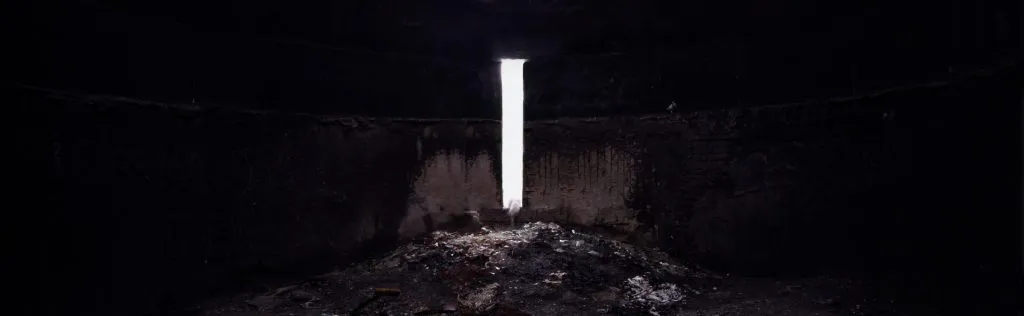
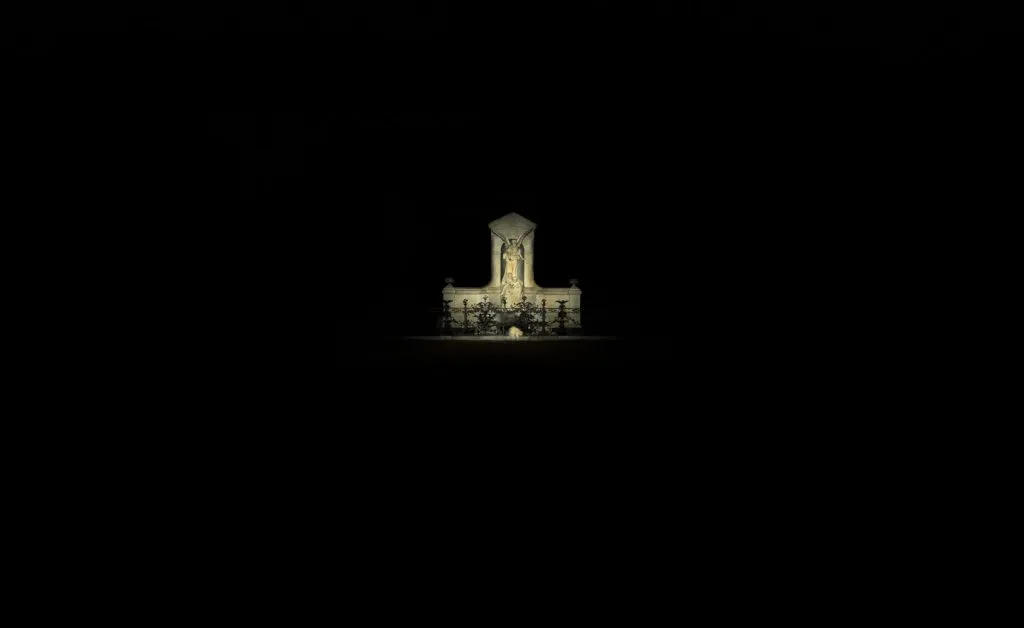
L.G.: In one room a single Avatar was to stand on a marble column, lit from above, while in the other there would be only one small fissure. Almost nothing. And the gentlemen liked it very much. I think Kamil Kuskowski was curator then; he worked with Jarek Lubiak. For some reason it came to nothing, but it was to be extremely minimal in such a large space. I still have that fissure for the room, unrealised and beautiful.
K.C.: Speaking of which, J. Lubiak wrote about that human-beetle sculpture, reinforcing “the mandibles of the beetle larvae, continuing the work over centuries, boring endless corridors” with “the efforts of contemporary philosophy, including those undertaken by Jacques Derrida, (…) aiming to undermine humanity’s self-definition through opposition to the animal”. A charming vision of the interspecies beetle-philosopher brigade drilling through the rotten wood of metaphysics. Yet despite the conclusions that “this is not about naïvely humanising the animal” or “primitive anthropocentrism”, it is, after all, the spectacular humanisation typical of the human understanding of art. You emphasise that “the gallery is never empty”; there are always living beings in it. Except that they know nothing about being in a gallery at that moment, and it matters little to them. For them, it is presumably territory like any other. Even if we accept that the art for which we come to the gallery—because, after all, we do not come to look at a living sheep as though it were a nativity display—is a perfect spiritual metaphor for the food on which a spider lies in wait in the gallery, it is a metaphor that is legible and significant only to us humans.
* * *
K.C.: Let us talk about blurred photographs. And about photographing cats. Why are cats photographed out of focus?
T.C.: Because they move.
K.C.: But surely technology can capture them sharply?
L.G.: I know a little about photography. At one point I had even completed every possible photography school and course in this country…
K.C.: But none of them taught you to take photographs blurred by movement…
L.G.: So I taught myself to respect…
T.C.: A certain accident…
L.G.: An accident, but not entirely…
T.C.: A deliberate accident.
L.G.: The photographs then have… meaning. Anyone who takes photographs will recognise how they are made technically. The exposure has to be set to around three or four seconds, and almost all the photographs are taken at the lower limits of available light—usually at night, with the lights dimmed. Even if an animal does not stir, it breathes. Everything is sharp, but it moves its little head and there is a slight shadow.
K.C.: There is Walter Benjamin’s classic text about the aura of a work of art. Lately, however, that aura seems to fit everything; it could equally well envelop the aurum from which you made the Avatars. In any case, suddenly it is not this demonic precision of vision that matters, but something more, even as it is less distinct.
T.C.: The photographed being participates in the creation.
L.G.: Benjamin wrote that quite a long time ago. Which photographers could he have seen? Atget? In other words, someone who photographed Paris from a tripod at four in the morning. He saw things made with long exposures.
K.C.: I have found something that will let us travel through time. It is a description of the icon of the Descent into Hell hanging in St Petersburg, painted by Dionisius in the early sixteenth century. Jerzy Nowosielski, an artist who exceptionally often drew attention to the scandal of animal suffering, wrote of the fallen angels visible in the scene: “the fundamental means of representing this satanisation is an aesthetic device; (…) they are no longer temptingly ambiguous beings (…); they have been decisively deprived of all beauty, cease to tempt through ambiguity, and are cast down from heaven”. It seems that the nonhuman beings you photograph are able, instinctively as cats do, to protect themselves from satanisation by moving. This is presumably also the trap of “sharp vision”, clear and distinct, of the kind supposedly available only to the animal rationale. Are your photographs ambiguous? Can they be expressed in words?
T.C.: They are sensual and intuitive.
L.G.: Intuitive, indeed! Everything is planned…
T.C.: But Leszek, this is about what the cats do!
L.G.: Ah, the cats are a bonus.
T.C.: Exactly—the added value in our work.
K.C.: In the end, it is not two against one, but everyone against everyone! That is a sign that it is time to finish. To do so meaningfully, on an exhalation I will ask one more question about breath, a subject that has returned irregularly throughout this conversation. The third chapter of Ecclesiastes contains the fundamental question, “Who knoweth the spirit of man that goeth upward, and the spirit of the beast that goeth downward?”—as Jakub Wujek translated it in the sixteenth century. The difficulty of the question is demonstrated by an exceptionally beautiful note in the Millennium Bible: “this cannot be established empirically…”. And further: “Therefore the end of man and beast is the same, and the condition of both alike: as man dieth, so they die; yea, they have all one breath.” The Hebrew word ruach, which can mean a gust, breath or spirit (including the Holy Spirit—ruach kodesh), was translated into the Greek pneuma and later the Latin spiritus. One could dedicate this verse to the murderous Melania. It shows that within European culture, apparently so dominated by the Greek metaphor of knowing as seeing, there are important words that are moved as lightly as breath. Blurred. Their meaning wavers uncertainly between above and below, human and animal. Am I very wrong to suspect that all these implants, oxygenating pumps, ionisers, strange third energies and, finally, animals blurred in photographs because they are alive, which you show, are intended to make us close our eyes at last, take a deeper breath and calmly think about everything in a different way from the everyday?
L.G.: Before we breathe, let us try to understand the text: “Who knoweth the spirit of man that goeth upward, and the spirit of the beast that goeth downward?” This passage can be misinterpreted, because what difference does down or up make once we are in the Kingdom of God—a mega-beautiful, fucking fantastic world—whether we are in the suburbs or the centre? We are within it; we have already crossed the boundary. Perhaps far apart, but TOGETHER.
K.C.: Agreed.
L.G.: Now I have breathed out.