
Contract Killer
Adam Mazur
Leszek Golec (b. 1959) and Tatiana Czekalska (b. 1966) are among the most important artists working in Poland today. The Contract Killer exhibition, prepared especially for Atlas Sztuki in Łódź, confirms the significance of the Czekalska–Golec duo’s achievements while opening this simultaneously performative and minimalist art to a new audience and inscribing it within an exceptionally important institutional context.
In presenting Czekalska + Golec, it is worth emphasising that—with the exception of his early practice and a relatively small number of solo exhibitions—Leszek Golec has worked with Tatiana Czekalska almost continuously for more than fifteen years. The + appearing between their names on exhibition invitations therefore signals that the duo has produced a new subjectivity. The artists challenge the myth of the author bound up with the rules of the art world, preparing exhibitions such as Homo Anobium: Saint Francis, 100% Sculpture, 1680–1985 (Witches’ Tower Gallery, Słupsk, 2006), where they showed a sculpture by an anonymous maker that had, over the centuries, been secondarily ‘sculpted’ by insects boring into the wood. Another project that symbolically crossed the boundary of authorship was The Favourite Action (Kont Gallery, Lublin, 2004), which—to summarise drastically—consisted in transferring the money received to make a work for the exhibition to the account of Polish Humanitarian Action for a socially important cause. On numerous occasions and in connection with different exhibitions, the artists decided to support public-benefit organisations such as the Red Cross—indirectly supporting victims of the war in Chechnya—or, in another version of the same performance, the Polish Association for Persons with Intellectual Disabilities. The performance was literally an action within reality, while simultaneously possessing a powerful symbolic potential: through the action itself, the artists indicated the social and political context in which art operates. The art of Czekalska + Golec may consequently be regarded as engaged, critical or even political. On the other hand, through such an action the artists relinquish the traditional function of makers of a stable work, both materially and symbolically—for example, framed bank-deposit receipts are exhibited. Czekalska and Golec also challenge authorship in less literal, more metaphorical projects. At an exhibition in the Cistern at the Ujazdowski Castle Centre for Contemporary Art, the artists refrained from making a work and instead placed information in the gallery about the metamorphosis (moulting) then being undergone by insects invisible to the naked eye1. Czekalska and Golec’s fluid, hybrid subjectivity also lies in the fact that, as artists, they do not ultimately abandon—despite everything—the production of works of art, whether in the form of minimalist objects (for example, Avatar I, 1996; Avatar II, 1999; Avatar BIO/LOGICAL, 2000; Columbarium I, 1995…) or the creation of thoroughly aesthetic photographs (From Two Energies, Strangely a Third, 1996; White Vege Fur, 2009–2010). This anti-essentialist position—formally coherent and justified in practice, though doubtless difficult to accept for many puristically inclined viewers—might provisionally be called ‘radical inconsistency’.
One Sheep, One Cat
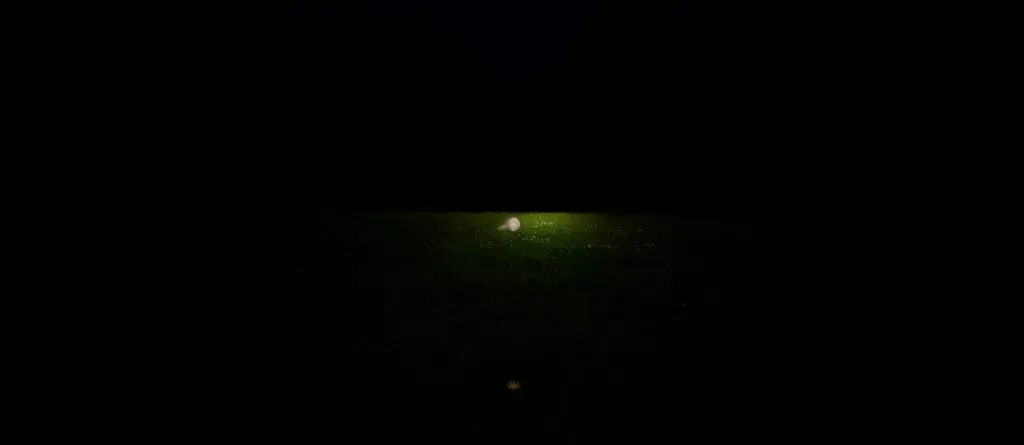
On the one hand, the exhibition at Atlas Sztuki develops the performative strand in Czekalska + Golec’s art, combining the actions of people and animals. The sheep present in the gallery, borrowed for the day of the opening, is an intruder disrupting both the gallery’s operation and the habits of the audience attending the event. Czekalska + Golec decline to keep the animal insistently and exhaustingly in an art gallery unsuited to the purpose. A photograph of the situation at the opening will replace the live sheep. This is important because outstanding representatives of both international art (Joseph Beuys, for example) and Polish art (Piotr Lutyński) did not shrink from forcing animals to remain inside galleries. The photograph of the sheep, a document of the event, refers to the exhibition’s second part: a series of colour panoramic photographs of a white cat that appears like a ghost within somewhat Romantic scenery submerged in darkness.
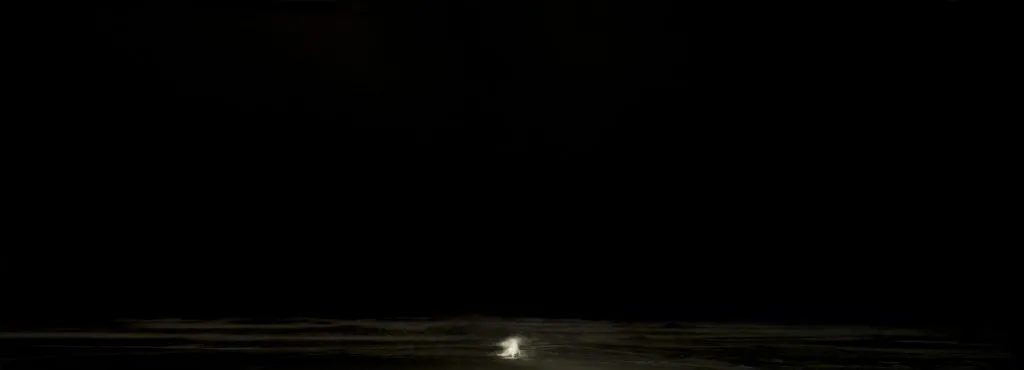
Importantly, the creature in the care of Czekalska + Golec is, its guardians declare, vegetarian. The presentation of both sheep and cat can be received as a distinctive declaration, a profession of faith in the possibility of change: change in the relationship between people and animals, and in relations among all creatures inhabiting the earth.
Contract Killer
Atlas Sztuki’s two spacious rooms belong to the tradition of the modernist gallery. They are two beautiful, bright and well-proportioned ‘white cubes’. Czekalska + Golec’s exhibition plays with the tradition of modern exhibition-making. In the artists’ understanding, the gallery no longer serves only for admiring beautiful, sometimes strange exhibitions and the objects assembled within them for a specified period—paintings, sculptures, films or installations. Aesthetic judgement of the individual photographs and of the situation encountered on the opening day gradually becomes ethical reflection. Without ethics, the exhibition might appear to be another rather minimalist, post-conceptual project, one of the many comprising contemporary art’s mainstream. The little sheep and cat in the photographs are intended to irritate those interested in abstract painting and the tradition of the Łódź visual avant-garde, though they would probably find admirers as well. Harmony for some and idyll for others are merely starting points for meditation on the fundamental problem. Czekalska + Golec make no secret of their worldview or of the values they wish to propagate through an exhibition treated instrumentally. The booklet containing an interview and the present text, the opening speech, conversations with the artists, leaflets and cards distributed by them, and their conduct during preparations, the opening, media meetings and encounters with visitors all serve an overriding purpose. It might be called ‘vegan propaganda’, ‘sensitisation to suffering’, ‘drawing attention to the problem’, or ‘raising the level of knowledge in society at large and the self-awareness of individual people’. What, then, is the titular ‘killer’ invited to the gallery by the artists?
The Gallery as Slaughterhouse, the Slaughterhouse as Gallery
Czekalska + Golec are interested in the rules governing the distribution of the sensible: what is hidden from people but visible to animals and insects—a revision of anthropocentrism, anti-speciesism—and what can be seen in the gallery yet remains invisible even when seemingly located at its centre—institutional critique. The artists’ critique of the power of judgement also takes place in the Łódź gallery. For what is a viewer confronted with a sheep supposed to do? Regard it as an art object? Think about a Christmas nativity scene, or rather a meat dinner washed down with wine? Golec’s exhibition may seem to become a space filled with relational art in Nicolas Bourriaud’s sense, or—to invoke Polish classics—with Jan Świdziński’s contextual art. In this context, Golec can be regarded as an artist akin to Rirkrit Tiravanija or the Polish artists Paweł Althamer, Julita Wójcik and Łódź Kaliska. Golec’s art does not, however, end with a celebration of interpersonal relations understood anthropologically. At a Czekalska + Golec exhibition, therefore, we should ask not so much how the people attending the opening feel and how they are doing, but what exactly the sheep is supposed to do in this situation. What does it see? What does it feel? What is happening to other sheep? Why is this one so exceptional and fortunate? The photographs in the second gallery, showing a tomcat roaming freely, may be regarded as an attempt to visualise and realise an animal-human utopia—or at least to offer a space for meditating on the conditions for undertaking the effort to realise it—but the room with the sheep remains troubling.
If the exhibition could have a reverse, it would probably be a photograph awarded a prize in the popular World Press Photo competition in 2010. A series of photographs by Tommaso Ausili from an Italian slaughterhouse includes an image, frequently reproduced in the Polish press too, of lambs peering through an ajar gate into a slaughterhouse where skinned carcasses hang from hooks. Although the photographs were described as ‘shocking’ and as showing ‘the animals’ ordeal’, attention is simultaneously drawn to the very attractive composition and colours intensified through saturation in post-production. Ausili, an agency photographer, performed his task: he presented the subject of slaughter as capably as possible to an audience sensitive to aesthetics, somewhat blasé, yet also aware of the subject’s gravity and responsive to suffering. He made drastic photographs from which nothing, or almost nothing, results—apart from an award, a touring exhibition and publication of the photo-essay in the press throughout the world. Czekalska + Golec work differently. They try to mediate rather than shock, to suggest rather than put viewers against the wall. Supporting animal liberation, they question the use of symbolic and visual violence. Instead of supplying attractive pictures of slaughter, the artists prefer to ask viewers questions—not only about their attitude towards animals and violence, but also about the artist’s role, the place of art and the meaning of an exhibition. Their work is intended to indicate a way out of the spiral of violence and cruelty. The photographs with the cat in the background in particular resemble a brief creation of a Garden of Earthly Delights evocative of Hieronymus Bosch.
Yet this new iconography faces difficulty. Art-history textbooks may suggest that people—and indeed artists—value meat and fleshiness very highly. Depictions of animal suffering and killing are as old as Magdalenian cave art, made, for example, in the celebrated caves at Lascaux or Altamira, and as compelling as the body of an ox stretched open in a slaughterhouse and painted by Rembrandt. What are we to do with this? How are we to treat and admire it? The gutted ox and mammoths killed from necessity turn into hunts for pleasure decorating the mastabas of powerful Egyptians (Khnumhotep), and once again birds, horned cattle and wild animals of every kind tremble at the sight of man, lord of creation. The roar of the wounded lioness, a masterpiece of Assyrian art decorating the palace at Nineveh, can still be heard when the massacre begins to concern Greeks, Romans, their art and the art made under their influence by conquered peoples. Anthropocentrism and meat: meat, blood, slaughter animals and sacrificial animals everywhere. Cruelty towards animals still appears equal to cruelty towards people. Gladiatorial contests, staged hunts in Roman amphitheatres and the feeding of Christians to starving beasts form this landscape of torment and despair extending across history, through art galleries and museum exhibitions. Czekalska + Golec will not paint over these more or less dead still lifes or end the horror, but they can signal change.
A Pyramidal Misunderstanding
The history of world art is one thing; the artists’ position in the history of Polish art is another. Czekalska + Golec are slowly moving from the margins towards the centre of the debate about critical art made by such well-known artists as Artur Żmijewski, Grzegorz Klaman and Katarzyna Kozyra. The last artist’s Pyramid of Animals (1993), in particular, can be regarded as a counterpoint to Czekalska + Golec’s work. Katarzyna Kozyra’s Pyramid of Animals might even be regarded as the paradigmatic form of animals’ presence in Polish art: they are dead, stuffed creatures, instrumentalised and turned by the artist into a now-classic sculpture arranged and ready for admiration in a museum room. The power of Kozyra’s Pyramid is based on the human subject’s identification with the animals’ condition, while the video accompanying the sculpture and showing the killing and preparation of a horse confronts viewers with the death of an animal—literally—and a person—metaphorically. Kozyra identifies momentarily with creatures ‘used’ by people every day and reveals the nature of that ‘use’, but ultimately passes through the experience like an ordeal by fire: victorious, though certainly not triumphant. From an anti-humanist perspective, it appears that a radical shift of perspective occurs only in Czekalska + Golec’s art, when there is an ‘entering into the skin’ of a living cat, dog or sheep, but also an insect and other creatures. The artistic subject here becomes fundamentally impersonal, as does the addressee of the exhibition From Two Energies…. On the formal plane too, it is worth emphasising the difference between an unorthodox but nevertheless recognisable sculpture (Kozyra) and functional tools referring to minimalist aesthetics and intended to bring about change—perhaps utopian change, but nonetheless work on transforming the world (Czekalska + Golec).
It is symptomatic that Czekalska + Golec’s exhibitions—including Contract Killer—contain none of the gut-like, fleshy, bloody quality so beloved by critics. Categories originating in a butcher’s shop were introduced into Polish historiography and criticism, willingly or not, by Jolanta Brach-Czaina, profusely quoted by Izabela Kowalczyk in Body and Power: Polish Critical Art of the 1990s, a book fundamental to reflection on Polish art.
Situating Czekalska + Golec in relation to artists such as Katarzyna Kozyra is merely a contribution to a broader discussion about their place among artists addressing the body (from Jerzy Bereś to Alicja Żebrowska), fleshiness (from Grzegorz Klaman to Andres Serrano), animals and living creatures (from Zbigniew Warpechowski to Piotr Lutyński), and nature more broadly (from Teresa Murak to Jarosław Koziara). At first sight, however, Czekalska + Golec seem to diverge from the mainstream of Polish art, which as a rule is focused on the human being and on displaying ageing, illness, death and annihilation—a Polish artistic tradition full of specimens, corpses, killing, cutting and sawing, withering and decomposition.
Meditation on Suffering Today
Czekalska + Golec make minimalist, ascetic art. They also live in this manner, thereby attesting to the authenticity of their artistic actions. There is no pretence here. At the same time, Czekalska + Golec are open to popular culture and New Age philosophy. They are interested in the gestures and positions of Brigitte Bardot or Moby—in an ideal exhibition scenario, stars of this calibre would doubtless have appeared at the opening in Łódź. Reflection and meditation on suffering precede, but by no means exclude, actions calculated for effectiveness and a change in the status quo. It begins with supporting websites and ends with the choice of catering for post-opening parties. Czekalska + Golec offer an opportunity to examine the ways suffering is presented and made present in contemporary culture. The local context seems especially interesting here: responsibility for what is closest and directly given. If a country is known by its inhabitants’ attitude towards animals, Poland appears to be a rather horrific state, although Czekalska + Golec’s actions offer hope for the future. And not only theirs.
Czekalska + Golec’s outsider, pioneering art of the 1990s enjoys an increasingly favourable context; it appears progressively less ‘irrational’, ‘strange’ or ‘detached from life’. Icons of popular culture openly declare their commitment to the cause defined by philosophers such as Peter Singer as ‘animal liberation’. Not long ago the word ‘ecologist’ was used as an insult; today former hunters such as Zenon Kruczyński write in a confessional tone, exposing the violent culture of hunting (Blood Tracking, 2008). ‘A great deal has changed during my lifetime,’ says Olga Tokarczuk, author of the crime novel Drive Your Plow over the Bones of the Dead (2009). ‘When I was a child and watched cavalry charges in films, I could not concentrate because I worried about what happened to the horses. Today no one will make a film without a special animal consultant; animals used to be killed on set, but now such things are unthinkable. On the other hand, the scale of violence towards animals is increasing unimaginably. This chiefly concerns the mass farming of animals for meat. Such a degree of cruelty is unimaginable to an ordinary person, so it is carefully concealed.’ Popular reflection on animal liberation is supported by psychological authorities such as Wojciech Eichelberger and connects with the actions of artists and activists, producing a new quality previously unknown in culture. Politicians, too, are under pressure. This is not merely about laws restricting the suffering of farmed and domestic animals and those used in scientific research. It is worth noting that a sudden change has occurred in this area as well, even if intervention frequently follows the presentation of abuses of violence and cruelty in the aura of media scandals—Katarzyna Kozyra’s Pyramid of Animals once created such a scandal. There are producers of dog lard, the cruel manager of a dog shelter, young people abusing dogs and cats, inhumane breeders of horses and cattle, and fear of dirt and epidemiological threats. Public opinion is alerted; silence and tranquillity are gone, and the animals’ situation increasingly enters public consciousness. Not long ago, it would have been unthinkable that Bronisław Komorowski, fighting for votes in a presidential election, would give up hunting. Calculated to improve the candidate’s image, the move by the present head of state appears both cynical and symptomatic of the contemporary moment. Under pressure from environmentalists, campaign staff and ordinary voters, Komorowski relented and announced during one of his many meetings with the media during the election campaign: ‘My children and grandchildren gave me a camera and asked me to stop hunting and start taking photographs of animals. I shall try to follow their request.’ An uproar then erupted among hunters, who called Komorowski a traitor on internet forums. As a journalist for Rzeczpospolita reported: ‘the Civic Platform campaign knows what it is doing: there are 100,000 hunters in Poland and around a million opponents. The calculation is simple.’ The calculation is also simple for animals, the indirect objects of politicians’, public opinion’s and artists’ interest. A sheep borrowed from the city zoo is therefore both the object and subject of the exhibition. Everything is for it and revolves around it. The artistic logic of the miracle operates once again. On the other hand, the sheep is, of course, a symbol. A little sheep represents innocence and gentleness. According to art history, it is part of a paradisiacal idyll, a promise of a better tomorrow. It is also the moschophoros, the Greek statue of a man carrying a lamb and smiling a faintly Archaic smile, the archetypal good shepherd. And if the good shepherd is Jesus Christ, saviour of humanity and of the world, then surely the Lamb of God is also the saviour of animals.
1. T.atrica METAMORPHOSISIMPERFECTA, Cistern, Ujazdowski Castle Centre for Contemporary Art, Warsaw, 25 June–25 July 2004, curator: W. Krukowski.
*Dr Adam Mazur, critic, art historian, American studies scholar, lecturer, curator and editor