
In Conversation with Professor Stefan Gierowski
Interviewed by Jacek Michalak and Marta Skłodowska
Jacek Michalak: The conversations published in the catalogues accompanying exhibitions are very important to me; they are an essential part of an exhibition. It is rare to meet someone who has taken part in so many events, lived through such interesting times and seen as much as you have. You were a young man during the war, so you retain a vivid memory of the chaos of those events. You then lived through the Stalinist system of the 1950s, the thaw of the 1960s, the period of modest stability in the 1970s, and the crisis and emergence of the opposition in the 1980s. At that time you even joined the organising committee of the Independent Congress of Polish Culture, which was interrupted by martial law. For years you were a professor and Dean of the Faculty of Painting at the Academy of Fine Arts in Warsaw. How did it all begin? Why did you decide to study at the Academy of Fine Arts? Why did you consider that the right path?
Stefan Gierowski: That was a rather long time ago. I have spoken about it many times, although I must honestly admit that my memory used to be better than it is now. I remember many things and not others. But to return to the question itself, I must begin with the home in which I grew up, what went on there and why. The milieu from which I came possessed a certain tradition of respect for paintings. My father, who was a doctor, had wondered as a young man whether he ought to attend an academy of fine arts. He always painted a little and also collected paintings. We lived in Kielce, which is a rather unusual provincial city. There was still a living tradition of artists who were young in the 1860s and 1870s—not of the previous century but of the nineteenth century—such as Aleksander Kotsis and others. They painted in the surrounding region and stayed in Kielce itself. There was also the magnificent Bishops' Palace, with excellent paintings inside. Taken together, all this made Kielce a city in which one could encounter something important.
It often happened that a painting bought by my father was slightly damaged. An elderly Mr Lenartowicz from Kraków would come to our home—a little eccentric and a little an artist—who worked in conservation. He and my father would sit over the painting together in the evenings; that was how my father relaxed after all his medical work. A real conservator today would doubtless say it was not done properly, but I can say that it nevertheless did me a great deal of good, because it brought an atmosphere of wonder and discovery into my childhood: watching something unknown suddenly reveal itself.
As a boy, I found this completely absorbing. I watched it with curiosity, and at the same time I enjoyed drawing. I would not say I was terribly gifted; I simply liked to draw. One of my brother's friends was superb at it—his life took a strange turn, incidentally, and one could write a rather dramatic book about it. But he truly was exceptionally talented. When I occasionally look today at some of his little watercolours that I still have, I can see that although they were made by someone who was still just a boy, they are excellent and mature. Beside him, I was very poor. But he was older, so I thought that when I grew up I would become just as good! That did not happen at all, but I always had that hope. My mother also had the ambition that, since my father had not become a painter, at least his son should. It was not something I had to give up or fear my parents would discourage by saying, “You'll never make a living from painting; find yourself a proper occupation!”
Because of all this, I thought about entering the Academy without any resistance. The only risk was that aviation might attract me more strongly, since I was enormously curious about it too. This was a time when two things were promoted everywhere in Poland: the navy and aviation. We built the Łoś, which was a good bomber, and the most important aircraft of all, given pride of place, were fighters. That was the message of the time. There were also good conditions for gliding near Kielce. The Świętokrzyskie Mountains are no trifling matter: something rises there, something falls, something is higher, something lower. Those gliding sites also fired the imagination of the boy I was then. Later, it all came to an abrupt end. My father died and war broke out soon afterwards. Everything changed. My mother, formerly the chairwoman of the Women's Military Training organisation in Kielce and a nurse during the war against the Bolsheviks, immediately became involved with the Union of Armed Struggle and later the Home Army. That was how I entered the resistance, while also completing my secondary-school leaving examination in clandestine classes. At the same time I took painting lessons from Andrzej Oleś, a well-known Kielce watercolourist and graduate of the Academy of Fine Arts in Kraków. During the last two years of the war, however, I was occupied with something entirely different from painting.
So aviation was no longer an option either, and in any case they probably would not have accepted me because I had problems with my hearing. But I had imagined it would be something… You see, aviation is also about space. Evidently space was still there somewhere, coded into my imagination as something important. And so events unfolded in such a way that art prevailed.
J.M.: Why Kraków? You said that Kielce was an important provincial city, but it lies somewhere between Warsaw and Kraków, and Warsaw is the capital after all…
S.G.: I chose Kraków for a very simple reason. Before the war, Warsaw did not count as far as painting was concerned. Its school was primarily concerned with applied art, closer to the ideas of Wojciech Jastrzębowski and the whole kind of art associated with functionality and what the state directly expected of art. On the one hand there was the state, and on the other perhaps the customs that shaped the artistic imagination of the period…
Kraków, by contrast, had the traditions of the Academy and was the city in which independent Polish painting had essentially been born. Leaving its earlier traditions aside, it was connected with the traditions of Young Poland. As far as painting was concerned, it was really the only place. As I later learnt, painting only began to play a larger role at the Academy in Warsaw towards the end of the 1930s.
J.M.: I understand. I asked the question with the country's changing circumstances in mind, whereas despite your youth your interests were already quite precisely defined.
S.G.: Kraków was always quite close to Kielce, so to speak. There were historic connections, established by the Bishops of Kraków, among others, who built their palace in Kielce. These things may not have directly shaped my choices, but they were nevertheless significant.
J.M.: Yet later you moved from Kraków to Warsaw. What prompted you to do so?
Magdalena Gierowska-Dybalska (the artist's daughter): Because it is still the capital, after all (laughs)—rebuilt in the meantime, with the Academy already open there.
J.M.: That is precisely what I meant—so there we are!
S.G.: Let me put it this way. On the one hand, there is artistic work: arriving at certain solutions in art, creative exploration, successes—when one sees that something is not bad, or that one has gone further than before—and failures, when one sees that it is worse. On the other hand, chance is very important. Good fortune. This “stroke of good fortune” can accomplish a great deal and offer an opportunity. One must make use of it, of course. If good fortune comes to somebody who understands nothing of it, then it will not be good fortune at all, but merely the same continuing misfortune without end. If somebody recognises the fortunate moment, they may be able to change something in their life. After finishing at the Academy, I returned to Kielce. Because I had to earn some money, I became a civil servant and worked in the culture department of the provincial office. At the same time, I began to become somewhat involved with the artists' union.
J.M.: How long did you work there?
S.G.: Until 1949, when I received an offer to move to Warsaw and become technical editor of the magazine “Wieś”. That was precisely the stroke of good fortune. I went. I had nowhere to sleep and nothing at all there. Although I was setting off into a void, several friends in Warsaw wanted me to be there and wanted to help me.
Of course, I knew nothing about printing processes, so I went to the print shop and said: “We've got half a litre here, and this has to be printed.” That was how I learnt, little by little. (laughs)
J.M.: And did you spend long at “Wieś”?
S.G.: As long as I ought to have done. Then came a second and a third profession, because I was constantly trying different things, and that was how I remained in Warsaw. It was that stroke of good fortune.
If we were to follow those strokes of good fortune, Warsaw began, in fact, with extreme poverty. At first I rented a room, because thanks to “Wieś” I could still afford one. Later, when my time at “Wieś” ended, there was no longer much money with which to rent anything. I married; a daughter and son arrived… We had a communal flat shared by several families, four of us, including two children, and no source of money. My wife had what was ostensibly a good profession as a dentist, but she earned pennies, because that was the only sort of work she could obtain. Things began to look rather strange again and no longer so cheerful. Yet that first stroke of good fortune proved useful because I began to paint in Warsaw; I simply worked without stopping. Today I do not know what doctors would say about it. But I thought that children were children—they could sit there while I painted. Today, because of the toxicity of paint, one must not paint near children, especially small ones. I painted day and night, smoked cigarettes and did not worry about it in the least.
M.G.-D.: That is why I enjoy walking in the forest so much. (laughs)
S.G.: Through all this, I met several people who became important to me. The first was
Marek Włodarski Streng. I met him because an acquaintance of mine also knew him and said, “What you are doing may interest him; I must put you in touch.” Marek and I did indeed become friends later. That was already half a stroke of good fortune, although everything was still built on proverbial feet of clay.
Later, Zachęta hosted the International Exhibition of Young Art, organised to coincide with the Fifth World Festival of Youth and Students, which also accepted work from Poland. I received some distinction or second prize for my painting at that international exhibition. Financially, it amounted to nothing, but it did make an impression. For the first time my name appeared in such a favourable context. The then director later told me that Xawery Dunikowski had been among those who noticed my painting. That carried weight! Dunikowski was an important figure, and also someone who did not know me yet had been able to see something in my painting… Then came the Arsenal exhibition, another prize, and mentions in magazines and newspapers… Something began to happen…
The painting I submitted to that exhibition was entitled I Love Life. Looking at it now, I can see that it contained something I took for granted: life is wonderful, not something to complain about. Some people reach everything through drama, squeeze something out of themselves and suffer… They do not love life. If you love life, you enjoy everything. Everything that happens is good. That is why the title became so important to me, although at the time I chose it rather casually. I was simply looking for a pleasant title and that one came to mind. But it remained within me—not as a title, but as a certain truth, the conviction that this was how one ought to live. It is quite a large painting. My daughter has it now, and it is gradually flaking because it has aged considerably…
Zuzanna Sokalska (President of the Stefan Gierowski Foundation): Flaking in a conservator's home?
M.G.-D.: It was flaking when you gave it to me. Nothing is flaking now. It was lined long ago.
S.G.: And so it continued until another completely strange chance event occurred: the elections of the Association of Polish Artists and Designers. I had been an ordinary member of the Association in Kielce, then an associate member in Warsaw and later an ordinary member, which gave me the right to vote. All this was connected with the change in circumstances after 1956. There were elections for a president and secretaries. The entire assembly chose the candidates.
Jan Cybis became president. He was elected by a single vote. I was chosen as one of three secretaries. And in those days a secretary was something! It immediately placed one in the proper order: First Secretary, Second Secretary… It sounded like real power, at least. (laughs)
The secretary assigned to our office had been placed there by the appropriate authority to keep an eye on everything. That was how things worked then. But that is not important. What matters is why this was a stroke of good fortune: I met Cybis and we became friends.
Together, we were to do a great deal of good.
It was still a time when we could amend the statutes. We changed them completely. They contained no socialist element at all. Amusingly enough, when Solidarity emerged, colleagues connected with it said, “We shall take these statutes to Solidarity's lawyers who deal with such matters and see what they say, because something will certainly have to be changed.” Instead, the lawyers said: “Nothing needs changing. These are ideal statutes, exactly as they should be; there is nothing political in them.” Yet it was we who had had to change the statutes and seek their approval from the authorities. We then worked under them for years. All elections and other matters were conducted in accordance with them.
I also dealt with exhibitions, and at the time I was connected with Krzywe Koło and Marian Bogusz. The situation was such that the places in Poland where one could organise an exhibition could be counted on the fingers of one hand. In Warsaw there was essentially only Zachęta. Kraków had the Palace of Art, while other cities had nothing at all. We began, above all, by trying to establish numerous exhibition spaces so that exhibitions could be held and would cease to be inaccessible to artists. We succeeded rather well. In any case, in my final report at the end of my term I could already name dozens of premises the cities had given to the Association.
So meeting Cybis and beginning to work with him was the second fortunate development. It also mattered to me that I began to become part of the artistic community and feel at ease within it. After all, I had graduated in Kraków and arrived in Warsaw without knowing any artists. It took a great deal of time, but eventually it worked. I suspect it was important that I painted and exhibited while also being socially active. I could not be treated as someone who was a good organiser but had nothing else to offer, because I had works of my own that were artistically important. The two activities continually worked together. I would even say I feel some satisfaction at having been able to combine them without harming either one. I did not want to join the Academy.
J.M.: Yet you eventually did find yourself at the Academy. You had two small children; it was the end of the 1950s. You had been in Warsaw for, let us say, ten years and were doing rather well. You have explained how this developed, but also said that you did not want to join the Academy, believing that certain things would work out differently. And yet the Academy appeared. How did that happen?
S.G.: I truly did not want to. Marian Wnuk, who was rector, tried to persuade me. Cybis also said it might be a good thing, but I had doubts, although my other social activities often brought me into contact with the Academy. In the end, they persuaded me. I spent some time in Paris; about a year after my return, conversations began
which resulted in my teaching Painting in Architecture. That was in 1961. I said that I did not know enough, but they replied that I would manage. Painting in Architecture belonged to Aleksander Kobzdej's department. I did not think of it as a job with a future, but while teaching it I encountered problems that later became important and popular. The first was space: open space, enclosed space and painting itself within that arrangement. I was also in close contact with those who taught painting techniques, so whenever necessary I could immediately consult them on questions of technology… Somehow, it worked.
J.M.: Did the Academy draw you in?
S.G.: Not immediately. Something else drew me in, however: the debate about education that was then taking place. I did not yet have the appropriate academic degree to take part in the council for art education, and as a representative of the Association I had greater scope for activity. But questions relating to art education greatly interested me. Nor was that all. I also spoke on various issues concerning secondary education, where not only were there too few schools, but the existing schools devoted very few hours to art classes—much as they do now. It was an important problem connected with educating informed audiences for art.
An entirely different situation arose when it was decided that I should be given one of the painting departments. In the meantime I had completed what was called a habilitation for a readership. In the 1960s it was one of the first such procedures. With the title of docent, one could take charge of one's own department. To tell the truth, the fact that this happened was also a matter of chance. At the meeting where the Faculty Council nominated and approved me, one of the professors was absent. He was a friend of mine, incidentally, but strongly opposed to my candidacy. He had someone else, an older person, in mind in his preferred order of succession and believed that man should receive the post. But he was absent and I was chosen. He later asked me to resign, while for a long time the ministry refused to approve my candidacy, although these were not political manoeuvres but rather internal matters of our own. By the time it was finally accepted, I had of course been running the studio for a long while. Thus I suddenly became—again through the chance absence of one person—a rather important figure in the Faculty. As became clear many years later, I left a certain “mark” there and introduced my own ideas about the institution. Because it was my habit to say openly what I thought—unless speaking openly would mean losing immediately—I sometimes prolonged meetings of the Faculty Council and Senate by arguing to the bitter end over certain concepts, views on art and approaches to education, and even over matters that might be called political when they concerned students.
I was genuinely very involved in all of it. That is why I was inscribed somewhere in the Academy's history. I am there, and I suppose there is no help for it now; I shall never escape. (laughs)
M.G.-D.: When my son began studying at the Academy in Warsaw, he suddenly learnt how highly his grandfather was regarded there. People spoke of the Academy “before Gierowski” and “after Gierowski”.
J.M.: Did you come to enjoy teaching? Earlier you said that painting came first: your children were very small and you painted at night. Alongside that was organisational activity, which also absorbed you. But teaching is something different. Did you enjoy it?
S.G.: Let me tell you: I did not teach. That was the point. (laughs) I accompanied.
That was how I understood it. I tried to help everyone with what they were doing and seeking. I generally had the older students. In the first and second years one genuinely had to “teach” rather more. The older students had already done some painting and, if teaching occurred, it was more through the atmosphere itself. I never said, “My dear fellow, what have you done? It should not be like that; it should be different!” I had no aptitude for anything of the kind. I always began by saying, “It is not bad.”
Marta Skłodowska: So that was how your critiques proceeded?
S.G.: First I said it was not bad, and then I explained what was wrong. But I did so in a way that made the student feel it was all “among friends”. And it was. That does not mean I had no programme, because I did, although it was rather broad. A class might concern the colour blue, for example, and what could be expressed through it. At the same time, there were ordinary classes: the nude and still-life studies. But I tried to introduce interludes—specific tasks intended to broaden the students' painterly imagination still further.
As for teaching in the strict sense, based on my knowing better than the student that this is how things are… I do not know. Just like the student, I do not know everything.
I was very strict, however, with those who did nothing. There were students like that too. If they wanted to receive course credits for nothing, they had nothing to discuss with me. But if someone offered even the slightest possibility, that was already good.
J.M.: Approximately how many pupils emerged from your studio during the years you spent in the Faculty of Painting?
S.G.: A book listing all the graduates was published for the anniversary of the Academy of Fine Arts in Warsaw, so I even have an exact record there. But I think that more than a hundred completed their studies and diplomas.
J.M.: Are there any pupils you remember particularly fondly?
S.G.: Let me tell you, the ones I remember most fondly are old people by now! The years do pass. There were many of them, working in very different ways, but of those hundred there are at least twenty or thirty whose work I know and who were good at it.
J.M.: Even if you speak of twenty or thirty people, that is still quite a large group. In other disciplines too, many people often disappear along the way, and the Academy has the additional factor of many women, whose role in life is more difficult.
S.G.: Yes, that is true. Whole ranks of people disappear.
J.M.: Are you still in touch with your pupils today?
S.G.: Not very much, to tell the truth. At a certain point contact breaks off—simply because of life. They have their own difficulties and their own ideas about art, and they do not always need me. Besides, I feel there may be a certain thoughtfulness in it as well: they do not really want to trouble me. But there are a dozen or so with whom I nevertheless remain in some contact, and I am very pleased about that.
J.M.: Professor, before I hand over to Marta Skłodowska, let me ask one thing. You were organisationally engaged: Secretary of the Association of Polish Artists and Designers and a professor at the Academy. Yet when you were still a young man of fifty-six, you experienced a complete transformation of circumstances in 1981. The Independent Congress of Polish Culture was held that year; you sat on its committee, and the congress was brutally interrupted by the declaration of martial law. How do you remember that time? How did you see the Academy and the changing situation? You were an important figure then, actively involved in shaping artistic life.
S.G.: A fairly major change did indeed take place, and it also concerned the Academy. We had to ensure that no unnecessary settling of scores occurred within the Academy itself, for example. I did not want matters to be handled badly. The first problem concerned replacing the rector. For quite a long time I wondered whether it was right or wrong, necessary or unnecessary, to remove Julian Pałka and elect someone else. Some of the more active people even came to me and asked what I thought, as though they were waiting for me to say that he had to be removed. Eventually I agreed, although first I had to convince myself that this was a step the Academy had to take if it were to move forward. It made it possible to open a certain path for people—not in the sense of positions and posts, but in terms of education, because the existing rector supported tradition in its Polish People's Republic version.
I do not mean that it depended on me alone. It certainly did not, but whether I wanted it or not, I was somehow involved in everything.
Lech Tomaszewski became the new rector, and we were in fact very close friends. In principle, everyone was fairly friendly with everyone else. There were only a few people with whom one had less contact. When Solidarity began, a certain mood prevailed everywhere. At a meeting of the Academy Senate, another Tomaszewski—Henryk—who always made good associations, not only in the posters he designed, said: “I walk down the street and see that people are standing upright again.” That was how he described the entire movement that had arisen. There was something true in it, a perceptive view of reality characteristic of him. Just before martial law, sometime in the autumn, the school organised a strike in solidarity with those striking in Radom, I think…
J.M.: There were already a great many strikes that autumn; they were spreading across the country.
S.G.: Before that, I had sometimes attended the Association of Art Historians. There was a place in the Old Town where we met. We also agreed there who would do what in connection with the Congress of Culture. I was delegated to the Congress council by the Academy. That was how I found myself on the list of members of the organising committee.
Then, on the second day of proceedings, it was closed because martial law had begun. Our activity under martial law was also unusual. Two things were closest to my own involvement: taking part in exhibitions outside the official circuit, in churches and elsewhere, and belonging to those who rejected the official galleries. That was one important matter.
The other was that, although a new Association of Visual Artists had been formed, we continued the activity of the Association of Polish Artists and Designers, which had been dissolved. We formed a committee of former recipients of the Jan Cybis Award and continued to confer the award, while “Tygodnik Powszechny” published information about it. This activity received mixed assessments: we considered it entirely justified, while those writing in the press criticised it as some kind of oppositional or “anti” activity. It was indeed “anti”, because we did not recognise the other association. Nor did that body acquit itself well in history. After 1989 it ceased to exist altogether, while our Association was revived. I greatly regret that today it has no significance, at least in Warsaw; perhaps it has slightly more in Kraków. It was once an authentic representative body for artists, uniting every discipline. Later it began to divide and now has no power: neither influence nor the ability to get anything done. At least in the early years of the Third Republic, it was able to keep studio charges low in Warsaw. At one point studios began to be treated as shops or commercial premises, so the charges rose. But we managed to keep the rents low, and I believe that arrangement may still apply. And so we have almost reached the point at which I found myself here in Konstancin, which had not been my plan. I was always connected with Warsaw and am still officially registered there.
M.S.: Since when have you had a studio here?
S.G.: I began painting here in 1996. Before that, I painted in Wola. But Wola is an entirely different story. As you may have noticed, people there always write “Wola for the people of Wola”; they do not joke about it. But it was a good studio, and I remained there for fifteen years because there was no longer anywhere to store my paintings at home on Gagarina Street, where we lived. I obtained the Wola studio by some miracle. I was in a rather poor position because people assumed I was well off and, moreover, a famous professor who could buy himself a studio. But I was not well off enough to buy one and tried to obtain one through the Association. I was continually refused. Eventually, one of my students, who knew about my difficulties, joined the committee that allocated studios. He managed to secure me an allocation from the Association, which at that time still had the right to administer registered studios. In any case, I received the studio. Although I later had to fight the building's owners to prevent them taking it away, I painted there. I also painted here—for as long as I still painted.
First I painted in one room, then another, and only later was this studio built. Once it had been built, I painted here for the shortest time of all, because my eyes failed. That is all.
But the advantage of the Wola studio was that it was high up. My flat was high and the studio was too. I could see the sky and space. Here I look out and see bushes and more bushes everywhere, completely blocking the view (laughs). I even installed a skylight so that I could look up and see a patch of sky.
M.S.: Apart from a view of the sky and the kind of light, did the studio—as the important place where paintings begin—have to meet any other particular requirements for you to paint well in it?
S.G.: All of that matters, but you see, in that respect my requirements were rather modest. Perhaps it was because I was accustomed to such conditions: for a certain period I had only a corner in which to paint, and I painted there too. It was important that the painting should fit.
As for special comforts… It was good if the place had the right atmosphere. It is difficult to say what that consists in, but the studio I made here, for example, has a good atmosphere. That is partly because the roof is glazed, so it is very bright inside. But I once painted here in this room and it was not good. In another building where I painted temporarily, the atmosphere was entirely wrong because people were always walking through. And I like peace and quiet.
M.G.-D.: As children, we were not allowed to disturb him either. We had to knock on the studio door. On top of that, when someone telephoned, I had to lie and say my father was not there. I always
found that difficult.
S.G.: In Wola I had the telephone disconnected, and it was an excellent situation. I do not think people today understand how wonderful it is to have no telephone or mobile at all.
M.S.: I would now like to enter more deeply into the space of the paintings themselves. I have enormous respect for the fact that for several decades you have worked within the quadrilateral of the canvas, continually examining and rediscovering it. What has allowed it to remain a site of exploration for so many years? What continues to fascinate you in that quadrilateral, white at the outset?
S.G.: The question is not unfamiliar to me; I have also asked it of myself. Why am I still doing this, and for what reason? The simplest explanation, at least to myself, is curiosity. Or rather, it was. I am accustomed to speaking in the present tense, but I shall have to speak differently because it has essentially passed. Yet it was always a curiosity about “what will happen if…”: if I arrange the colours in this way, or give a form this shape and colour, what will happen to that form and colour? What will happen if the colour, the paint, is applied using one technique or another—if it is more glazed or more impasto? How will the colour act? Will it produce greater or lesser emotion? Curiosity about this was the constant reason.
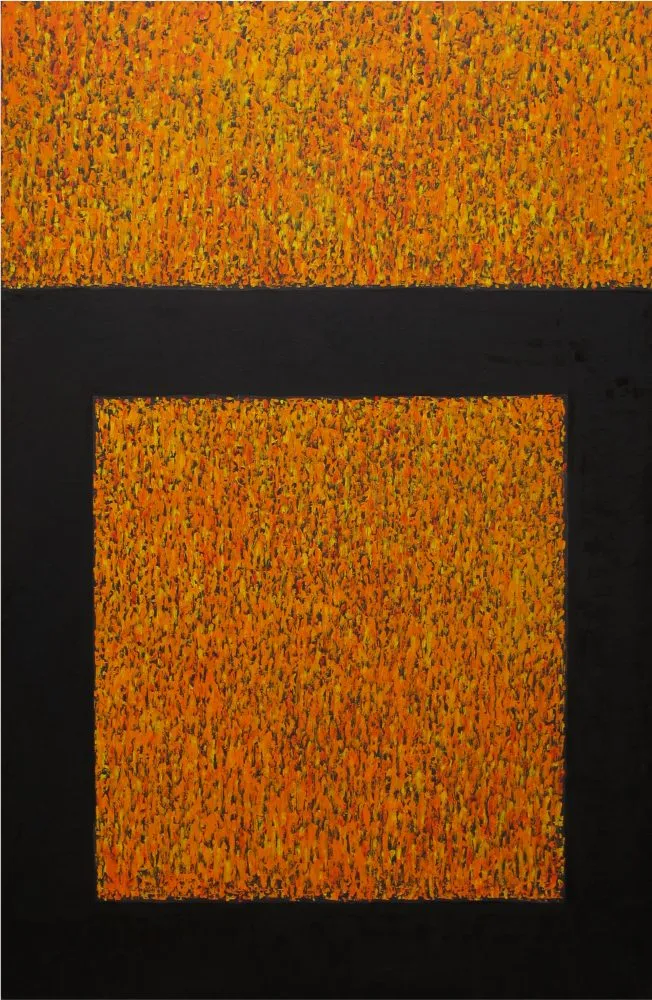
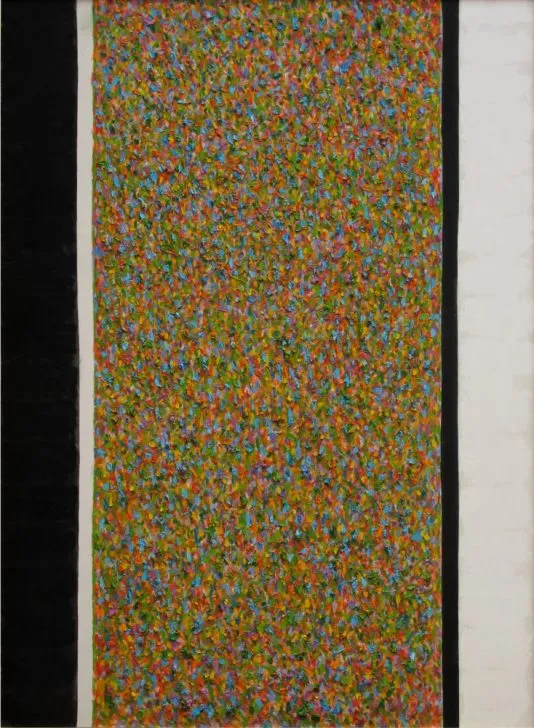
At the same time, I always sought a new solution. The paintings later become fairly coherent in a certain way, but while working I tried not to repeat the same thing. I did not want to find a good gesture and use it for everything from then on, so that people would know that this gesture was my signature. My paintings are therefore recognisable not because of any consistent drawing but rather because of what happens with the light born of the colours. For colour is meaningful when it gives light. What is most important—and is often forgotten now—is that good paintings, whether old or contemporary, abstract or non-abstract, are all distinguished by the light that emanates from them. It comes from them; it does not fall upon them and create a reflection. The radiance arises from the paint itself. A painting may be very dark and yet give light. Some artists have even claimed that black is the most luminous colour. Everything is possible. That would be my explanation, and it is probably difficult to find another. This curiosity about seeing something is very important to me. An idea appears in the mind, and one searches for the simplest and most apt way of conveying it, considering which colours might be used. Then one sees how it works, how it proves itself in my mind when only the painting and I remain. It is deeply absorbing and never becomes boring, even though fundamentally I work with the tradition of the most elementary forms and colours.
One might therefore say that there is nothing innovative about the technique. Yet for me it continually reveals something. A line placed in a slightly different way suddenly acquires an entirely different meaning. That is what it is: curiosity about whether that meaning will suddenly appear, and how it is born.
M.S.: Is the impulse that leads to the birth of a painting derived from observations of nature and phenomena, or rather from concepts and theories?
S.G.: Everything. Everything. In other words, life. I love life, you know. All of it is there.
A great many things happen in nature, and a painting is also a part of nature. It cannot be eliminated, although thought is equally important. Abstract art in particular makes it possible to create situations that cannot ordinarily be seen anywhere and that contain a certain metaphysical seed. It need not be something grand. It may involve serious explorations connected with transforming concepts into colour, because every colour has its meaning, although that is not all.
M.S.: Do you therefore have a personal alphabet of colours and personal meanings associated with them? For Vincent van Gogh, for example, yellow—commonly perceived as an expression of joy and the sun's radiance—was instead a colour associated with death. Did you also develop such a personal relationship with certain colours?
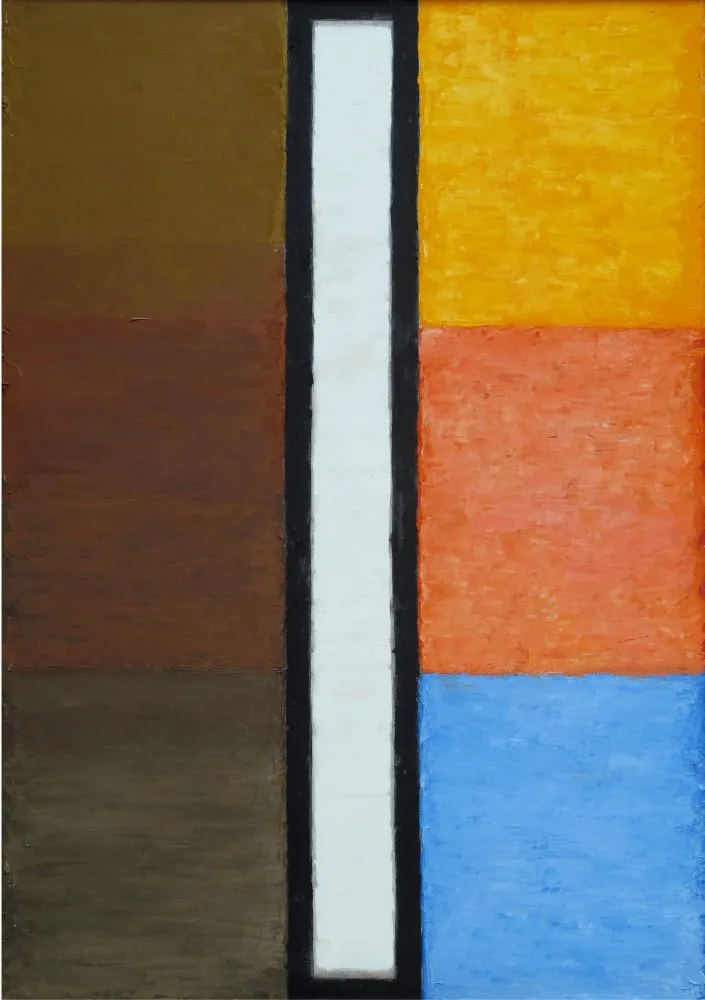
S.G.: Yes, I have my own colour codes. A colour often has the meaning I devise for it. One likes certain colours more than others and expects something from some of them. There is, of course, an entire range of colours described differently in different cultures and meaning different things within them. There are almost no colours with a universal meaning, of which one could say that throughout the world they signify good or evil, life or death. It is never like that. A colour means one thing in one place, another elsewhere, and something else again in a third place. It depends on many factors. I painted the large pictures hanging in the hall with colours intended to symbolise the elements. But the number of elements differs: Eastern culture has five, whereas Mediterranean culture has four, although names of colours connected with the elements have survived. I painted two works according to that principle. But these are already my colours. This is my blue, my red.
M.S.: Knowledge of colour is also scientific knowledge: of secondary colours, complementary colours, the colour spectrum and the colour of light. In your work, one can see this scientific knowledge meeting a certain alchemy of colour. Which predominates? What is the point of departure: science or intuition?
S.G.: I think it varied, depending on the subject that intrigued me at a given moment. I studied the physical properties of colour and read works on physics and optics, but the knowledge of colour obtained through research into light and other matters is one part of the truth. The second part is simply one's own experience of it. All the more so because most people—myself included, even when I could still see well—make certain errors in perceiving colour. Thus, the idea and the ideal divisions of colour presented in books about colour and light are generally not entirely true. That is, they are true, but only for a certain group of people. One might say they are true within a physical system. But there is also the psychological system, which does not respond to scientific data because it does not experience them. A very great deal in a painted picture lies precisely in psychological experience: in what happens in the brain, what is born there and why. That is unknown, and it is the source of the entire mystery inherent in painting. People often want to read a painting, but nothing reaches them. They can read only what they have learnt, and receive no direct inner communication.
M.S.: What, then, do you expect from the viewer?
S.G.: People differ, and this is very important. What I mean is that a painting alone means nothing. The painting together with the person constitutes the painting in its fullness, and that fullness grows with the person's sensitivity… But sensitivity is not something that can be learnt. I have discovered many times that people with no education at all, even people living rather unsophisticated lives and of average or below-average intellectual ability, can experience a painting superbly. Paintings reach them immediately. Gentlemen who are professors at institutions of higher education, including the Academy, sometimes see nothing. They see only that it is a painting, that it stands there, and that it contains blue and yellow. That is where their sensitivity ends.
Unfortunately, art is a field that requires time and calm feeling. A painting does not move, flash or entertain. One has to sit down and look. One must simply possess a certain need for it. Not everyone does. I do not mean that people are in a hurry; sometimes the need is simply absent. Yet there is a need to boast about visiting a famous museum and seeing famous works of art. A kind of “I was here, I was there”… I remember being brought to my senses many years ago when I encountered a woman in a good museum in Vienna. There were beautiful paintings there, and she was looking at them through green spectacles! It astonished me so much that I remember it to this day!
M.S.: Looking at your paintings hanging all around us here, one has the impression that they radiate.
M.G.-D.: They require time. When someone buys abstract paintings, they know that the works act very strongly. This is not a neutral little window in a frame. One therefore has to consider: how will I live with this painting? Can I manage it?
M.S.: Do you plan how a particular painting will “radiate” towards the viewer, and what feelings or ideas will arise when that viewer stands before it? Your paintings are often said to combine physics—the painterly matter itself—with the metaphysics that emerges as a result. What means do you use to create that metaphysics in the viewer, or to encourage the viewer to notice it?
S.G.: You see, the means were here, in the head, and here, around the heart. Those are the means I truly used. Apart from that, there were paints. But paints without the rest… So these are the means one simply has to possess. What distinguishes artists—and I no longer mean the great ones, but people who paint as I did? Among other things, something in their minds is arranged in such a way—perhaps to the detriment of some other function of the brain—that they are particularly sensitive to certain things. This cannot be taught, which is why one cannot teach somebody to paint. That is relevant to my earlier answer about why I could not teach. It must be present within a person. If it is there, one can help them achieve something more quickly. But it cannot be taught. One can see it. When one has sat on as many examination boards as I have, and reviewed hundreds of successful and unsuccessful candidates, one recognises almost immediately those who possess it. Whether such a person makes a still life or another drawing, it is absolutely right. One must have that something; without it, it cannot be done. That is, one can still accomplish something in art and learn to make something without it, but one will not become an artist. It is a mystery. Music is similar: dozens of people play, yet a few individuals play in a completely strange, somehow different way…
M.S.: Could one say that they play from somewhere else? I am referring to your description of yourself as an intermediary. Between this world and… well, which world?
S.G.: It certainly played an important role in my life that, fairly early on, while still at the Academy, I took a strong interest in Chinese art and Eastern art more broadly. Some Chinese artists imagined that they were essentially only a hand, guided by someone else. Their drawings were therefore very spontaneous. Another school, by contrast, was extraordinarily painstaking and treated everything in great detail. It depended somewhat on the philosophy.
But even then, when Chinese art in Poland was generally still treated as local art, I sensed that it contained a truth, that something important could be found within it. The same was true of children's art. I discovered these things when I was very young, and they greatly enriched me. Later, when I encountered various readings connected with Eastern art, they confirmed my intuitions.
At the Academy I already tried to promote this art and argued that the art-history curriculum should not end with European art. It should go further, because these are things that contain a great deal of wisdom—not only wisdom, but also a creative stance and a creative way of seeing the world that is very close to us today.
Such different encounters are very interesting. The very presence of painting over the centuries is a remarkable thing. Sometimes people even become sick of it and daub walls instead. But this merely shows that some need nevertheless exists within them. In India, meanwhile, cars are painted from top to bottom. Then there are those magnificent caves, also containing good, beautiful paintings—probably religious, but what paintings! Art is a thing that contains, even in a small fragment, something closely connected with the better side of humanity. If human beings have better sides at all, because as the years pass I am beginning to doubt it! (laughs)
M.S.: In Eastern philosophy, art is perceived as a path. Much is said about the artist's responsibility: throughout their entire life, in principle, they contribute to the concentration that is later transformed into art. Having explored the painting so deeply, you must certainly have taken an interest in the origins of the Polish word “obraz” [image or painting]. When preparing for this conversation, I realised that I had never checked where the word actually came from. There is the Latin “imago”, meaning an “image” or “representation”, and the Greek “eikōn”, which develops the theme of the image by adding sacred meanings concerning, among other things, the portrait and representation. Yesterday, however, I found an etymology of the Polish word “obraz” in a text by your pupil Ryszard Woźniak. It is connected with “rezanie”, meaning carving, and was presumably associated with certain Slavic rituals. Initially it referred to making cuts, first ritually in living tissue and later transferred to the more symbolic plane of art. On the one hand, this is interesting because it presents the artist as a shaman, making gestures intended to lead a community into regions it would not enter unaided because it lacks the preparation. On the other, it seemed interesting in relation to the role of space in your paintings. Unlike three-dimensional sculpture, this is not physical space, but perhaps there is a certain affinity? Is this understanding of the word “obraz” close to you?
S.G.: You have raised a rather interesting subject. From a certain point onward, my paintings have always simply borne the title Painting, followed by a consecutive number written in Roman numerals.
At the beginning, when I started giving successive works the titles Painting I, Painting II, Painting III and so forth, always including the word “painting” in the title, I thought that a painting was simply a painting. With time, however, it began to acquire a special significance for me. You have given one example, but the Polish word “obraz” is used in many different situations far removed from a painting understood as something one simply paints. An image may have a religious origin; after all, we speak of the “image of God”. This is important because it is effectively something that cannot be seen, named by means of something that supposedly can be seen. Thus, what can be seen is in fact immediately made impossible, because its model is something that cannot be seen. This shows how many problems the word “obraz” contains.
At one point I began to wonder why I was actually using that word. It is not merely because it denotes something painted using a traditional technique. When I saw that the titles had reached Painting DC, Painting DCC and Painting CMXII, the word “painting” had begun to acquire serious significance. As you said, it was symbolic, although this was a rather individual symbolism. Words contain many different mysteries.
For an artist who was still young to call a work Painting III or Painting V unexpectedly became, even to me, an initiation into an entirely different sphere. The word became highly significant. Although I do not entirely know the fullness of that significance myself, one could write an entire essay on what “painting” means within my painting.
M.S.: In arriving at abstraction, you eliminated from the painting the things that might distract attention from the painting itself: figuration and representation. Only the painting remained. I wanted to ask about the “first” painting. Could you describe the circumstances in which one of the paintings became Painting I? Was it more an evolution or a revolution? In your work, it marked the beginning of a path that led you all the way to the present. I therefore wanted to ask what that beginning looked like and what the circumstances were.
S.G.: That first painting hangs there, in the next room. You can see it. It is in fact a very ordinary painting, and rather small. Magda, show her which one it is.
M.G.-D.: But there are two in there.
S.G.: The first one, nearer the window.
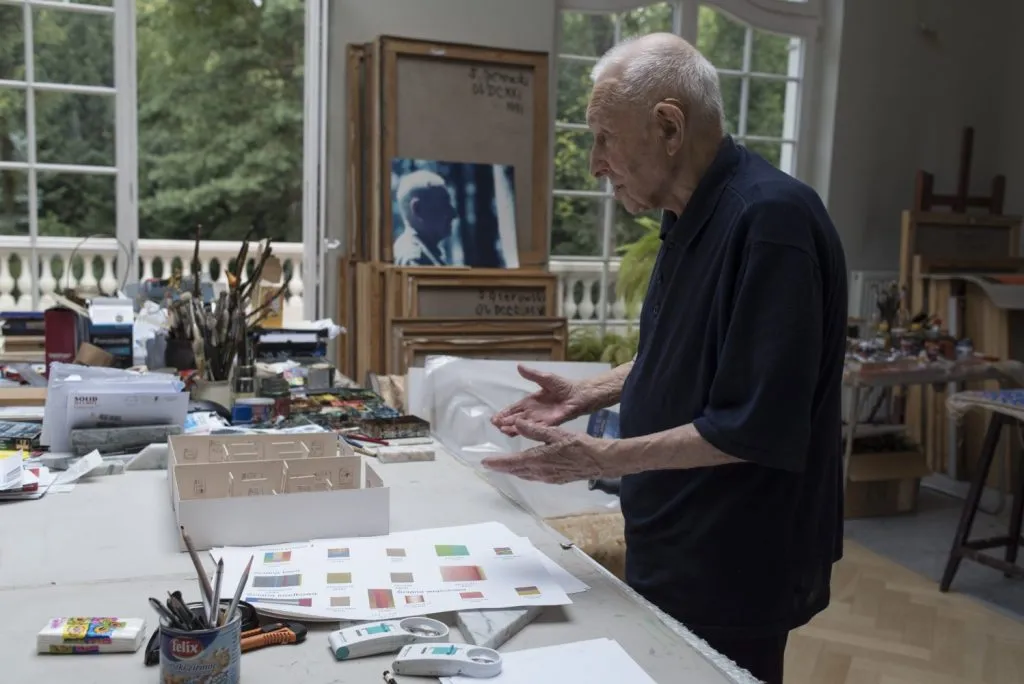
M.G.-D.: This one. It shows space coming into contact with something that appears upon it—a line that later developed into colour. The paintings hanging here relate to the evolution of my father's interests. In the next painting one can see how a colour changes where it meets other colours. The one on the left glows differently at the top and at the bottom, even though it is the same colour throughout. It is a kind of riddle. When preparing to work on another painting, my father makes many pencil sketches on whatever pieces of paper happen to be at hand—invitation cards, envelopes, paint boxes and so forth. These black-and-white sketches are a way of thinking through form and solving the problem; Dad has the colour in his head. He then makes his choice and paints the picture quickly and confidently.
J.M.: Professor, how long does it take you to paint one picture? Was it different with the first painting, the two-hundredth and the five-hundredth? How much time does it take?
S.G.: It varies greatly, regardless of what the picture looks like. Sometimes it appears to have required a great deal of work although I painted it quickly, and sometimes the reverse is true.
J.M.: How much time do you mean by quickly?
S.G.: Let me tell you, I prepare for a very long time. The painting itself, I try… or rather, I do not so much try as find that it proceeds fairly quickly of its own accord. A large painting can be made in three or four days. I may later return to it, but that rarely happens. I am one of those who paint quickly, and the result is either good or it is not. The next day, one has to check. It always happens like this: on the first day it seems very good; on the second, something seems wrong and has to be changed; and on the third day, the painting ought already to exist—to accord with what is in my mind.
J.M.: Tell me, have you ever destroyed your paintings?
S.G.: Yes, I destroyed several.
J.M.: So considering how many you painted, that is not very many.
S.G.: Not many, but I destroyed several because they did not work very well or because something made me angry. It happens. But to return to your question about the very beginning and the emotions that accompanied the painting of the first Painting: it was an experience of a certain joy, freedom and liberation. I mean painterly freedom, the sense that the painting is what matters most and that it need not depict anything, that nothing has to appear upon it, that it is a document of my freedom. It was not my first abstract painting, of course; it emerged from a certain series, but it was the first to be signed simply Painting. I submitted it to the Second Exhibition of Modern Art and it was simply most convenient to call it that. The painting returned from the exhibition, but I continued to sign my works in the same way and knew that this would continue from then on—although I did not know where it would lead. A certain necessity to name the paintings in this way arose within me. My pictures are generally signed on the back, usually with the date, while the consecutive number is binding and fixed. Very occasionally, however, a picture has no number—there is even one in this exhibition—because I forgot. (laughs)
I intended to work on it a little more, but hung it temporarily in the meantime. It remained there. I was going to correct it, but as I looked at it I decided that everything was right after all. I began something else, and when I took it down several years later, I looked and discovered there was no number!
J.M.: Professor, how many paintings have you made over the entire course of your career?
S.G.: I made about fifty paintings as a student and more than nine hundred afterwards. These are not sensational figures in the several thousands. There are more watercolours. Altogether I have made around a thousand paintings.
J.M.: I asked because I recently spoke with Professor Stanisław Fijałkowski, and he painted 1,600 pictures.
S.G.: Ah, that is indeed more…
M.G.-D.: I remember different people coming to our home and asking why Father painted such large pictures. They could neither be moved nor put away; they were nothing but trouble.
S.G.: I do not paint as though it were an official duty. Perhaps that is why there are slightly fewer pictures. First of all, Stanisław Fijałkowski always had everything very well ordered, systematically described and planned: he had to paint from one hour to another, and that was that. Not me; I would go to a meeting…
M.G.-D.: …and later for vodka… (laughs)
J.M.: In that case, I wanted to ask a second question—about the situation in which a viewer appears, but one who wants to acquire a painting. Someone arrives and wants to buy a painting by Professor Gierowski. What does Professor Gierowski do then?
S.G.: That person has no such difficulty, because they do not get in at all! (laughs)
M.G.-D.: Dad, but you do have the general idea that paintings should circulate among people!
S.G.: Many are circulating already; that is enough now. For a long time I have kept aside a certain group of paintings that I did not want to sell. I began doing so as much as fifty years ago. I simply have my own collection of my paintings. I am a collector, but I collect only myself (laughs). Sometimes I even find information that a painting of mine appeared at auction and fetched quite a good price… But as a rule those pictures did not come directly from me; generally they were works I once gave as presents. Until recently I still sold paintings through a gallery, but lately I have withdrawn virtually everything. I will not do so for a certain period. What will happen later remains to be seen. At present I have a particular plan connected with these paintings, and this exhibition is one element of it. The entire exhibition comes from my collection. One could even write that it is from the author's collection—from Mr Gierowski's collection. (laughs)
J.M.: I like the idea, even as the exhibition's title: From the Collection of Professor Gierowski. We shall discuss it!
S.G.: Shall we continue, then? More questions, please!
M.S.: What kinds of paint do you use?
S.G.: Only oil paints. And watercolours.
M.S.: Were you ever tempted to prepare them yourself in order to achieve a particular effect unavailable from manufactured paints?
S.G.: No, I was not tempted. Of course, there were paints I liked more or less than others, but the first consideration was that they should contain good pigments. Good pigments were generally difficult to obtain in the past, so making paint myself would have been troublesome. I had no aptitude for it. At the very beginning, when I was still very young, I tried mixing paints and all the rest, but I abandoned it and devoted myself solely to painting.
M.S.: When your works are viewed chronologically, they become an ordered investigation of successive problems connected with the reality of the painting and the most important elements that construct it. At the risk of considerable simplification, one could say that you began with the particular nature of the painterly plane itself; at a certain point lines began to appear upon it; then came the question of light; and later you added the interactions between colours. Was this a conscious programme of learning ever more deeply about the mysteries of the painting, or did it arise spontaneously, with each successive problem emerging from the previous one? For example, did you investigate the possibilities of configurations or colours and then move to the next problem?
S.G.: One certainly moves from one problem to the next, and each painting is a separate problem. When one stands before a white, primed canvas, then even if everything is already arranged in my mind and I know how it ought to be, practically anything can still happen upon it.
It always begins in the same way—as though one had never begun before, as though it were the first painting. Although an entire series exists in my mind, and even the next picture is already there. But for it to be the first painting means that it contains a different problem from the previous one. I could not arrange a row of canvases and paint the same thing on each of them, although ostensibly that would be possible. Even great artists received commissions for identical portraits so that they could, for example, be sent to family members.
M.S.: The first thing you began to investigate was your key concept of space. Could you elaborate on what space is to you and what it is in your art?
S.G.: I began using the word “space” in the late 1950s, when it was not yet so common. Today practically everyone who makes anything speaks about space. I imagined a kind of space that could not be seen in any way. That is probably the essence of my understanding of it: a somewhat metaphysical space. It is something with which we have contact but do not really know what it is. This arose from a very simple—I would even say peasant—observation of the world: there is the sky, which is a vast space, but what actually is it? We do not know. And there is the earth. That was how I saw it. I could tell you an entire series of strictly scientific things about space, but they are not so important to me. The ordinary observation was what mattered greatly.
What is most interesting is that the concept of space exists in our minds. It cannot really be drawn or painted. We do not know where it ends, how it expands, bends or returns. Everything is contained within it. Yet when speaking of my vision of space, one must simultaneously come back down to earth, quite simply.
M.S.: A line appeared in that space, another concept fundamental to art.
S.G.: Yes. I was interested in it first as a sign upon space, as a cut through it. When there is space and there is a line, the arrangement acquires a particular meaning. The problem of the line is fairly complicated and cannot be simplified to the point where, like space, it can be described through ordinary examples such as sky and earth. A line, even a straight one, always introduces an enormous number of different anxieties. It is never entirely straight in any case. There are, of course, numerous very interesting reflections on the line. It is difficult to speak of the line without referring to Wassily Kandinsky's classic reflections in his book Point and Line to Plane. But I understand it slightly differently. In that first period it mattered greatly to me as something that disturbed an element of the painting and introduced an action of its own. I think that is what you meant, because what more can I add about the line? Kandinsky has already said everything, and I have added what Kandinsky did not say because he did not concern himself with such details. But those very details mattered to me.
M.S.: I do not think we can conclude without asking about your teachers. They included Andrzej Frycz, Andrzej Pronaszko and Jan Cybis; you were also associated with Władysław Strzemiński's Unism. What role did they play in your choice of this particular artistic path, and where was their influence apparent?
S.G.: There were no diplomas when I finished my studies. I had only a certificate of completion and left the Academy with that. In my final year I studied stage design with Andrzej Frycz, and before that mural design, which he also taught. I was connected with Frycz in another way too: his sister lived in Kielce with friends of mine, and when travelling to Kielce I sometimes carried letters from her, because the post was unreliable just after the war.
Frycz represented Young Poland. I found that very intriguing, because it was an entirely different period yet not so distant after all. How many years had really passed between 1945 and, let us say, 1910? It was not such a great distance; now I consider it no distance at all. (laughs) I therefore always enjoy speaking about Frycz and how much I gained from him. Among other things, he told me about his journey to Japan and the East, that entire culture, and how he had been invited to sit on the jury of a competition there and completely failed to understand why the jurors argued over which picture was better or worse when they were all magnificent but all looked the same! (laughs) He also had a large painting brought back from China in his home. He was an interesting man in every respect. His teaching, too, consisted of conversation and pointing out important things in a friendly way. In the theatre, he could tell you at any moment where a particular piece of cloth was hanging and from which production, should it be needed. I never worked in the theatre myself, although I understood it and received very good marks. But perhaps it was fortunate, because I could have entered an entirely different situation and do not know whether it would have suited my personality.
Thus, although he belonged to a different field, he played a certain role in how I saw the world. Above all, he showed me a continuity: there had been Young Poland, now there was us, and others would come later.
Pronaszko, in turn, intrigued me enormously as one of the people who created modern art. Although by then he was painting works concerned rather more with colour, his history was connected with Formism. He was also interesting as a teacher, and most of my colleagues were in his studio. As a rule, these were the people I considered interesting and talented—and not only I, because generally speaking that was their reputation. Pronaszko's studio and Cybis's were the two important studios, and even competed with each other to some degree. What did I take from Pronaszko? Certainly the ordinary truths of painting. One sometimes happens to learn something extremely important by chance. Pronaszko liked to speak of the classical golden ratio, but he also discussed compositions based on three areas of colour, which I later eliminated by basing everything instead on strong contrast. At least when he was teaching, he relied on that less.
Cybis, meanwhile, entered into what a student was doing and observed his students. He looked at their works and sometimes tried to explain that something was admittedly not bad, but had already been done. These were the two artists at the Academy in Kraków with whom I was most closely connected.
Besides, one's entire life is an education. It does not end at the Academy. One ought to know how to teach oneself. To some extent, I too am self-taught: because I attended art-history classes, I missed many other classes and later had to catch up on my own. Once I found myself in Warsaw, I began to see gaps in my understanding of painting and in what I was doing.
My path was not immediately easy; for about five years it was rather winding. Those five years were genuinely difficult. The period itself was also terribly difficult. As regards the years immediately after the war, one has to admit that it was a somewhat indeterminate time. There were many disturbing matters, of course, but at the same time some contact with the West still remained. Magazines arrived from there, and albums of paintings by Picasso and others could be obtained for little money. Everything was still open. Some colleagues travelled to Paris for further study and went to the same places as before the war, including Fernand Léger's studio. On the one hand, terror was already emerging; on the other, there was a certain self-defence against it. People at the Academy came from everywhere: some straight from the forest, others from the underground, still others who had somehow survived the war, and several Jews who had managed to survive. Five year groups studied simultaneously. The Academy was therefore charged with that reality. It reflected what was happening around it, but nobody said anything. Only later did I learn more about my colleagues and where each of them had been during the war. At the time, nobody asked. One did not. The rule was not to speak.
There were also those who worked with the Security Office: hardened communists who, although they did not interfere, passed certain information onwards.
In later years, however, once I had finished at the Academy and 1949–1950 and the Party Congress were approaching, the repulsive terror began. There had been terror before, but now it became absolute. Why was it so palpable? During that first period, amid all the movement of people from east to west—looters travelled west, but so did people who were to begin their lives there—a large majority, at least eighty or ninety per cent of the population, were waiting for the Russians to leave and for it all to end. Practically everyone was waiting for the Western countries to liberate the Republic of Poland.
During the first two years, one could clearly feel that something was supposed to happen. This arose, of course, from complete naivety. People did not know about all the agreements of which we are aware today. In any case, what happened then also affected the Academy. All those people, after their different experiences and arriving from different places, wanted the Academy to be as normal as possible, for people simply to receive a normal education there, and the same was true of the university. They wanted there to be more people to replace the intelligentsia exterminated by both sides.
It was a remarkable period, and many very interesting people emerged from it. Fijałkowski also studied then, after all. As for Strzemiński, whom you mentioned, I saw him only once, quite by chance at a congress in Poznań. Several of us were sitting together, in a museum as it happens, and he spoke very interestingly. His Unism greatly intrigued me, and that was really the aspect that most attracted us… or rather, attracted me to him. I was drawn to his Unist thinking. Yet if one were to take his texts, he and I understood his Unism somewhat differently.
The same applies to Afterimages. I understood those Afterimages more physically, while his understanding was more psychological. Similar devices existed in painting, so I thought: yes, indeed, if two colours are placed beside each other, an entirely different colour appears in the white space between them, and that is an afterimage. It was a genuine afterimage based on the laws of physics.
But it turned out not to be an afterimage after all, because for Strzemiński the afterimage existed somewhere between the sun, the eye, the canvas and memory. It was more complicated. As it turns out, I have always had a very simple view of the world: one simply loved life! (laughs)
Konstancin-Jeziorna, 30 March 2016