
Visibility
Stach Szabłowski
Stefan Gierowski ceased representation in his painting nearly sixty years ago. Since then, he has created non-representational Pictures, titled with successive numbers written in Roman numerals. To date, almost a thousand of these Pictures have been made. This is an extensive yet simultaneously countable body of work that exists in parallel in two worlds. It belongs to the history of recent art: two decades ago, reproductions of Gierowski’s works had already entered popular surveys of Polish art after 1945, and his paintings hang in permanent museum displays. At the same time, Gierowski’s work belongs to the present. It remains an open project. Gierowski is happening now, yet it is not easy to move beyond already petrified textbook clichés and speak about him in the present tense. By renouncing figuration and representation at the turn of the 1950s and 1960s, and then pursuing a single continuous and consistent artistic project for the next six decades, the painter deprived those who wished to say something about him of words—or at least severely limited the number of words available to them. What can be said about painting whose meaning suggests that one should not flee from its visuality into words?
One can, of course, say ‘abstraction’. Yet this, nomen omen, abstract concept explains little; it contains too much. Moreover, although Gierowski is generally regarded as a classic of Polish non-geometric abstraction, some theories hold that he does not practise abstraction at all. And those theories are difficult to dismiss. The concept of abstraction has its roots in the verb abstrahere—to separate, tear away, abduct. Abstract painting would thus be ‘abducted painting’, separated and torn away from reality. Yet although Gierowski’s Pictures do not represent, it is easy to see—one need only look at them—that they are not detached from reality. On the contrary: rooted in the artist’s experience and transcending that experience, they themselves constitute reality.
*
Since I once again began paying attention to Stefan Gierowski’s Pictures, which for a long time had seemed transparent to me—you look at them but do not see them—I have wondered how their reality intertwines with the reality of present-day art. In the context of this reflection, it is interesting to bring Gierowski’s painting into contact with the phenomenon that Walter Robinson called ‘zombie formalism’1. The term, like many others in art criticism, is an intellectual provocation—and, one must admit, a quite fertile one. The image concealed behind the phrase ‘zombie formalism’ terrifies with a vision of art that is ghastly and predatory, yet dead and exhausted. Since art is inexhaustible, however, the suggestion that formalist works are corpses merely pretending to be alive provokes attempts to prove otherwise: that the supposed living dead are genuinely alive. Every such proof successfully carried out is a good thing. Forced to search for signs of life in artistic practices, we often genuinely find them—and such discoveries are reassuring. Yet honesty requires us to admit that these signs cannot always be found. Zombies truly are among us: all those forms and formulas that, although long dead, continue to be reanimated and set in motion, only for that movement to prove an empty, dead gesture…
Much of the visual matter subjected to operations by ‘zombie formalists’ belongs to forms developed precisely by Stefan Gierowski’s generation.
Anyone who has seen any zombie film knows the greatest problem with the living dead: from a distance, they look deceptively like living people. Only close up does it become apparent that they merely look similar, but possess neither self-awareness nor will and, in truth, have no meaning. And vice versa: living art can easily be overlooked amid a crowd of ‘zombie formalisms’. Gierowski is particularly easy to overlook. Not even because his work is overfamiliar, though it is. Nor even because he paints abstractions, although surely all abstractions are fundamentally identical: they represent nothing, so how can one be distinguished from another? It is easy to let one’s gaze slide across Gierowski and move on without ever truly seeing him, because we do not expect to encounter art based on assumptions whose seriousness is embarrassing. We are accustomed to ephemeral and mobile art, without foundations and at times even based on nothing. Thus, when we encounter an artistic phenomenon such as Gierowski’s work—painting rooted in decades of practice and driven by the profound conviction that a work can transcend its author, can be something greater than the artist rather than simply another of his projects—we find it difficult to believe that this time it is serious. Until we believe in something, we shall be unable to see it, even if we pass it in every other museum and have it before our eyes on the pages of textbooks. We must therefore return to Gierowski, whom a moment ago we swept with an errant, unseeing gaze, and look again in order to perceive that this painting is genuinely happening.
*
There is something else that silences discourse on Stefan Gierowski. The duration of his creative practice corresponds exactly with the history of Polish art after 1945. It might seem that this parallelism would make the painter an ideal protagonist for a historical narrative. Gierowski was such a protagonist, but only up to a certain point, one now very remote in time. Around 1960, the painter ceased to be an actor in artistic history. It is somewhat like the popular, simplified reading of Francis Fukuyama’s The End of History: history reaches a certain boundary beyond which a state of persistence begins, one difficult to capture within traditional narrative structures. Fukuyama’s theses were invalidated by the course of events. Contrary to his hopes, political history did not stop but, having reached a certain zenith in the 1990s, began moving backwards, towards wars, imbalances and crises—and can once again be eloquently narrated, not merely presented. Stefan Gierowski’s case is different. A kind of ‘end of history’ genuinely occurred in his artistic path—and the painting of the Pictures began.
Before this happened, however, Gierowski seemed deeply immersed in the current of history. He came from a middle-class family with landed roots, attached to patriotic tradition—his ancestors fought in every struggle for independence from the Napoleonic Wars, through the November and January Uprisings and the Legions, to the war with the Bolsheviks—but also sympathetic towards art: after working hours, the artist’s father painted for pleasure. Stefan Gierowski began learning to paint during the occupation, combining it at the time with underground activity. At the beginning of 1945, although the war was not yet truly over, Gierowski was already studying painting in newly liberated Kraków. He belonged to the generation that, at the end of the 1940s, found itself between the challenge of continuing artistic modernity and officially decreed Socialist Realism. Unlike contemporaries such as Andrzej Wróblewski, Gierowski did not work through wartime traumas artistically and did not take up political subjects—neither in the language of modern art, which he passionately explored and tested, nor in the language of Socialist Realism, which he neither wanted nor was able to learn. He chose ‘peripheral subjects’, as Jerzy Stajuda later described them, subjects as unburdened as possible by literary references and metaphors, leaving the greatest possible space for developing the language of painting itself.
Gierowski once confessed in an interview with Jan Michalski that Surrealism—the most swiftly flowing current of those years—did not appeal to him at all. Yet he could experience deeply the lessons of painters such as Léger and Braque. In the same conversation, the painter emphasised the important role in his artistic maturation played by work on a seminar dissertation for the art-history course he pursued alongside painting. The subject was Impressionism. Like practically everyone, Gierowski had been raised on history painting, Matejko and Symbolism in the spirit of Malczewski; studying Impressionism opened his
eyes to the fact that paintings need not be a means to an end, but can be an end in themselves. ‘I realised,’ the painter recalls, ‘that content and figuration are not as important as the picture itself, the way of seeing, something more primal and fundamental’2.
Such an awareness had, virtually inevitably, to lead to abstraction. At the time of the Arsenal exhibition and the 1956 Thaw, Gierowski had not yet reached this point, although he was already close.
Asked about his masters and what shaped him, Gierowski once replied: ‘Four things were most important: the Academy, Włodarski, Krzywe Koło and my great friendship with Cybis and Artek Samborski’3. In the case of Marek Włodarski, the artist’s attitude inspired Gierowski more than the art itself. In turn, the collaboration with Marian Bogusz and the Krzywe Koło gallery he ran from 1957 to 1960 was a major adventure for the painter, both artistically and institutionally. Gierowski once said that, in those years, perhaps thirty people in Poland seriously engaged with abstraction. They all knew one another, and treated their artistic choices, including formal ones, with extraordinary seriousness by today’s standards.
The institutional base of so-called new art after the Thaw was smaller still. Krzywe Koło was one of only a handful of places in the country where intensive experimentation took place. It was during the years of collaboration with Krzywe Koło that Gierowski made definitive and decisive artistic choices. In January 1957, he organised an exhibition with Bogusz which, according to Aleksander Wojciechowski, the great authority on the painter’s work, ‘consolidated the moment of transition to autonomous abstraction based on the free play of light and irregular patches, on melodic arrangements of hieroglyphic signs embedded in the vibrating matter of the picture, although the exhibition included shooting ranges and other works that were still figurative’4. It was in 1957 that Gierowski began creating works he titled Pictures and assigned successive numbers. From then on, the painter’s works could only be counted, not named.
‘I wanted to move away from nature, to break with figuration,’ the painter says of those decisions. ‘When I did so, I felt more confident. (…) It was an emotional rather than intellectual choice, arising from the conviction that painting is autonomous and subject to no dependencies’5. The first Pictures could still be associated with Informel, the great and controversial subject of the post-Arsenal era. By the end of the 1950s, however, Gierowski was essentially outside that current as well. As Aleksander Wojciechowski writes:
‘In 1959–60, Gierowski moves beyond the realm of intimate painting and emerges from a mood of intimacy. He increasingly limits the number of colouristic and textural effects. He speaks in a simplified language and finds the courage to abandon tested methods of winning the viewer’s favour. He places colour accents at the edge of the canvas (Picture LXXIII). In this way, he suggests the picture’s continual expansion, its further life in extra-painterly space, in the imagination of the artist and the sensitive viewer. He thus frees his conception from the limited dimensions of the stretcher. This makes it possible to speak of the monumentality of Gierowski’s works’6.
At this point, we are already close to the beginning of the painterly path Gierowski follows to this day. ‘From then on, I merely went deeper into myself, from which it follows that I am in fact wildly conservative—at least towards myself,’ says the painter7. Gierowski, hitherto engaged, or at least entangled, in the collective experiences of the artistic transformations of the 1940s and 1950s, leaves the vehicle of history to pause at the reality of painting and the concreteness of the Picture.
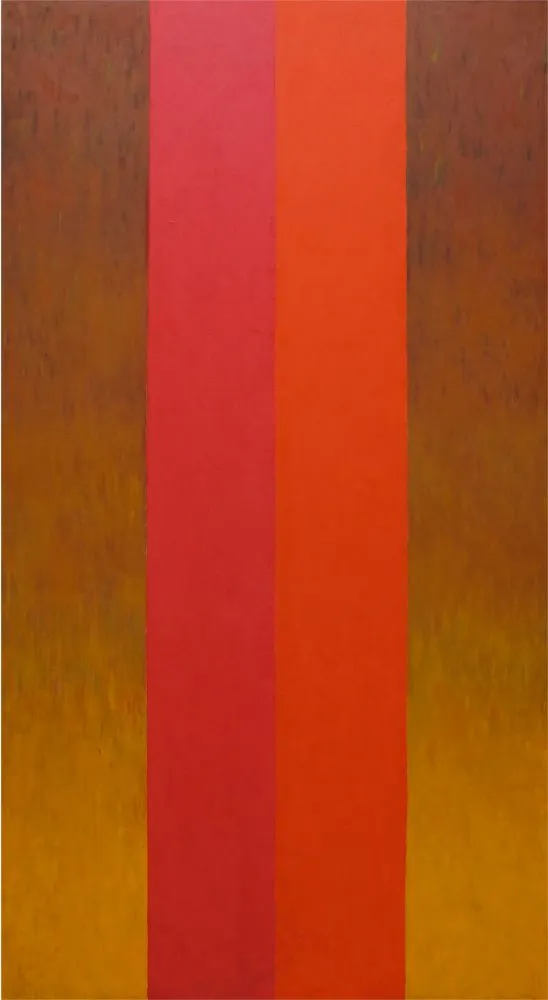
From that point onwards, history appears to flow past Gierowski’s work. Op Art, Pop Art, Conceptualism, Body Art, Land Art, new media, the New Wild, Post-Conceptualism and Postmodernism—these and other formulas of creation, shifting axiologies and definitions of art all unfold close to Gierowski’s work, because the painter has not gone anywhere and has never been an outsider; he remains a participant in the present. Yet at the same time, he does not interfere in the events taking place near his painting and does not lend a hand—or a brush—to redefining the field of art. He has another occupation: defining visuality within the narrowed field of the Pictures. Each Picture is another definition and simultaneously another sentence, another phrase added to the meta-definition of visibility: a meta-definition comprising the entirety of the artist’s work after 1960.
*
In the 1968 essay Painting i.e. Painting8, Jerzy Stajuda attempts to locate the place Stefan Gierowski occupies in the landscape of Polish art in the 1960s.
In the author’s eyes, this is, first, a landscape shaken by debates over the values flowing in the broad stream of new artistic formulas and, second, a landscape divided between left and right. The left naturally consists of progressives, among them Gierowski’s friend Bogusz, who tirelessly animates the modern movement. It is a pre-Conceptual world, the domain of newly established events in the spirit of the Biennale of Spatial Forms in Elbląg, the world of Kantor and Ludwiński and of the plein-air meetings at Osieki: a world in which increasingly open and often performative forms are tested, challenging the status of the work ever more boldly and circling ever closer to the tradition of anti-art. The right is modernity too, but a conservative modernity in the sense that it does not entirely sever its ties with what Stajuda calls the Mediterranean Tradition. The author describes criticism’s problems in placing Gierowski on the left or the right. The artist’s faith in painting, the Picture and the work should theoretically place him on the right, but Gierowski does not really fit there: his proposal is too radical for that.
The point is that Gierowski escapes the crossfire of the dialectic between the artistic right and left, moving in a third direction towards what Stajuda calls the Grand Strategy. In his statements, Gierowski repeatedly emphasises the primal nature of painting and his belief that it cannot be removed from the horizon of human experience. A painter might settle a particular subject, but not the problem of the matter and ontology of the Picture itself, which is a reflection—a model—of the matter and ontology of the world. Such a question can be pursued only on the scale of an entire life, and this is precisely what Gierowski does. Roman Opałka comes to mind: he too was an artist who made an artistic commitment whose fulfilment required all the time remaining to him. The analogy between Opałka and Gierowski also operates at the level of numbering. For both artists, number is the measure of their consistency in carrying out their tasks, their ‘grand strategies’. Beyond the boundary of number, however, the analogy loses its force. The strength of Opałka’s project lay in the predictability, even inevitability, of its outcome. With Gierowski, the opposite is true: the painter’s power stems precisely from unpredictability. Each successive Picture discovers another fragment of visuality that could neither be seen nor even imagined until the painter created it. Through his counting, Opałka measured the passing and disappearance of both world and author. Gierowski’s counting serves to expand the world: each new Picture slightly enlarges the reality in which we live.
*
The key to Gierowski’s work is not concept but action; what counts is what is physical, what has been made. The painter once said that the twentieth century would go down in history as the century of theory, an era that sought the artistic philosopher’s stone. To some extent, he too appears to believe in its existence, but expects to find it not in theoretical reflection, but in practice, in the painted Picture. This is why Gierowski is so difficult to place within a theoretical landscape, although he was repeatedly pressed to declare himself, subscribe to some theory or acknowledge some tradition. Naturally, he could not entirely avoid responding to such demands. Stajuda writes that Gierowski, ‘when listing those close to him, assigns Strzemiński one of the first places. And there is something in that. I know that when he speaks of Malevich, it is only out of pure courtesy. When he speaks of Cézanne, Poussin, the Venetians or Pompeii, it is to define a climate, as though to make the listener aware of the modal grounding of the melody being spun, because only with such determinants does it become fully apparent that it is Ionian rather than Dorian. But with Strzemiński, the matter is probably different again’9. What does ‘different’ mean? Stajuda argues that Gierowski de facto rejected the theses of Strzemiński’s Theory of Vision, ‘but did not reject the profound reason for which the treatise was written’. Strzemiński writes: ‘The law governing the construction of the picture should stand above the painter’s individuality. The painter’s work should always be greater than the painter’s particular nature, accidental and changeable.’ According to Stajuda, this is the treatise’s fundamental thought, one that Gierowski can also accept as his own.
An illuminating perspective on these reflections is offered by a statement Gierowski made in his conversation with Jan Michalski: ‘When asked about theoretical assumptions, I sometimes referred to Theory of Vision, which always worked and even inspired respect,’ the painter says. ‘The only thing is that, although I respect Strzemiński’s painting, I have never read his book or even looked inside. I know only the cover because it sits on my shelf.’
*
While circling Gierowski’s painting, I encountered a text by Jan Michalski published in the catalogue of the painter’s exhibition issued by Galeria Zderzak in 199110. The critic devotes a considerable part of this otherwise brief essay to describing the problem he had in responding to the work of the author of the Pictures, and the process of overcoming his own prejudices and drawing back the curtains of stereotypes—the action required in order finally to see the Pictures for real. I read this account with surprise, because Michalski seemed to describe not only his own problem with Gierowski, but also my personal problem and my path towards his painting.
‘I felt an aversion to this painting, as to tedious book learning,’ Michalski confesses. ‘Whenever it had to be defined, if only in thought, it appeared as an investigation of space, an exploration of optical phenomena, and so on. […] The larger the painting, the weaker the expression. I reduced each painting to the series; they were all similar! I saw no individuality’11. And further in the same spirit: ‘For my own purposes, I christened them—Gierowski’s Pictures [S.S.]—“provincial painting”. The phrase sought to convey the repellent impression I had received and confine it within a particular circle. Its metaphor for me was the painted dadoes at railway stations in Płock or Częstochowa, the cold rooms of Zachęta, Warsaw’s concern with façades, the provincial nineteenth century. And the conviction that painterly academicism stands on the stilts of abstraction…’12.
Michalski describes the process by which he arrived at Gierowski’s painting through the work of the latter’s students at the Academy in Warsaw—Jarosław Modzelewski and Marek Sobczyk—artists apparently entirely unlike their master, if only because of their fundamental attachment to figuration. In Michalski’s case, the process of ‘discovering’ Gierowski unfolded in the 1980s, when the practice of the author of the Pictures seemed ‘to resemble something that had merely survived its own formation’, namely the modernity of the Arsenal generation. This refers to a moment ‘when this painting was beginning quietly to gather dust in museums’. I can add that, a quarter of a century later, the layer of museum ‘dust’ covering Gierowski’s work is thicker still, while his status as a classic is even more indisputable and consequently more paralysing to critical thought and more damaging to the very act of looking at the Pictures. Fortunately, the latter prove strong enough and luminous enough to break through the paralysis and reach the eye of a beholder willing to look.
What, then, are these paintings about? This is the most difficult question. Here, Gierowski continues to escape a discourse incapable of replacing the experience of encountering his painting, or even of describing that experience precisely. Jaromir Jedliński once put it aptly when he wrote that Gierowski’s work is defined by ‘the painter’s effort to embody the matter of visibility’. Attempting to define the subject of the Pictures, the same author points to the Earth. ‘The Earth, which in all its forms undergoes sublimation in the creative process,’ Jedliński writes. ‘The Earth on which one walks; the Earth that rises; the Earth that soils and the Earth that contains all pigments; the Earth with its abysses and the Earth that returns a gleam; the Earth that, moistened, smells like a wet oil painting; the Earth whose scent is in the painter’s studio…’13.
*
Discussing metaphysics is awkward, but Gierowski is not afraid occasionally to call things by their names and says that there is no exaggeration in speaking of metaphysics in the context of painting. Indeed, both Gierowski’s Picture and any other picture are pure matter—countable, measurable and tangible—yet, as the painter observes, on leaving the studio this matter changes into a mystery. In the 1960s, attempts were made to explain Gierowski’s mystery through cosmic metaphors and imagery drawn
from the sciences, especially physics, at both micro and macro levels. Indeed, motifs appeared in the artist’s painting that could feed such interpretations: streams of light and lines that might be understood as visualisations of electromagnetic fields or radiation… Yet the matter seems somewhat simpler, and Jedliński is right to remain with the Earth instead of seeking assistance from quantum physics. The Earth is at once cosmic, as a celestial body suspended in a vacuum, and close, like the smell of damp soil rubbed between the fingers. Gierowski’s painting operates similarly, proving equally adequate when measured against a cosmic scale and against one that is entirely concrete and commonplace, even the provincial railway stations Michalski mentioned and the painted dadoes covering their interior walls. Light, Gierowski’s great theme and one closely bound to the Earth, must naturally be added to the figure of the Earth.
In the Pictures, light radiates from the centre of the canvases or disappears into them, passes from one side of the frame to the other, and at other times is present at the edges. It is the very essence of visibility that the painter seeks to capture in his works. How can light be enclosed within, and then ‘released’ from, a picture? This is the fundamental problem posed by Gierowski. The artist answers the challenge himself by creating rather than representing light, because, as he says, ‘the light of the picture is another light’.
The Earth—colours, textures, matter, weight, lightness and darkness—and the light that makes the Earth visible, when they come into being together within the field of the Picture, constitute space. Gierowski’s entire practice is contained within these three parameters. Viewed from this perspective, it indeed appears not abstract at all but, on the contrary, highly concrete. The painter concerns himself with how reality becomes visible. The question cannot be exhausted in a thousand Pictures, or even a hundred thousand canvases. This is the source of Gierowski’s surprising relevance: he is an artist addressing a question that remains open. One cannot know everything about the subject, but few have learnt as much as Gierowski discovered through practice. Most interestingly, the artist concealed the key to the Pictures within the Pictures themselves. Each individually, and all together, form a study of visibility. One need only look at them carefully to discover how they are to be viewed.
Stach Szabłowski, curator, art critic and journalist. A graduate of the Institute of Art History at the University of Warsaw. Since 1998, he has been associated with the Ujazdowski Castle Centre for Contemporary Art in Warsaw. He has curated and produced more than fifty exhibitions and artistic projects in Poland and abroad. He publishes in exhibition catalogues, books on art, specialist periodicals and the press.
1 Walter Robinson, ‘Flipping and the Rise of Zombie Formalism’, http://www.artspace.com/magazine/contributors/see_here/the_rise_of_zombie_formalism-52184
2 ‘The Walls Are Already There: Jan Michalski in Conversation with Stefan Gierowski’, in Stefan Gierowski, ed. M. Meschnik, catalogue of the exhibition at the Upper Silesian Museum in Bytom, Bytom, 1998.
3 Ibid.
4 Quoted after Jerzy Stajuda, ‘Painting i.e. Painting’, Miesięcznik Literacki, February 1968.
5 ‘The Walls Are Already There: Jan Michalski in Conversation with Stefan Gierowski’, op. cit.
6 Quoted after Jerzy Stajuda, ‘Painting i.e. Painting’, op. cit.
7 ‘The Walls Are Already There: Jan Michalski in Conversation with Stefan Gierowski’, op. cit.
8 Jerzy Stajuda, ‘Painting i.e. Painting’, op. cit.
9 Ibid.
10 Jan Michalski, ‘The 1980s in Gierowski’s Painting’, in Stefan Gierowski: Painting, ed. J. Michalski, catalogue of the exhibition at Galeria Zderzak in Kraków, Kraków, 1991.
11 Ibid.
12 Ibid. Several years after the text appeared, in a conversation published in the catalogue of the exhibition in Bytom, Stefan Gierowski reminded Michalski of his words about ‘provincial painting’ and commented on them as follows: ‘After all, as you once wrote, I make “provincial painting”, so I too belong to the spirit of an empire that left its traces on these lands for two hundred years. There is something in that, ha, ha! After all, I come from the lands of Congress Poland, from Kielce itself. And I will tell you that I was very fond of my home town.’
13 Jaromir Jedliński, ‘Reflections of Light, Reflections of the World’, in Stefan Gierowski, ed. M. Meschnik, catalogue of the exhibition at the Upper Silesian Museum in Bytom, Bytom, 1998.