
Stefan Gierowski: Paintings from the 2000s
Jagoda Barczyńska
Stefan Gierowski – the doyen of our contemporary age – belongs to the small group of Polish artists whose lives connect memories of the Second Polish Republic, the drama of war, the iniquities of the Stalinist repressions, the breath of air brought by the Thaw, the utopian optimism of the 1970s, the Solidarity uprising of the following decade, and the path of transformation and construction of the country’s statehood on new terms.
On account of his position – as artist, teacher and organiser of artistic life – Gierowski was more the vanguard than an extra in these events. Even if the artist attributes this to a stroke of luck that certainly helped him many times, his intelligence, talent, diligence, ethical attitude and fidelity to principles of the painted work once adopted nonetheless made him a model for subsequent generations. As a painter, he had the opportunity to experience various revelations. He associated his youthful ideas about art with mimesis – the imitative representation of the world. Yet already during his studies at the Academy in Kraków, his attachment to historical tradition began to lose its clarity, replaced by new rules of form, spatial solutions and constellations of colour. His inquisitiveness and keen powers of observation absorbed the broad range of beliefs and artistic norms transmitted by his professors, without overlooking the attitudes revealed by other students. Years later he discovered the achievements of Andrzej Wróblewski, a younger student at his alma mater, who already during his academic education stood out for his innovative approach to the two-dimensional surface of the canvas. He himself followed the radical current of solutions unhurriedly, experiencing along the way a Cubist-inflected style that he expanded with the then-fashionable Surrealist tendency. One could advance the provocative thesis that while Wróblewski’s rapid artistic maturation may have stemmed from a feverish and unconscious premonition of an early end, Gierowski possessed enough time to unfold his painterly epic in long sequences of events.
In the first half of the 1950s, now from the perspective of the capital but still at the stage of a simplified figurative convention, he could not meet the demands of the universally binding doctrine of Socialist Realism.
He attached great importance to friendship and valued connections; he met many significant, creative people along the way, listened, debated, learnt, observed and drew from collaboration with leading figures in many fields of Polish visual culture. As he maintains, he owed much to his acquaintance with Henryk Tomaszewski, Waldemar Świerzy and Roman Cieślewicz, who instilled in him the idea of working through abbreviation. He retained in his memory Léger’s pictures, which caught his attention at the Wrocław exhibition organised on the occasion of the Peace Congress. He remained under the influence of Władysław Strzemiński’s theory of Unism and held the achievements of Marek Włodarski in great esteem; their conversations about art still evoke vivid memories in him.
A fresh wind of change arrived in 1955, when the exhibition Against War, Against Fascism, which opened at the Warsaw Arsenal, sided with deformation, simplification, colour contrasts and pronounced textures. Gierowski’s participation in this pivotal manifestation of young visual thought was recognised with an award. A separate chapter spanning several years concerned his collaboration with Krzywe Koło Gallery (1957–1960) and Marian Bogusz. In the atmosphere of this distinctive forum for discussion, amid exhibitions promoting new formal and ideological solutions, Gierowski’s artistic consciousness and the face of his art changed. The role the painter played in shaping what was, for the time, an independent venue for promoting innovative artists was recalled by the exhibition Stefan Gierowski and Krzywe Koło Gallery, organised in 2003 at Muzeum Sztuki in Łódź. In numerous statements, the artist himself stresses that he experienced almost every tendency in contemporary art through his painterly experiments. Yet it was only in the crucible of modernity, whose temperature was set by the Arsenal and raised by the profile of Krzywe Koło’s activities, that the idea of the Paintings was born; beginning with the first, the artist started numbering them with Roman numerals.
The 1960s and the beginning of his teaching work at the Academy of Fine Arts in Warsaw would add Jan Cybis and Artur Nacht-Samborski to Gierowski’s circle of friends; their personalities provided an important point of reference in the formation of his own teaching practice. The mixture of names, situations and places invoked by the artist assumes the form of a ready illustration corresponding to words once spoken by Willem de Kooning: ‘Whatever an artist’s personal feelings are, as soon as he fills a certain area on the canvas or circumscribes it, he becomes historical. What he does comes from other artists and will affect other artists.’ Gierowski absorbed and was inspired, adopting certain phenomena, but always in his own way, never directly, consciously seeking the most fitting score to unite his chosen field of inquiry within the single organism of the picture.
There was another, secondary but highly important aspect of his friendships, sealing the closeness of the bonds he valued so greatly. Shared feasts and long conversations at café tables only seemingly brought no deeper reflections. To support the thesis about the importance of social life during that period, I shall refer to a statement made by Wojciech Fangor in 1996 during the Plein-Air Workshop for Artists Using the Language of Geometry in Okuninka by Lake Białe. Presenting the premises of his art, he recalled the almost endless meetings among friends and the boundless hours spent at Warsaw’s Bristol, Europejski and Kameralna cafés. He argued that this slowing down – providing time for reflection and the polarisation of views, abounding in apt retorts and constituting a kind of forum for discussion – provided him with the most valuable foundation, reference and support for his future work abroad. In the new reality and the haste that constantly accompanied it, he recalled the image and atmosphere of those moments spent in Poland, which had activated the precision and flexibility of his reactions.
Stefan Gierowski’s activity was diverse, but two areas were of fundamental importance to him: painting and teaching at the Academy of Fine Arts in Warsaw (1962–1996). As a teacher, he continued the lineage of masters who, while helping to create an atmosphere of exceptionalism and initiation into art’s mysteries, above all passed a decalogue of painterly faith and ethics to their successors1. His position at the academy became legendary, establishing a chronology of its history ‘before and after Gierowski’. Asked how many diploma students left his famous studio, he answers from memory ‘probably about a hundred’, as though unable to believe the true (double) number recorded in the archives. He described the objectives of study in the studio he directed with the words: ‘The programme is essentially open – its only boundary is painting, which should be understood first and foremost as an individual transmission of a vision of the world. For that transmission to become credible, experience supported by penetrating observation of nature and far-reaching mastery of painterly matter is required.’ On another occasion he added: ‘At the centre of my interest is the picture, but one in which a person creates a new way of seeing the world, regardless of the technical and formal means employed…’2. In this respect he resembled Josef Albers – creator of the epoch-making Homage to the Square series and unforgettable lecturer at Yale University, who emphasised the conviction that ‘a good teacher is more likely to ask the right questions than to give the right answers’3. Jasper Johns’s story has passed into history: while completing a colour test prepared by the author of Interaction of Color, he answered every question incorrectly. Confiding this unfortunate result to Albers, he received the immediate retort: ‘But that’s excellent! You scored one hundred per cent!’4. Charismatic teachers who create ‘schools’ bearing their own names do not propose tried-and-tested theories; they believe in the student’s individual intuition and intellectual resources.
Gierowski’s conviction that ‘learning to paint essentially consists in painting the same picture throughout the entire course of study’ sounds like an explication of his own art. Speaking about the essence of the medium close to him, he expressed his belief in this discipline’s autonomous territory and character. He maintained that this closed entity, the picture, contains ‘a particular way of expressing thoughts and emotions, and a great tradition of striving for truth, perfection and beauty’5. Many scholars following the trail of his achievements emphasise the Modernist continuity of his views on the form of painting. From Painting to Painting, he himself consistently demonstrated the sense and value of the path he had once laid out.
He never departed from it, only broadened it. Before the canvas assumed the form of a painterly statement, its outline arose in his head, worked out in every detail and supported by a note on a sketchbook page. The artist applied colour that not only derived from the adopted programme but sounded tones appropriate to the moment, climate, mood of thought and surroundings. Its warm properties neighboured cold ones, and the energy of colour black. Rejecting routine, the artist could always surprise through his choice of pigments. At times he appeared an Epicurean of colour, employing joyful, vibrating ranges; at others, their resonance approached a projection of ultimate matters. Painting made ‘by eye’ revealed the course of the brush and foregrounded texture. Light – one of the primary components of these works – flared up, only a moment later to lose its power and pass over to the side of shadow. Dynamic arrangements found their counterweight in balanced ones, and vertical premises opposed horizontal ones. When the artist intended to subject a composition to the discipline of order, he turned to the language of geometry, which brought the whole under the control of harmonious order. At times, however, he would free his art from geometric relationships, giving this the tone of a categorical declaration: ‘…I should like politely to inform you that geometry is not at all within my field of interest and that I am an avowed ignoramus in this area. If, however, someone finds in what I paint a resemblance to geometry, that is entirely their own affair and I bear no responsibility for it. Since I leave the paintings an open road on which to exert their influence – ultimately, it is the paintings’ affair, not mine’6. Bożena Kowalska, the critic most distinguished in championing art marked by Euclidean forms, retorted: ‘Geometry always remained the domain of his [Gierowski’s] work, even when verbally denied’7.
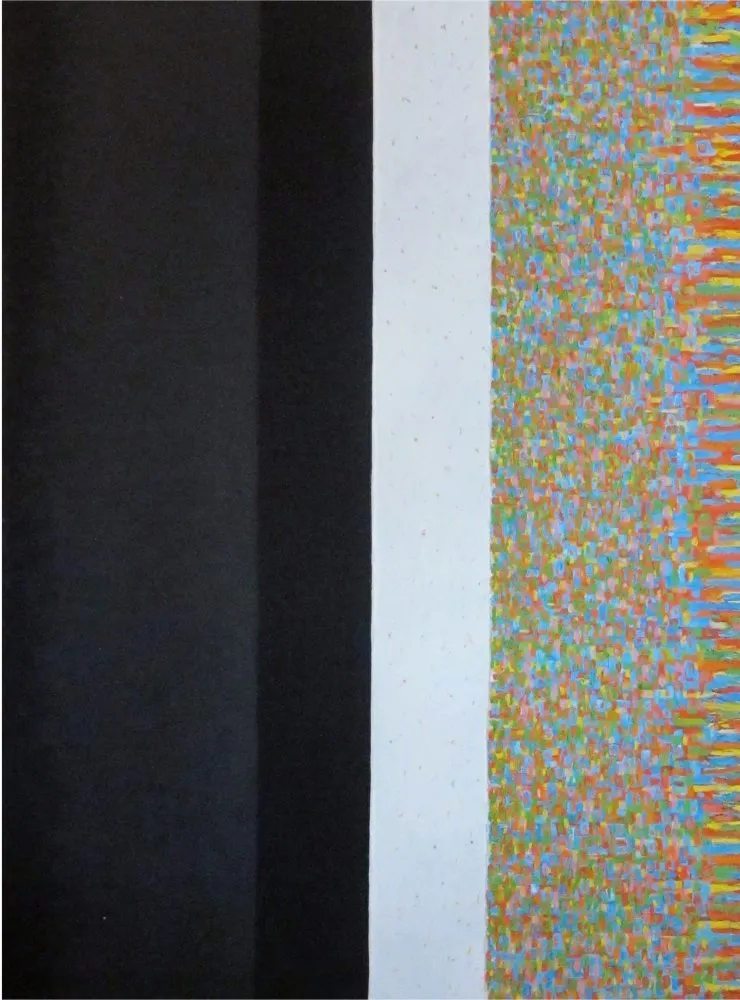
The exhibition presented by Atlas Sztuki in its space allows the recipient to engage with both positions. The display, for which more than forty works were selected, comprises canvases made between 1997 and 2013. The earliest picture – bearing the Roman numeral DCCXVII – was made just before the new millennium, while the most recent (CMVIII) was painted in 2013. It is easy to calculate that the exhibition represents a selection from 191 canvases made during these years. Their formal content is so varied that we can argue for both a tendency towards symmetrical solutions and a predilection for asymmetrical arrangements. The artist assigns colour changing tasks: at times he uses it to fill shapes, only then to outline them; at others, he covers entire surfaces with a Pointillist system of dots or employs gradations of tone that create the impression of pigment being ‘sprinkled’, achieving spaces saturated with tonal value. Moreover, many compositional premises are defined by a band of colour running along the edge, which appears to hold everything else in place. The paints – always reliable oils – are sometimes distributed smoothly but with painterly sweep, while in other cases they form dense, impenetrable impasto textures. Light occupies central positions or the edges of the picture, which mark out the site of its emanation.
The presentation at Atlas Sztuki in Łódź shows the work of an outstanding painter who consciously employed the diversity of expressive means available to him in order to speak of beauty and the joy of life, as well as its irreversible and ultimate destiny. This painting, which unites contradictions and binds contrasts in the service of a single medium, constitutes one of the most significant chapters of the discipline in Polish post-war art. Roman Owidzki’s fears have already passed into history. He wrote: ‘I do not know how the fortunes of contemporary art will unfold. I approach certain matters with a degree of sadness. Where will people such as Gierowski, Tarasin, Nowosielski, Gostomski and Stażewski be… […]. I see certain problems here that fill me with anxiety. Things are rewarded and promoted which, for us, regardless of whether we are old or young, already lie beyond the sphere of profound artistic experiences and that question of “inner necessity”. Cold calculations appear that take precedence over that necessity’8. He was wrong: all those mentioned are present, even if some are no longer among us, and they help shape our contemporary age.
Jagoda Barczyńska, art historian, curator and head of the Contemporary Art Department and Gallery 72 at the Chełm Land Museum in Chełm. Curator of numerous exhibitions presenting the achievements of significant Polish and international artists, and author of thematic exhibitions promoting the Gallery 72 collection. Organiser of many international art meetings. Long-standing mentor, advocate and collector of the work of Stanisław Koguciuk – one of the foremost contemporary folk painters.
1 Wojciech Włodarczyk, Miejsce malarstwa. Wydział Malarstwa Akademii Sztuk Pięknych w Warszawie 1948–2008, Warsaw 2008, p. 144.
2 Ibid., p. 88.
3 Josef Albers, Interaction of Color, Yale University Press, New Haven, 1963, p. 73.
4 Thomas B. Hess, Homage to Albers, Galerie Gmurzynska, Cologne 1973.
5 Wojciech Włodarczyk, op. cit., p. 102.
6 Język geometrii [exhibition cat., CBWA ‘Zachęta’; catalogue materials prepared by Bożena Kowalska], Warsaw 1984.
7 Ibid.
8 Quoted in: Piotr Szubert, Aktualny obraz, Radom 2009, p. 12.