
In Conversation with Gerard Jürgen Blum-Kwiatkowski
interviewed by Krzysztof Cichoń and Andrzej Walczak
Krzysztof Cichoń: Do you perhaps know what art is?
Gerard Jürgen Blum-Kwiatkowski: Art is the higher consciousness of people who create beings that nature does not create. Nature is incapable of creating beings beyond necessity. Bees and ants build fantastic structures, but they do not create spiritual beings – that is the difference between nature and art.
Andrzej Walczak: You cannot imagine a world without art?
G. J. B. K.: I believe that human beings could not live in such a world without art. A person would become a bee, ant or spider, subordinating everything to securing their existence, but unable to rise to a higher consciousness and create beings beyond functionality.
A. W.: I shall ask an indelicate question: what do you live on?
G. J. B. K.: I am good with my hands; I can paint portraits, restore paintings and design small-scale architecture. I sometimes receive commissions – such as for the water monument in Hünfeld. To me, that is not art but craft. I earn money through craft. Besides, I have the Free Academy of Art, almost a hundred people who pay 160 euros a year. I do this in order to invest in art and collections. Sometimes I managed to earn a great deal, and with that money I could bring people over from Poland and realise their works. I continue to do so today. I never saved; I invested everything in art. When I had no money, I borrowed it. If I liked certain works, I bought them. Sometimes it cost a great deal, but what are banks for? I borrow and repay later. That is how I live. And I never have any problems, because I have nothing to lose; I can only gain.
A. W.: Do you only buy art, or do you also sell it?
G. J. B. K.: I never sell my art. I do not sell other people’s art either. I only act as an intermediary. If someone comes and says, ‘I like this’, I give them the artist’s address. I always live for today; I do not plan or organise possessions for myself. I told myself: God created me and knew why He created me, so He will know what is to become of me. Why should I interfere with His work? Because I do not live through imagination, do not live in yesterday or tomorrow but only today, I must always do everything in order to live on that day. I organise the day by becoming aware of what happens. I do not predict, but submit to events…
A. W.: Have you experienced a situation in which you felt it was Providence that decided?
G. J. B. K.: I have had many such experiences. The first was in 1945. The Russians took me to drive cattle to Russia. We drove cows, horses and rams all day long. After three months we were already near Leningrad. I thought: what will I do in Russia? I’ll escape! But I walked along the roads and they caught me. They led me back. On the way they found another nine German soldiers, deserters hiding in haystacks and on farms. They lined us up and were going to rasstrelat us. When I watch execution scenes in films today, all those cries make me laugh. Neither those soldiers nor I was capable of making a sound; we were paralysed. Suddenly a woman ran up, pulled me out of the line and said she had lost her son and would adopt me. She was the commandant’s wife and a German interpreter. They shot the other nine. And I suddenly became the commandant’s coachman. I could not imagine it: me in Russia – a terrible thing. There was always good food at the commandant’s; I found some sacks and dried bread for myself. Once I had filled two sacks, I found a good horse with a saddle. I already knew that the Russians began drinking after six. They had German women with them who had to dance for them, and they drank until morning. When it was dark, I mounted the horse and, because everyone was drinking, no one was keeping watch. The second time I was clever: I slept in forests or cemeteries during the day. Everything was green by then; the horse had food, I had bread, and after three months I returned.
A. W.: Where to?
G. J. B. K.: Elbląg.
K. C.: I wanted to ask about Wróblewski’s Execution. Is it a true picture?
G. J. B. K.: Yes, that is what it looks like.
K. C.: When you escaped from Russia, was the providence that you believe helped you religious and personal, or was it already impersonal?
G. J. B. K.: It is difficult to say anything about that today. When I recall those moments, I have to conclude that they were dictated by the Unimaginable. I did not do it through imagination, because then I would have imagined the consequences. I did it without considering the consequences…
K. C.: Without imagination?
G. J. B. K.: Yes, without imagination. And I think it has pursued me all my life. You know, once I was no longer alive. I had a car accident and was dead. What they write in various Lives after Life is nonsense. When you really die, there is only the perceptibility of existence. There is no perception of colour, a tunnel, or anything material. You feel that you are part of that energy; it is not even a feeling, but some higher consciousness that is the certainty of remaining in that state. I have had many such experiences, which continually give me the possibility of getting ahead of what is imposed upon me. School, home. Everyone imposed something on me, told me to think one way rather than another. Hitler, for example, said: grass is green – paint it green; the sky is blue – paint it blue; roofs are red – anyone who paints them otherwise will be practising degenerate art.
I try to use this consciousness in my daily life, which is why I have no life insurance, no pension, nothing. I believe in my being; I believe that someone watches over me. One must never ask – I do not ask for health or help, absolutely not. Faith must be pure, innocent and without speculation. If I have expectations and wish for something, I may later be disappointed, because my imagination cannot even reach what will happen in a few minutes. (…) I learnt to live without fear and without hope. Life pushed me sometimes one way, sometimes another, and I would not wish to lose a single second of what I have experienced…
K. C.: You have a powerful sense of a force that guides…
G. J. B. K.: A person who does not believe will not find strength within, but religiosity and faith are different things. Only someone who believes in the force within them, not somewhere else, is right.
I shall tell you something else from my life. In 1933 we moved from Faulen to Elbląg. I was born in Faulen, now called Ulnowo. The border was there, and we lived in a customs officer’s house by the forest. In the evenings I liked looking through the window at animals emerging from the woods. My father once helped a Jewish doctor leave Germany. That made his own position uncertain later. He had to keep moving and changed jobs. When we found ourselves in Elbląg, advertisements had just appeared in the press saying that the well-known acrobat Helmann was seeking talented children from the age of three for his circus acrobatics school. Every circus that came to Gdańsk or Elbląg hired Helmann’s troupe, sometimes for two or three months. Mother tucked me under her arm and, as a six-year-old, I was trained to be the twelfth person in a pyramid.
K. C.: So by profession you are an entertainer after all…
G. J. B. K.: I was a circus acrobat. Acrobatics helped me in the sense that I became more precise and confident; I had to practise perseverance. That helped me a great deal later in organising my life.
It also helped me in Russia. The Russians liked me because I jumped from six-metre towers, walked on my hands across roofs and stood on a galloping horse. The soldiers always bet strangers that the little fellow could do this or that. That gave me an easier time than others, but before the war my life was hard. I had no childhood. School in the morning; after school a car would be waiting to take us to perform. Then home and homework. And I wanted to be in the Hitler Youth…
K. C.: Did they have nice uniforms?
G. J. B. K.: Yes, it was about the girls. They were always smartly dressed, while I wore a jacket made from a blanket and felt ashamed. I made up for it with circus tricks: I did somersaults and the girls looked at me. Unfortunately, there were too few young people in that circus, only three boys. Too few to establish a Hitler Youth group. No one knew then that it was dangerous; I saw nothing wrong with it and wanted to wear a uniform. When I learnt everything after the war, I thought: God, You spared me! But it was not through my own will; I had no awareness that it was something bad.
K. C.: In your biography, 1952–56 is described as a period of studying art theory and history. What did that involve?
G. J. B. K.: From 1952 onwards I began intensively following and responding to various theories of art. I sat at it day and night.
K. C.: Did you read Strzemiński’s Theory of Vision?
G. J. B. K.: Of course; I later translated it into German. All my students must know Theory of Vision.
K. C.: It must be difficult to conduct such studies alone, without conversations or contact with others. What was the story of the Red Inn?
G. J. B. K.: It was the Young Intelligentsia Club in Elbląg. Engineers from Zamech created it. Jarosław Dymczak was the chairman. For a time I managed the club. At first it was conceived as a film discussion club, so that we could obtain permission to screen films borrowed from embassies. Later we did not only that, but also organised large events. We invited the National Philharmonic; thanks to Lorenz and the National Museum in Warsaw, we mounted the exhibition From Egypt to Picasso, and I had originals there in Elbląg.
K. C.: Did you work at Zamech in Elbląg?
G. J. B. K.: Yes, I was a decorator there. I also worked at the Elbląg Museum, because one could not survive on a single job.
K. C.: That, at least, has not changed.
G. J. B. K.: I managed quite well; I earned a fair amount of money from pennants. I made pennants with fringes from scraps of leather. They were for the Sopot Festival and sporting championships; people came for them from all over Poland.
K. C.: With the first Elbląg Biennale in 1965, there were probably problems obtaining the authorities’ permission.
G. J. B. K.: I had friends – one was a party secretary responsible for propaganda. People trusted him; he held an important position. I presented him with a proposal that convinced him. I wrote a manifesto saying that artists, workers and engineers would work together. Everyone liked that – they thought socialist art would finally emerge.
K. C.: An alliance between the world of labour and the world of art…
G. J. B. K.: Those welders from Zamech, that world of labour, genuinely liked it. Sometimes the entire plant came to a halt…
K. C.: Everyone made sculptural forms – binoles?
G. J. B. K.: Yes, everyone made forms. At the gate you did not have to show a pass; they would only say, ‘Ah, a binole – carry on.’ It was wonderful. Beneath the foundations we always buried a bottle containing the names of the artist and all the welders. When the installation was finished, we spread out a sheet; the artist put down a bottle and a pickle, we joined in, and later people from the town arrived. Sometimes it went on until morning. One could wish for nothing better.
K. C.: And what about the official opening of the 1st Biennale?
G. J. B. K.: When the first forms appeared, the entire management, the secretaries and the municipal office all went on holiday. No one was there. Since the exhibition From Egypt to Picasso, Director Lorenz had been Elbląg’s patron. I learnt that he and his daughter happened to be on holiday in Krynica Morska. I knew a general who sometimes sent soldiers to dig foundations; he gave me a jeep with a driver and I went to Krynica. Lorenz arrived the next day. We walked through the works; Lorenz said, ‘This is fantastic’, and telephoned Warsaw. When it emerged that so many people would be coming from Warsaw, even from the Central Committee, everyone suddenly reappeared. Lorenz gave a speech at the Słowiańska and announced that the National Museum would mount an exhibition of documentation and models later that year. And he did. Forty models of all the binoles from the 1st Biennale stood on plinths throughout the National Museum. Thousands of people attended the opening, the entire capital’s high society. The worst part was that we came from Elbląg in three buses, and after the opening the artists took their welders home; I then had to spend three days looking for them.
K. C.: You could do anything then; you were the man who had organised it…
G. J. B. K.: Yes. Later Ochab and Zenon Kliszko came. They brought foreign guests. I met Val de Roche, the First Secretary of the French party, and Ranković, Tito’s deputy. If there was a guest who wanted to see contemporary art, there was not much of it to be found in Poland at the time. They telephoned me and then came to Elbląg. Once Spychalski came with the entire Warsaw Pact. Jaruzelski was there too; he was the only one who said nothing, but merely stood looking and did not address a word to anyone. Spychalski was an architect, and his daughter studied at the academy, so he had some interest in it. He sat me beside him in the general’s vehicle – little Gerard being driven by a general! Officially, no one in the town knew about the visit, but after that drive, when I returned home, the telephone did not stop ringing. People called from every military unit: is Spychalski there, will he come, where will he be? I told them he was supposed to come to see them. They later told me they scrubbed all the barrack corridors until morning.
K. C.: And what was the connection between the Biennale and clearing the rubble from Elbląg?
G. J. B. K.: When Ochab came, the Old Town was in ruins. He did not particularly like contemporary art amid the ruins. Later the municipal committee telephoned to find out what we had discussed. I joked that Ochab had said he would have to send Józek Cyrankiewicz to Elbląg to sort things out. All the workplaces were mobilised immediately. On Sunday, two thousand people cleared rubble from the town and we sowed grass.
K. C.: Did the authorities not frown upon such fairly elitist art?
G. J. B. K.: Piotr Piotrowski from Poznań wrote that it was convenient art with no influence on politics. He does not know what happened alongside it. At the Meeting of Dreamers in 1971, Jacek Malicki placed a white chair with a red chair on top, bound the whole thing with a red ribbon, and scattered green dust below. White crushed by red, imprisoned by red, but dust – hope – remained. Paweł Freisel, dressed entirely in white, walked through the town with a white table and chair. Or there was me, with the AZ troupe, with anonymous figures in sacks pushing wheels – as though we were all merely inventory numbers, appendages serving technology. The troupe appeared here and there; we too were taken to the police station.
K. C.: And what did you say to a militia officer at the station?
G. J. B. K.: They asked: ‘Citizen, why are you dressed in white?’ We said that white did no one any harm and asked, ‘Why is everything here painted green and you painted blue? Can you gentlemen explain that to us?’ I was rhetorically prepared; in situations like that no one could outtalk me. The best part was when Freisel – after we had crossed the town with his table and chair – carried them into a restaurant and demanded a meal. Of course, someone telephoned the station to say there were lunatics there. A police van arrived. Freisel informed them that the table and chair were works of art and, if they wanted to take him away, they would have to take the works too, or he would demand compensation. How they struggled to fit that table into the van! They could not manage it, so they posted an officer to guard it until it could be transported in a lorry. And they interrogated us for twenty-four hours to discover what lay behind it.
K. C.: Who was behind it.
G. J. B. K.: Yes. That is why Piotrowski is wrong. We had a language independent of the authorities, but it was not the language of aggression, in which one shouts, ‘Down with it!’
A. W.: Was the first painting you hung one you had bought, or one you had painted yourself?
G. J. B. K.: The first paintings I hung were works by Sosnowski and Stażewski.
A. W.: Where was that?
G. J. B. K.: In Elbląg. I still have those paintings.
A. W.: How did you acquire them?
G. J. B. K.: They gave them to me. We loved one another. When we met, our conversations about art went on until morning – and sometimes for several days.
K. C.: Those conversations were fairly heated. You mentioned a meeting at the Kryształowa in Warsaw, when you apparently shouted at the artists.
G. J. B. K.: Yes. I accused them of making something imaginary, illusionistic. If Concrete Art operates with two colours, white and black, it already produces the illusion of fractured space. It is therefore not concrete. I said that concrete art, rather than illusionistic art, must arise for a concrete, one-off situation; otherwise we miss the purpose. Through illusionism we do not allow the surroundings to participate.
A. W.: Why did you shout at artists while not painting yourself?
G. J. B. K.: I no longer painted; I made objects. The most important thing to me was always the thought that the thought itself is the completion. I merely tried to find a form that would lead to that thought – a form that would be only a means, not an end.
K. C.: How do people in Hünfeld see you?
G. J. B. K.: Now I am an authority.
K. C.: But it was not like that from the beginning.
G. J. B. K.: Of course not. At first I was nobody. I arrived as nobody.
K. C.: You arrived as a Pole…
G. J. B. K.: People said: ‘What is he going to tell us about art and culture? He wants to set up communism here!’
K. C.: Had you remained in Poland, could you have done something similar?
G. J. B. K.: In Poland I did something I never did here: five biennales; together we cleared the rubble from Elbląg’s Old Town. I managed to change things so that young people had somewhere to exhibit. Who would have shown them in large centres such as Kraków or Warsaw? We organised the Meeting of Dreamers, and artists who were then just starting out came: Murak, Warpechowski and Kubiak.
K. C.: Who devised that name?
G. J. B. K.: I did. Young people came and could allow themselves things that were impossible elsewhere. Later they created new milieus. When I organised the first Biennale, Osęka wrote that it resembled the production of washing machines and criticised it, but later he admired the work of people who had made their debut at the Biennale.
K. C.: Today the Biennale and Galeria EL are regarded as among the most important events in Polish art of the 1960s…
G. J.B. K.: I once met Nawojka Cieślińska at the Polish embassy in Berlin. When she saw me, she cried, ‘I hate you!’ I asked why. ‘I failed the entrance examination because they asked me about Galeria EL and I didn’t know.’
K. C.: Why did you leave for Germany in 1974?
G. J. B. K.: My wife lived here at the time. My son was terminally ill; I received a telegram and came. On the way back I had a car accident. While I was in hospital, a minor campaign was mounted against me; people wrote that they considered me a spy. I was dismissed from my job in Elbląg. Why should I have returned? Then I realised that no Poles were known in the West. I thought: I’ll show you a spy. I shall do everything to make Polish art begin to exist here. After leaving hospital I lived with my brother, but did not feel comfortable there. I asked him to lend me a tent because I wanted to go somewhere.
K. C.: Where?
G. J. B. K.: I simply walked.
K. C. Until you reached Cornberg. The ruins of the monastery at Cornberg?
G. J. B. K.: Yes. After three days the police arrived; someone had reported a tent pitched in the ruins. They said I could stay, but needed permission, so I wrote an application to the mayor, who supported it.
K. C.: So the story from Elbląg repeated itself. In 1961, when Galeria EL was being established, you wrote to the Municipal National Council requesting permission to use the former Dominican church ruins in exchange for looking after them.
G. J. B. K.: Yes.
K. C.: Did you spend your first winter in Cornberg in a tent?
G. J. B. K.: Yes. I stuffed it with crumpled newspapers and had a little stove. Later it became easier: television arrived and made a report. Word spread that some madman who wanted to concern himself with art was there.
K. C.: How many art stations have you established since then?
G. J. B. K.: Cornberg, Schloss Rittershain, Fulda, Bad Salzschlirf, Bad Hersfeld, Eschwege, Kleinsassen and Hünfeld. And, of course, above all the Museum Modern Art in Hünfeld.
K. C.: And do these stations still exist today?
G. J. B. K.: Yes. Some are run by Volkshochschulen – adult education centres.
K.C. Did you do most things yourself?
G. J. B. K.: To this day I do everything myself; only a woman who keeps watch at the museum comes for three hours. I am a one-man institution.
K. C.: And how many people have passed through the studios you run?
G. J. B. K.: More than six and a half thousand. Everyone who later applied to an art academy was admitted. Older people also come, people who have worked in a single occupation all their lives. Their interests are very narrow, and suddenly they discover that other worlds exist.
K. C.: How does this relate to the Bauhaus, which was not far from here in Weimar?
G. J. B. K.: The Bauhaus was something entirely different. I believe that the movement in Russia was far better. Everyone had their own job. After work they met, and there would be a craftsman, a constructor and a philosopher, and then they discussed. They did not work collectively; everyone worked individually, but they took care that there should be no aggression and that no one should impose themselves too much. That they should properly show what they did to the outside world, so that art did not intensify the aggression embedded in daily life. Because they began thinking and philosophising too much, it proved harmful to the state, and the state destroyed it. But I do this at home. I have every profession here, from priest and architect to cleaner. Everyone forms a unity; they are part of the collective. Anyone can do what they want. They may copy a flower from a postcard, or – if they wish – receive a complete education. It is about conscious seeing. I have a programme for constructing conscious vision based on Strzemiński’s theory of vision. It works, and I do not have to advertise. If I had a hall for a thousand people, I would fill it. The age when art was only for craftspeople has ended. People still look at art from the technical side: what is beautiful, what the composition is. Art is not a craft; that is complete nonsense. Art must be understood from the standpoint of spirituality. (…) I once wrote a manifesto of stationism. The artist should be a stationist. One should invest not in dead objects but in a living person, and where that person is, conditions should be created so that they can make work in that locality and from those materials. That is the purpose of art stations. Academies should exist only to introduce people to art history; apprenticeships should take place at art stations, and it is there that a new reality should be shaped, one whose purpose would not be to make objects for trade, because the artist would not have to trade – they would receive a grant. The goal would be to involve the artist in the life of the community, to serve life rather than the mafia. Today art has become a mafia. There are those who conduct it, and anyone who wants somehow to live must submit to their dictates. But that harms art, because it does not admit another person who may be very valuable. When I understood this, I created my own system and now have people around me who understand that we can exist only together. Things that introduce a new thought are often not spectacular. And who wants to think today, among people raised in front of the television? It is a tragedy. It leads people to aggression. If art repeats it, it will become play, entertainment. Art has no right to be merely entertainment.
K. C.: Your system resembles the Russian Vkhutemas.
G. J. B. K.: Of course; I come from that period. After the war we were all raised on it. Why did Stażewski not leave Poland? He said: ‘I must remain here. As long as I am here, I will influence the younger generation.’ And I am Stażewski’s pupil.
K. C.: How did the collection in Germany begin?
G. J. B. K.: I held my first exhibitions while still at the monastery in Cornberg. I travelled to Kassel and Oldenburg and borrowed works; sometimes something was given to me. Later Polish artists began appearing, making works on site while I merely arranged the materials. Then I developed an appetite for more and wanted to have works by well-known artists.
A. W.: Did you acquire any works opportunistically, in the sense that you had not dreamt of them but decided you ought to have them?
G. J. B. K.: Yes. Max Bill, Vasarely and Richard Lohse, for example. Recently I bought Gladfelder and Seuphor. I have many such works. I shall tell you my fundamental intention. As I mentioned, when I found myself in Germany in the mid-1970s, I had recovered from the accident and visited many museums. I discovered that not one of them contained a single Pole – not one! I therefore decided that I had to organise an international collection and mount exhibitions in which Poles would participate, exhibitions featuring good names such as Donald Judd or Lohse. If I showed only Poles, it would be perceived as provincial. Unknown artists automatically acquire significance when juxtaposed with well-known names.
A. W.: Did Poland, and Polish artists, matter?
G. J. B. K.: They did not exist in the West at all, apart from Opałka. Opałka was known. Stażewski, who was my master, was unknown. He and Mondrian began creating Neoplasticism in Paris, which, after all, was concerned with universal beauty. Why do I collect art? Because I want to draw attention to Polish art. If we look back at history, the avant-garde ended in Russia in 1923 and in Germany in 1933, while in Poland it lived until 1939. The Polish avant-garde remained alive throughout. I discussed it with Dłubak and Sosnowski. They were in camps, where they practised art and survived. After the war, Stażewski remained in Poland. We often forget the level Polish art had reached. This tradition – avant-garde and Constructivist – was never interrupted in Poland. The world does not know that. When people in the West now see someone such as Stażewski or Winiarski, they say: ‘That is similar to so-and-so.’ Our own Wacław Szpakowski, who in 1900 developed the magnificent idea of an endless line, is being discovered now and called an imitator of Frank Stella! Yet Szpakowski did this before Constructivism, before everyone.
A. W.: How important is contact with the artist for one’s reception of the ‘body of art’, the finished painting?
G. J. B. K.: Neither art schools nor art history teach what is not formalised art. Critics once visited artists, conducted dialogues with them and could report directly on their creations and thoughts. I reached the conclusion that it is not the creation – the work – that is art, but the thought. I therefore practise intelligible art myself, an art that can be apprehended only spiritually. The thought is the goal, and the work serves only to lead to that thought. Through transcendence, thought can pass from the author to the viewer. That is the path; there is no other. Stażewski once said – when we were discussing speed and art – that thoughts have the greatest speed. We do not know where they come from or where they go. He said: ‘If you manage to catch a single thought, that will be art.’ Thoughts come from outside; they are gliding past my body now. For the boundary of my world is my skin.

That is why I strive for art without content. If I invent content through art, I impose my concepts on the viewer and enslave them. They are not free then; they cannot decide. Content speaks only of phenomena, events and associations – then I am not free. In the limited world of content, only what is visible and tangible is reality. True reality exists in the realm of the unimaginable. When I concern myself with it, I broaden the possibilities of searching for other beings with which we come into contact without realising it. What we can name, what we see and what we know through science is not the whole world. A human being who develops towards a higher consciousness must search more inquisitively for those beings that appear unknown and invisible.
Every artist, on the basis of their path through life, discovers unimaginable beings. If art is without content, it opens the path to the unimaginable. Art with content does not permit this; it restricts us. Today our technology is highly developed, as is knowledge that moves only towards calculability. Everything scientific is calculable. I disagree. Włodzimierz Sedlak said that science is not yet science because it concerns itself with detailed research. There is no holistic thought. Universities have no room for free science; they demand specialisation. There is no whole. That is why there is no science at the level of the human being of the future, or even of the present.
A. W.: If you suddenly abandoned art, what kind of person would you be?
G. J. B. K.: I do not know; it would have to be tested. So far I have not tested it.
A. W.: Can you not imagine yourself without art?
G. J. B. K.: I do not want to combine reflection with imagination. If I tell you about my imagination, I will restrict and enclose myself, you and everyone.
A. W.: Please imagine a person who does not have such a collection, this adoration of art.
G. J. B. K.: Contact with art is not limited to collecting works of art.
A. W.: But you collect art instead of looking at it in other people’s collections.
G. J. B. K.: Not only that.
A. W.: So you could live without your collection?
G. J. B. K.: I could.
A. W.: And would you be the same person?
G. J. B. K.: Yes. I shall repeat it once more. I collect art because I want to draw attention to Polish art.
A.W. Have you ever been a teacher?
G. J. B. K.: Yes, I have run a free academy of art for many years. I was trained to work as a teacher, but gave it up because one must not impose knowledge on people. Schools, in my view, are an obstacle to acquiring knowledge. They require people to repeat from memory what someone else invented. Schools should only inspire, and pupils should even be allowed to make mistakes.
K. C.: What, precisely, is the material of your art?
G. J. B. K.: My material is perceptibility. My sculpture is the environment. My cubes have their own dates of birth. From birth to the present moment, they acquire their temporal energy. All the objects surrounding us possess their own birth certificates. We depend on those objects and on our environment. Even a change in temperature affects us – we dress or undress. My sculpture is what surrounds us. If I can analyse it, I know why I feel liberated or constrained.
K. C.: Do you discuss your art with other artists?
G. J. B. K.: It is rare to be able to conduct a dialogue with artists now. In the West they are so mannered – in Poland we still talk, and talk very well – that they look only at where they can exhibit and for how much. But they do not talk about art, which is innocence itself, as it should be, without speculation; only then does it admit the unimaginable. (…)
.
K. C.: What is the exhibition at Atlas Sztuki to be like?
G. J. B. K.: I want to show successive stages – from Constructivism through Op Art, Concrete Art and Reductivism to intelligible art. I want to show problems. Not to impose a vision in advance, but to offer a choice, a possibility of comparison. In any event, I would not like it to be a decorative exhibition, like a department store full of decorations.
A. W.: Do you think viewers can be presented with a choice?
G. J. B. K.: I must take that risk.
A .W.: And do you care how the exhibition is received?
G. J. B. K.: No. My duty is to answer for myself, not for others. I once thought that the world I saw in my own way was the most beautiful world. Later I understood that it was a very poor world. I therefore began bringing many artists together and began seeing the world in many ways. My field of vision expanded. An artist who says ‘only me’ is severely limited. It is a mistaken belief that juxtaposing many artists creates chaos – it gives us a broader scale of comparison. Only these tensions give us the possibility of choice. I do not want to restrict the view of the world to the gaze of a single artist. This is precisely what I call organising a state of exception. Art is a state of exception.
A. W.: In that case, let us forget the exhibition and simply show you. Why show all these works? Let us simply show you.
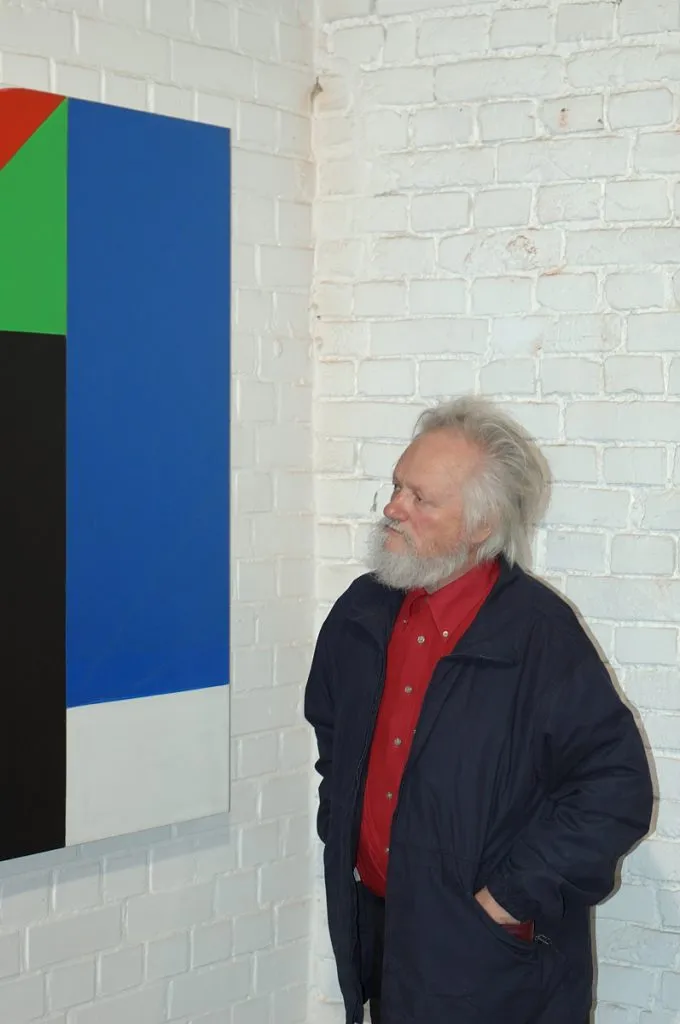
G. J. B. K.: You are being guided by imagination now. I am sufficiently open to admit every state. Only then do we live in an expanded world that does not restrict us to my vision. I am a dissenter. A dissenter accepts everything. Since you exist, if I did not accept you I would be a fool. A dissenter agrees with no one. If I agreed with you, I would also be a fool. After all, I do not sit inside your body; I have not experienced what you have. We meet on the principle of plus and minus, or provocation and reaction. And truth lies neither in provocation nor in reaction. It is always between them, in the interspaces.
A. W.: Tell that to the people who elect the president in Poland.
G. J. B. K.: If the president were an artist, he would be a composer. I always tell the mayor of Hünfeld: you are a greater artist than I am, because you have many people at your disposal. If you played upon them, you would create a harmonious orchestra that would serve everyone. But if you want to decide for everyone, there will only be disharmony. You are not making use of all the sounds. There are other possibilities of governing, without governing. People must be given opportunities and trust…
A. W.: If the president were an artist, trams would cost four times as much.
G. J. B. K.: You already know how much they would cost? Perhaps they would cost nothing and you would travel for free?
A. W.: Is art subject to the free market?
G. J. B. K.: I shall tell you nothing about that. I do not know what the market is. I have never concerned myself with it. I am outside the market. That is why you will not meet me in galleries that speculate in art, only where people of goodwill want to use creative energy to conduct a dialogue.
A. W.: What are the principal ideas that guide you?
G. J. B. K.: I have no ideas. If I had one, I would be subject to it. I would impose something external upon myself.
A. W.: Is there anyone you hate?
G. J. B. K.: No.
A. W.: A waste of time…?
G. J. B. K.: I have never fought. I did not fight because in every struggle there is a victor and a loser. I would not want to dominate anyone, and I would not want to be submissive.
A. W.: What is the difference between the paintings sold beneath the Barbican in Kraków and the works in your collection?
G. J. B. K.: They are entirely different dimensions. What I saw in Kraków were paintings sold by people who want to make a living from them. I do not make my living from this. I try to secure my existence through various activities; that gives me the opportunity to serve art, which need not be a source of income for me.
A. W.: You are one of those fortunate people who can earn money and devote themselves to art…
G. J. B. K.: I do not devote myself to art; I live art. My life is art. Art need not be functional; it need not organise space. It should, however, create an experience of value – value that need not act through dimension or form.
K. C.: Your texts repeatedly offer examples and references to the rational apprehension of faith – Meister Eckhart, for example, who wrote that God possesses the privilege of being someone pure of all being – puritas essendi, pure potentiality. Is that not similar to your conception of art as an empty, potential place?
G. J. B. K.: That is how it manifests itself in my work. And unlike religions and churches, it imposes nothing upon us.
K. C.: I am considering the concept of Reductive Art, which hardly functions in the Polish language.
G. J. B. K.: It is my invention. Reductivism consists of two concepts: reduction and activity (German: Aktiv), mental activity. It gives complete freedom. Reductive Art is devoid of real and recognisable objects; it liberates individuality and demands activity from viewers, who can continue their own reflections. We cannot ignore viewers by assuming they know nothing. That is nonsense. Viewers are capable of receiving art actively; they merely need opportunities to do so. And there is no need for convoluted art forms that are depressing and continually retell what we have learnt. It should be something that opens rather than closes. Reduction means restricting chatter to the minimum so that the pure essence remains.
K. C.: Eckhart likewise, describing successive stages of approaching truth, recommends retreating to the rational part of the soul. We can then unite with external truth…
G. J. B. K.: But he indicates what one must do and how one must behave. That is absent from my work. Everything depends on the level of my consciousness. I cannot force my consciousness upon someone else. It would be impossible anyway. Eckhart thought a common method could be created for everyone. He contains imposed elements such as ritual. The same is true in Buddhism and the Zen tradition. Clothing, ritual and liturgy – in my view, these are obstacles. The conviction that ritual can raise us to a higher level is false. Everything depends on self-knowledge. If we do not find that truth and that god, or whatever we call it, within ourselves, everything else is meaningless.
K. C.: And art…
G. J. B. K.: Art is moving precisely in that direction. It must be as pure and innocent as faith that makes no claims and demands nothing.
K. C.: Do you believe that such a society can be built in the contemporary world…
G. J. B. K.: It can never be done. Art has no right to convert, no right to point the way, no right to absolutely anything. It must come into being; coming into being itself is the value. Whomever it encounters – that is their affair. As is whether the encounter changes anything in them. That alone is liberty and freedom. Everything else, anything that is a command, has nothing to do with freedom.
K. C.: You run a school and develop a museum. I do not believe you expect no response whatsoever. You leave complete freedom, but on the other hand, one would like someone to come.
G. J. B. K.: Only someone with that inner need will come. If you summon people using tricks and they find themselves there by chance, do not expect it to yield anything. You may even provoke the opposite reaction. It will always be individuals.
K. C.: Yet the Constructivists believed they would build a new human being.
G. J. B. K.: They wanted to, and they burnt themselves out. They burnt themselves out, and I drew conclusions. They wanted to build a new human being. I too speak of a new human being, but that person has not yet been born. I shall not tell anyone which path to take.
K. C.: You dislike art entangled in emotions, art that tells stories and imitates…
G. J. B. K.: Let it be. Let it exist, like everyday life. If someone wants to go over problems from which they are not yet able to detach themselves, that is their affair. Not everything can be classified as art. Art moving towards an absence of association, a renunciation of illustrating events, should be isolated. All the rest may exist; people may do it, and we will not convert anyone because the effect may be the opposite. One must merely create opportunities for comparison.
K. C.: Do you not think an encounter with such literary, emotional art can produce the same effect?
G. J. B. K.: I do not believe it. It is impossible. A person who does not control their emotions has no will of their own. They do not decide for themselves. Human beings are emotional by nature, and higher consciousness attempts to liberate itself from that.
K. C.: You do not believe Aristotle, who speaks of the beneficial effects of catharsis: purification through an encounter with art that simulates emotion?
G. J. B. K.: No, because that is a rather one-sided view. Of course one sometimes has to scream or cry in order to be freed, but these are only physical matters that torment us because we lack consciousness. If we attained that consciousness, screaming would serve no purpose. As now, while we are talking: what would be the point? I am going to the Wagner Festival in Bayreuth now, but not in order to cry or overcome stress; I am going to discover what I have not yet seen. I have never lived under stress, although there were times when I slept only twenty-something hours a week. Why did people invent stress? I think Western culture cannot repeat what succeeds in the East. Here it is impossible to free oneself from problems through contemplation or meditation. Those are only appearances. A person who does not live the kind of life others live – those condemned to it, who genuinely have to subordinate both hunger and fear to it – will achieve nothing that way. In my view, Western people have a different path: to work ten times more than they are capable of. Then what is unimportant falls away by itself.