
The Contemporary Folk Art of Stanisław Koguciuk and Jan Uścimiak
Agata Mendrychowska
In his Musée Imaginaire, André Malraux placed folk saints beside Michelangelos and Rembrandts. In the home of a collector in Chełm, contemporary folk art stands next to geometric abstraction. A peculiar cabinet of curiosities, a Wunderkammer. A gallery of phenomena encompassed by the term ars insita, from the Latin insitus — unformed, original. Aleksander Jackowski writes that this art “embraces primitive creation, the borderlands of folk art, naïve art, magical art…”1. Most of the collection and the flat is filled with Jan Uścimiak’s small sculptures, reliefs and sculptural groups, arranged tightly on shelves beneath the ceiling and hanging on the walls, as well as naïve paintings known as Humours. Their creator is Stanisław Koguciuk, sometimes called the Nikifor of Pławanice, although nothing connects him with Nikifor of Krynica beyond his growing popularity and chosen artistic field.
The formal value of folk sculpture and painting was first recognised in connection with the searches of Avant-Garde artists, who rejected earlier artistic canons and sought other means of interpreting the world. “Above all, one must arrive at a schema that satisfies our instinct for reality without repeating naturalistic illustration… One must be capable of precisely the unconscious impulse of which a child is capable…”2, the Formist Leon Chwistek wrote.
Folk art, like the countryside — the former orbis interior — underwent change. After the Second World War, growing numbers of inexpensive industrially manufactured products replaced handicrafts, while plaster figurines shaped new aesthetic models and met public demand. Over time, folk creativity became increasingly independent of traditional patterns transmitted from generation to generation, and folk artists found audiences in cities and institutions such as ethnographic museums.
The work of folk artists in Poland was discovered for a wider audience and used for propaganda by the communist authorities. A protective system under which Cepelia, the Central Union of Folk and Artistic Industry, purchased work gave folk artists a means of subsistence. This was a period when Nikifor’s watercolours were shown at Zachęta and the folk sculptor Leon Kudła became the subject of a documentary film.
The rural inhabitants portrayed by Zofia Rydet in her Sociological Record no longer exist, and the homes whose interiors formed an integral part of those portraits are disappearing. Folk motifs enter design and fashion in a superficial, decorative manner resembling the folk-mania of Young Poland. In Berlin’s Monbijou Park, an old farmhouse moved from a Polish village became a theatrical space known as the Märchenhütte (“Fairy-Tale Cottage”).

The art of the contemporary folk artists Stanisław Koguciuk, a painter, and Jan Uścimiak, a sculptor, occupies the space between folk tradition and individual exploration. Both create contemporary folk art that differs from the former peasant art, which contained a canon of folk representations. Yet the categorisation of folk art was always imposed from outside and belonged to urban audiences.
Koguciuk’s painting arises to a considerable extent from imagination and nostalgia. The subjects of Uścimiak’s sculpture are perhaps more closely connected with a fascination for the world surrounding the artist: the provincial, peripheral reality of a borderland city.
Artists’ and audiences’ awareness and aesthetic aspirations have changed, and with them the subjects and iconographic patterns of contemporary folk art. This is evident in Jan Uścimiak’s work, which finds room for the sculptural group The Bar beneath the Tit; a gallery of relief portraits of local personalities and Chełm urban types — village singers, town musicians and a long-haired boy with a guitar; and a relief panorama and allegory of Frankfurt containing the European Central Bank building, a line of cars and an aeroplane taking off. The traditional subjects Uścimiak addresses are modelled on sacred art but may be modified by the artist, as in his Native American-style Angel with the wings of an Indigenous totem. St George, St Francis and other sculptures of patron saints who once occupied places in household shrines are shown in accordance with traditional iconography, as is Christ in the Mystic Winepress, an allegorical representation dating back to the Middle Ages. Uścimiak polychromes angelic choirs like those in paintings by pre-Renaissance masters according to the principles of angelology: seraphim with fiery wings painted red and cherubim whose wings, according to the writings of the Church’s holy doctors, should be blue.
Sculpted scenes from the life of the Pope, a “contemporary saint”, are relatively new to folk art. The phenomenon has its equivalent in the vast number of monuments with this subject throughout the country. Uścimiak carved a scene familiar from media coverage: the Pope at Okęcie Airport, kneeling to kiss his native soil, with an aircraft behind him. In another “papal” work, modelled on a popular image recorded by a television crew, Uścimiak immortalised the moments after Mehmet Ali Ağca’s assassination attempt. Placing the Pope in a vehicle carved to resemble the Popemobile, he showed him frontally with arms outstretched like a contemporary interpretation of the Crucifixion traditional in folk sculpture, which represented suffering universally.
The philosophy of the painter Stanisław Koguciuk’s art may be contained in a story he repeats in interviews about his first pictures, painted spontaneously on the sleeves of a linen shirt: “I took those two pictures and went to the market in Chełm. I had already sold my rural produce, but no one looked at the pictures. I thought: I will not take them home because I have ruined the shirt anyway. I will throw the pictures in the bin, because I will not sell either of them. But then a little girl came along — perhaps eight years old; in any case, she was already walking around the market by herself. I said: girl, would you like these pictures? She said: I would, but I have no money. But I would give them to you for free, because I am in a hurry to get home. Tell your mother a man was in a hurry and gave you the pictures. So I gave them to her. I was happy. If it had not been for that girl, I would have thrown them away. And I would not have painted. She gave me the desire to paint. Because a child is an expert like that. Better than adults”3.
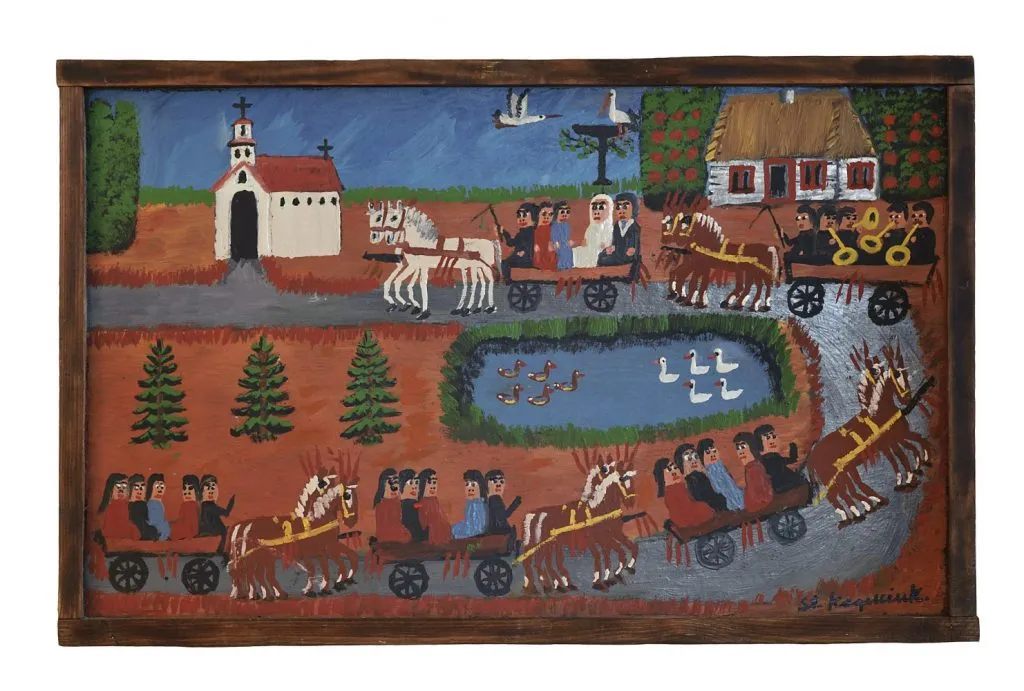
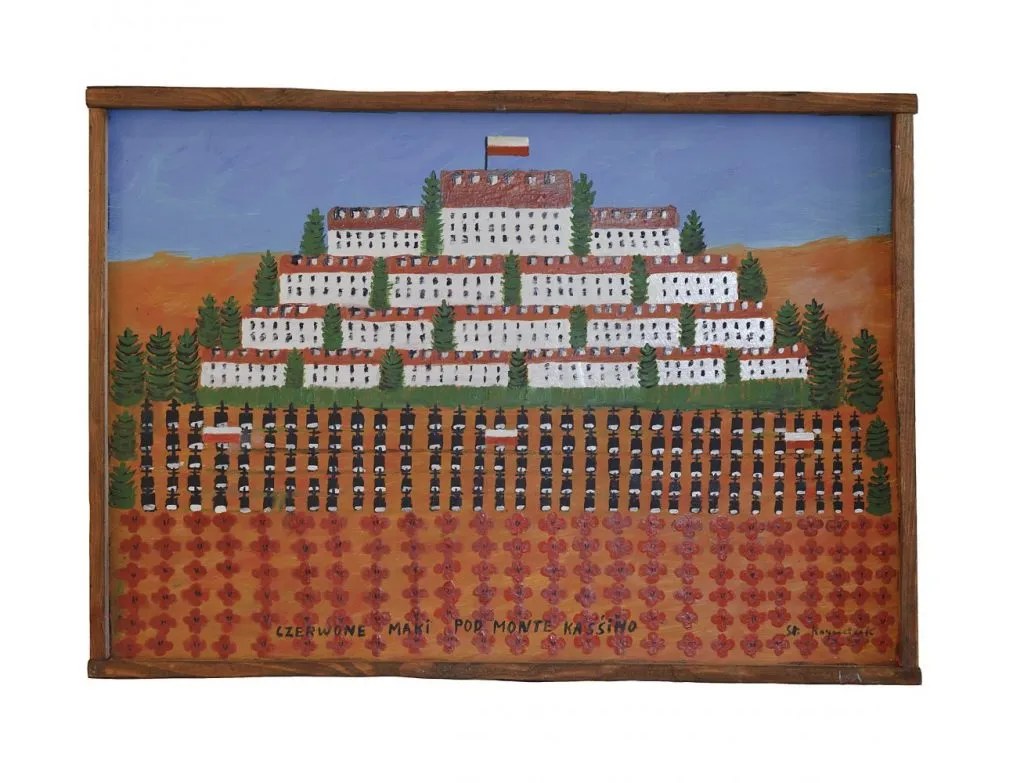
Koguciuk constructs his imaginary landscapes and genre scenes of village life set within idyllic scenery horizontally, in bands. Like children, he separates the individual planes by applying local colours: blue for the sky, a strip of green for grass and forest. At times the sky assumes a colour other than “natural”; in a winter landscape, it may have a rusty hue. A tiered composition allows a multi-stranded narrative to be arranged on the picture’s small surface when, for example, an entire village market or the crowded summer beaches of White Lake must be shown. Since the picture is subordinated to the artist’s message, execution and technique are intended to communicate its content as effectively as possible. Human figures and animals are painted in profile or frontally, as in children’s drawings. They resemble paper cut-outs glued to the flat surface, dynamically composed in an alternating rhythm. The pictures’ decorative quality is folk-derived. Trees often flank the landscape on both sides, as they once did on folk wall hangings.
The artist paints his landscapes at home after dusk, using candlelight. As he paints, he listens to the radio, which may occasionally inspire works from the Humours series. He has produced these since the mid-1990s, and their generous dose of peculiar wit has contributed especially to his popularity.
Every work in the series combines a verbal commentary, sometimes rhymed and inscribed on the picture, with painted scenes of social and even political satire “in the folk manner”. Figures such as “the blonde” and personified animals — protagonists of the Humours — allow Koguciuk to mock what he regards as human faults and stupidity. Yet as he himself says, the Humours are above all “pictures for laughing”.
Initially, every newly painted Humour was placed in an ornamental frame. The artist soon abandoned this presentation and replaced it with a border of thin slats indistinguishable from the uniform ground. There is no doubt that Koguciuk’s audience influenced his decision to give up the frame’s decorative ornament. It is they who see the Humours as modern works and read connections with the comic strip, as did a journalist who called Koguciuk “Great Stanley” and, in a similar vein, assigned him to Pop Art.
On the other hand, folk art contains examples that, like the Humours, presented comic scenes accompanied by text and featuring assorted protagonists: soldiers, girls, innkeepers, village musicians and a dog offered moonshine for leading a cow on a rope. These were the ceramic stove tiles of the nineteenth century, described as folk painting.
Painting in series and frequently making copies to order — although, Koguciuk stresses, without preliminary sketches — gives the work an almost Pop-Art mode of production while belonging to folk tradition. An example is provided by nineteenth-century itinerant image makers, who satisfied demand for “products” such as devotional pictures, signs and painted ceramic stove tiles. Unlike other forms of representational creativity, painting required skills and materials long unavailable to rural inhabitants, who were therefore offered pictures produced according to iconographic templates.
In 1966, the Polish Academy of Sciences and the editors of “Polish Folk Art” organised the seminar “Kitsch — Fairground Art — Folk Art”4. The subject belonged to the then-fashionable debate on kitsch, which had arisen in part because of Pop Art. The discussion concluded that what distinguishes “good” art from kitsch is authenticity, understood as an artist’s sincere message. To quote Chwistek once more: “Anyone who does not care to admire another’s dexterity while discreetly yawning will always want artists to be at least clumsy enough that the world does not seem banal to them”5.
- A. Jackowski, “Third Triennial of Self-Taught Art in Bratislava”, “Polish Folk Art”, no. 3, 1973, p. 162.
- L. Chwistek, “The Problem of Knowledge in Painting”, “Przegląd Współczesny”, 1936, p. 315 ff., quoted in Józef Grabowski, “The Problem of Folk Style”, “Polish Folk Art”, nos. 9–10, 1948, p. 4.
- “Paint Like Koguciuk: Excerpts from a Conversation with Stanisław Koguciuk”, www.homoinqui-etus.org [accessed 14 May 2012].
- “Polish Folk Art”, nos. 3–4, 1966.
- L. Chwistek, op. cit.