
A Dialogue Between Self-Taught Artists
Jagoda Baczyńska
Beginnings
The exhibition of paintings by Stanisław Koguciuk and sculptures by Jan Uścimiak was conceived as a dialogue between two artists who, despite expressing themselves in different materials, resemble one another more than they differ.
I first encountered their work in the early 1980s. While serving on the jury of the annual Folk Art Reviews in what was then Chełm Voivodeship, I had an opportunity to see their early artistic achievements. These works lacked today’s sweep. They were modest, as though entering the broader confrontation of a competition with some timidity. Yet even then they were marked by an unfeigned thread of truth, an authenticity of expression that foreshadowed the further development of both innate talents. Koguciuk principally painted landscapes in which a clear sky was reflected in the waters of lazily flowing streams, and every species of tree familiar to him grew along their banks. These works were distinguished by their calm, balanced compositions, while the predominant blues and greens evoked the idyllic mood of nature. In time he ventured to paint other seasons, of which the winter landscape, immersed in soft and friendly down, seemed to bring the greatest solace. The painter’s undivided interest in the familiar atmosphere of rural life continued for many years, and nothing foretold the radical changes that would later arrive.
Uścimiak carved small figures—small enough to fit in one’s hand—that corresponded to familiar folk sculptures: figures with the attributes of labour (‘Woman with a Kneading Trough’, ‘Farmer with a Sickle’), scenes of the Passion, and compositions preserving the traditions of the old countryside. He covered them with paint, which served not only the purpose of artistic expression but also helped distinguish important details and animate the small, puppet-like protagonists, who began to look at us with wide-open eyes.
The time when both artists took their first steps in art favoured their development. The 1970s and 1980s were characterised by a profusion of competitions, fairs and reviews, while museums, galleries, cultural centres and associations whose statutes included the promotion of folk culture competed to organise exhibitions presenting non-professional art. This provided effective encouragement, spurring rural communities to attempt artistic creation.
Even those who could find no genuine divine spark within themselves tried to strike one and show that they were no worse than their neighbours. This is no exaggeration, for examples are known from that time of almost an entire village, encouraged by one fellow resident’s success, taking up sculptors’ chisels or painting tools to join the ranks of the so-called Primitives. For some it was merely a flash in the pan, but others discovered an inner need and began to look at the world more closely, rediscover it, filter it through their own sensibility and finally interpret it in their own way. They were then given a chance to continue their work, which—when supported by truthful expression—astonished with the freshness of its forms and convinced through the sincerity of its artistic message. These home-grown artists were given hothouse conditions not only for working but also for earning money, an effective stimulus for the production of works arising from non-professional rural communities. Their audience proved to be the city dweller, usually an intellectual, but also the state, which spared no expense in expanding ethnographic collections in museums of varying reach: regional, district and national. This boom reversed at the end of the 1980s. Economic and political changes in the country meant that no one now ‘courted’ folk-art ‘labourers’. This heralded a natural selection among rural artists: those in whose hearts and minds art had taken firm root did not lay down their chisels or brushes. Stanisław Koguciuk and Jan Uścimiak were among them.

Following Nature’s Voice
Koguciuk—called by some the Nikifor of Pławanice—has not changed his place of residence for more than sixty-seven years. Now approaching eighty, the artist has witnessed the enormous transformations that have taken place in his surroundings. He is aware of them, observes the world intelligently and sees both the beneficial and destructive effects of contemporary civilisation. He submits to neither and lives according to his own rhythm, arranging his day around painting. He cooks for himself, basing his menu on the simplest products readily to hand. He grows beans on a plot beside his house, sells the surplus at the market in Chełm and, if anything remains, gives it to those closest to him—family and neighbours. He paints by votive candles, choosing those that produce the least soot and ensuring that he always has an adequate supply, because only the combined flame of four candles provides the right conditions for work. He sends finished paintings to reviews and competitions, and readily exhibits at fêtes and fairs, where the large flow of visitors makes contact with other people easier. And he likes to escape his solitude from time to time. He once travelled to Wrocław and Kraków and was always present at the Festival of Folk Bands and Singers in Kazimierz Dolny; now, as he stresses, his only recreation is nearby Chełm and the people who have admired his art faithfully for years. Although he never complains, he admits that his stooped posture is a consequence of back pain. He has lived with an acquired hernia for forty years, yet speaks of his condition as his closest friend, one he has known since youth. He has never sought medical advice; the only medical examination he underwent was when entering military service. His hands remain dexterous enough to refine the smallest details, emphasise particulars and guide a thin line with a precision that rules out any tremor. Koguciuk believes in the beneficial effect of the clay he used for more than fifty years to build stoves. He adds that he pressed it into the tiles with his bare hands and maintains that direct contact with this malleable mass produced such favourable results.

The painter is a deeply religious man who entrusts his life to higher providence. He believes that someone above directs the course of his fate, for how else could he explain his dreams, which always come true? He confides that if he dreams of a pike caught in his net, it guarantees a significant prize in an important competition. Things are worse when he catches smaller roach or crucian carp, for that is an infallible sign that only a commendation or a lesser form of recognition awaits him. He does not know jealousy; always kind and warm to everyone, he surprises with an extraordinary straightforwardness of behaviour that seems out of place in our times. He intuitively seeks cheerful people in his surroundings and equates their smiles with goodness. Once asked how he dealt with signs of irritation, which never appear on his face, he answered without hesitation and put it succinctly: ‘But I don’t know what nerves are!’ Endowed with this unique personality trait, he accepts every adversity with an incomprehensible calm and dignity. He does not evade it; on the contrary, he assumes obligations caused by others. This gentleness of heart makes his face smooth and younger than his age would suggest. Stanisław Koguciuk belongs to that very rare kind of person who does not have to learn the commandments of the Decalogue: nature has thought on their behalf.
Uścimiak is an extrovert. Every colour of the rainbow paints on his face the experiences he is undergoing at any given moment. Conscientious, he is constantly concerned about his flat and all the payments connected with maintaining it. He often pays them in advance in order to put them out of his mind for a month or two. The subject occupies him obsessively and demonstrates not only his conscientiousness but also his attachment to inner peace, without which he will not reach for a chisel and his imagination fails. Every anxiety blocks him; when he tries to carve another figure against his own inclination, he cuts his hands and, discouraged, puts the work aside. He then gets on his bicycle and seeks contact with nature. The forest has the most soothing effect on him. He likes returning to the same places and following the changes brought by passing time and successive seasons. He selects, for example, trees in the forest that interest him, wraps string around the full circumference of the trunk and throws the resulting ‘measure’ high onto a branch. He returns to the same place a year later to see how much the observed tree’s circumference has changed. He knows the properties of many herbs and uses this knowledge to relieve ailments as they arise. He gathers forest fruit and makes juice from it; he knows which to take when his blood pressure ‘jumps’ or his stomach troubles him. He complains that after recently turning sixty, a person is no longer what they once were. Only in dancing can he still summon a little strength, but he expects his partner to move lightly, fluidly and in time with the music.
Prudent and provident, in autumn he pickles cabbage and cucumbers and preserves various foods that will make it easier to survive the winter. This is a habit from the days when the family was still together and he assumed the culinary duties.
Always neat, he likes to keep several shirts and pairs of trousers in reserve, as well as jackets suited to the weather. Fortunately, the density of second-hand shops in Chełm is comparable to the number of bars embedded in the urban fabric of Paris. There is plenty to choose from, and genuine treasures sometimes appear. Uścimiak is a demanding customer. He likes everything to be made from natural fibres, because synthetics are unhealthy and do not breathe. Jackets should be light and down-filled, but those are quickly snapped up, so he prefers to wait and rely on a lucky chance. Recently he found one whose cut and reputable brand were admired even by his son-in-law from Lublin—a scholar and doctoral student—although Uścimiak himself had not the slightest idea that the brand existed.

He is an excellent storyteller whose language is sufficiently vivid to conjure without difficulty in listeners’ imaginations the setting and atmosphere of the events he recounts. His eye is keen; he takes everything in at a glance and then records in a block of wood a remembered scene, gesture, inclination of a figure or amusing situational context. He also has a critical nature that tells him which work has fulfilled his intention and which has ‘defied’ his expectations.
Uścimiak is an incorrigible romantic who longs for the rural life he vividly remembers. The years of his childhood and early youth remain before his eyes. He can still hear the speech of the eastern borderlands, which resulted from many cultures.
Mature Work
In their work, Stanisław Koguciuk and Jan Uścimiak draw upon the tradition of sacred folk art and are interested in the old countryside and its rituals, but what distinguishes their artistic achievements is rooted in a reality unfolding before our eyes.
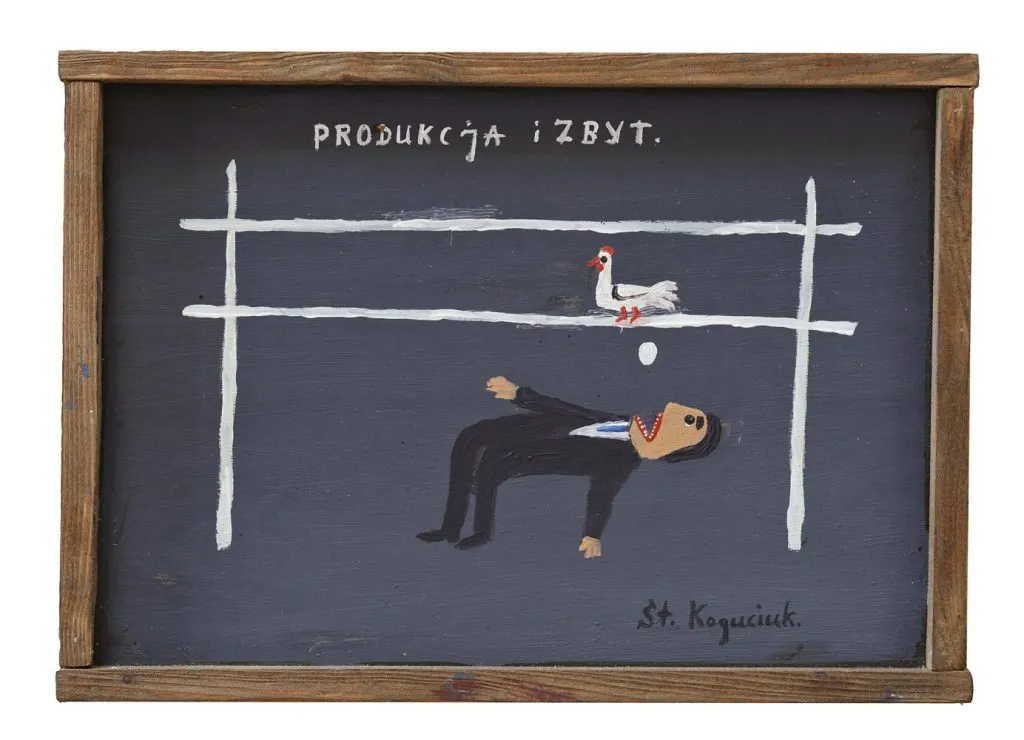
Koguciuk creates his small paintings on fibreboard, which he primes with ‘Polinit’ emulsion before covering it with zinc or titanium white. He has the highest regard for Polish oil paints; he complains that Chinese ones ‘cover poorly and everything comes out insipid’, whereas he likes vivid, resonant colours, so that a painting delights the eye with the richness of its hues. He encloses the finished work in a simple wooden strip stained brown. A few years ago, when he was younger, he cut notches into the frame—a simple ornament completing the representation. To make the work ready for hanging, he cuts scraps of sheet metal from used tins and skilfully fits them as a hanger.
The artist continues to paint his native landscape, family traditions and folk rituals, and creates works on religious and patriotic subjects. Every composition has a carefully considered order and a mood produced by colour; it displays a tendency towards symmetry and an attachment to detail. A zonal perspective based on horizontal arrangements suggests the sequence of planes, from the nearest and lowest to the higher ones signalling distance. The silhouettes of houses and people are subjected to schematic rhythms without depriving the whole of its logic and representational validity. The protagonists of the compositions are treated synthetically and contrast with more meticulously rendered stands of trees, their foliage and identifiable species of flowers. The painter uses figure types: young boys have dark hair, while old men have grown grey beards and their heads are covered with frost. Girls are distinguished by long blond hair, while older women conceal theirs beneath headscarves. The gallop of horses is excellently characterised (‘Wedding Procession’) and their rhythmic step superbly conveyed (‘March, March, Dąbrowski’). The bowed heads of grazing cows are keenly observed (‘The Herdsman’) and the lazy movement of farm animals aptly captured (‘The Farm’).

Koguciuk’s religious painting (‘The Way of the Cross’, ‘The Last Supper’, ‘Lord, You Are Sleeping and We Are Drowning!’, ‘The Nativity’, ‘Madonna in Flowers’) is directed towards individual and personal expression in its chosen means. Taking delight in accentuating details, he displays a tendency towards decorativeness and, at the same time, concision. In some works he is quite graphic; in others he becomes more sensitive to painterly patches. In general, his work operates more through colour than through line and outline.
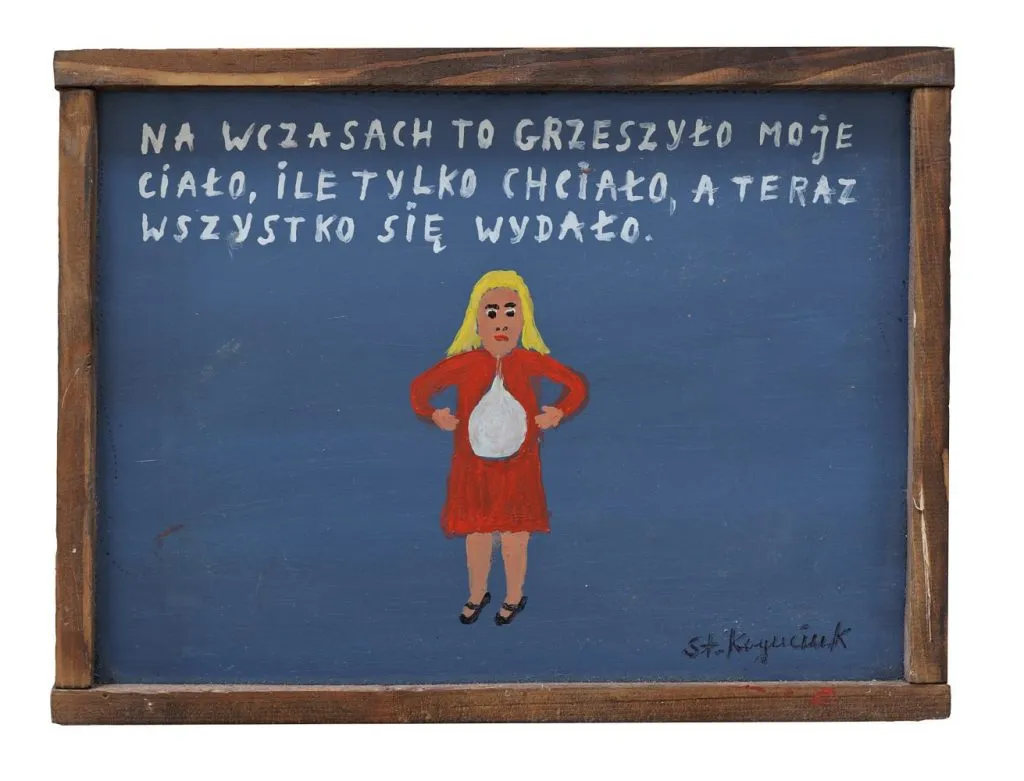
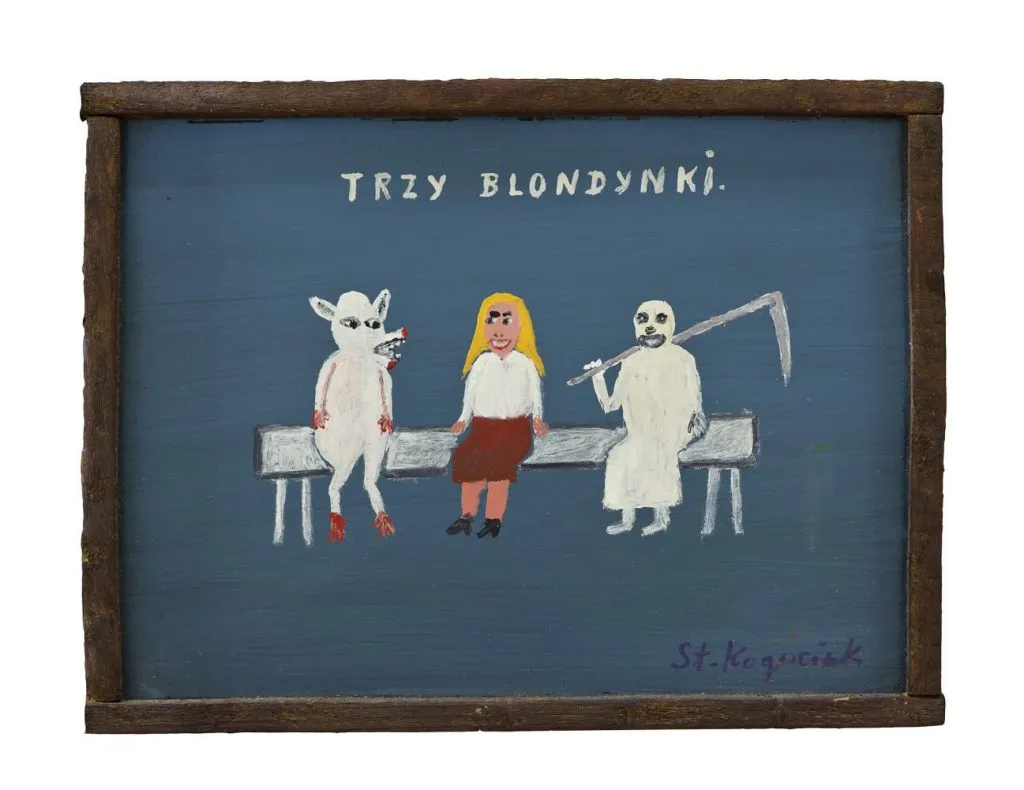
What distinguishes him from all other self-taught artists is his long and rich series of ‘humours’, which he has been creating for more than fifteen years. Kept to a single format—30 × 42 cm—they speak not only through painterly form but also through text, which explains the meaning and essence of the anecdote they contain. The concise or more extensive words, often rhymed, always provide an apt and amusing complement to a representation that employs abbreviated form devoid of superfluous ornament. These scenes take place against a dark, neutral background, which only helps expose the punchline they contain. Thematically, they address different areas of our lives: politics, partnership, feelings, interpersonal relations, social and even eschatological matters. In difficult times full of tension and stressful haste, Koguciuk allows us to relax, smile, pause, reflect more deeply upon the meaning of life and gain some distance from reality. His work encourages reflection, warns, ironises and acts as a mentor, but is always indulgent towards our weaknesses.
Uścimiak creates sculpture in the round, but relief occupies him to an equal degree. He ensures that the limewood is of good quality and properly dried. He covers finished works with polychrome, revealing a preference for warm, pastel colours. On convex surfaces he rubs back the paint to suggest the action of light. This device not only distinguishes his work but emphasises its painterly aspect. He develops the figures from a single block of wood, while attaching decorative details with glue to the overall compositional conception. He shows the greatest determination in this respect in his carved vehicles, whose intricate construction and structural complexity he seeks to reproduce faithfully. The picturesque quality of his lorries, and especially his tractors, lies in the fact that they do not resemble machines fresh from Ursus’s latest production line. One can readily see that some home-grown craftsman-constructor has ‘resuscitated’ them, his talent giving them a ‘second life’. Tractor drivers tow ladder-sided carts on which crouching figures travel to market or church; only one couple, relaxed after the toil of the harvest, seeks solace in amorous games.
More often than the countryside itself, Uścimiak is interested in current affairs observed in the street, park, town market, orchard, beer bar or at a dance. The titles alone intrigue and stir our imagination: ‘Cheap Shoe’, ‘Zhenia from Kyiv’, ‘The Eastern Wall’, ‘Aunt Olga from Volhynia’, ‘On a May Outing’, ‘The Lovers’, ‘On the River Bug’, ‘The Venerable Birthday Girl’, ‘Businessman and Beggar’, ‘Artists’, ‘The Crisis’, ‘They Ate Dinner, Took the Pension—Goodbye Grandma, See You Sunday’. Uścimiak recently recounted in two reliefs—‘Frankfurt am Main’ and ‘Agat Kraśnik’—his recent and only journey west of the border. The narrative shows a dual carriageway along which streams of cars, each different, speed past. The landscape is varied by buildings typical of Poland’s German neighbour; blue cloud formations float above the whole conception, with a solitary aeroplane lost among them. This extraordinary cavalcade of cars heads towards a modern architectural structure dominating the composition and bearing the inscription ‘Europen Bank Center’, beside which a sizeable symbol of the common euro currency is prominently displayed. Measuring 145 cm horizontally and 57 cm high, the work proves that its author continues to look freshly at the shape of this world. He does not follow others or watch what they do; he relies on his own resources and remains an independent creator of his own visions. Even when he repeats a subject, he always does so differently; he never repeats himself, for duplicating a version he has already developed bores him. This can be seen clearly in his sacred sculpture, in which the ‘Angels’ constitute a particular and distinctly separate group. They appear alone or in groups, creating openwork compositions of ‘Angelic Choirs’; they accompany and provide decorative complements to ‘Crucifixions’ and representations of ‘Mary with the Child’ and ‘The Pensive Christ’. In these figures, attention is focused on the wings: their placement on the shoulders, angle of opening and treatment of the surface all testify to the artist’s clearly decorative intention. There are also precisely constructed musical instruments, upon which the angelic beings play, glorifying and praising the ‘Holy Maiden’. ‘Guardian Angels’—God’s messengers—pull their charges from watery depths, protect them from falling off a skateboard, watch over small footballers and guard children playing on a swing.
The art of Stanisław Koguciuk and Jan Uścimiak, addressing both temporal and divine matters, always uses forms referring to everyday reality. Both artists are frequent visitors to a museum studio filled with canvases belonging to an abstract current marked by geometric forms. They do not comment on these works or attempt to explore their message or the intentions of the artists who made them. Only once did Uścimiak—to my surprise—bring in a small relief in which he distinguished a circle, square and triangle and placed a large question mark above the whole. It was not merely a joke, but a reaction to a somewhat cool art that is an expression of formal speculation and the product of an intellectual tradition. Although I love the magic of geometry’s ordered world, I myself draw emotional equilibrium from art created under the clear dictates of the heart. Bihalji-Merin, one of the most eminent experts on the work of self-taught artists, said in his introduction to the catalogue of the exhibition Le monde des naïfs, organised in Paris in 1964: ‘We love this art because its spontaneous warmth allows us to endure the cold climate of our civilisation.’