
In the Gap between Art and Life
Maria Poprzęcka
In 1949, a poll conducted by the popular, mass-circulation magazine Life named Jackson Pollock the best-known American artist. Fifteen years later, in 1964, Robert Rauschenberg became the first American to win the Grand Prix at the Venice Biennale. The years separating these two events divide the triumph of action painting — expressive abstraction, whose most spectacular exponent was Pollock — from the triumph of Pop Art, a movement that negated abstraction. It was also a period of unrelenting rivalry for supremacy in the art world between the United States and old Europe, between New York and Paris. In the background were Cold War political tensions, profound changes in the mechanisms governing the modern art world and the artist’s place within it, and — especially in the United States — an impressive rise in the funds committed to contemporary art.
Yet rather than viewing artistic events solely as the consequence of the increasingly decisive actions of dealers, gallerists, museum directors and curators of major international events, let us consider the situation of the generation of artists who, like Rauschenberg, entered artistic life in the early 1950s. In the United States, Jackson Pollock was undoubtedly the most recognisable artist, not only because of the social scandals, alcoholism and extravagance that brought him into the pages of the popular press. Influential critics saw him as an intrinsically American artist, on account of his vehemence and his independence from the European avant-garde. Filmed in his barn studio performing the rite of painting like a ritual dance, leaping across canvases and splashing them with paint from tins, Pollock was perhaps the first artist to turn the creative process itself — the painter’s creative gesture, his “action” — into a spectacle. The famous abstractionist acted here as a pioneer of performance and process art. Ultimately, however, he painted pictures that commanded fabulous prices. Alongside Pollock worked a large group of outstanding artists, including Robert Motherwell, Mark Rothko, Byron Browne, Willem de Kooning and Barnett Newman. In 1983, the French historian and critic Serge Guilbaut argued that expressive abstraction had been harnessed to United States Cold War policy1. Even if one does not wholly accept the claim that “New York stole the idea of modern art”, the turn of the 1940s and 1950s marked the apogee of the international success of the “New York School” and the definitive shift of the centre of Western art from Paris to New York. It also consolidated the image of modern American art as an expression of strength, emancipation from the pressure of the European masters of the avant-garde, unrestrained breadth and freedom of creative expression.
In 1953, the not-yet-thirty-year-old Robert Rauschenberg erased a drawing by Willem de Kooning, one of the leading representatives of Abstract Expressionism. This act of licensed iconoclasm — it was said to have taken place with de Kooning’s permission, and he supposedly sold the drawing for a bottle of whisky — acquired the status of an event symbolically marking the beginning of a realignment of forces on the American scene. It was no in-crowd prank, although it may have looked like one. The work’s solemn artistic status was assured by the artist’s title, signature and date: “Erased de Kooning Drawing. Robert Rauschenberg 1953”. The erased drawing was mounted in a tasteful passe-partout and a noble gold frame. The work has retained its importance, as attested by its prominent presence in historical accounts of twentieth-century art2.
Rauschenberg, the destroyer of the famous abstractionist’s drawing, was not a beginner or a youngster seeking notoriety in order to establish himself in New York circles. Born in Texas in 1925 into a family with no artistic traditions, Rauschenberg had a colourful artistic biography that resists any straightforward narrative. “Painting relates to both art and life. Neither can be made. I try to act in the gap between the two” — this was how he defined his art in 1966, when Pop Art was at the height of artistic fashion3. He also described himself as a man hungry for life and curious about the world, not merely about art. From his impoverished student years onwards, Rauschenberg engaged in all manner of artistic and personal activity. He travelled to Europe and North Africa, took part in artistic manifestations, worked with composers and ballet companies and helped organise Experiments in Art and Technology. Early on, he passed through the experience of non-representational painting in its radical, minimalist form. John Cage poetically described his large, uniformly white paintings of 1951 as airports for lights, shadows and particles. It was Cage who introduced Rauschenberg to Zen Buddhism, whose meditative character offered a spiritual antithesis to “action painting”. Hence the contemplative, emptiness-radiating White Paintings.
His close and also personal relationship with Cage, a composer who radically revised the question of artistic “creation”, brought about a decisive change in Rauschenberg’s view of art. A work they made together — the trace of a car tyre, from a Ford driven by Cage, printed on a strip of paper almost seven metres long — pointed the way towards the “gap between art and life”. A purely mechanical imprint of something as ordinary as a car tyre could hardly have been a more mocking comment on the mythologised “gesture” of the abstractionist artist. In a photograph taken many years later, the two now grey-haired artists, like patriarchs of the avant-garde, stand before Automobile Tire Print, displayed like a precious antique scroll, confirming the wisdom of the course they had chosen. It was then, too, that Rauschenberg erased de Kooning’s drawing.
To what extent was this a gesture of generational rebellion against the artistic establishment? And to what extent did it invoke Marcel Duchamp’s iconoclasm? Rauschenberg met Duchamp personally through Cage and was fascinated for a time by the great blasphemer of art. Although Duchamp’s most radical works, such as Fountain (1917) and The Large Glass (1915–23), were made in New York, he carried with him the traditions of the European avant-garde: the Dadaist avant-garde at which, as the bard of the generation Allen Ginsberg “howled”, young Americans threw potato salad4. It soon became clear, however, how differently Rauschenberg had absorbed the lesson of Duchamp’s readymades. Bed, made in 1955, is an assemblage of “ready-made” things subjected to anti-aesthetic destruction. Most importantly, it is an object, not its painterly representation. A bed is a bed: there is none of the perverse play of meanings Duchamp so enjoyed, in which a urinal is Fountain and a snow shovel In Advance of the Broken Arm. It is an ordinary bed, only hung vertically like a painting — a museum painting, as its present place on the wall of New York’s Museum of Modern Art attests. The bed is made with a patchwork quilt painstakingly sewn from scraps into a geometric pattern. It is untidy and rather repulsive. The quilt and pillow are worn and dirty, scribbled on in pencil and splashed with paint that runs down the bedding. How much of this is perversity directed at Duchamp’s pristine, factory-new readymades; how much a mockery of Pollock’s dripping; and how much triviality set against the bombastic rhetoric of the critics championing abstraction? How much irony is directed at the “Americanness” that critics attributed to the New York School, represented here by a typically American patchwork — one that is decidedly stale and smeared with paint? The term abject art did not yet exist in the 1950s, but Rauschenberg’s work belongs within it. Of course, it remains a long way from Tracey Emin’s My Bed, nominated for the Turner Prize in 1999: the artist’s own bed with all its shameful and repellent traces of use. Yet almost half a century separates the two works. Incidentally, comparing the two Beds — Rauschenberg’s and Emin’s — could provide an excellent starting point for analysing what happened over those fifty years, in and around art.
What kind of art did Rauschenberg propose as he turned away from abstraction and towards life? Drawing on the traditions of Dadaist and Cubist collage, but transferring them to the contemporary iconosphere, he made combine paintings — pictures painted with “American” breadth into which he incorporated photographs, old junk, bottles, tins and newspaper clippings: the rubbish-bin “waste of life and reality”. But his intentions were more serious. In 1959, he produced a cycle of images inspired by the thirty-four cantos of the Inferno in Dante’s Divine Comedy. What prompted a Texan living in New York to take on one of the greatest canonical works of European culture? Was it the result of a journey to Italy, even though Italy was no longer the destination of formative grand tours? Or did the thirty-four-year-old artist feel that “midway upon the journey of our life” he had “lost the path that does not stray”5 and ought to find it again by plunging boldly into the dangerous thicket of the contemporary world? Did he wish, like Dante, to consign his contemporaries to hell and interweave descriptions of the torments of the damned with current political affairs? Rauschenberg’s Inferno is not a set of illustrations for the great late-medieval poem. It is the hell of the modern world. The faces of politicians, celebrities and sportspeople and scenes of headline events emerge like apparitions from an indistinct nebula, alongside images of concentration camps, anti-racist unrest in the United States and evidence of the aftermath of atomic explosions — the greatest terror of the age. Direct political engagement, as expressed in Rauschenberg’s Inferno, carries the risk of quickly becoming dated. Who now remembers Adlai Stevenson, who assumes the role of Virgil, leading the author through the circles of hell? The work’s form proved decisive to its durability. Rauschenberg invented a technique of his own that gave the Dantean scenes an appropriate contemporary form. He used the laborious manual method of rubbing selected newspaper illustrations onto paper soaked in solvents that absorbed the printing ink. The literalness of the newspaper is thereby effaced, the eyewitness immediacy of reportage blurred, and the images acquire an almost visionary, timeless character. As a result, this indictment of the contemporary world at the end of the 1950s remains menacing and resonant.
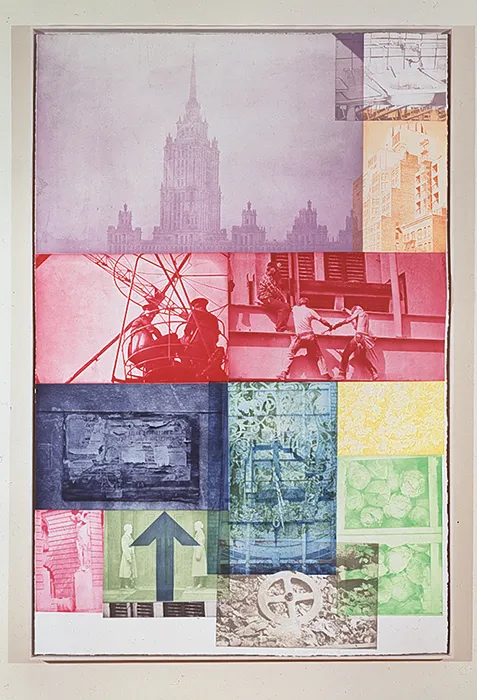
Technological invention also characterises Rauschenberg’s works from the early 1960s, which became his most recognisable and remain his signature to this day. He took many photographs himself and could therefore naturally treat the canvas as a light-sensitive screen onto which photographs were projected. He swept streaks of thinned, translucent paint across photographic images screenprinted onto canvas. Thus emerged multi-layered, ambiguous, compelling yet obscure palimpsest-pictures: the condensed visual chaos of the modern metropolis. Reproductions of celebrated paintings, technical and natural-history photographs, proof sheets, press materials, snapshots from sporting events, private archives, production stills, maps, calendars, advertisements and billboards show through and overlap between layers of paint. This mingling of the mediated, commonplace, contemporary iconosphere with images by Rubens or Velázquez — the fusion of triviality and high art, American everyday life and European masterpieces — probably underlay the artist’s success in Venice in 1964. Large compositions filled with cultural references and at the same time with universally legible allusions — and, finally, pictures satisfying the need for sex appeal, as in perhaps the most famous work, dominated by Rubens’s misty Venus at Her Toilet — revealed a new and seductive face of American art.
Rauschenberg was the first American artist to receive the Grand Prix at the oldest and most prestigious international competitive art event. He had the backing of Leo Castelli, the powerful gallerist who dominated the New York art market, had “discovered” his art several years earlier and thereafter directed his career. The American’s victory in Venice was received as confirmation of the primacy of American art, although in its artistic form and meaning it was already far removed from the action painting that had triumphed a dozen or so years before. Part of the French critical establishment regarded the jury’s verdict — its Polish member was Professor Juliusz Starzyński, director of the Institute of Art at the Polish Academy of Sciences — as a sign that Europe would be dominated by American artists, gallerists and critics. And by American capital. In today’s globalised art world, that conflict of half a century ago may seem obsolete, yet for many years it fuelled numerous institutional and artistic initiatives intended to defend Europe’s cultural advantage against the threat of Americanisation.
Definitional disputes about whether Robert Rauschenberg should be classified as a Pop artist are fairly sterile. Rather than becoming entangled in them, it is better to point to his creative and extensive links with different fields of art. Fortunately, his triumph in Venice did not confine him within his own idiom, a signature style — an endlessly repeated “individual” painterly formula that, once commercially successful, became a trap for many painters of the period. Restless and changeable, Rauschenberg kept searching for something different; he did not begin producing “Rauschenbergs” (which is not to say that he never made weak works).
His links with avant-garde makers of music and ballet — John Cage and the choreographer Merce Cunningham — seem particularly interesting. They were not limited to the jointly produced Automobile Tire Print mentioned above. From the watershed year of 1953, Rauschenberg became involved in actions and spectacles that combined what were not yet called the visual arts with theatre, ballet and music in their most avant-garde forms of the time. “In his attempts to go beyond the boundaries accepted in the art world,” Urszula Czartoryska wrote, “the artist already reaches the point of absurdity. He used the impossibility of controlling the course of a production as a means of expression: on one occasion he staged a performance whose duration depended on how long a dog chose to remain onstage. The artist staged a ballet in which men on roller skates appeared alongside a ballerina moving en pointe in classical ballet shoes. In another of his performances, the dancers noisily and laboriously carried tyres on their bodies or dragged them fastened to their legs; then, to release the tension, one of them rolled across the stage safely sheltered inside the tyres, while a ballerina raised on her shoulders a kind of cage-like armour containing a flock of fluttering birds”6.
All this happened at a time when video recording was not widespread, so we know Rauschenberg’s performances mainly from descriptions and photographs. Perhaps because the documentation now feels dated, they seem close to the Dadaists’ absurd cabarets and Surrealist excesses. Many similar tendencies in the art of the 1950s and 1960s were, indeed, described as Neo-Dada. Yet in the 1950s such more or less successful spectacles, often ephemeral and not always taken seriously, worked subversively to loosen the restrictions of genre. They not only erased the distinction between flat painting and three-dimensional sculpture, but replaced traditional forms of visual art with spectacle, projection, installation and live action, and artistic material with the artist’s body — one of the processes that fundamentally transformed art in the second half of the twentieth century. Rauschenberg should also be counted among the artists who anticipated a participatory form of contact with art that engages the viewer, even if some of his ventures were called “fairground attractions”, an epithet used by the elder statesman of criticism, Sir Herbert Read.
From today’s perspective, Rauschenberg’s experiments with the latest technology appear highly intriguing. They, too, grew out of his contacts with composers of electronic music, above all John Cage, who, incidentally, made visual works throughout his life. Alongside the artist Robert Whitman and two engineers, Rauschenberg founded the non-profit organisation Experiments in Art and Technology. Its purpose was to foster collaboration between artists and engineers, physicists, acousticians and electronics specialists — collaboration based on direct personal contacts rather than institutional structures. Art-and-technology projects were intended to break down the barriers between art and knowledge, which rapid technological progress was driving ever further apart, and to use inventions and technical achievements in artistic activity. The immediate impetus for EAT was 9 Evenings: Theatre and Engineering, a series of performances — quasi-theatrical and balletic spectacles — employing technological innovations never before used in art: radio control of performers’ movements and lights, photocells, microphones connected to telephones, self-propelled platforms, Doppler sonar and wireless sound transmission. Rauschenberg directed a section in which a game of tennis triggered sound and lighting effects. 9 Evenings also had a symbolic dimension: the performances took place at New York’s 69th Regiment Armory, paying homage to the historic Armory Show, the celebrated 1913 exhibition of avant-garde art regarded as the beginning of American modern art. In view of the subsequent development of twentieth-century art forms — the importance of performance, kinetic art, video art and the extensive use of digital technologies — this reference to the pioneers of the period seems entirely justified.
Robert Rauschenberg died in Florida in 2008. In 1997, New York’s Museum of Modern Art mounted his great retrospective, an artistic canonisation. Rauschenberg’s most creative period was the 1950s and 1960s, when he continually undertook new experimental activity. Later he lived to see consumer culture annex the strategies of the avant-garde and absorb its former mechanisms of negation and contestation. Yet Rauschenberg remained faithful to the credo he articulated in the mid-1960s — acting in the gap “between art and life” — even when his creative powers waned. In the decades that followed, not only in Rauschenberg’s work, both art and life pressed into that gap ever more forcefully, now crushing one another, now offering mutual support. His standing as an artist who exerted a profound influence on the art of the second half of the twentieth century remains undiminished.
*Maria Poprzęcka, art historian and critic, full professor in the Faculty of Artes Liberales at the University of Warsaw. Her principal interests are modern art, the migration and “long duration” of images, and the links between the visual arts and other fields of creative activity. She is the author of many books, including The Feast of the Goddesses: Women, Life and Art (2012) and Other Images: Eye — Seeing — Art, from Alberti to Duchamp (2008). She is a recipient of the Gdynia Literary Prize for the essay.
1 Serge Guilbaut, How New York Stole the Idea of Modern Art: Abstract Expressionism, Freedom, and the Cold War, Warsaw 1992 (original edition Chicago 1983).
2 See Hal Foster, Rosalind Krauss, Yve-Alain Bois, Benjamin Buchloh and David Joselit, Art Since 1900: Modernism, Antimodernism, Postmodernism, 1st edn, London 2004; revised 2nd edn, London 2012, passim.
3 Dorothy Gees Seckler, “The Artist Speaks: Robert Rauschenberg”, Art in America, 1966, vol. 54, no. 3, p. 84.
4 Allen Ginsberg, “Howl”, in Howl and Other Poems, San Francisco 1956.
5 Translated into Polish by Edward Porębowicz.
6 Urszula Czartoryska, From Pop Art to Conceptual Art, Warsaw 1973, p. 76.