
They Arrived: An Introduction to the History of Liminal Photography
Adam Mazur
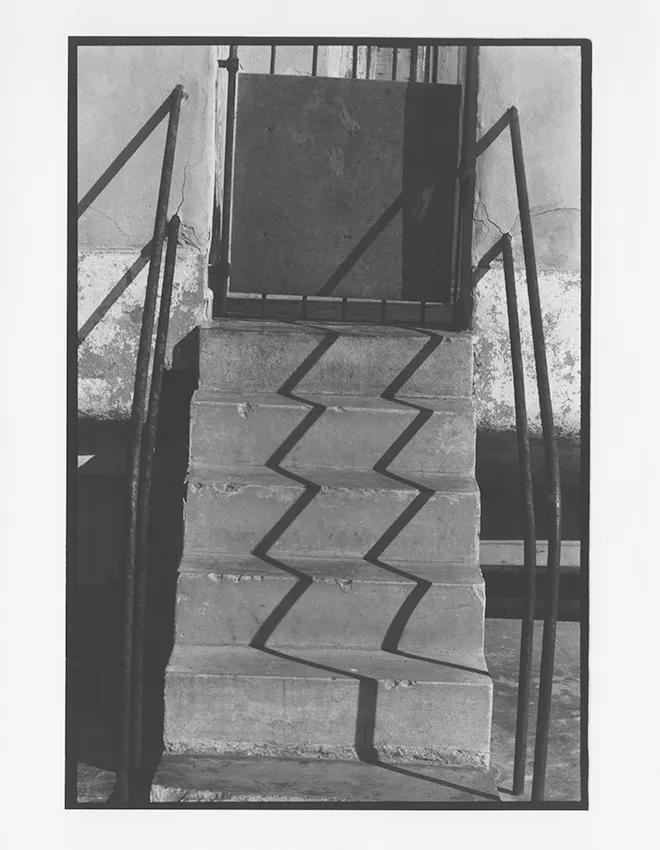
Who knows whether, for Americans, an expedition to Russia is not less obvious than a flight to the Moon. On the Moon, one can blithely plant the Stars and Stripes, wave at the camera, take a souvenir photograph and return home more or less safely. The risk of encountering alien life forms is close to zero, while ideological neutrality is guaranteed by the vacuum of space. Travelling to Russia is more like flying to Mars. That must have been how it appeared between the wars and during the Cold War, and to some extent how it still appears today. The excellent works of the brilliant Robert Rauschenberg report on contact with an alien civilisation and attempt to bring together two societies, cultures and political systems separated by light years. Although the Pop collages allude to Constructivist photomontage, even the deepest red can no longer persuade anyone of the Soviet revolution. Made in the late 1980s, as the empire approached its end, the works are at once nostalgic and utopian. On the one hand, they sound the death knell for American–Soviet image wars; on the other, they record Rauschenberg’s struggle with an archive of photographs brought back from beyond the Iron Curtain and, more broadly, from his travels around the world. Compared with the collages, the photographs seem autonomous, almost modernist. They reveal lightness, control, a knowledge of the history of art and photography and, above all, sensitivity. The pictures balance on the boundary between document, notebook and the useful study of form that photography has provided painters since its inception. There is also an element of tourism, albeit an ambitious kind. With great sensitivity, Rauschenberg avoids the intolerable position of the outsider whose gaze rests on the surface of things and cannot penetrate more deeply.
Robert Rauschenberg’s exhibition is being shown in Łódź: somewhere between Moscow and New York, between East and West. That changes matters. It forces us to ask what travel photographs brought back from journeys, used and transformed by artists and documentarians, actually are; what travelling exhibitions by masters of Western art are; and what photography festivals organised by Western curators are. In Poland — that is, nowhere, as Alfred Jarry would have said. Following the trail of Rauschenberg’s Łódź exhibition reveals an entire world of pictures that elude researchers usually focused either on a universal narrative (meaning one that reinforces Anglo-French-German Western hegemony) or a local one (meaning provincial, national and untranslatable). Extremes attract, but perhaps the time has finally come to look at what lies between them: at photographs of us, the natives, made by visitors on the plain — though hardly a desert — stretching between East and West. Who, exactly, are these visitors? How long have they been coming, and for how long do they stay? Why, what and how do they photograph? What place do their pictures occupy in their bodies of work and in the history of art or photography? What use do they make of photography? How do they see and represent us? Do they colonise us, despise us or admire us? Do they have any right to do so? And what is this central, East-Central-European, Polish and at the same time non-Polish photography?
Photography has been travelling for 180 years. The view from a window photographed by Nicéphore Niépce and the Paris boulevard captured by J. L. M. Daguerre anticipate scientific expeditions, colonial adventures and tourist escapades. Photography happens outside the studio window: in the countryside, in the street, in the world. This is the photography that interests me, except that I look at the pictures and think of the travellers who photographed my village, my street, my world. A photograph snapped “there” is far less interesting than one snapped “here”. There is no point in analysing yet again pictures made by local documentarians and photojournalists, still less those by the legions of amateurs confronting the theme of their native land. I am interested in travel photography, but not tourist photography. Mass tourism is a separate issue: all those Polish Americans visiting relatives; Germans touring former East Prussia as well as Gdańsk, Silesia and Wrocław; Israeli groups in Kraków’s Kazimierz district and at Auschwitz-Birkenau; or Britons descending on Kraków for a stag weekend.
Many treasures can doubtless be fished from this vernacular ocean, but looking at Robert Rauschenberg’s photographs and collages, I know that what interests me is the artist on a journey, the artist searching for and crossing the boundaries of visual and existential experience.
On reflection, Rauschenberg is a rare example of an artist whose principal medium is fundamentally different from photography or video, yet who translates the record he makes so profoundly into his own artistic form. Frank Stella may have drawn inspiration for his paintings from photographs of synagogues located in Poland, but he only came and saw them for himself at the opening of his exhibition at the POLIN Museum of the History of Polish Jews. It is easier to find examples among artists using techniques based directly on photography and video: Sharon Lockhart, who makes films and installations (the Milena series, 2009–16); Yael Bartana, who produces series of films and performances (Mary Koszmary, 2007; Wall and Tower, 2009; Assassination, 2011); Omer Fast (Spielberg’s List, 2003); or Christian Jankowski, who stages performances and uses them to make films, photographs and objects (Heavy-weight History, 2013). It seems that Poland no longer has any prospect of serving as a location for painters other than local ones. On the other hand, having mentioned artists as far apart as Stella and Jankowski, perhaps we should follow this thread and confront synagogues with the burden of history. In this context Poland — and East-Central Europe more broadly — appears a location as nightmarish as it is inspiring, as in Ori Gersht’s multimedia installations (The Forest, 2004; The Clearing, 2006) or Christian Boltanski’s projects dedicated to victims of the Shoah (Les Habitants de Varsovie, 2001). This is not to mention journeys to former extermination camps, from Hans Citroen through Andreas Magdanz to Georges Didi-Huberman. For descendants and families of the victims, a journey to Poland and neighbouring countries in search of traces of traumatic history is a liminal experience, and there is truly nothing strange in that. What is perhaps strange is how often that experience is translated into art. Liminality can also be understood more broadly and used to describe photography: not only in the sense given to the term by Arnold van Gennep and Victor Turner, who wrote about rites of passage and the intermediate moment between stages in the development of individuals and social groups. It is photography made between East and West, suspended between the here and now and the there and then — often connected more with the memory of events than with an image of current events. Liminal, and therefore of uncertain identity and use. Non-canonical and unorthodox, transboundary, oscillating between limes — a limit, but also a boundary strip — and limen — a threshold or obstacle.
Travellers visiting Poland can thus be divided roughly into two categories: artists who use photography and photographers, who in turn divide into those with artistic ambitions and those who express themselves through documentary, photojournalism and other formats close to journalism. We may also assume that all visitors have a choice: they may take account of, or reject, knowledge of the history of the place in which they have landed. The Second World War and the annihilation of East-Central-European Jews — Polish Jews in particular — constitute a clear dividing line. One need only look at Louis Arner Boyd’s and Willem van de Poll’s records of pre-war Poland to see easily that history was not their leading subject. Even Roman Vishniac, who shortly before the outbreak of war made a documentary record of Polish Jews for YIVO, concentrated on the present and, despite emphasising attachment to tradition, his photographs are more likely to contain the future in the form of Zionist propaganda than an analysis of the past. Before the war, Poland was intoxicated with independence and modernity and sought in every respect to catch up with the West. These were the things it boasted of and displayed while looking hopefully towards the future.
We might attempt to generalise the conclusions that emerge from looking through pre-war photobooks and press publications and those concerned with the pre-war period. It seems that nineteenth-century Mitteleuropa, partitioned between three empires, never had its Felice Beato or Alexander Gardner. Divided, colonised in advance and only occasionally rebellious, the province held little interest for the elites of the powers that eagerly reached for photographs from Africa, Asia or — in the case of the United States — the Wild West. The area that interests us had the status of the empires’ familiar periphery, which was to be subordinated and, at most, inventoried. It is in this context that we should view archives such as the one made by the Imperial-Royal photographer Andreas Groll, or the inventories of subordinate territories, towns and buildings commissioned by Prussian authorities from anonymous documentarians. It took Gavrilo Princip to turn the eyes of the world towards the depths of the East-Central-European provinces, but by then it was already too late for good old-fashioned nineteenth-century travel photography.
As a separate subject in world photography, Poland first appears somewhat timidly during the interwar period. It is as heterogeneous and fluid an entity as its place names, often declined in four languages. It is a border zone, like the whole of East-Central Europe, which encompassed a series of new political entities — small, scattered and, above all, overshadowed by the strengthening totalitarian regimes, Soviet and, in time, Nazi. However nightmarish it may sound, Hitler and Stalin created Poland as a subject in world photography by rolling over it with tanks from west to east and back again. As Janina Struk has rightly observed, it was the Nazis advancing in September 1939 who perceived its exoticism and began systematically photographing the conquered country. Pictures taken by criminals and invaders haunt histories of photography and largely define the region’s image and specificity. But they are not the whole story, as the image created by John Vachon during his many journeys to Poland shortly before and after the war makes clear. Vachon penetrated the historical fabric far more deeply than agency photographers such as Robert Capa, who also worked on commission for American organisations providing post-war aid and documenting destruction; Chim Seymour, who briefly returned to Poland after years of emigration; or the architectural photographer Harry N. Cobb. Vachon exemplifies the returning photographer, who seeks opportunities to confront the subject again and enters into the histories of the people and places he encounters. The antithesis of this position is the brief, one-off, targeted visit, like Capa’s stay: like many post-war photographers, he was fulfilling a commission by illustrating wartime destruction in East-Central Europe. Seymour, by contrast, is an example of a return after years of voluntary emigration. Some photographers return briefly, others permanently (Marian Schmidt, for example), while still others can hardly be considered emigrants because they never fully broke their ties with the country (Tadeusz Rolke, Eustachy Kossakowski, Zbigniew Dłubak, Mariusz Hermanowicz, Andrzej Jerzy Lech…). Others remain abroad and publish their photographs of Poland there (Joanna Helander). Even if every story is personal, in East-Central Europe one can speak of the merciless rule of more or less forced emigration that shaped the history of twentieth-century photography. The exodus that began with the First World War lasted in effect until 1989 and, for many — Josef Koudelka or Bogdan Konopka, for instance — never ended. The photography of East-Central Europe is émigré photography: exiled and returning. To some extent, the same is true of literature, as Czesław Miłosz observed in the essay opening Koudelka’s Exiles.
A further impulse for interest in the region came from Solidarity and the election of Karol Wojtyła as pope, a visible sign of the decline of Soviet domination. It was no accident that Chris Niedenthal settled in Poland at this time, while photobooks were published abroad by Bruno Barbey of Magnum Photos (Portrait of Poland, 1979–81) and Tomasz Tomaszewski (Remnants: The Last Jews of Poland, 1986, with Małgorzata Niezabitowska); Bertien van Manen came to photograph Polish women; and towards the end of the 1980s Carl De Keyzer appeared, returning in the mid-1990s to confront the post-communist transformation of the region (East of Eden, 1996). This interest in late communism was an expectation of change, both epochal and epic: an expectation of the foretold but never accomplished “end of history”, which was supposed to mean the absolute triumph of liberal democracy and free-market capitalism. The subject interested outstanding artists working independently of one another who remain important today: Allan Sekula, Mark Power, Hannah Collins and Rosalind Solomon. While De Keyzer, Sekula and Power were chiefly interested in economic transformation, Collins and Solomon combined this with an interest in the history that shaped the change. This resonates in the titles of Solomon’s series Polish Shadow (1988–2003) and Collins’s In the Course of Time (1996).
The outstanding artists Zoe Leonard and Rineke Dijkstra approached the subject somewhat more broadly. Like Sekula and De Keyzer, they saw the changes taking place in Poland in the context of the global economy, but treated them more symbolically at the same time. Leonard incorporated her photographs of Polish shop windows and markets into the monumental project Analogue (1998–2009), while Dijkstra’s famous portraits made on Polish beaches in 1996 became part of a cycle that also extended to Ukraine and the United States (Beach Portraits, 1992–2002).
Ahlam Shibli treated the Polish context quite differently in a series focused on children in a residential home (Dom Dziecka. The House Starves When You Are Away, 2009). Like Sharon Lockhart, mentioned at the beginning of this text, Shibli is interested in the condition and problems of young people, giving their struggles with growing up under extremely adverse circumstances a universal and poetic character. Still less documentary and more subjective are the portrait series made by Dagmar Keller and Martin Wittwer (Passengers, 2013), who waited for moments of reflection and distant gazing among passengers travelling through provincial Poland on public transport. Made surreptitiously, the photographs become an almost painterly metaphor for existence, connected by only the slenderest thread to the social and political context of Poland in the second decade of the twenty-first century.
All the projects mentioned above concerning Poland in transition — and, often, the region as a whole — are distinguished by the consistency and time devoted to their production, which meant weeks and months spent travelling through the region. They often represent a return to Polish roots stretching back generations (Allan Sekula, Polonia and Other Fables, 2009), or an attempt to confront one’s own birthplace (Misha Kominek, First Journey Home, 1997). The resulting exhibitions, autonomous books and reportages are only one possibility. Another is represented by Sebastião Salgado, who also photographed Polish workers and the collapsing heavy industry of the former Soviet-bloc states, but included only individual photographs in his project Workers: An Archaeology of the Industrial Age (1993).
Another type of photography — less epic but still more lyrical — consists of individual photographs and series centred on a Polish partner of the photographer. Besides the exemplary “Polish wife”, who makes a photographer such as Chris Niedenthal feel no hesitation when deciding to remain in the Polish People’s Republic, and Richard Kern or Craigie Horsfield photograph their Polish wives to exceptional effect and visit Poland for the proverbial stay with the in-laws, there are more incidental but equally interesting love affairs. This explains a number of photographs by Nan Goldin, for example (Pawel on the Beach Laughing, Positano, Italy, 1996), Heinz Cibulka’s photomontages and the intimate diary of the less well-known Austrian photographer Philippe Gerlach (Gosia, 2010). This, too, is interesting liminal photography concerning personal events and intimate experience. Less intimate in character are photographs made during professional journeys through the region by such outstanding figures as Wolfgang Tillmans, Juergen Teller and Torbjørn Rødland.
This roll call of names allows us to grasp a fundamental question about the standing of photographs made on the periphery by photographers from the centre. How important are these pictures within their work? Might they not also occupy its margins? Certainly that is true of individual photographs, although here too there are exceptions, as in Dijkstra’s most famous Baltic pictures in the series. Publications and exhibitions conceived with a return in mind — cycles by Horsfield, Collins and Solomon, but also by Michael Ackerman, Dagmar Keller and Martin Wittwer, and Mark Power, all of whom returned repeatedly or even lived in Poland for years — should be regarded as crucial to their work. The cases of Niedenthal or Nicolas Grospierre, who came to the country, assimilated and successfully became part of the national historical narrative, are nonetheless rare.
The photographers and artists mentioned above come from Western cultural centres: London, Berlin, New York, Vienna and Paris. Is Poland an interesting subject only for photographers from the West? A few examples of interest can be found among photographers from the East: the Japanese artists Takui Tsukahara and Yuanyuan Yang (10 Days in Kraków, 2014), whose repeated stays in Poland reach back to the 1980s and who perceive the region’s events and history from a different perspective. At present, I find it difficult to name a single convincing example of a photographer from Africa, South America or India who has made a work about the region. The exchange between photographers from countries of the region that are at once close and distant — the Czech Republic, Ukraine and Poland, for example — is another subject again. The example of photographers from the Sputnik Photos collective travelling to Belarus, exotic to Poles, may be contrasted with photographs made in Poland by the Czech duo Martin Jasanský and Lukáš Polák, for whom Poland appears at least as strange as Belarus does to its western neighbours.
The liminal photography of East-Central Europe is something different from Robert Frank’s America. The journey may have a similar character, but the meanings found along the way are quite different. It is more a journey to the limit. A periphery haunted by stars of Western culture searching for memories, trauma, identity and transformation is not the same as the readily and predictably undertaken journey from periphery to centre, from countryside to city. What are we to do with this photography and these images? They do not usually qualify for the global canon, but they also fall outside peripheral narratives, occupying a no-man’s-land. The question of what America would be without Robert Frank must be replaced by the question of what Poland would be without John Vachon, Rineke Dijkstra, Allan Sekula, Hannah Collins, Rosalind Solomon, Misha Kominek and the many others about whom we still know so little.
*Adam Mazur, critic, curator, art historian and American-studies scholar, lectures at the University of the Arts in Poznań. He is the author of books including I Love Photography (2009), Histories of Photography in Poland, 1839–2009 (2010), The Decisive Moment: New Phenomena in Polish Photography after 2000 (2012) and Depth of Field (2014). He is editor-in-chief of the contemporary-art magazine SZUM. Together with Łukasz Gorczyca, he runs a blog devoted to Polish photobooks (polishphotobook.tumblr.pl).