
Anna Konik's Video Labyrinths
Marcin Giżycki
I refuse to write about the art of ‘wideo’. I am willing to let this crudely Polonised word denote equipment and technology. But in art I want to hear the Latin ‘v’, as in vide.
Anna Konik uses wideo, but practises video. Many people make wideo; few are video artists. At least few are genuine ones, who understand what they have at their disposal and what a powerful means of expression—in its capacity to create meaning—they hold in their hands. For video is in essence the most total discipline of art: it engages space and time, can be narrative and yet non-linear. And by nature it is interactive, because it leaves the viewer free to choose the beginning and end of the spectacle.

Of course, this was not always so. In the beginning, however, there was rather ‘wideo’. Allow me to offer a brief history of video art here. The first artist credited with introducing television broadcasts into his installations was the German artist Wolf Vostell, who simply began placing a working television set in his installations (at the time, the term environments1 was still used) around the turn of the 1960s. Later, Nam June Paik, a Korean artist working in Germany and the United States, used television sets in many of his sculptures and also distorted the picture on a television screen with magnets.
These undertakings were not concerned with what television could communicate. What mattered was rather what could be done with it. One could bury a television set, as Vostell did in 1963, or drive a speeding car into a pile of receivers, as members of the Ant Farm group did several years later.

These actions naturally contained a critical message directed against an institutionalised medium. In the second half of the 1960s, however, technology previously available only to producers of mass information reached the consumer market. Paik is generally regarded as the first artist to make use of it. Andy Warhol had in fact received portable magnetic video-recording equipment from Norelco for testing several weeks earlier, but it was an expensive prototype system that failed to catch on commercially. Warhol used it, among other things, in the two-screen film Outer and Inner Space (1965), in which Edie Sedgwick, one of the stars of the Factory2, conducts a dialogue with herself as seen on a monitor. Paik's affair with video lasted much longer and had incomparably more momentous consequences. As the story goes, Nam June simply bought his first video recorder and camera that October at Liberty Music in New York and supposedly made his first recording the very same day. It is uncertain what equipment this was, since the first portable video recorder, the Sony Portapak, did not go on sale until two years later. It is a fact, however, that on 4 October 1965 Paik showed an audience gathered at Café au Go Go in the artists' quarter of Greenwich Village a video recording of a street parade marking the Pope's visit to the city (nomen omen, the hidden meaning of the word ‘video’ is ‘to see God’). The screening was accompanied by a manifesto which stated, among other things, that ‘as collage supplanted oil painting, so the cathode-ray tube will now replace the canvas’. ‘In my electronic vision recorded on videotape,’ the artist proclaimed, ‘you can not only see your image immediately and discover what bad habits you have acquired, but also see yourself distorted in twelve ways achievable only through electronics’3.


Such were the beginnings of video art. Since then, video art has ceased to be a black-and-white moving image on a single monitor and has become an elaborate, multi-screen installation. It has also long since left behind the experimental phase in which many artists investigated the possibilities of video technology itself, such as image distortion, multiple exposure and so forth.
In our postmodern times, the disputes between ‘researchers’ and ‘activists’ have also subsided. The latter saw video primarily as a tool of social communication. ‘At present,’ says Chris Meigh-Andrews, ‘artists understand video less as a medium to be investigated and admired for its own sake than as a far more complex vehicle for a broad range of cultural and contextual issues’4. Today one can address weighty matters while drawing on the full arsenal of means offered by digital, computerised video. This is precisely what Anna Konik does: she speaks of important things without relinquishing an attractive, complex form. What interests me above all in the artist's achievements, however, is their relationship to the traditional forms of cinema and, to some extent, theatre. Video art developed, as it were, in opposition to television on the one hand and film on the other. Artists practising the discipline sought a sphere of autonomy for it. Paradoxically, with the advent of high-quality digital methods of recording and processing images, which have become standard in television and cinema alike, as well as new means of distributing programmes and films by satellite or the Internet—not to mention the widespread availability of large, flat-screen HD television sets and video projectors—the outward technical differences between these three fields, or at least between television and cinema, have ceased to matter very much. ‘Digital video,’ Meigh-Andrews observes, ‘is rapidly blurring the boundaries between cinema and television, with the result that the distinction retains any meaning only for the most diehard purists’5. In fact, there is no obvious difference between the working methods of a documentary filmmaker who creatively uses new media and a video artist who does not shy away from reality. The difference lies in how the results of their work are presented and received.

Anna Konik is acutely aware of the significance of space and the absence of ‘established rituals’ in the reception of video installations6. Nevertheless, the artist's works often consist of recordings that in themselves enter the territory of documentary film. It is worth examining not so much their similarities to film documentary as their differences from it. In this way we can reach not only what is important in the artist's own practice but also what is significant in video art today in general. Let us look at three of her works: In the Middle of the Way, Transparency and Our Lady's Forever.
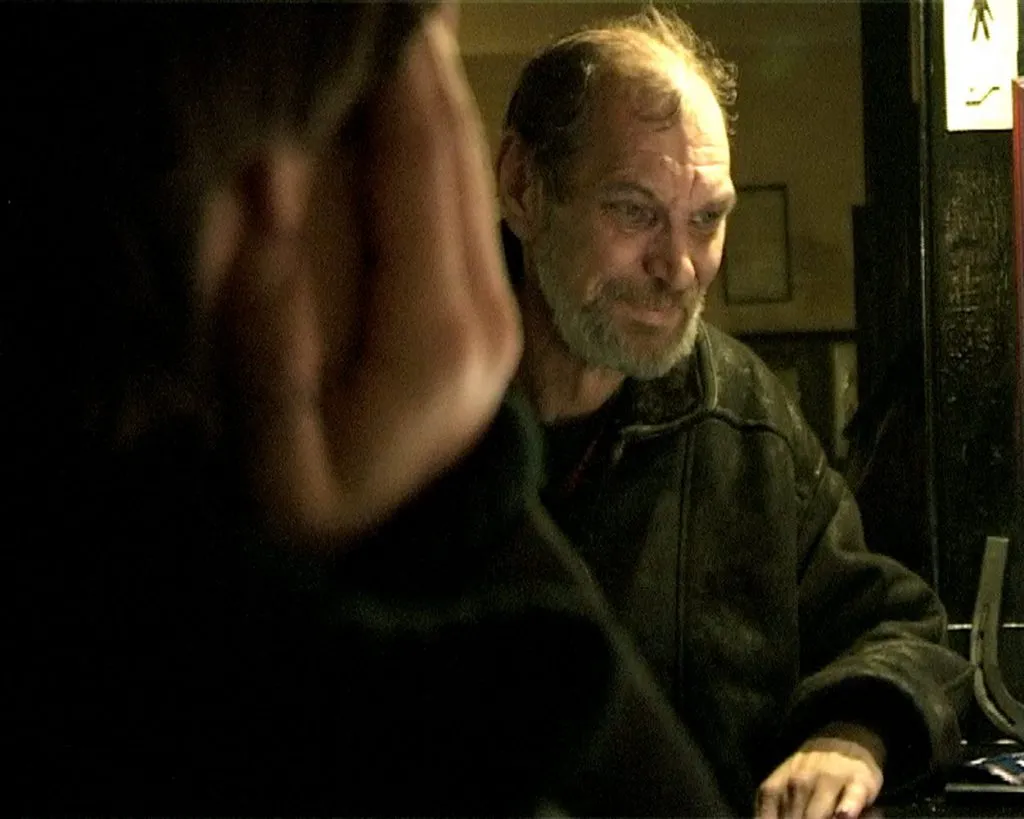
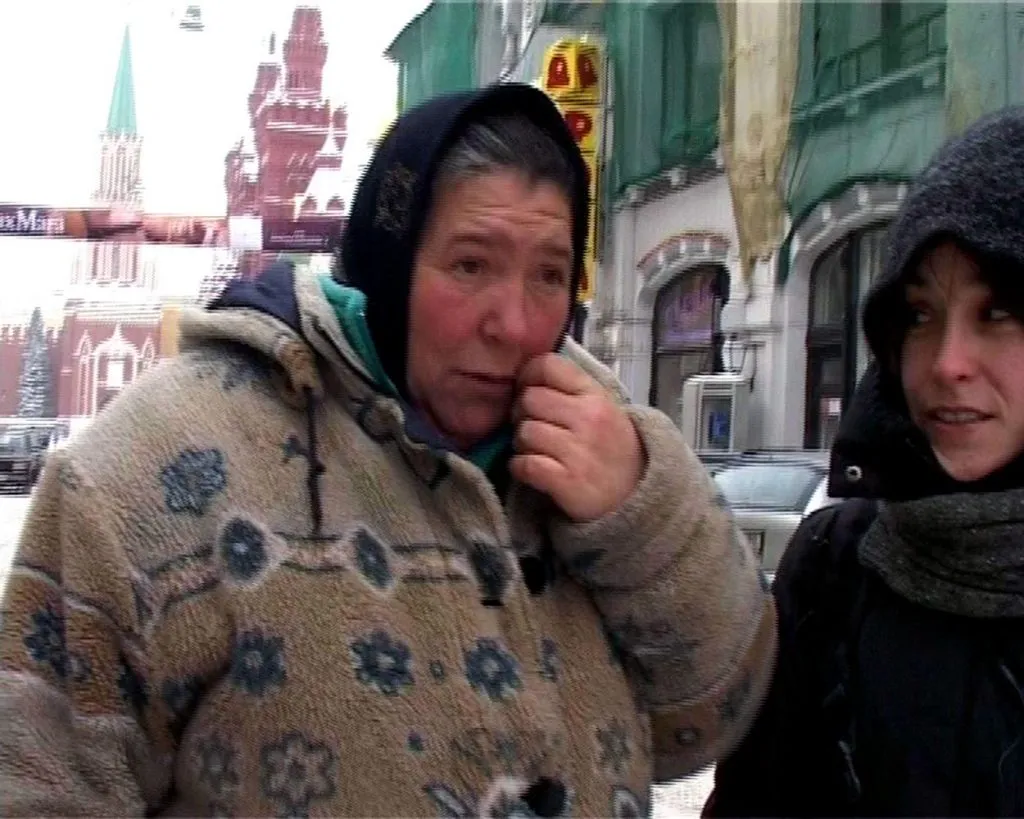
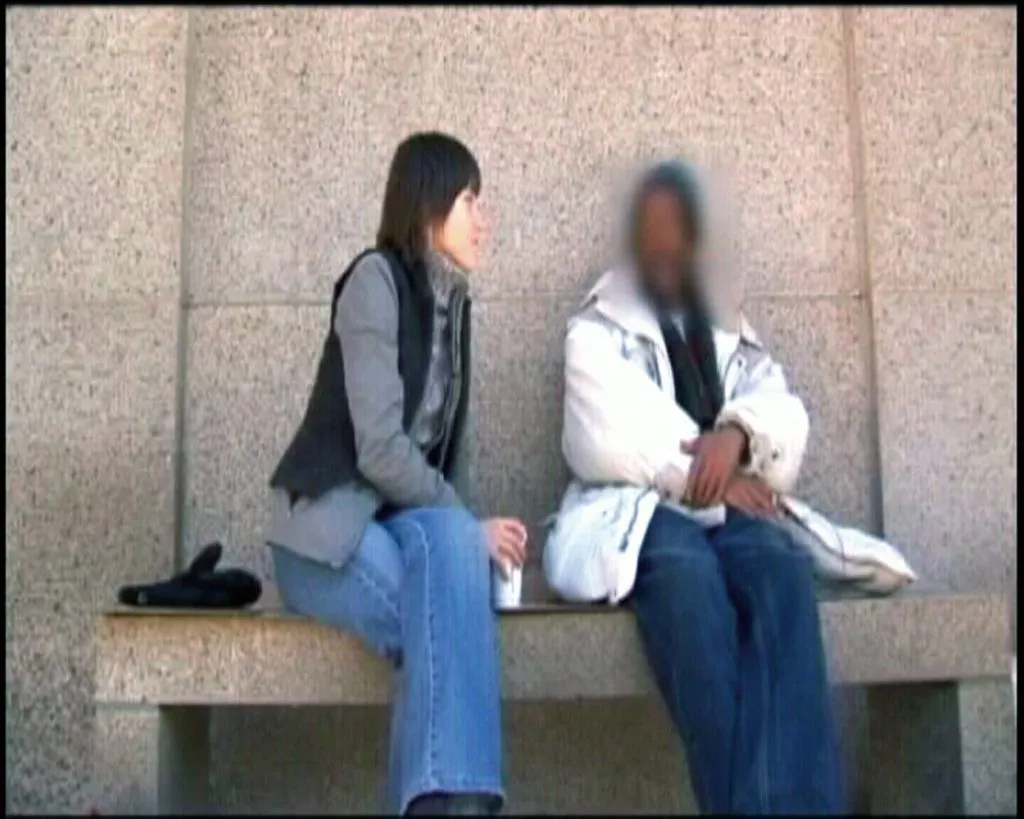
In the Middle of the Way (2001–2007) consists of eight ‘films’. Each of them (except the last, to which I shall return) tells of the artist's encounter with a homeless person in a different city. They are unaffected documentary accounts of the several hours Konik spent with each protagonist. The artist accompanies them as they wander through the city and listens to their confidences, but never exerts pressure or attempts to steer the conversation in a particular direction. She asks questions more to keep the conversation going than to prove a thesis established in advance. At times she manages to capture a brilliant thought, an aphorism ingenious in its simplicity yet rich in meaning: for example, when a homeless Warsaw man named Tadeusz says that he is an architect but parted ways with the profession long ago. ‘And since then I have become more human,’ he adds. These portraits are fragmentary; they give us no complete knowledge of their protagonists, nor are they a sociological study of homelessness. Viewed separately, on a computer screen for instance, they leave one unsatisfied. More is demanded of a film, a closed work: a deeper exploration of the subject, a journey to the heart of the problem. But the episodes of In the Middle of the Way are not quite films; only together do they form a whole. Shown simultaneously, they create a collective portrait, a spatial mosaic of lives, while the physical space of the gallery becomes a metaphor for the geographical space inhabited by the protagonists (Warsaw, Berlin, Moscow, Cleveland, Youghal in Ireland, Vienna and Zurich). Thus, in moving from screen to screen, we in a sense repeat the experience of the artist herself—a nomadic artist, as the installation's final episode explains. We encounter the same people as if by chance. This form of active participation is precisely what fundamentally distinguishes a video installation from a series of documentary films watched at the cinema or at home on a television screen.
Whereas in In the Middle of the Way Konik used what we might call a reportorial method, in Transparency, a 2004 installation, she employed a completely different, far more formal device to draw near to her protagonists. With the exception of Tadeusz—the homeless man mentioned above—they are very old people. They speak of unbearable loneliness and of death as deliverance from it. As though wishing to ease their solitude, the artist gave them doubles, drawing on the possibilities of digital technology. Within a single frame we see the same figure duplicated—or perhaps rather split in two—delivering a monologue independently of his or her other self, or in fact two monologues.
Monologues, because this is by no means a dialogue with oneself. Even when the spoken sentences concern the same thing, they flow separately, only intensifying the protagonists' painful sense of abandonment, isolation and exclusion.
From a formal point of view this is an extraordinarily pure, contemplative and compositionally studied work, encouraging concentrated reception. There is something unquestionably sublime in the symmetry of the frame. Yet to experience it fully, one must stand alone in a darkened room before images showing nearly life-size figures. Cinema cannot offer such intimacy with the people filmed.
For all the documentary truth of Transparency, there is something unmistakably theatrical in this work, owing to its static frame and the careful positioning of the figures, as though we were observing them seated on a stage from the centre of the front row. The installation Our Lady's Forever (2006) is more theatrical still. The presence of a theatrical element in Konik's works can to some extent be explained by the fact that the artist had several years of stage experience from working at Teatr Akademia and with people experiencing mental illness. Our Lady's Forever is a kind of staging of a dramatic sketch written by a young man with schizophrenia. The setting is a real old abandoned psychiatric hospital in Ireland. Actors wander through its empty interiors: a young couple and two children. Perhaps the children are the same young people several years earlier, but that is left to the viewer's imagination.
Indeed, this is an installation we must fill with our own conjectures. What are these people doing there? What are they looking for? What do their whispers and fragments of sentences mean? The four never meet in the labyrinth of corridors and rooms. The installation's seven screens convey the atmosphere of this labyrinth. It reminds me a little of New Book (1975), a short film by Zbigniew Rybczyński whose protagonist moves across nine small screens representing nine places at the same time. Or Mike Figgis's feature film Timecode (2000), in which the action unfolds on four screens simultaneously. But both these works, which perhaps ought to have been made as video installations, hold the viewer's attention through a technical device, seducing us with the question: ‘How was that done?’ Konik could hardly be further from dazzling the viewer with technical tricks, quite apart from the fact that Our Lady's… has no unity of time or place. The artist uses several screens to locate her protagonists in space and intensify the sense of their isolation from the outside world, both psychologically and physically. The arrangement's dominant and constantly present element is a fan fitted into a window, a device intended to pump air artificially into stuffy interiors but offering no relief here because it is not working. It is a beautiful poetic metaphor.
Alongside the theme of loneliness, Our Lady's Forever also returns to another thread in Konik's work—mental illness—first addressed in the 2000 work Toys (an installation resulting from activities with people experiencing mental illness), and to some extent also in In the Middle of the Way. In the latter work, the aforementioned Tadeusz from Warsaw remarks at one point that his passion for collecting everything that comes into his hands must have a pathological basis, which naturally casts a subtle light on the circumstances that brought him to his present situation. These two threads, illness and loneliness, combine into a larger story of alienation, of the many faces of falling outside the ‘normal’ rhythm of life. This of course raises the question of the norm—of whether society itself has not fallen ill by casting some of its members to the margins. These are the matters addressed by Anna Konik, a video artist pained by human lives but who, in recounting them, has not become a reporter.
The Villa of the Entranced (first presented in 2009) also takes a specific building as its point of departure—Villa Linde in Berlin, made available for study residencies to artists and scholars from various countries. Konik too had an opportunity to stay there, listen to lectures and concerts, and participate generally in the rich life of this intellectual and artistic ‘oasis’ isolated from the clamour of the great city. The architecture of the historic building, combined with some of the lectures she heard there and her reading of Borges's The Library of Babel, inspired an installation which, unlike the earlier works, does not directly address the problem of loneliness or illness, yet stimulates the imagination no less than Our Lady's Forever. In The Villa of the Entranced, Konik deconstructed the architecture in order to create a new interior, full of illusion and evoking the artist's subjective experience of staying in a particular place. This purpose is also served by the soundtrack, composed of fragments of lectures and sounds overheard during her stay in the villa. The work as a whole is thus a virtual, illusory space, built from shards of memory and drawing the viewer into its mystery, never fully disclosed.
In the installation Play Back (of Irène), presented to the public for the first time at Atlas Sztuki, Konik attempts to enter with particular depth into the psyche of her next protagonist, a mountaineer who survived a dangerous fall. Once again the artist seeks to create a symbolic space that would reflect—in a more tangible and sensory way than a straightforward film recording or the spoken word—a specific event, one person's experience. This time the image has been distributed across monitors incorporated into a white structure. With this work, the artist unquestionably opens a new stage in her creative exploration.
- Allan Kaprow was the father of this term, first using it in 1958 to describe his spatial arrangements.
- Warhol's studio.
- Quoted in Chris Meigh-Andrews, A History of Video Art: The Development of Form and Function, Oxford–New York 2006, p. 16.
- Ibid., p. 277.
- Ibid.
- Anna Konik, Vorwort, in: idem, Projektraum DOR 28. Video als Raum, Berlin 2010, p. 3.