Art Does Not Emerge from the Positivity of the World, but Rather from Its Rupture
Andrzej Turowski
In French, la déchirure means a tear, but also a rupture; it refers both to matter and to a person. It can be a repeated action and a lasting state. In artistic practice, it is a striving to define incoherence, a recognition of edges coming apart, ragged shapes and blurred colours. In the French sound of the words la déchirure, we hear the onomatopoeic noise of paper being torn, fabric being ripped and glass shattering. We pronounce the words with a hiss of exhaled air and a breath that is held with difficulty.
1. Rupture
I first used the word and concept la déchirure, meaning a tear or rupture, in my writing on contemporary art a very long time ago. Sometime in the early 1990s, it helped me challenge the popular concept of the avant-garde; in critical texts, it described the creative fracture then discernible within the very structure of the image. Because from that time onwards I applied it both to artistic matter and to the artist’s personality, it enabled me to break the structuralist separation between a work and its author and to seek mediated relationships between art and biography. Thus I metaphorically connected a torn canvas or sheet of paper with the fractured identity of the postmodern artist.
Of course, I did not mean the tragic aspect of existence familiar from certain interpretations of Art Informel, nor the subjective and aleatory freedom of the ‘open work’, about which much had already been said. In the 1990s – and I still often incline towards this view today – I linked the conviction that rupture was a profound source of artistic practice with the concept of lack: whether in art based on the memory of what no longer exists, in the flight of pictorial meaning from its first signification, or in the difficulty of describing reality through art when confronted with the loss of the ‘Real’.
Much has been written in recent years about the optical unconscious (distinguished from the unconscious by a historical displacement). Reflecting on the modernist convictions underlying the formalist avant-garde – their logic of universal vision as a means of knowing and constructing the world, and their artistic purity of the plane as the condition of an image’s autonomy – Rosalind Krauss turned towards an alternative history of twentieth-century modernity1: a history of artists entangled in modernity but swimming against the current of, as she repeatedly put it, a modernist opticalism founded on the epistemological principle of the visual. Inheriting the tradition of iconoclastic heresy (that is, representing the unrepresentable) and distrusting the Cartesian eye of reason (consciousness as the source of representation), Krauss sought, by analogy with Freud’s psychoanalytic interpretation of dreams, the essential properties of incomplete visibility; she traced the concealed movement of desire within the rupture of the image.
The term and concept of rupture returned repeatedly in my texts. Among other things, I used it to interpret Marek Szczęsny’s works on torn paper, exhibited years ago at the Centre for Contemporary Art in Gennevilliers near Paris and at Kordegarda in Warsaw. It must be stressed, however, that by then the concept of rupture already had a well-established place in French art history and theory and was employed in various semantic contexts. The most interesting of these, with its pronounced psychoanalytic orientation, was popularised only by Georges Didi-Huberman’s book Confronting Images, published in 1990 by Les Éditions de Minuit in Paris. My reflections at the time owed a great deal to that book.
Art historians, Didi-Huberman wrote, ‘wanted knowledge about art, so they fashioned art in the image of their knowledge. They did not want their knowledge to be ruptured in the image of that which causes a rupture within the image itself.’ Such statements resonated with me in the face of an uncertainty linked to the sense that the concepts employed by art history had worn out, leaving it defenceless before the crisis and ‘end of the image’: its fragmentation, transience, imperfection and, above all, the invisibility it contained. The formalism of the first avant-garde – to which I shall return – rested on a belief in the image’s complete visibility, in its concealing nothing from sight. The accompanying art criticism made it fully available to knowledge. The concept of rupture disrupted this modernist order. If artistic practice crosses desire with reality rather than reason with the image, leading to a traumatic collision with the ‘void of the Real’, then, in my view, we were faced with an irrevocable fracture: a rupture that tears art apart, requiring it to be seen within another order, to emerge from other meanings and to relate to other worlds. ‘Once again, we find ourselves in the situation of an alienating choice,’ Didi-Huberman wrote: confronted with a choice expressed in the bitterest of alternatives, knowing without seeing or seeing without knowing. ‘In either case, there is a loss. The person who chooses knowledge alone will of course gain the unity of synthesis and the self-evidence of simple reason; yet they will lose the reality of the object within the symbolic enclosure of a discourse that creates the object in its own image, or rather according to its own representation. The person who desires to see, or rather to look, will lose the unity of a closed world and find themselves within the uncomfortable opening of a fluid universe, vulnerable to every turbulence of meaning; here synthesis is fractured, while the object of vision, touched by reality, displaces the subject of knowledge, producing a rupture in simple reason. Rupture will therefore be the first concept that allows us to renounce the magic words of art history’2.
If I write about all this here, it is only to evoke the intellectual context, the distant echo of those initial reflections from which the present exhibition emerged. I do not wish to return to those ideas and the struggle with them; rather, I want to emphasise how the problem of rupture was reformulated, acquiring different meanings in specific works of art. Yet a conviction I once expressed and have retained in the title of this essay has remained in my thinking: that art does not emerge from the positivity of the world, but rather from its rupture. It marks my thinking about art today as well, imbuing it with internal tension and a sense of crisis. When I write of rupture today (and perhaps this was also true in the past), I mean neither a bleeding wound that inflicts suffering on the body, nor a lost logic of meaning that causes thought to go astray, nor an expressive form supposedly testifying to the artist’s tragic helplessness in an alien world. In my vision of artistic processes founded on crisis, I proposed and continue to propose dialectics in place of alienation, and a critical configuration of contradictions in place of estrangement. I propose a situation in which the concept of identity (unity) becomes doubtful, while the foreignness inscribed within it becomes a critique of homogeneity. Rupture means tearing and fraying, rending and puncturing. It is a distinctive refusal to reconnect diverging edges, join ragged shapes, rebuild a fallen structure or reconcile incompatible words. It is a ‘living’ intervention in the creative process itself, making it an unfinished, imperfect and flawed act.

Of course, to understand art in this way, we must treat form dynamically: not as a material fossil of meanings that arose previously, but as an open, ripped object, full of scratches and fissures, produced through a long and never-ending process of creative negotiation in which the seen mingles with the unseen and the conscious with the unconscious. We must treat plane and space as a world of traces, shreds, remnants and fragments that connect (but do not complete one another), always with something else: already blurred images, unlocated quotations, foreign languages and impressions that are still alive.
Rupture is a lack within a non-existent whole, a failure to see within visibility. Everything visible is invisible, Merleau-Ponty writes. ‘When I say that perception is non-perception, that consciousness has a punctum caecum, that seeing always means seeing more than one sees, this must not be imagined as my adding to the visible – precisely defined as being-in-itself – something invisible (which would be an objective absence, that is, an objective presence elsewhere, some being that exists elsewhere). It must be understood that visibility itself contains invisibility’3. Invisibility (or, as others would have it, the visual unconscious) does not supplement visibility with what is invisible, just as a rupture does not supplement woven fabric with the hole within it. Rupture – a place to be concealed from sight, the invisible – is a radical critique of a disintegrating structure, a rejection of unifying vision, a challenge to the apparent identity of artist, image and world, and a critique of the eye’s usurped power and the reason that speaks through it. This is an essential fact, one that allows us to regard the artist not as the conductor of a consumer spectacle or an engaged tribune in the struggle for a better future, but as a sensitive critic of the society in which they live. Art that takes rupture into account proposes a crisis of form in place of identification with the positive history of the world, and an alarming turn and resistance in place of secure tranquillity and the perfect image. Such is the breadth of meaning carried by the words la déchirure in the present exhibition.
2. Neo-formalism
My choice of the three artists whom I invited to collaborate on the exhibition at Atlas Sztuki was not accidental. I had known Marek Szczęsny’s work for years. I spent many hours in his studio, looking at paintings and exchanging comments that, in our polemical fervour, could be very sharp. For years I have observed his ‘struggle with form’: his search for a gesture that will ‘construct the image’; his return to a surface that can be ‘saturated with shape and meaning’. I do not always accompany him in this, nor do I always agree with him. I nevertheless believe that he is one of those artists for whom form possesses its own metaphysics and art strives to find the final crack beyond which nothing remains: the absolute of Mondrian and Malevich, and later Pollock, whose ambition, as Rosalind Krauss emphasised, was to paint the whole of Being – and, in Szczęsny’s case, perhaps rather its finitude. It is therefore understandable that, when thinking about rupture as an artistic (and philosophical) problem, I invited him to participate in the exhibition.
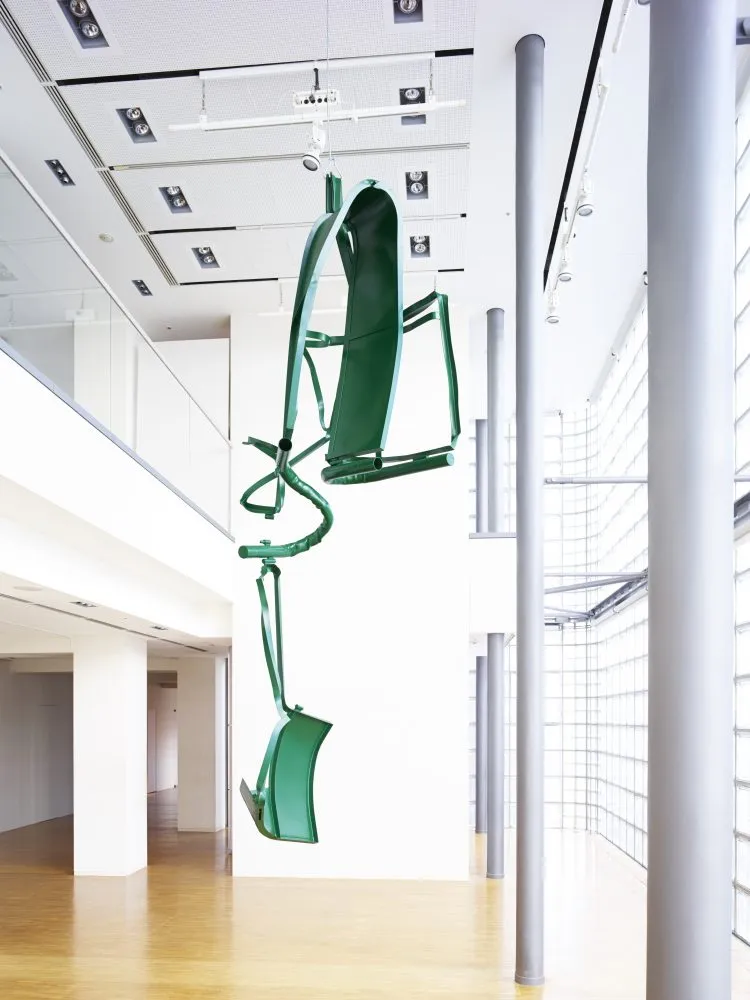
I have known Monika Sosnowska, who is a full generation younger than Marek Szczęsny, for three years. Before that, I followed her work in exhibitions and the press. We began working more closely when she started deconstructing Tower. The project interested me all the more because the tower had been the subject of many of my own studies. I treated the biblical story of the Tower of Babel as one of the topoi of the ‘builders of the world’ – the avant-garde artists who believed in its construction while simultaneously anticipating the coming catastrophe. In my view, the tower’s dark labyrinth was not the antithesis of joyful construction: it was embedded within it, the dark side of the same work. It threatened its structural cohesion, rational totality and universal unity. ‘As an architectural figure of translation (but also of untranslatability),’ Derrida stressed, ‘the Tower of Babel thus points not only to the confusion of languages, but also to incompleteness: the impossibility of consolidation, totalisation, or the creation of a coherent and universal system. It therefore challenges structural order and coherence’4. I wrote a long essay about Sosnowska’s Tower, and the presence of her art in the Łódź exhibition was indispensable.
In the work of Szczęsny and Sosnowska, a painter and a sculptor, I was interested in the monumentality of pieces made in entirely different materials. I discerned in them both excess and a particular strangeness of form. These works were simultaneously over- and under-formal, contradicting every categorisation familiar from the history of formalism in contemporary art. Szczęsny’s torn papers spread across an entire wall and Sosnowska’s metal structures of real buildings, crushed into the gallery space, abandoned every meaning customarily ascribed to sculpture and painting (painterly/linear, open/closed, static/kinetic and so forth). They deconstructed their material forms, lending weight to drawings on paper and lightness to suspended masses of steel and concrete. From this play of formal oppositions, which challenged the genre purity of sculpture, architecture, drawing and painting so highly prized by the avant-garde, emerged a contemporary neo-formalism that attached no importance to the material limits of shape or to an aesthetic of ‘pure visibility’ that deprived art of meaning. By denying both the constructional demands of a spatial building and the structural conditions of a flat image, neo-formalism became the most incisive critique of form. Giving primacy to deconstructed ‘visuality’ (abstract logic) and siding with iconoclasm, it accepted what was residual, abandoned, improper and marginal in form – even what was bizarre. The form of a sculpture could now arise from crushing it, and the form of a drawing from fraying and tearing it.
It is therefore unsurprising that the starting point for the process of fraying and tearing in Szczęsny’s work was the conception of visual boundaries: grasping the image’s virtual field in relation to everything outside it with which it would enter into various forms of interference. At first, this concerned materials: paper, canvas, adhesives, sizes and pigments; later, the surroundings: walls, ceilings and floors, changing light and unexpected reflections. The next step led towards the image’s interior. It would be defined by simple yet opposing gestures: juxtaposing panels, bringing individual forms together, laying down two colours, drawing a line – and then tearing the cardboard, shifting the shapes and creating a dissonance between colours. A poorly defined field, torn and pasted together, punctured and patched, upon which a discourse about ‘truth in the image’ unfolds.
In recent history, art has repeatedly claimed the right to formulate truth. It did so in the name of either politics or metaphysics. Social theories justified the former attitude; the latter found artistic purpose in the experience of one’s own existence. The two positions were rarely reconciled, although the avant-garde made more than one such attempt and, I should add, failed. Szczęsny knew the avant-garde experience well, and this knowledge allowed him to maintain his distance from every attempt to leave the image’s abstract surface. Deeply connected with the crisis of representation and the need for transgression, the neo-formalism in his work was bounded by questions concerning the truth of the image and the essence of vision. It was linked to repainting the plane available to the painter’s eye, repeated to the point of exhaustion (is this the dimension of art’s finitude?). Form in his work is a result of repetition.

In the process of repetition, which is a critical reference to what came ‘before’, I discern a tension between the final phase of modernism and its postmodern mutation. Modernism was characterised by the pursuit of a total conception of what is given to us through visual cognition: an attempt to grasp the phenomenon of an image irreducible to representation but connected to the plane as a visual absolute (utopia/non-place). Post-structuralism concerns the dismantling of that whole – which never achieved its final form – through repetition and citation, as well as through tearing surfaces, smudging ink and pasting scraps together (deconstruction/place). In Szczęsny’s work, these are torn and punctured boards of white or grey cardboard and sheets of brown wrapping paper. They are juxtaposed and superimposed, some crumpled, all involved in complex relationships. Sharp or ragged edges overlap, separating the layers and leaving gaps from which a shadow seems to seep, outlining forms in contours that are sometimes stronger, sometimes fading. The layers eliminate space from the papers. They shuffle; they cause the movement of slightly displaced shapes; finally, they create the impression of plunging in, as if rummaging beneath the surface. Of perceiving the reverse, concealed yet showing through because the paper is coated with paint on both sides. Szczęsny’s papers constitute an endless process of changing boundaries, positioning, attaching and peeling away; of looking beneath the surface of the image, scraping and stripping it. Of returning and repeating. Each successive image, each successive drawing, is a critical invariant of the one before, moving endlessly towards finitude – towards the sole truth of rupture contained within deconstructed form.
The dialectic of the construction/destruction process that interests Sosnowska arises from the very essence of the architectural metaphor present in her sculptural projects. On the one hand, she refers to the ‘structural foundation’ upon which a human edifice ‘reaching towards the heavens’ is raised: modern architecture as a symbol of the modernist metropolis, with its ruthless order of lines and right angles, the sheen of steel and transparency of glass, the regularity of elementary blocks and modular surfaces. On the other hand, with the irony of a detached observer, the artist discerns within the structure a premonition that this ‘solid foundation’ will be destroyed and the intricate construction will collapse, expressing the end of modern utopias together with the chaotic disintegration of the postmodern world in the image of a ruin.
Sosnowska’s ruin is the very essence of the process of deconstruction, in which dismantling the whole transforms the structuralist order of upward ascent into a play of horizontal proximities and differences, or into dangling architectural remnants. In this sense, too, a ruin is a building, simply a different kind: one inhabited by the instability of the human condition, the formlessness of a bent form, an aesthetic of spontaneity and an ethics of contradiction. Art, Sosnowska says, is closer to the image of the ruin, the source of all unease: ‘Architecture organises, introduces order and reflects political and social systems. My works introduce chaos and uncertainty instead. They cause reality to cease being self-evident’5.
The strategy of deconstruction understood in this way in Sosnowska’s sculpture is a rhetorical process shaping an internal mechanism of expression based on form – a mechanism once directed towards aesthetically sublimating sculpture and ennobling its shapes, but today towards challenging all those categories. The process is complex, however, and far removed from the anti-aesthetics of readymades, the poetics of random, abandoned objects, or even the formless (informe) and the abject (abject) in raw matter. The neo-formalism characterising such expression requires us to identify within the internal dynamics of deformation a sequence of events whose metamorphoses reveal a movement that ultimately dismantles the order once inherent in formal structure. The artist abandons the final effect (the meaning of meanings), dramatising each event in its own fashion. Sosnowska’s form thus enters narrative sequences, employing their characteristic rhetorical devices, of which she privileges synecdoche. She substitutes part for whole, uses a material in place of the object’s name, adds or subtracts, rearranges or replaces. As a formal disorganisation, rhetoric deconstructs both sculptural order (the sublimation of form) and sculptural strategy (the meticulous working of matter).
The first formalists of the 1920s, who emerged together with the avant-garde, and their second mutation thirty years later, often called Greenbergian, sought to strip form of meaning by neutralising its expression or enclosing it within its own autonomy. They pursued the absolute silence of form. American postmodernism arose in opposition to formalisms understood in this way. So too did critical art, which sought the social application of form and engaged activism. There, the return to reality – fractured into an agonistic multiplicity of voices – also had an ideological character that entangled art in relations of power. The return of the formal in Sosnowska’s sculpture places her within another generation of postmodern deconstructivists. Her art is not concerned with realism, but with a ‘realist style of form’: documentary work (historical studies of architecture) and prosaic speech (work in a factory workshop). Together, they create the sculpture and its internal self-commentary (its rhetoric). This is neither a theoretical manifesto nor a political text, but a wordless visual narrative about transfiguration, material, production and context. It is a deconstructive reworking of sculpture.
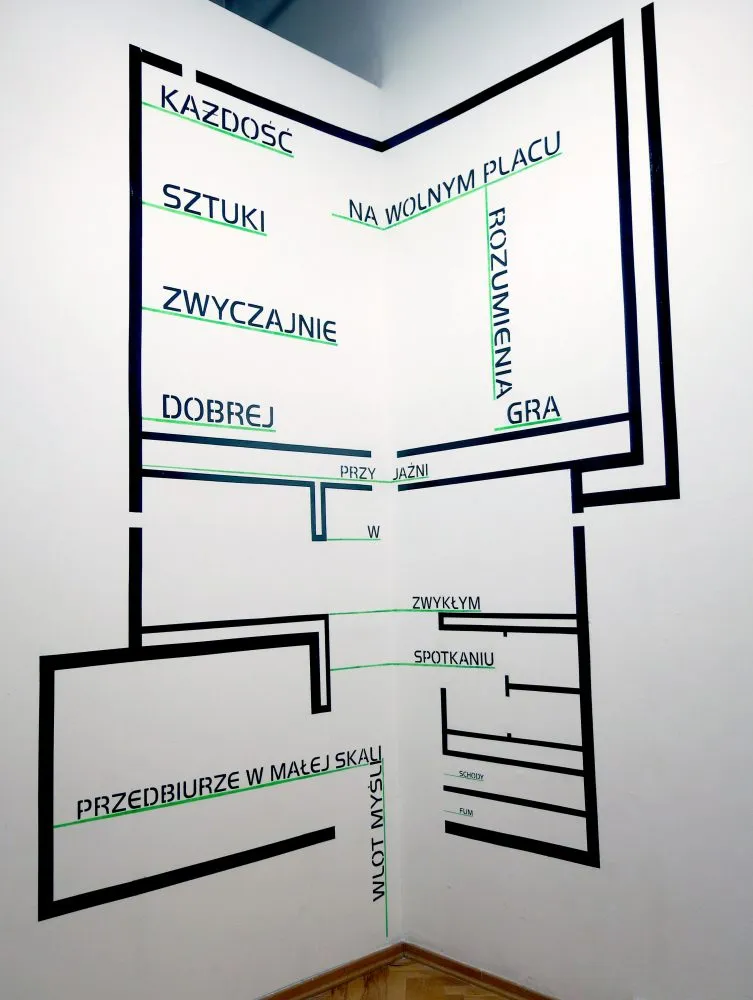
I made contact with Karolina Wiktor last. I knew her earlier works from the period when she created radical performances (with Aleksandra Kubiak), after which she disappeared from my view. A television interview in 2014 told me about her stroke, illness and aphasia6. I became interested in the blog in which she wrote about aphasia, her book Volga through Aphasia, and her exhibition at Zachęta, where she presented her aphasic writing and aphasic territory with biographical meticulousness; finally, I reached the proceedings of a conference on culture and neuroscience organised by the artist. By then I was already working on the Łódź exhibition and, although at first sight everything seemed to distinguish Wiktor’s work from that of Szczęsny and Sosnowska, I became interested in the deeper affinities between these artists. These concerned the explicit references in Wiktor’s work to the stylistic language of the Constructivist avant-garde (Sosnowska drew on modernist architecture, Szczęsny on the modernist canvas), as well as to the modern formalism of Russian theorists and artists who played a decisive role in defining the idea of the ‘pure image’, deeply rooted in the art of the first half of the twentieth century. In Wiktor’s works, I discerned attempts to deconstruct this paradigm on the grounds of contemporary neo-formalism and, at the same time, to question the perfection of the linguistic (sign) system by replacing its structuralist completeness with its constitutive rupture. Wiktor’s neo-formalism was thus an appropriation of lack. ‘I wondered,’ the artist said in the interview that so interested me, ‘what I could do as an artist in the state of absolute impossibility in which I found myself. Because my impossibility was total – at first I could not even walk, speak, read, write or count…’7.

Aphasia, as an experience of absolute lack in which every form of verbal and written communication has been severed, may be treated as a neurological reset: a radical clearing of the brain’s screen and the enclosure of the body within a hole of blackness and silence. Emerging from aphasia, in Wiktor’s view, means learning individual words that will sound strange in their imperfection; it means binding together the whole system of language, from whose rupture an inalienable foreignness will emerge. ‘…I still don’t know,’ the artist writes on her blog, ‘where exactly the creativity of impairment lives,,, whether in the territory of impossibility itself ???? or in the border towns surrounding various incapacities ??-?? or perhaps in the strip of no-man’s-land –?– that would be logical ))*((…’8.
Logical, of course, I would add, according to the logic of formalism and structuralism, on whose territory neurology once encountered linguistics and poetics. The principal subject of formalist poetics, wrote its founder Roman Jakobson, is the question of what transforms a linguistic message into a work of art. In his celebrated essay Two Aspects of Language and Two Types of Aphasic Disturbances, Jakobson linked the different kinds of aphasia to two preferences governing combinations within sentences, situated either on the ‘axis of contiguity’ (metonymy) or the ‘axis of substitution’ (metaphor). As he argued, the former is usually employed by prose and the latter by poetry, in which ‘aesthetic functions’ predominate9. This problem is close to Wiktor because, for her, emerging from aphasia (‘A Journey through the Land of Aphasia’) takes place above all through artistic practice. Yet what for Jakobson was a process of pure combination between aphasic and linguistic structures is, for Wiktor, the traumatic experience of language being ruptured in the ‘strip of no-man’s-land’.
Her neo-formalism is an experience of the uncertainty of words that may have meant something else, may have sounded different; it is the drama of their unpronounceability, their slipping towards the void and the non-existence lodged within it. Wiktor turns the rationalism of structuralism into an errant circulation of poetic words within a system ruptured for ever. This process of circulation and repetition, which in language learning leads to the memorisation of meanings, becomes within the structure of the poem a constant loss of sense, an elusiveness of final shape and meaning. ‘The first glance of an artificial eye at life in aphasia,’ I shall quote Wiktor’s blog once again, ‘is the same as in real life —- only the dimension is different —- time is inversely proportional to space – the indifference of the mass of time and space is unequal to itself and to the psychophysical conditions of an a’fazjanin,,,, “it was bad and uncomfortable”, reality chafed me…. in my new country —- now prohibition – is the main instrument of coercion and reward —- because I Don’t write, Don’t read, Don’t speak —- I have two legs and four arms —- what are they for ???? I quickly needed artificial joy in order to live —- “this will be my third life” – I said in sign language to the minister of psychiatry,,,, the pills gave me perspective,,,, the imagination is in place – the programme can begin now ,,,, tick tock tick tock ,,,, – how do you do it in the void ???? – I asked myself – you can write empty reportage from emptiness – I answered myself ,,,,’10.
3. Trauma
The connection between rupture and trauma is self-evident, although it has acquired different meanings within different interpretative perspectives. If rupture is primary, trauma, according to some, is its consequence; if, as others maintain, traumatic experience is a condition of emerging consciousness, then the resulting rupture inevitably constitutes identity. Much has already been written on the subject, so let us confine ourselves to the general statement that contemporary identity is a site of rupture, while ‘culture as a site of suffering’ entangles the human being in ambivalent experiences. If a sense of crisis predominates, it results from an awareness that the well-organised rationality of modernism’s functional world (in other words, the age of humanism) has failed, and from the uncertainty of being amid the countless stimuli of spectacular postmodernity (the ‘society of the spectacle’). In this history of the twentieth-century human being, the sense of continuity collapses, and the artist’s fragmented biography becomes a fluid reference to mingled facts from past and future. It is a kind of collage of incomplete forms and effaced images negotiating the artist’s place in a phantasmatic or ideological reality. In a world marked by the lack (or return) of the Real, an illusory turn towards the Imaginary takes place11.
We should remember that, in psychoanalysis, the Imaginary order is a primordial lack of differentiation, a pre-subjective and pre-linguistic unity and therefore a state lost for ever. In this sense, one might say that, in expressing a desire for immediacy and homogeneity and experiencing the drama of presence, abstraction positioned itself in relation to the substantial void differently from realism. Whereas realism entered the symbolic order through trompe-l’œil and revealed with horror what it had sought to conceal, abstraction, interrupting the processes of illusion (fantasy), attempted to become incarnate in reality, where it encountered the death of the image with equal horror and found its only chance of survival in preserving the illusion of presence12. One might say that the pursuit of truth, becoming the doubtful basis of the disappearing image (finitude as the absolute goal in Szczęsny’s art), entered a territory already governed by trauma.
Art founded on truth, Szczęsny might say, is the art of constructed form; that form has a history that must be reworked and a metaphysics that must be explored. The reworking of the image (for it involves a continual process of taking apart and putting back together) is not, therefore, an abandonment of contemporary territory in Szczęsny’s art, but a difficult attempt to inhabit it differently. It is not a matter of taking root, but of maintaining a practically untenable equilibrium between the present location and non-location (u-topia). I have already written about this. Contemporaneity understood in this way, close to Szczęsny, means balancing between actuality and memory – a memory that justifies actuality through circular returns, intersecting lines, overlapping shapes and layers of translucent tones.
The question of memory proves crucial here in psychoanalysis. How, after all, can one remember something that eludes every representation, something that makes itself known only negatively, through disturbances of the symbolic order, and leaves no lasting trace? The work of trauma, frantically recording the terrible and astonishing presence of nothing but the trace of a thing, is therefore not complete information, but merely a cue that stirs the psyche into the effort of recollection, although this recollection is always incomplete.
If memory is individual, it loses itself in familiar landscapes and labyrinths of houses, among loved ones and preserved faces, in lived moments and unrealised destinies. If memory has a universal dimension, it contains the entire anthropology of painting: from the magical imprint of a hand on a cave wall and the phantom of presence in Fayum portraits, through the rationalisation of vision in modern illusion, to the space of a spiritual cosmos and the screen of libidinal pulsations in twentieth-century art. If memory has a panhuman dimension, it contains human pain and joy, faith and blasphemy, truth and falsehood, recognition of the Other and hatred of the Stranger, times of truce and the tragedy of wars. An image of ruins. ‘This is how one pictures the angel of history,’ Walter Benjamin wrote. ‘His face is turned towards the past. Where we perceive a chain of events, he sees one single catastrophe which keeps piling wreckage upon wreckage and hurls it in front of his feet. The angel would like to stay, awaken the dead and make whole what has been smashed. But a storm is blowing from Paradise; it has got caught in his wings with such violence that the angel can no longer close them. The storm irresistibly propels him into the future to which his back is turned, while the pile of debris before him grows skyward’13. Memory is a traumatic experience.
If Szczęsny is an ‘abstractionist’, Sosnowska is a ‘realist’. In her art, which belongs to the period of political transformation in Central Europe, there is a clear shift ‘from reality understood as an effect of representation to the real as a traumatic thing’14. Viewed within the broad perspective of the avant-garde and neo(post-)avant-garde at the end of the twentieth century and the turn of the twenty-first, this process has numerous connections and references to psychoanalytic and feminist theories. Here, I am interested only in the extent to which the shift towards art constructed around trauma in Sosnowska’s work reflects her historical experience: the experience of the post-communist era, a period of fundamental political and ideological, social and cultural, regional and generational change.
Among the fundamental categories used to describe the ‘age of transition’ in Central Europe and Poland is the concept of a society without foundations. This is one of the diagnoses offered by contemporary political philosophy, which assumes that no positive foundation can be ascribed to postmodern society – a foundation identified in communist ideologies with the economic base, and in others with language, nation or faith. This does not mean, however, that in times of crisis, upheaval or change every foundation of political community has disappeared irrevocably. They continue to exist as caricatural traces of once-solid foundations upon which, in ‘times of transformation’, dubious social hegemonies arise, characterised above all by political (neoliberalism), cultural (Catholicism), propagandistic (populism) or ideological (nationalism) fanaticism and by imagined or actual power. The ‘post-foundational condition’ characteristic of young democracies does not abandon the search for a social foundation, but regards that search as futile from the standpoint of social practice and dangerous from the standpoint of democracy. It thereby challenges traditional political theory and exposes the social inadequacy of contemporary conventional politics. It is a ‘thinking through of its own time’ that ‘emerges from the ruins of what were once regarded as the unassailable foundations of society’15.
In the historical turning point of 1989–1990, writes Boris Buden, the Croatian philosopher of post-communist society, ‘one can also easily recognise a post-foundational rupture: the event of the political understood as the experience of society’s radical loss of foundation. If post-communism does indeed constitute an epochal “situation”, then it does so in the sense of a post-foundational situation in which the “dispute with the foundation” decisively determines not only the public political life of a given society, but also the conditio humaine of the human being as a social being’16.
Life in a community that has lost its foundation and deemed the search for it futile or dangerous possesses all the features of a traumatic experience, transforming existential fear and alienation into dread of the future. This is also Sosnowska’s cultural and generational experience: she stands uncertainly between two eras, the past having lost its meanings in the process of deconstruction while the future has not yet acquired them. Sosnowska’s hanging or recumbent structures, deprived of foundations like sculptures without plinths, become terrifying tangles from which no utopia emerges, their realism permeated by trauma.
Returning briefly to more general questions, let us recall that trauma occurs when the psyche is suddenly exposed to stimuli too powerful for it to manage unaided. The first response is intense fear, helplessness and horror. This usually happens when a person confronts a threat to life, is involved in an accident or becomes a victim of violence and terror. This is no longer the primal trauma arising from the ego’s development in the libidinal phase or from the lack of the Real, but traumatic events encountered by people and societies throughout their biographies and histories. Natural disaster and war, illness and death are, of course, limit situations. In response to a traumatic event, the person who experienced it relives it through intrusive, recurring memories (in the form of dreams, hallucinations, apparitions and dissociations), even if they appear reconciled to what happened. Helplessness also returns, now manifesting itself as a sense of estrangement and states of apathy, and finally as agitation that is difficult to control. Expelled from consciousness, the traumatic event remains concealed deep within the self. Those who have experienced trauma suffer psychological and functional disorganisation that disrupts every relationship and leads to a deterioration of life.
Therapy, as a means of bringing people out of trauma, essentially proceeds in three stages. The first must create a sense of safety for the patient, a necessary condition for the next stage, during which they can articulate and contemplate the trauma and ‘mourn it’. The final phase of the therapeutic process, leading towards health, involves reconstructing the patient’s personality on new foundations and rebuilding severed social relations. The therapist should help the patient move from a secure anchorage in the present towards past events, so that they can experience their feelings in their full intensity while drawing support from a sense of safety and connection with other people that was unavailable at the time of the trauma. The victim undergoing treatment faces the task of articulating in the present the values and convictions they once held, which now lie in ruins, and rebuilding them in a new context. The aim is not to forget the trauma, but to integrate it into the totality of the person’s experience. The trauma is to become closer, more real. The fundamental premise of psychotherapy is a belief in the healing power of truth. Upon this foundation, one can begin to build one’s individual and social future. This entails rethinking and working through in practice the relationship between the Self and the Other. The circulation of time between memory reaching into the past, present experience and future life plays an essential role in reconstructing the subject’s internal and external space.
Trauma and depression in Karolina Wiktor’s life were a natural consequence of a cerebral haemorrhage and the aphasia that followed. ‘During the first few months, it seemed to me,’ the artist said in an interview, ‘that I would cope, and I refused to take antidepressants. But how can you live when you are unable to do basic things? I could see no direction in which I might develop. So I thought that I did not want to function like this. I wrote that I dreamt of flying in a golden aeroplane; it was a parallel to the way I wanted to die.’
Emerging from depression allowed the artist to confront her trauma. At that point, Wiktor said in the same interview, ‘I felt the pleasure of creating again’ and the need to understand ‘what is inside aphasia’. The transformation of aphasia into art at this moment (a narrative about a traumatic event) was simultaneously the beginning of speech-therapy training and the ‘work of mourning’ so necessary in trauma. It was a return to the traumatic experience on its own territory, within the aphasic field. Wiktor’s art, emerging on this ground, became the principal means of inscribing trauma within the artist’s new life and the rupture she had experienced within artistic practice.
The need to understand how the brain functions, the work on relationships of similarity and contiguity disrupted in aphasic language, and the visual poetry arising from this became a defence against illness. A work of art emerging from such premises could not be an object of disinterested delight (although, by concealing the fracture, it could still appear as one), but a product of terror, tension, madness and rejection. If the forms created were an experience of language and a practice for resolving psychological conflicts, they appeared above all as evidence of a traumatic and inalienable rupture in the face of aphasic nothingness (‘I felt as if I were in a zone of nothingness, except that it had no guide’). Wiktor might say, following the Surrealists, that the formal act is an apotropaic act: its purpose is to avert danger, it is a means of protection, and art has the power to save. ‘The future continues to inspire me’17, Wiktor concluded the interview quoted several times above.
Between past and future extends the territory of ruptured form as an experience of the contemporary world. Of art expressing resistance to dangerous totality and anxiety about every identity. Of art that emerges not from the positivity of the world but from its rupture, not from form but from its crisis. Of art that redeems trauma.
Professor Andrzej Turowski is an art critic and art historian, and Professor Emeritus of contemporary art history at the University of Burgundy in Dijon, France, where he founded the Centre de Recherche Comparative sur les Avantgardes. Until 1983, he taught the history of modern art at Adam Mickiewicz University in Poznań, and subsequently at l’École d’Architecture in Paris and the University of Clermont-Ferrand. He holds an honorary doctorate from the Academy of Fine Arts in Łódź. He is a member of the Polish Academy of Sciences’ Committee on Art Sciences and chair of the Council of the Museum of Modern Art in Warsaw. He has received numerous awards for his academic work. As an art critic, he collaborated with the Foksal Gallery in Warsaw for a decade during the 1970s. His research interests focus principally on the history and ideology of the avant-garde in Central Europe, Russia and France in the twentieth and twenty-first centuries. He has written several hundred academic studies and critical articles published in many languages, as well as more than a dozen books (including Polish Constructivism, 1981; Existe-t-il un art de l’Europe de l’Est?, 1986; The Great Utopia of the Avant-Garde, 1998; Avant-Garde Margins, 1998; Builders of the World, 2000; Malevich in Warsaw, 2002; and Art That Kindles Anxiety, 2012). He collaborated on the organisation of major international exhibitions of avant-garde art, including Présences polonaises at the Centre Pompidou in Paris (1983), L’Europa dei razionalisti in Como (1989) and Europa, Europa in Bonn (1994). He has curated several dozen exhibitions, among them Fin des temps! L’histoire n’est plus in Toulon (2004), Malevich’s Supremus at the National Museum in Warsaw (2005), Jerzy Kujawski’s Maranatha at the National Museum in Poznań (2006), Awake and Dream (2009), Particolare: Art That Kindles Anxiety at Palazzo Donà in Venice (2011), Revisiting the Theory of Vision at the Ujazdowski Castle Centre for Contemporary Art in Warsaw (2010), and Teresa Żarnower. An Artist at the End of Utopia at the Muzeum Sztuki in Łódź (2014). His book The Locomotive of History (2012) and Anna Baumgart’s film Conquerors of the Sun formed the basis of their joint exhibition at Atlas Sztuki in Łódź (2012). He has lectured at various universities, including as a visiting professor in Poland at Adam Mickiewicz University and Jagiellonian University, and at the University of Warsaw during the 2009–2010 academic year. At the FGF Avant-Garde Institute, he and his students then worked on a series of exhibitions devoted to ideosis. He has lived and worked in Paris since 1984.
1 R. Krauss, The Optical Unconscious, Boston: MIT Press, 1994.
2 G. Didi-Huberman, Confronting Images: Questioning the Ends of a Certain History of Art, translated by B. Brzezicka, Gdańsk 2011, pp. 97, 110.
3 M. Merleau-Ponty, The Visible and the Invisible, translated by M. Kowalska, Warsaw 1996, p. 245.
4 J. Derrida, Letter to a Japanese Friend, translated by J. M. Godzimirski, ‘Konteksty’ 1994, nos. 1–2.
5 K. Pijarski, One to One. A conversation with Monika Sosnowska and Sebastian Cichocki about the Polish pavilion at the 52nd Venice Biennale, ‘Obieg’ (online version): www.obieg.pl/rozmowy/1442.
6 K. Marcysiak, Cult Conversations: https://www.youtube.com/watch?v=fzdRILnM95Y .
7 Citizen of Aphasia. Marta Miś talks to Karolina Wiktor: http://www.zacheta.art.pl /files/edukacja [accessed 4 December 2015].
8 Cf.: http://www.afazja.blogspot.fr/search/label/klimat%20i%20archiektura%20a’fazji
9. R. Jakobson, Two Aspects of Language and Two Types of Aphasic Disturbances, in: R. Jakobson, M. Halle, Fundamentals of Language, translated by L. Zawadowski, Warsaw–Wrocław, 1964.
10 Blog: http://www.afazja.blogspot.fr, op. cit.
11 This procedure makes it possible to defer the traumatic encounter with the Real and remain on the relatively safe ground of the phantasmatic reality of repressed desire. It is not a psychologically carefree position and is certainly ideologically dangerous. Cf. S. Žižek, The Plague of Fantasies, translated by A. Chmielewski, Warsaw 2001, pp. 115–144.
12 Taking up the Freudian theme of experience and expression (according to Freud, the experience and expression of the ‘uncanny’ contains both the fear of losing a captivating fiction and a desire to pursue reality; both responses are anxious and connected with a profound sense of trauma), Lacan revolves around their ambiguity while radicalising the concept of reality within fiction. In his account, understanding trauma as a confrontation between our psychological experience and the Real is simultaneously an encounter with the ‘primordially unwanted’ and a break in the symbolic order, a kind of rupture in narrative continuity. It is a double trauma arising from non-realisation (fantasy-not-to-be-realised) and non-articulation (the Real-not-to-be-articulated). It is a rejection of the sensation of pleasure arising from sublime unity (the sublime). Beneath speech one can always hear a scream, he says; in an image one can always see a rupture. The most harmonious work of art must be fragmentary because, a priori, it is the capacity to incorporate the central void and its resonance into its own structure. A work of art is always fragmentary because, even when it is an organic whole, it rests on a distance from fantasy. The encounter with the Real is an acceptance of non-fulfilment. The desire for unity realised in the child’s fantasy later returns, demanding fulfilment ‘truly, in reality’; it returns in the form of trauma connected with absence (lack). This inaccessible Real and unrealised fantasy, Lacan says, are the source of suffering.
13Walter Benjamin’s Ninth Thesis on the Philosophy of History, in: idem, The Author as Producer, selected by H. Orłowski, translated by H. Orłowski and J. Sikorski, Poznań 1975, p. 156.
14 H. Foster, The Return of the Real: The Avant-Garde at the End of the Century, translated by M. Borowski and M. Sugiera, Kraków 2010, p. 177.
15 B. Buden, Zone of Transition: On the End of Post-Communism, translated by M. Sutkowski, Warsaw 2012, p. 73.
16 Ibid.
17 All the quotations above come from the same interview: Monika Stelmach talks to Karolina Wiktor: http://www.wysokieobcasy.pl