
Karolina Wiktor: Art after the Big Bang
Łukasz Musielak
‘Art does not emerge from the positivity of the world, but rather from its rupture’, Andrzej Turowski wrote. This is true, but in Karolina Wiktor’s case we are dealing with something more than a rupture. Her work emerges directly from the disintegration of the world, from the existential experience of absence. It appears soon after the ‘Big Bang’, like a plant sprouting amid the rubble, becoming evidence of art’s existential fundamentality to our being in the world.
Before the ‘Big Bang’, Karolina worked primarily in performance art. From 2001 to 2010, together with Aleksandra Kubiak, she formed the duo Sędzia Główny, which carried out several dozen distinctive actions in a variety of spaces, skilfully combining personal concerns with a critical stance. The duo commented on consumer society, exposed its hypocrisy, tracked chauvinism and patriarchy, and explored the borderland between freedom and security, while testing the limits of their own endurance and that of their audiences and institutions. Communication was an important aspect of Sędzia Główny’s practice. On the one hand, communication with the recipient, through provocation, involving them in the course of events and giving them control over the situation. On the other, communication with a partner, through shared reflection on their internal relationship and a search for truth by testing the boundaries of empathy and individuality. In this case we can perhaps speak of a dialectical being that spoke with one voice, drawing strength from its internal tension. Without warning, that tension was suddenly torn apart by the ‘Big Bang’ of Karolina’s world. Aleksandra was forced to follow her own individual path. To this day she continues to test different media and forms of expression, as though she has still not entirely found her bearings after the ‘explosion’. Karolina, meanwhile, was forced to embark on a long journey towards recovering herself and the world.
As Ernst Cassirer might have put it, Karolina was suddenly and against her will thrown behind the veil woven from symbols, into a dark world-in-itself lying beyond language, myth, religion and art. She found herself ‘in deep shit’, as she later described the condition herself, in a world of absence, alienation, deficiency and impossibility. Step by step, she had to travel once more along the ontogenetic and phylogenetic path of language development, ‘spell out’ reality anew, connect sound with object, recreate the sign and find its referent. In the trenches of the First World War, Ludwig Wittgenstein wrote that the limits of our language are the limits of our world. Shortly before the next war, Benjamin Lee Whorf, generalising the conclusions of his research into the languages of the Hopi, concluded that the language we use is decisive for our perception of reality and, in a sense, simply places us
within a particular architecture of the world. From this perspective, the ‘Big Bang’ Karolina experienced was almost literally the destruction of the world.
Karolina awoke in hospital with severe aphasia after two strokes caused by a cerebral aneurysm. As she herself says, this awakening was like being born again. Aphasia is a dysfunction of the intellect involving the disintegration of information processing, and therefore of the capacity to decode and encode a variety of linguistic and non-linguistic symbols. It is caused by injury to the brain’s left hemisphere and is often accompanied by facial paresis and paralysis of the right side of the body. There are many types, but the common symptom is always an impairment in understanding and expressing content. Karolina could not speak, write, count, read or understand what others were saying. Emotionally shattered and engulfed in fear, floating on antidepressants, she set off in an ultramarine Volga through a world of ‘communicative silence’. It was a long, difficult road back to society, towards rebuilding the world and making herself at home in it once again.
During this journey, Karolina experienced the primordial unity of image and word, which for us – ordinary mortals – is lost in the mists of humanity’s Golden Age. She saw the meaning of a sign as shape, time as the number of signs in space, and space as the movement of a hand tracing a shape. From her first patterns drawn with a stick on water, through crooked letters to simple sentences, she began to reconstruct her world. ‘In the beginning was the Word (…)’, we read in the prologue to the Gospel of John. Reinterpreted through the Neo-Kantian tradition, this verse aptly expresses Karolina’s experience at the time. Finding material referents for symbols, creating sentences and the very act of writing were for her more than learning intended to restore social competence. They were a repetition of the divine creative act, a reconstruction of the architecture of the world: objects and their properties, time and space.
Art appeared remarkably early in this process of recovering the world. After all, all one needs to write on water is a short stick. In truth it had never disappeared; merely buried under rubble, it waited for the right moment to emerge into daylight. It immediately revealed its primordial function as a form of cognition, self-development, making oneself at home in the world, seeking mutual understanding and establishing closeness. It opened a space of invigorating creative distance and made it possible to transcend the liminality of aphasia by framing it intellectually and aesthetically. At the same time it pushed fear aside, restored an interest in the world and supplied tools of understanding, becoming a natural route for overcoming one’s own deficiencies and impossibilities. It was through art that Karolina learnt so quickly that sailing the seas of Aphasia was merely a ‘line of division’, and that beneath the paving slab lay a labyrinth of possibilities.
The experience of aphasia naturally led Karolina to visual poetry. Her earlier interest in the visual aspect of reality, the critical potential of the visual arts and their possibilities within the communication process merged after her stroke with a personal communicative deficit and the need to reconstruct linguistic codes. Karolina turned her attention to the letter, the word and the sentence, perceived not as static, abstract carriers of content but as signs that perform reality and that, at the outset, possess physical and visual properties above all. The need to rediscover the connections between a sign’s visual aspect and its content, together with a creative exploration of their shared communicative potential, resulted in an original body of work.
She began by writing a blog, which became the basis for the visual poem Wołgą przez Afazję, published four years later by Zachęta and the Ha!art corporation. Karolina assumed the role of a correspondent from the land of Aphasia and began reporting her experiences. In posts dating from 2010 – often laconic, reminiscent of Surrealist experiments with automatic writing, sometimes akin to haiku, and consistently overusing certain signs like hieroglyphs of emotion – she poignantly conveyed the atmosphere and architecture of her world. She expressed emotions, overcame shame, shared reflections, discovered her impossibilities and reported on gradually moving beyond them. From the beginning, however, she avoided autistic hermeticism. She thought about her recipient, experimented with the form of her message and ensured its intelligibility. At times she even gave her entries the character of stories that maintained a narrative distance, often witty, ironic and critical.
On the blog she also published absurdities of the real world encountered during her walks, and above all traces of brothers in thought who had left fragments of their journeys through other worlds there: murals, drawings, inscriptions, objects and private belongings. I do not mean other Aphasians, but traces of subjectivity left in public space by completely unknown people – traces of their distance from and disagreement with reality’s existing form. Karolina never ceased to be an attentive, critical observer of society. Her story of the land of Aphasia is largely a story about our reality, about the surreal quality of our everyday world that we overlook day after day. This double meaning is where the poetry’s enormous value lies, but that, after all, is also the nature of a good correspondent’s work from distant lands: to learn about ourselves through confrontation with what is different, incomprehensible, alien and remote.
The experience of aphasia shifted Karolina’s understanding of the role of critical art, and indeed of art as such. Sędzia Główny introduced tension and discomfort, provoked, forced confrontation and violently shook people out of habitual patterns of thought. Today Karolina speaks of an attitude of empathy, compassion and responsibility. She emphasises harmony, reducing distance, social development, education and the creation of new avenues of communication. After four years spent repairing her world, the time had come to test her ideas about the artist’s social role. ‘A mouth of astonishment spits another “O” through a straw,,,, I wade on in the indecency of my health’, she wrote on her blog in her last entry as a correspondent from Aphasia. For Karolina, this was a symbolic turning point, after which her intensive activity in the real world began.
Karolina became involved in addressing the problems faced by people with neurological conditions. From the perspective of her experiences, she set herself an entirely natural goal: to help them draw closer to the real world. She had begun thinking in terms of responsibility for others much earlier, while still in hospital, where as a patient she experienced at first hand a lack of empathy and basic emotional imagination among representatives of the healthcare system. It was then that the idea of an ‘Aphasian’s Passport’ emerged: it would grant a patient symbolic, empowering citizenship in the real world and, in practice, enable them to take a safer walk without the constant, irritating presence of carers. The principal motivation behind the blog, and subsequently the publication of the book, was likewise a desire to share her experience with people directly affected by aphasia and draw their attention to the crucial importance of understanding the patient’s first-person perspective.
Today Karolina focuses above all on the interdisciplinary Culture and Neuroscience project, whose purpose is to disseminate knowledge about neurological illnesses. In 2014, the project held a conference on aphasia at Zachęta in Warsaw. Preparations are currently under way for another conference, this time devoted to multiple sclerosis and centred on the Czech artist Iveta Pilařová. In the future, Karolina intends to address depression and Alzheimer’s disease. These conferences seek to create a platform for people connected with neurological illnesses in different ways – neurologists, linguists, cognitive scientists, computer scientists, artists, educators, as well as patients and their families. The aim is to enable an exchange of experiences and prompt attempts to develop a shared perspective, a shared language.
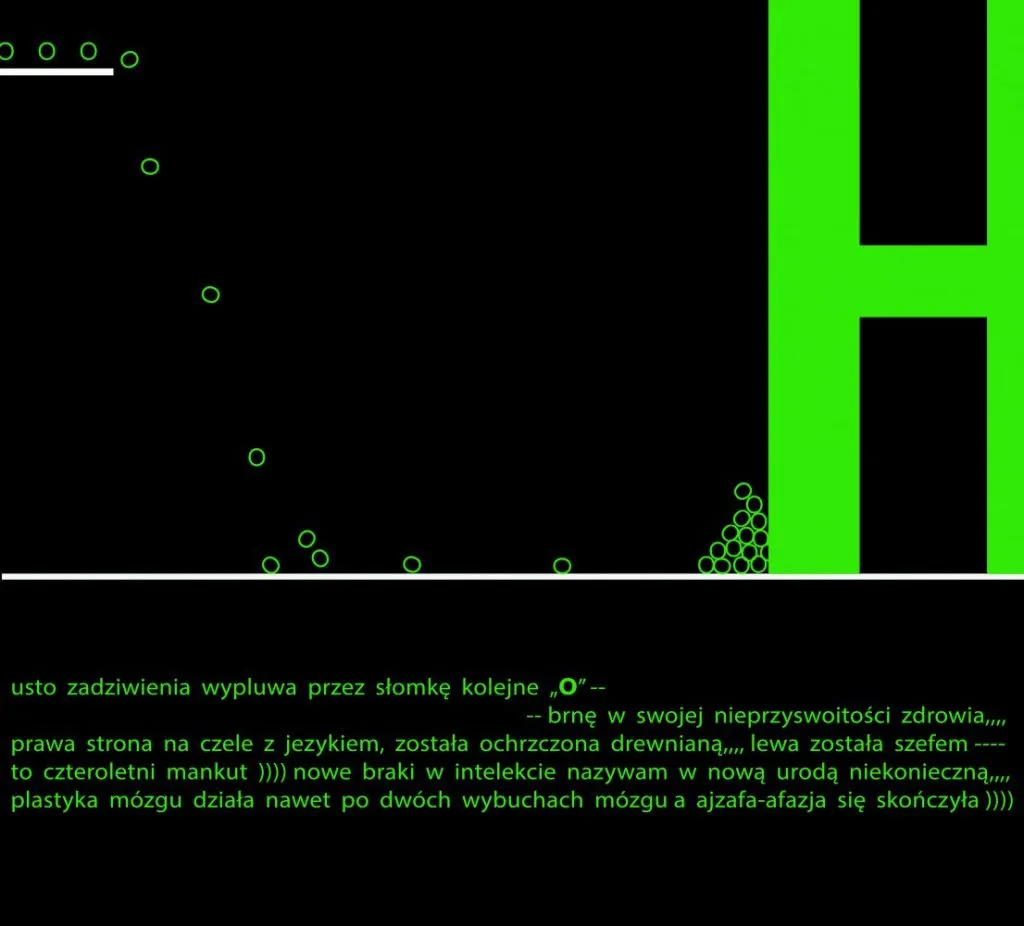
Alongside her educational activity, Karolina continues her artistic interest in the semantic potential of language’s ‘visuality’. After concluding her correspondence from Aphasia, she began a blog devoted to visual poetry, where she publishes her poems under the heading ‘spelling out the image’. Her work remains very closely connected with everyday experience. It will probably remain permanently one of her most important ways of orienting herself in space-time, recognising relationships and planning the future. As she herself admits, the activities she organises as part of Culture and Neuroscience very often begin precisely with sketches in the form of visual poetry. After we completed the experimental visual interview that we made together in 2015 for Szum magazine, Karolina called me and said: ‘I am a cartographer!’ Indeed, if we momentarily detach ourselves from the meaning of particular words and view Karolina’s works from a certain distance, we see an architectural plan. The artist consciously used this self-knowledge soon afterwards in a work made to mark the 50th anniversary of the BWA gallery in Zielona Góra. At the junction of the gallery walls, she applied a map that encouraged viewers to tame the impersonal architecture through memories, associations and personal relationships.
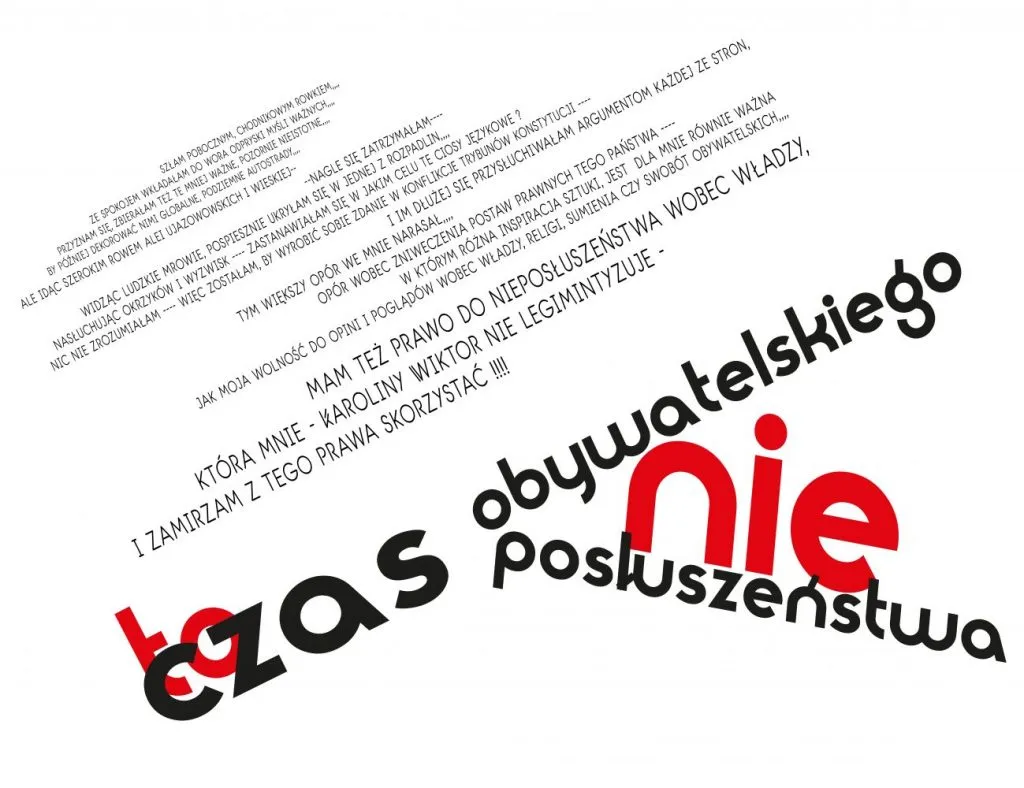
Karolina found inspiration for her work in the tradition of the Polish and Russian avant-garde of the 1920s and 1930s, which grew out of early studies in geometric abstraction (Rodchenko, Berlewi, Lissitzky, Malevich, Wat, Peiper, Czyżewski and Strzemiński). Significantly, she largely bypassed the work of contemporary visual artists. The obvious exception is the Twożywo group, whose work she considers brilliant and iconic, and which remains an unsurpassed model. The pre-war avant-garde gave Karolina something that was not easy to find in contemporary art disillusioned with the Enlightenment: faith in science and human possibilities, a cult of self-improvement and the figure of the artist-designer devoted to serving society. She also found inspiration in Constructivist formal experiments, which counter the chaos of irregular shapes resembling the discharges of a diseased brain with the elegance and order of geometric lines, the command of reason and the tranquillity of space. Karolina combined early twentieth-century avant-garde inspirations with the valuable qualities of postmodernity: subjectivity, an emphasis on the significance of individual life, empathy and responsibility. This combination enables her to move beyond the limitations of postmodernism in an interesting way and anticipate the spirit of the coming decades of the twenty-first century.
Bibliography:
• www.poezjawizualna.blogspot.com
• www.ha.art.pl/prezentacje/poezja/4094-wolga-przez-afazje-fragmenty
• www.magazynszum.pl/rozmowy/literowanie-luk-codziennosci-rozmowa-z-karolina-wiktor
*Dr Łukasz Musielak, art critic and philosopher. He completed his doctorate with a dissertation on Zygmunt Bauman. He contributes to the art magazines Szum and Obieg. Author of a visual interview with Karolina Wiktor. A precariat worker.