
The World According to Piotr Naliwajko: A Sketch for a Portrait of the Painter
Lechosław Lameński
Do young, artistically talented people born many years after the Second World War, entering adult life during the 1980s and 1990s or the first decade of the twenty-first century, and graduating from one of Poland’s several academies of fine arts have a realistic chance of making their mark on Polish or European art?
Without doubt, it is a difficult task, but certainly not an impossible one. Above all, in addition to genuine talent and the necessary technical knowledge acquired during years of study (or through individual painting practice after completing them), an artist should have something interesting to say (or show) to the public in exhibition salons. With a little luck and support from influential critics, they must also find a lasting place for themselves and their art within the swift current of the diverse movements and tendencies prevailing in contemporary art.
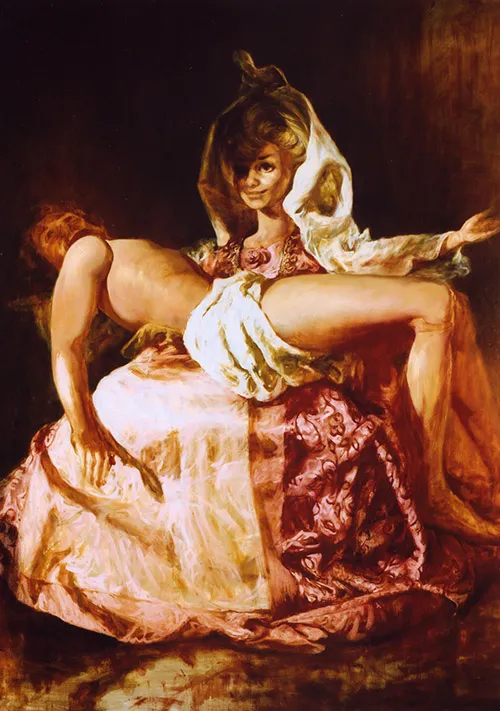
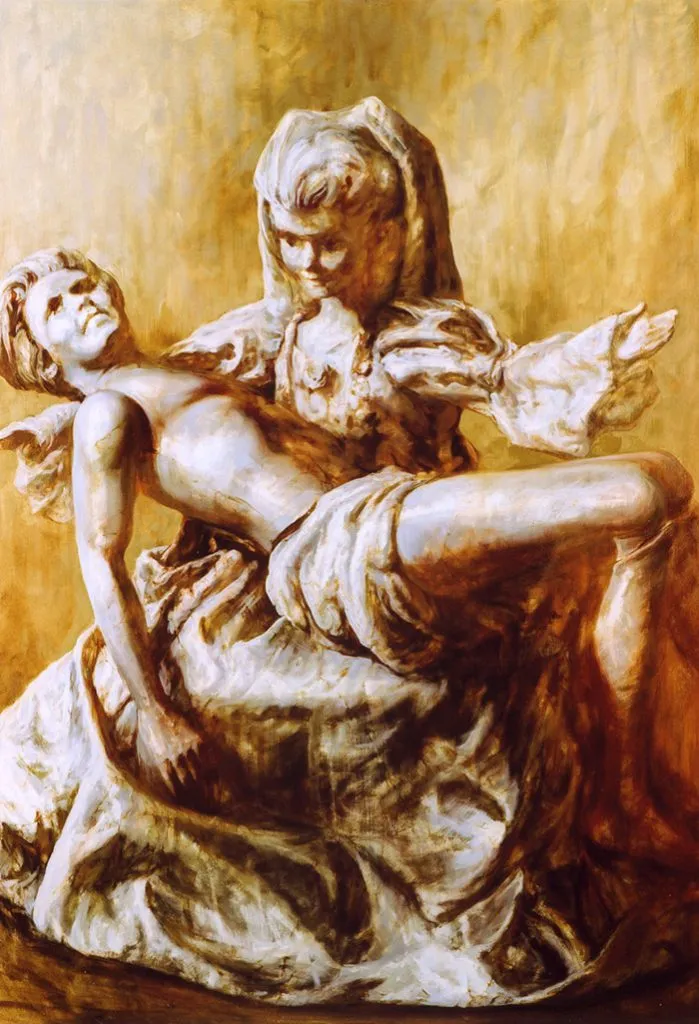
Can Piotr Naliwajko (b. 1960) be included among such artists? I believe so, although time – or rather its inexorable passage – will ultimately verify the place and role of his painting in our consciousness. If, several decades from now, after the death of today’s forty-four-year-old, what he painted continues to provoke debate or extreme opinions, we shall be able to say that Piotr Naliwajko was an outstanding figure: an artist speaking through a language of visual signs characteristic of him alone; a creator as prone to provocation as he is profoundly reflective, absorbed in his rich and restless interior, which enables him to record visually the emotions and phenomena accompanying his daily life.
Piotr Naliwajko’s rebellious, provocative spirit made itself known shortly before he left the Katowice branch of the Academy of Fine Arts in Kraków, where he studied from 1979 to 1984. In 1983, together with his fellow students Leszek Michał Żegalski and Janusz Szpyt, he formed the Group of Three, also known as Tercet Nadęty [the Pompous Trio] – that is, completely new, wild, normal Dadaists. In fact, from their first exhibition they were regarded as new barbarians who, while demonstrating exceptionally mature technique – rather unusual in very young, twenty-three-year-old artists at the very beginning of their creative careers – simultaneously displayed a complete lack of deference towards the greatest achievements of nineteenth-century Polish art (especially historical and religious painting), while mocking the entire fashionable current of abstraction so popular in the twentieth century.
What the artists intended and what they sought to achieve can be learnt from the now-historic Artistic Manifesto of the Group, proclaimed publicly on 20 May 1985 in Kraków in connection with the Trio’s seventh exhibition. It reads: ‘We are painters practising “true contemporary painting” based on the centuries-old experience of the great masters of European painting; at the same time we fight against the entire pseudo-avant-garde rampant in academies, salons and exhibitions. We wish to return painting to the tracks of simplicity, beauty, truth, authenticity and perfection. We want it to be a humanist protest by thinking people against every manifestation of evil and to continue the tradition of our societies. We wish to express this through painting based on a unity of composition, drawing and colour – in a word, PERFECT PAINTING, with perfect knowledge of craft and the layered technique: with grounds, imprimaturas and paints of the greatest possible lightfastness prepared by our own hands, varnishes and polymerised oils – we want painting as solid and durable as that of our masters. WE WANT TRUE CONTEMPORARY PAINTING.
‘At the same time, WE CONDEMN every artist who, because of their own IGNORANCE and LACK OF SKILL, and finally DISHONESTY and EXCESSIVE SELF-CONFIDENCE, has destroyed and continues to destroy – bringing about the decline of – every art, especially painting. DOWN WITH ALL ACADEMIES! DOWN WITH CONSUMERISM! We call on you: COME TO YOUR SENSES!
‘Do not deceive yourselves or others. Our contemporary academism – the dregs left by Picasso, Cézanne, Matisse, Mondrian and a few other celebrities – is worse than all its predecessors combined; aided by the babble of so-called art experts, it is a pursuit of the easy option, money and “recognition”. We declare our solidarity with all who think likewise; we shall gladly exchange views and compare the results of our painterly work. Our group was founded in 1983 and since then we have felt obliged to fight for TRUE contemporary painting. We ask you to do the same; it is a duty towards our times.’
That is everything Naliwajko, Szpyt and Żegalski had to say almost twenty years ago, in 1985. The impassioned and lofty tone of their appeal should be placed within quotation marks of light irony and bravado, considering that Naliwajko and his colleagues had previously familiarised themselves carefully with numerous manifestos of avant-garde groups, beginning with the Futurists and Dadaists. Their declaration was concise, reasonably clear and sufficiently provocative in its programme to attract attention. To the surprise of observers of contemporary artistic life, the artists opposed the pseudo-avant-garde while proposing the practice of simple painting, full of beauty, authenticity and truth, inspired by the highest values of the great masters of European painting. On the other hand, a substantial part of the declaration consists of slogans already familiar from the history of twentieth-century Polish painting. The call for technically perfect painting based primarily on tradition (presumably that of the sixteenth and seventeenth centuries) repeats at least one of the most important points in the declaration of Tadeusz Pruszkowski’s pupils from the Brotherhood of Saint Luke, active during the interwar period. In turn, the protest against the academy as an institution that in fact gives its graduates nothing, merely glorifying – for unknown reasons – the achievements of artists such as Picasso, Cézanne and Matisse, almost literally repeats the slogans of the rebellious Stanisław Szukalski, better known as Stach of Warta Szukalski, charismatic leader of the Horned Heart Tribe, who shocked and outraged the Polish art world far more (through both the form and content of his intemperate statements) as early as the 1930s.
Are we therefore dealing solely with self-absorbed epigones who, although young and angry, decided to provoke the milieu in which they found themselves in a controlled manner, attempting at any cost to impress critics and the public? I believe not. Tercet Nadęty existed for eight years (until 1990), conducting highly active exhibition work in all of Poland’s principal cities. The artists showed their pictures several times in Warsaw (at galleries including Stara Kordegarda, Brama and Galeria Art), as well as in Kraków, Wrocław, Poznań, Rzeszów, Katowice, Białystok and Elbląg. In addition to conventional exhibitions, members of the group organised presentations of their usually large-format works in places and ways that departed from generally accepted canons and rules.
In 1987, the artists’ pictures were shown in the remand prison in Gliwice – among them Piotr Naliwajko’s controversial canvas Christ on a Bus, which aroused the inmates’ interest. The foreground of the composition was filled by the stooping figure of Christ with a red halo; beside him appeared a punk, a worker reading a newspaper and a sexually alluring girl dressed in black. The artist can be discerned among the passengers in the background. In June 1989, two days after the first free parliamentary election, Tercet Nadęty organised a happening. At noon, a tram circulated around the Katowice market square, with the artists’ works provisionally suspended from it. One year later, another group happening took place in Chorzów-Batory (Piotr Naliwajko’s home town), on 16 Lipca Street. The Batory steelworks band played, while a horse-drawn cart carrying Tercet Nadęty’s paintings entered the dingy, grey and dirty courtyards behind the workers’ tenements. The artists hung them on a decaying wall, on cracked old plaster covered in blotches. Among them was Christ’s Arrival in Chorzów – another provocative painting by Piotr Naliwajko. In the centre, the bound figure of Christ; above him, three drunken men; beside him, an anguished and resigned girl from a brothel. And one more unusual venue: a smoky, squalid pub on the same street, packed with a crowd of petty drinkers. The artists hand out free beer; there is an unbelievable crush and a cacophony of sounds and diverse smells, while Naliwajko’s pictures again hang on the walls (including Behold the Man – a contemporary version of Christ in the crown of thorns and a proletarian coat, smoking a cigarette among the gloomy brick walls of workers’ tenements). The ‘public’ is mostly negative (some even hostile) towards the exhibited works, although there are also those interested in the process of their creation, who want to speak to the artists and even ask them simple questions.
In 1990 Tercet Nadęty ceased to exist, and its members embarked on artistic careers of their own. Piotr Naliwajko did remain in Poland; he has a studio in his native Chorzów and even organises at least one solo exhibition every year in the city of his childhood. But he exhibits more willingly and far more frequently abroad, primarily in Germany – in Würzburg, among other places – as well as Barcelona, The Hague, Zandvoort and San Diego, California, where his pictures – chiefly portraits and compositions saturated with a distinctive poetic quality, usually large and with clearly legible religious themes – arouse mixed feelings but nonetheless attract considerable interest and are purchased, while dozens of publications (articles, polemics and interviews) about the artist and his work appear in almost every major German newspaper.
The depiction of a human being (Jesus), of his naked, defenceless body in vertiginous perspectival foreshortening and an unusual context, supported by an emphatically realist vision of reality and its particular manifestations, together with great compositional maturity and a feeling for colour – Piotr Naliwajko’s pictures are not only images to be viewed or to have their (more or less disguised) content or message deciphered, but also pictures that prompt reflection and contemplation on the world in which we live.
I am personally moved by, and accept into my consciousness, the figure of Christ struggling helplessly at the top of a cross (a telegraph pole), three-quarters submerged by the swollen waters of a flood in which, alongside dignified, well-fed fish, a television set swept from someone’s home rocks amid the waves (Flood). Pilate likewise speaks to me: beside the half-naked, tormented Christ with the beam of the cross across his shoulders, at the bottom of the foreground sits a secret-police officer (or perhaps simply an anonymous official) aspiring to the role of the titular Pilate, smoking a cigarette, unshaven, his shirt open and protruding from beneath his jacket.
The large canvas Our Lady of Częstochowa with the Baby Jesus may certainly provoke more criticism and indignation. In it, the artist depicted Teresa Barbie (one of the many types of this immensely popular American doll, unfortunately familiar to Polish girls as well) with the Christ Child beside her, in a pose and arrangement resembling the image of Our Lady of Częstochowa. I would not, however, read this painting – as some have done – as a profanation of the venerated image from the Jasna Góra basilica, dear to every believing Pole, but rather as a voice in the debate about how religious images intended for worship should be painted. Through this simple device, and through other, more sophisticated canvases on religious subjects, Piotr Naliwajko exposes all the thoughtlessness and stupidity of numerous pseudo-artists who unreflectively repeat compositional schemas and arrangements borrowed largely and uncritically from nineteenth-century artists. The result: the interiors of Polish churches (especially the newest ones) are filled with bad, overly literal and eclectic Stations of the Cross and utterly misguided images of saints or compositions depicting scenes from the lives of Jesus and the Virgin Mary.
Piotr Naliwajko’s pictures with clearly legible religious themes have certainly provoked and will continue to provoke lively responses, especially in Poland (so far, the prevailing view is that they amount to mere posturing, a pursuit of cheap popularity, pastiche, or perhaps simply stupidity). Yet it is worth remembering that although they are not strictly sacred paintings (intended for church interiors, altars and processional images), the artist has succeeded in provoking the faithful, ordinary viewers, critics and even church hierarchs (both in Poland and Germany) to speak, which may soon develop into a genuine debate. Whether anything beneficial for the future development of this type of painting will emerge from it remains unknown.
Piotr Naliwajko is most often presented as a pupil of Jerzy Duda-Gracz and Maciej Bieniasz. The artist himself admits that the tradition of the Wprost group’s fairly brutally literal painting influenced his early works. Naliwajko nonetheless avoided the excess of literary motifs present in Jerzy Duda-Gracz’s work. His distinctive painting arises and exists on the basis of solid craftsmanship; a fascination with the realist – truly academic – method of constructing the naked human body, supplemented by in-depth psychological study (in numerous highly mature portraits resulting from an individual experience of Flemish painting); and a desire for dialogue with the great masters of early modern European painting, artists of the stature of El Greco and Velázquez.
In the artist’s pictures – both those deliberately provocative works referring to events from the New Testament and the more poetic ones concerning an ordinary grey person in the world around them – one senses his fascination with his home region (fragments of an authentic Silesian landscape provide the backdrop for many pictures), together with the presence of a rebellious Slavic spirit that contributed to the development of Polish painting, especially in nineteenth-century Munich, far from the subjugated homeland at a time when no independent Polish state yet existed. Perhaps this too is one path for the development of Polish painting in the twenty-first century, and at the same time a way of preserving its own identity?