
The Naliwajko Case
Jarosław Krawczyk
A man like me — a “regular” art historian, an admirer of the Old Masters who likes painting still to be done as it once was, seriously, properly and with a brush — is bound to have considerable difficulty with Piotr Naliwajko’s work.
On the one hand, there is genuine sympathy for someone who continues to offer truly interesting lessons in the history of painting and knows very well which hand should hold the brush. On the other, an equally genuine irritation with a painter who tries to scandalise in a manner at once methodical and banal. Naïve, in truth.
Scandal, provocation: let us deceive the townsman, the philistine, the petit bourgeois — best of all, the capitalist. We rarely realise what an old, threadbare idea this is. Successive generations of artists growl at us and periodically raise their hackles, though their fur is increasingly worn and their incisors badly loose.
It is almost embarrassing to recall that the first artistic provocations date to the end of the eighteenth century, when two young painters — secessionists from Jacques-Louis David’s school — sought to shock the respectable citizens of Paris by dressing as Homeric heroes in the most classical style and taking to the streets. Today the style is different and so is the school, but the idea remains the same. Tedious beyond belief, which is why each generation must increase the degree of provocation. No eccentric will astonish anyone in the streets, squares and galleries of a large city (and incidentally, the Upper Silesian conurbation, including Chorzów, is by no means small). Yet it is difficult to beat the record of the Viennese Actionist Schwarzkogler, who cut off his manhood in order to provoke. Everything has already been done. Artistic provocation is pure, senile academicism. Naliwajko does not, of course, turn himself into a street spectacle, mutilate himself or kill small animals. He simply paints — and does so skilfully. Yet there is something to it. In the large cities of our country (and I repeat: it is the city dweller whom the provocateur targets), very little causes outrage any longer, especially since Kozyra the “taxidermist” became a venerable classic. There is one exception: the so-called offence to religious feelings. Nieznalska’s case is eloquent enough. If you want to publicise your name “provocatively”, target religion and the Catholic Church and add an erotic or scatological context. The effect is guaranteed: Catholic fundamentalists — including genuine bigots and reactionaries — will raise the alarm that sacred things are being defiled; Radio Maryja will sound a bell so loud that the courts of the Republic will raise the hand of the law against you. The liberal press will then defend artistic freedom — quite rightly. And there you have it: a name is made.
I have no idea whether Piotr Naliwajko consciously employs this artistic tactic. In practice, however, that is how it appears, since anyone even superficially familiar with his work can clearly see how he is drawn into the realm of cheap “anti-religion”. In these paintings it is rather like Scorsese’s The Last Temptation of Christ and dozens of other productions: in a moment Christ will have a child with Mary Magdalene. Contemporary culture has specialised in producing caricatural, erotic pseudo-apocrypha of the most beautiful story in the history of European culture. I have always thought this the province of artistic bunglers. The problem is that I cannot place Naliwajko in that category, because he can paint. What is more, I largely share his work’s most general assumptions — not those set out in the manifesto of the “Three Puffed-Up Ones” (all artistic manifestos are exceedingly tedious and unreadable except under the compulsion of an art-history examination), but those announced by the works themselves: “There is nothing above figurative painting.” Several prophets have spoken on this matter.
Perhaps the most forgotten among them is Claude Lévi-Strauss, one of the twentieth century’s most prominent humanists, who at the height of abstract painting’s development harboured serious doubts about its meaning. A sophisticated connoisseur of painting, he was troubled by the question of whether the many beautiful forms of nature — a sea anemone, a coral or a deep-sea fish gleaming with the splendour of saturated colours — might offer the observer richer and more profound emotions than works of non-objective, non-thematic art. Art, after all, is not merely a peacock’s tail of colours (is every arrangement of them — the effect of different conventions — aesthetically more valuable than the colour harmonies of a hummingbird or chameleon?), but the history of the human soul rising above nature…
There is no sensible response to such a dictum other than to say that abstract painting arbitrarily breaks off the dialogue with the viewer, culture and humanity. By relinquishing the field of vision given to us and the associations connected with it, it is anti-humanist in essence. Or, to put it differently: it can become an authentic object of experience only rarely, as an exception that proves the rule.
Some are scandalised that Naliwajko is forever quoting, that he very often constructs his own paintings by citing one of the great masters of the past — something he readily acknowledges and even takes pride in. There is Rubens, Rembrandt (as well as several less commonly known Netherlandish classics), Delacroix, El Greco and an overall atmosphere we might call Caravaggesque. This painting gazes towards the Baroque and its emphatic moods, disliking all generalisation and looking us in the face. For his time, Caravaggio was an extraordinarily powerful painter of religious scenes, which in his hands became scenes from the lives of ordinary people. Naliwajko is a Hyperrealist to the extent that references to certain Baroque forms are hyperrealist. The objection to quotation is somewhat absurd; the same accusation could equally well be directed at Balthus, perhaps the painter who best embodied the spirit of the “anti-abstract reaction”, and who paraphrased old masters in almost every work. Not necessarily only Renaissance masters, as is often claimed: Caravaggio is present there too. And Balthus himself appears in Naliwajko. I suspect that the crawling figure in Cubism Is Cheerful came directly from the work of Balthasar Klossowski de Rola, an artist who was no admirer of Cubism. Cubism itself is suggested by a “dissonant” insertion from Guernica. I understand, in theory, that this is the painter’s conscious intention, a place in the picture “strongly charged with meaning” because it somehow relates to the title. Yet this frenzied Picassoesque horse tears the entire composition apart, and nothing can be assembled into a coherent vision. This is probably one of Naliwajko’s principal “manoeuvres”: he simply refuses to “hold” his paintings within a single poetics and must somehow break or disrupt it.
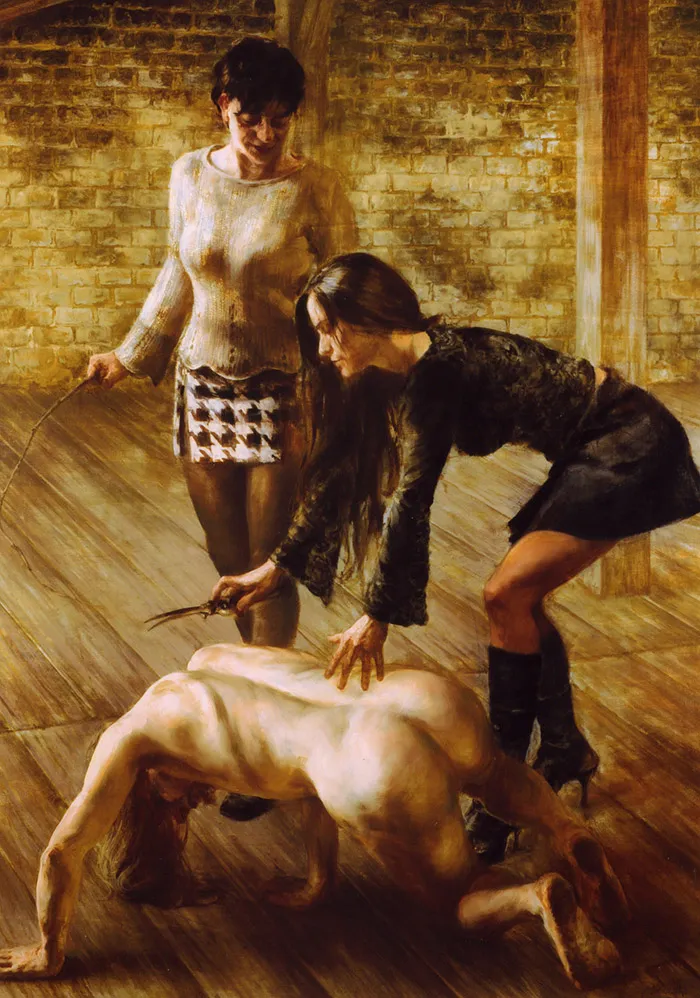
Piotr Naliwajko says — more than once — that Jan Matejko was his favourite painter in childhood. As the author of many texts on Matejko, I wanted to view the Chorzów artist’s work from this perspective. Unfortunately I cannot, because to my eye the Matejko inspirations are so opaque and well concealed that Naliwajko’s game with Matejko offers no possibility of a meaningful interpretation, at least without in-depth study. Curiously, in this respect Naliwajko resembles the master of Floriańska Street himself. Sources tell us that while painting the notorious Maid of Orléans, Matejko spent dozens of hours in the Czartoryski Library copying Old French illuminations in order to absorb the painterly spirit of the period and practise the stylistic “archaising” of appearances, so that the picture would look as though it had been painted in Joan of Arc’s day. The result was nil.
It is impossible to discern any trace of that “training” in The Maid. Once Matejko had learned to represent forms in a manner we might call “Baroquising academicism”, the die was cast. He could paint in one way only and proved organically incapable of playing with another painterly style. Could it be similar with Naliwajko, a painter with such a pronounced manner?
I have no doubt, however, that he is in very close dialogue with the work of one of Matejko’s two most celebrated pupils: Jacek Malczewski. Some of Naliwajko’s paintings — Smutas, for example — look almost like persiflages of Malczewski’s peculiar and disconcerting art. I will not say that this is the purest source of Naliwajko’s painting, because we all know that Malczewski was a painter of poisoned springs…
My first university professor, the late Andrzej Jakimowicz — an excellent authority on the subject — used to say that he simply could not cope with Malczewski. On the one hand he admired his purely painterly gifts; on the other, he recoiled from the various violations of decorum that the great artist continually committed. Patriotic decorum, of course, since Malczewski was a bard of national martyrdom in the highest emotional register. And yet something continually fractures here, something profoundly embarrasses us. An eroticism so sensual and personal too often shows through his figures that even a genuinely unprudish person begins to feel deeply uncomfortable. Those Rubenesque forms — Venus of the Legions, for example — and the passionate kisses on Ellenai’s feet refuse to keep time with songs of insurrection or exile. The martyrological phrase about our people who went into battle unarmed — a sacred phrase, newly illuminated by the desperate heroism of Polish youth — appears almost to be read according to the teachings of Dr Freud.
And so we return to the beginning, because the difficulty with Naliwajko is in some respects similar — all proportions preserved — to the difficulty with Malczewski. In our culture, an authentic and deeply experienced sacrum enters into inevitable collision with eroticism. They belong to separate orders and are better left unmixed, especially as the mixing has recently become all too easy.