
In Conversation with Krzysztof Skarbek
Krzysztof Cichoń
Krzysztof Cichoń: Your paintings are filled with an atmosphere of joyful play. The humanities often invoke Huizinga’s Homo Ludens and his concept of play as something that can simultaneously possess the utmost seriousness — play akin to contemplation, in which losing ourselves allows us to forget the pragmatic context of everyday life. Is that how you paint? Yet your pictures also contain many emblems of the contemporary world: cars, aeroplanes, computers…
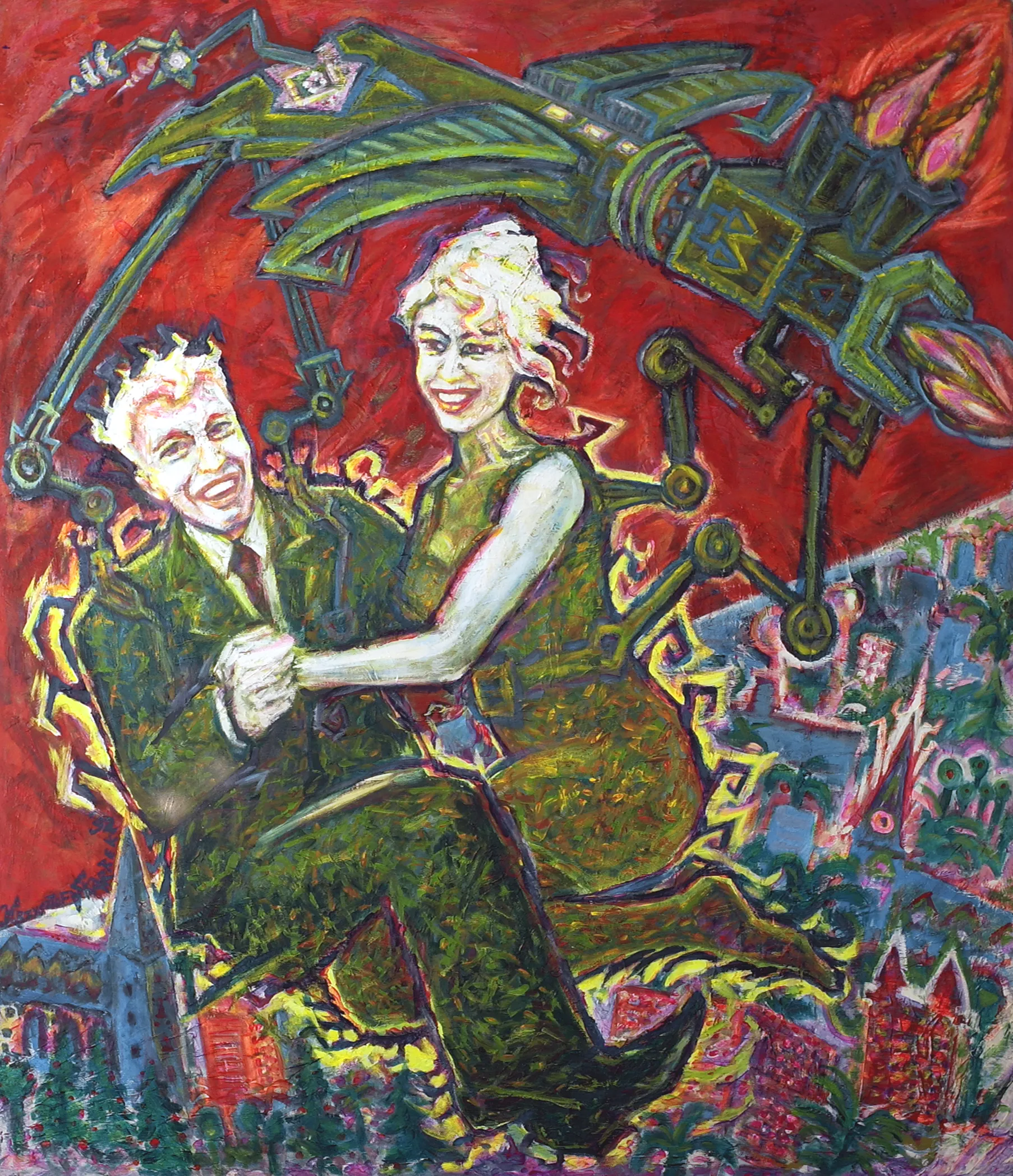
Krzysztof Skarbek: I treat them as part of the iconography of contemporary life. In former times, Dutch painters depicted beautifully laid tables; earlier still, artists painted the attributes of power. In religious painting these were objects associated with worship, while secular art made for the aristocracy conveyed the hieratic, royal character of power. Great art was founded upon such things. Today a new bourgeoisie is emerging at the intersection of science and business. The realms of need, supply and demand meet there, and at times conflict with what an artist wishes to say on their own behalf. Naturally, I keep my distance from certain propositions about the future of the world. I would like to approach all this intuitively. At the same time, the word “play” is not the principal key to what I do, because I refer to what lies within us and within our collective consciousness: archetypes, signs and symbols that can be analytically related both to every activity of daily life and to everything intellectuals associate with the humanities in the broadest sense. I would sooner invoke the perspective represented by a group of researchers into irrational thought — the celebrated English satirists of Monty Python. They mercilessly ridiculed human hypocrisy, whereas I look upon people with warmth and use play to reveal certain threats posed by civilisation. An aeroplane, for example, appears in my paintings in various contexts: it can be driven into the ground like a totem or a monument to the past. A monitor can become an element that goes beyond its utilitarian function of conveying information.
K.C.: Did you encounter any new interpretations of the aeroplane motif after 11 September?
K.S.: I treated it as a dangerous toy in the hands of people who are themselves controlled by the media or politics, by supranational structures. But I would not dwell on that, because politics does not interest me greatly. I care more about relations between people, about human communication, which I would like to show in some way — to demonstrate that we can live better and more interestingly, and communicate with one another in unconventional ways.
K.C.: Did you draw aeroplanes as a child? When did you decide to become a painter?
K.S.: I knew from early childhood. Before the war my grandfather was a painter and sculptor in Kraków; my mother is exceptionally gifted artistically, and her sister graduated from the Academy in Kraków. I was not encouraged — quite the opposite. Yet it was always inside me, and my means of expression was always the sign, drawing and painting.
K.C.: You were so artistically predisposed and aware that…
K.S.: To tell the truth, I always tried to build new worlds. Adolescents are usually interested in elements of art history that lead either towards a mimetic representation of the world or in a metaphysical or impressionistic direction. In my case there was a great fascination with Hieronymus Bosch and Bruegel, but also with Pop Art and Surrealism. Yet I always tried, as I understood it, to build my own world of realism: to use visible means to create something that might elude the established definitions of art history. Someone told me that my paintings could be compared to the way extraterrestrial civilisations might perceive and imagine life on Earth without fully understanding all its realities. In general, I want to create a better, more interesting world, founded upon a truthful and sincere view of the present situation.
K.C.: Is that what painting is for, in your view?
K.S.: Yes, although I am speaking for myself and about my own work. In figurative art it is very easy to create a cluster of negative phenomena and contrasting elements that yield an obvious drama. We have more compelling and profound black tragedies than positive answers to humanistic problems.
K.C.: So I presume you do not like Bacon?
K.S.: There are simply certain things that do not interest me in the context of my own practice. Certain compositions, whether musical or visual, may not interest me even though I consider them valuable and good. I do not judge them in terms of liking or disliking.
K.C.: To make their work easier, critics have an unattractive but practical habit of tying artists into bundles. I have trouble deciding who might be placed alongside Skarbek. If we were to choose the already mentioned Bacon, someone representing the “impressionistic side” such as Cézanne, and Matejko, then you would probably be closest to Matejko.
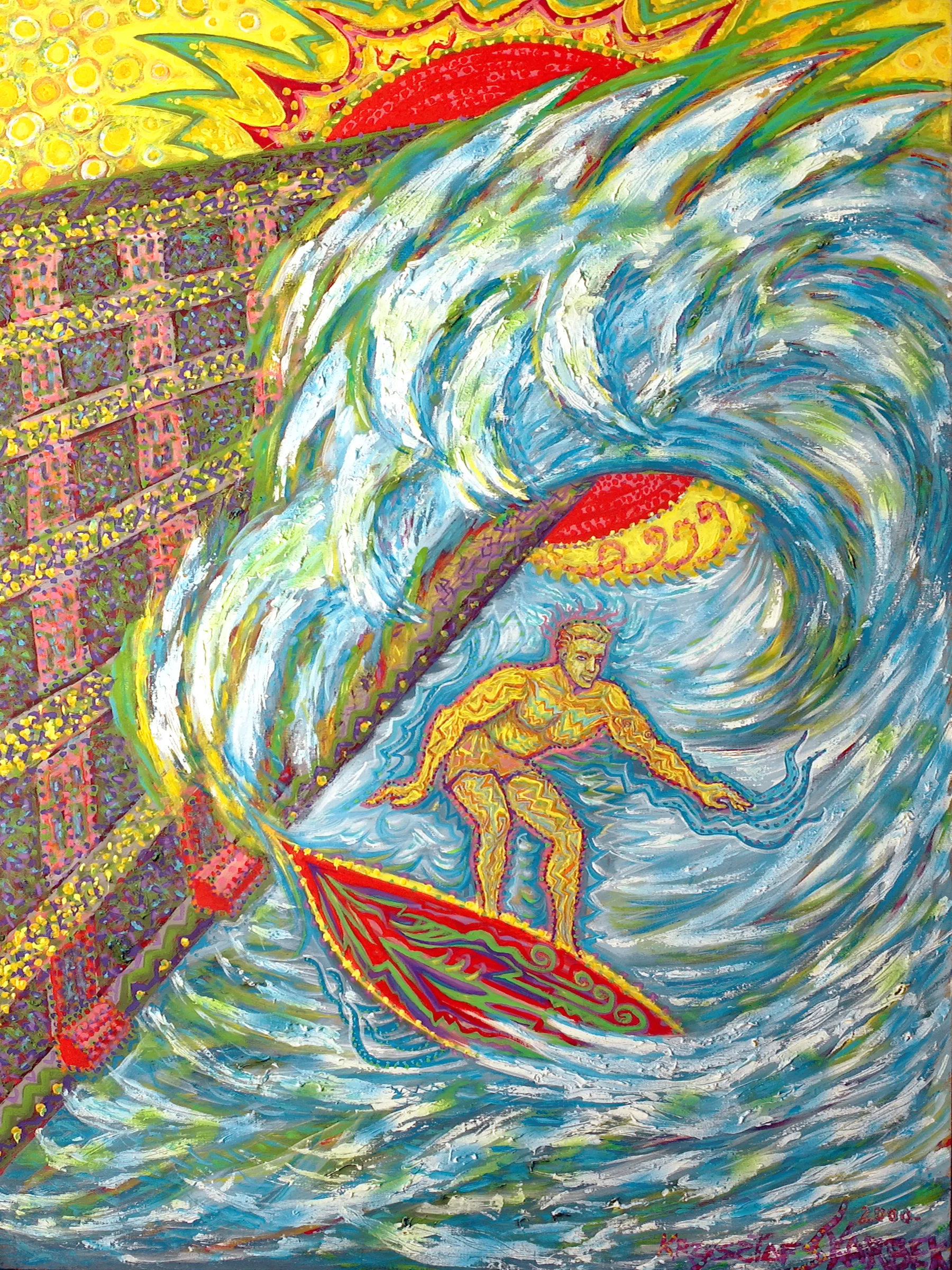
K.S.: In one of my texts I write that Jan Matejko is my favourite artist. But the way I apply and arrange paint is most readily compared to Van Gogh. At one stage I had a method of laying down small patches in which every mark was a separate biological entity. This was neither Sisley nor Op Art, but the creation of microorganisms that subsequently interacted with one another. For me, colour as a symbol should heighten the significance of a moment and emphasise a certain euphoria. Dark colours, on the other hand, are associated with reflection, although the two can be reversed through contrast: something dangerous may be depicted in euphoric combinations of colour. (…)
K.C.: So painting should show the bright side of life?
K.S.: Mine should. On the one hand, it smiles at the weaknesses of civilisation and humankind; on the other, painting should point towards a new path. It should use all these elements — the aeroplane and the car, which function as symbols — to create a new and more interesting world commensurate with our own desires, rather than one determined by functionality. I always emphasise that tools formerly served to shape our civilisation and surroundings, whereas today certain tools — the mobile phone, car or plasma television — are no longer merely tools, but entities in their own right to which a kind of worship is devoted. Young people must possess ever more fascinating objects of the kind you call gadgets. I would not use that word, because a gadget is understood as something unnecessary and merely decorative, whereas this is something more. It is a fetish, an object of contemporary technological veneration. Consider a car, a new engine and its new components, or a mobile phone that is no longer merely for conversation but performs almost magical functions…
K.C.: It is like a knot binding reality together. If telephones suddenly disappeared, everything would fall apart…
K.S.: Yes, exactly.
K.C.: Have you ever been tempted to assemble your paintings into a single whole?
K.S.: I wanted to create something like a vast panorama, with the story of a group of people unfolding across the horizon as they pass through various events: profoundly dramatic and fantastical, real and poised on the threshold of dream, imagination and the subconscious. Many cultures say that dreams and material existence have much in common.
K.C.: You seem to share the conviction that painting is a form of metaphysics; a broadly understood sacred theme continually returns in your pictures. To paraphrase the title of a book by Jacek Woźniakowski, can painting bring salvation?
K.S.: That is a question about the power of the leaven, the causative power of certain ideas. It began with the word, an extremely potent element with almost the force of a chemical catalyst…
K.C.: The word has surely always been more important than the image in European culture…
K.S.: Yet if there were only words, there would be no abstract sound of music. Music and images are entities that move beyond the verbal realm. They are at their best when they act upon human consciousness and can change a person without needing to be supplemented by words. The struggle between so-called pure painterly form and representational painting is about separating the domain of painting from the domain of language. I often encountered the argument that if you want to tell yourself a story, it is best to write an essay for a newspaper, whereas here one should concern oneself with pure form and composition. I have always opposed that view. It seemed to me that one could create an interesting situation composed not only of formal painterly signs — brushstrokes, patches of colour, geometry and rhythmic arrangements — but also of symbolic pictorial narratives.
K.C.: Let us speculate: if there were only words, what would you do? Would you be a shaman, a storyteller?
K.S.: Besides having the power of speech, human beings have the capacity for movement. So there would be movement and the organisation of the space around oneself, together with the word.
K.C.: Could you name any painters who, like you, make joyful, optimistic pictures?
K.S.: Generally, the experiences expressed on canvas arise from profoundly dramatic and traumatic events, and people find it difficult to show something optimistic. Art usually poses questions, while answers that speak of a better world seem dangerous. Artists fear that they will appear ridiculous or banal, and consequently shy away from such answers. It requires a little courage on the one hand and a somewhat investigative approach on the other to create — or at least attempt to create — something that eludes the definitions of comedy or a joke and establishes a new, optimistic reality. But the attempt is worthwhile and often produces new solutions.
K.C.: Do you know anyone like that?
K.S.: I am thinking… Perhaps some of Zdzisław Nitka’s paintings, when he shows a person in a forest with a wolf and an eagle beneath a sunny sky — a human being in harmony with nature. The form itself is of course expressive and sharp, and there is no distinct smile on the person’s face, but there is a certain truth about nature.
K.C.: It seems that Polish painting once witnessed an eruption of joyful painters, in the 1980s. Was it generational optimism? How might one explain it? Most simply by saying that you had all seen the Neue Wilde painters and…
K.S.: That was not how it happened. The history is more serious. In academies of fine art throughout the world, painting was defined in accordance with Gauguin’s theory that painting is colour. Students’ and applicants’ abilities could therefore be tested through their capacity to transpose what they saw — in a still life, for example — onto the plane of the picture, thereby demonstrating their sensitivity and ability to perceive colour. In practice, a serious, maturing artist would begin to narrow the palette, create refined greys and work in subdued ranges of brown and grey. In theory, this was regarded as a serious approach to painting. In our socialist reality at the time, where printing was poor and neither good-quality art books nor the colours now seen in the streets were available, greyness possessed an ambiguous character. There was greyness in everyday life: grey weather, grey days and grey nights. Among certain people this prompted a rebellion against the established rules governing the cultural understanding of painting and good taste. In the 1980s, several colleagues and I began from an inner need to introduce sharp combinations of colour, hoping to bring a little sunshine to that grey reality. As for the German Neue Wilde, their catalogues reached us only later. The schools could not afford subscriptions; it was not until the latter half of the 1980s that they began subscribing to Kunstwerk and Artforum. People with enough money to travel abroad might have glimpsed something, but they were older. My generation and I had no such contact when we graduated in 1985.

K.C.: Do you believe painting belongs to the rational sphere? You speak about it precisely and logically. What kind of animal is painting?
K.S.: On the one hand, it should not be rational because it ought to be poetry’s kindred spirit. On the other, academies teach both artistic technique and visual awareness. A painting by a trained artist and one by a mentally ill person may both be brilliant, but the conscious artist’s painting passes through the artist’s self and spirituality, whereas an unaware person who creates brilliant things is merely a transmitter, a medium for a causative, divine force. In our Mediterranean Christian culture, however, the human being is a causative force acting in communion with God. As I understand art, attention should be paid not to total freedom of expression but to the ideas that guide an artist in making art. Those ideas may be rational or irrational, while the artwork itself can remain unfathomable and open to many readings. We should also remember the theory according to which the newest art is precisely the art for whose interpretation we do not yet possess the necessary tools. If society gives critics and museum professionals carte blanche to translate art into something comprehensible, it means that the language and methodology are already known — which in turn means that the work referred back to old art.
K.C.: In the catalogue of your 1992 exhibition I found a quotation said to come from a collection of stories entitled How to Live and Be Happy, written by Krzysztof Skarbek. Does such a book exist?
K.S.: How can one live and be happy? Everyone wonders about it, and no one has provided a universal answer. It is worth attempting such an affirmative view of one’s own life and seeing at least the germ of a purpose within it. My sketches contain a great many notes that touch upon this problem.