
>XPawela<
Laura Pawela in conversation with Tomasz Załuski
T.Z. Why do you paint Windows dialogue boxes rather than, for example, preparing them digitally, photographing them, and so forth? Why painting? Could you expand on this comment you made about these “computer” paintings: “I responded to the contemporary world in what we might call a non-contemporary way”?
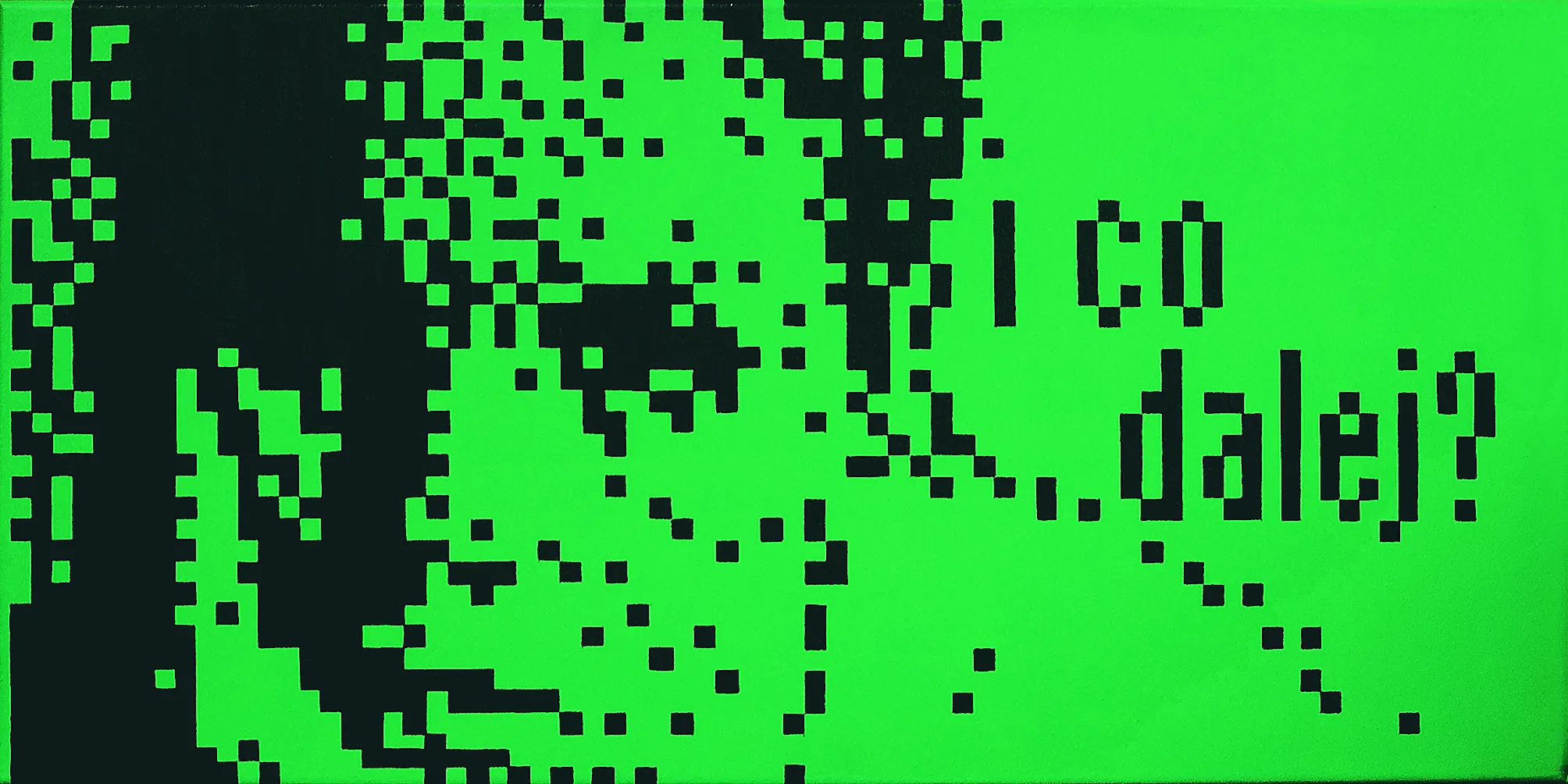
L.P. The contemporary world is a computerised world, full of technical innovations, a world in which access to media is ubiquitous—television, computers, the internet, mobile phones, and so forth. This is our new natural environment, whether we like it or not. My response to this world was “non-contemporary” insofar as it was confined to a very traditional medium: first oil painting, then acrylic. I wanted to juxtapose a traditional and a modern “medium” of communication, to bring painting and the computer into collision as two ways of conveying meaning. When I began the series of paintings inspired by computer systems, I was also responding to the frequent use of this medium to create images. Many young artists use images processed by computer, and so their paintings likewise combine elements of traditional “making” with the use of available “new” techniques. I wanted, however, to go a little further. There was something intriguing about painting scrollbars, graphic elements and messages, and changing the commands into things a person might say; after all, the computer is an extension of the human being—it is our hand, brain and nerves. Who knows whether, before long, one person will communicate with another solely through brief commands, expecting an equally brief response selected from the available “OK” or “Cancel”? The easiest thing, of course, would have been to take a screenshot, or make a graphic resembling a computer message, and print it digitally, but I wanted to use painting techniques. There is something perverse and striking about painting a computer system, while at the same time, as our increasingly natural environment, that system has as much “right” to inspire a painter as any other element of reality. Painting Windows is a way of speaking about the present. Painting is accessible to a narrow group of viewers, whereas computer systems are already familiar and domesticated for most of society. Either contemporary art will concern the contemporary world, or no one will be able to receive it.
T.Z. What do you make of the effect of “roughness” that arises when the visual infrastructure of Windows is transferred to the medium of painting? What does this effect mean to you?
L.P. Painting computer environments or telephone displays is like painting a landscape. Our nature is changing; the landscape has changed, and so has our environment. If we paint reality, we should do so without pretending that the world of modern technology is absent from it and that there are only trams and dirty courtyards. As a non-digital medium, painting contains a certain element of imperfection that we do not find in the digital image. I mean all those crooked lines, unwanted textures, uneven letters and irregularities caused by the trembling hand. I tried not to conceal the fact that an image depicting a computer system was nevertheless painted by hand, that it was painting rather than merely a computer printout. It is very easy to take a screenshot and print it, whereas a painting takes time. Making it with a brush is a kind of perverse game: ostensibly a computer, yet lacking the perfection and digital quality familiar from a monitor; ostensibly painting, yet lacking painterly flair.

T.Z. How did you come up with the idea for Reallaura, the project to which the “green” paintings now on show refer?
L.P. Without any special effort. In essence, the idea was suggested by star-making media, companies advertising new telephone handsets, and the general fashion for original graphics on one’s private mobile-phone display. For some time I had been interested in the interpenetration of technical innovation and human life, as well as in media as the natural human environment. I was inspired by this urge to individualise one’s telephone, this desire to identify with some tiny image on its display, this impassioned gazing at one’s screen as a new human altar (the next after computers and television?). Ultimately, however, the project was born while I was making my first bitmap for a phone, for a competition announced by Siemens. That was when I discovered how these bitmaps were made, what their specifications were, and how simple it was to create one. The initial lack of interest in the project from companies distributing such graphics, picture messages and logos to mobile networks made me decide to send episodes of Reallaura over the internet as spam—as though I were advertising a product that would “soon” be available to download to your own phone.
T.Z. Why did you decide to juxtapose the visual and communicative conventions of mobile phones with events from your own life? Where does this autobiographical-exhibitionist, perhaps even narcissistic, strand come from? What is there in Laura Pawela’s personal reality that made her decide to present it to others?
L.P. There is nothing in my reality that is absent from yours. On the one hand, Reallaura is an individual figure, because I did speak about my personal affairs; on the other, she is highly universal, since I was also speaking about the problems of hundreds of people, about banalities, about what irritates and delights us, about small and trivial matters. The Reallaura project was intended to belong to the present, when every individual seeks their identity and feels a lack of privacy. There is no narcissistic strand in Reallaura. You need only read a few of the texts appearing in the graphics to notice at once that the matters raised appear to be mine, but essentially say nothing about me. I extracted one, often trivial sentence uttered on a given day. Hundreds of people might have said the same thing. So on the one hand I show myself, but on the other I present a fiction, because perhaps Reallaura does not exist at all; or, as in popular reality shows, a fragment is shown on the basis of which the viewer thinks they know the protagonist. The project used a number of mechanisms operating in our world, such as the rapid, shallow careers of reality-show participants, the glitter of advertising, and lies about the product on offer. This “real” was completely unreal, because it actually said nothing about me, so we cannot speak either of exhibitionism or autobiography. I reveal my privacy, but nothing follows from it—why should anyone want to know about my private life? Reallaura is a certain perverse game, and it is easy to be taken in by it, just as we are taken in by gossip in glossy magazines about who is having an affair with whom. Reallaura also speaks about privacy in the media, the sphere of life that is paradoxically the least private and the most eagerly described. The work therefore drew upon the natural act of voyeurism so characteristic of the viewer, while at the same time creating itself. I also drew on the experience of blogs, internet diaries whose popularity demonstrates only that it is not narcissism but a subterranean need to assert one’s individuality in an age of its disappearance that drives people to speak about themselves. It is a kind of individual sabotage directed against the contemporary world—a quiet struggle for individuality and identity.
T.Z. How long do you intend to continue Reallaura? Like Opałka’s project, is it meant to encompass your whole life?
L.P. No, I completed the project several months ago. Recently I made just one more logo in order to comment on a fairly important and absurd situation (I had grown accustomed to the comfort of speaking aloud about things that annoyed me). Sometimes I add new graphics for phones, but as far as the version distributed by email is concerned, the project is over—too many different episodes are circulating online. The comparison with Opałka is misplaced. I treat my projects as temporary occupations, not boring permanent jobs. Besides, I have had more than enough of the “grid”. With the exhibition at Atlas Sztuki, I also intend to stop exploiting my own image.
T.Z. Reallaura also exists directly on the mobile network: individual episodes can be downloaded to one’s own phone for a small fee. Was this departure from the traditional system in which art operates—galleries and so forth—a one-off event resulting from your use of a particular convention, or is it a tendency that attracts you and that you will try to pursue in the future? Do you think it is possible for art to operate in an alternative way at all?
L.P. Reallaura bypassed galleries. The gallery-and-institutional situation in this country is so exhausting that one breathes more easily when creating a project outside the gallery. Yet although my project bypassed galleries, it ultimately appeared in them anyway. There is no avoiding it—the institutional circuit was the final grounding of something ephemeral. For a very small sum you can indeed own a little art on your private altar of yearning, the telephone display. It is probably the cheapest art in Poland, and you can download as much of it as you like. I honestly admit that creating outside a gallery has its good and bad sides. Without dwelling on the bad ones, I shall only say that you yourself control “what”, “how”, “where and when”, and that is already a great deal. I am indeed planning further projects for which I shall not need the interior of an institution. Can art function alternatively? Of course it can; it is happening all the time! Net art, for instance! And numerous projects in the city, on billboards and… on phones. Why do you ask whether it is possible? It is happening, and is often far more interesting than pictures hung evenly on a white wall.
T.Z. In asking about the possibility of art functioning alternatively, I meant precisely the paradox outlined in your answer: ephemeral, “extra-gallery” things must still reach for the identity designated by the word “art” and consequently find support and grounding in institutional art, whose circuit they also enter sooner or later. What, however, should change in our galleries so that artists can “breathe more easily”?
L.P. The institutions’ approach to art itself, which cannot be shoved into the maw of the bureaucratic machine.
T.Z. How do you assess the system in which art operates in Poland as a whole? Do existing institutions support young artists, or must they be “their own institution” and practise a form of self-marketing?

L.P. Self-marketing is a feature of a society living in a media world. There is no alternative—if you have no “advertising”, if no one writes or speaks about you, it means you simply do not exist. One could talk at length about the system in which art operates. Everything needs rebuilding (that sounded like an election slogan…), from the system of educating artists (I am up to date on this), through the functioning of institutions, criticism and the media, to artists themselves and their professional “policies”. As for institutions that “support” artists, I regret to say that they are disappearing. By “support” I mean a certain degree of help in producing and promoting a project. Such institutions are decidedly lacking; on the other hand, one cannot expect someone always to do everything for the artist. I am a young artist and an institution named Laura Pawela: I have to advertise myself, work hard, look after the brand… That is the market; those are the rules. There seems little point waiting for help at a time when institutions are closed down because they exhibited a single work.
T.Z. You recently graduated from the Academy of Fine Arts in Wrocław. What idea of artists’ role and their status in society was fostered there? Did it stand up to the test of reality? What role does the artist you are have to play?
L.P. You know, I wrote my master’s thesis on being consumed and consuming—do not ask me for the details; in any case, it was not a popular subject at the Academy. The school trains craftspeople with two left hands. They are told to create in accordance with what plays in their soul (naturally, it has to play in a rather academic-poetic manner), without a word being said about the fact that after graduation one somehow has to find one’s way in the art market and somehow earn a living from one’s profession. Academies still operate according to an old model, which assumes that students are too stupid to create interesting works and leaves no room for their own statements. That has to be learnt after graduation. This is why 98 per cent of students disappear: without being given another theme for an artwork (an “inner landscape”, for example), they are unable independently to ask themselves a question or formulate a problem worth addressing. You probably know perfectly well the situation in art academies: forced into their unreformable system, students are unable to discover art for themselves and have little chance of obtaining information about the latest art. I was fortunate enough to be in Professor Leon Podsiadły’s wonderful studio, where the approach is entirely different. But what is there to say… the thought of professors’ attitude towards students makes me sick. I did not have an easy time; I fought throughout my studies, and at last I can speak about it because no one can threaten me with difficulties in obtaining my diploma any more. What role does the artist I am have to play? I am not a missionary; I have no roles to play. Art is not theatre performed according to a script. I carry no messages, I do not fight and I do not rebel.
T.Z. In that case, what is art? Or rather: what is it for?
L.P. As a rule I do not answer questions like that. I do not possess such knowledge.
T.Z. Let us return to the previous subject. How, then, do you assess the “art education” you received? Among the episodes of Reallaura, I found the following question: “why can’t I study what I want?”
L.P. Education? What I learnt over five years I owe solely to myself, to my persistence and curiosity, and to the professor I mentioned, his assistant, and the handful of open-minded people with whom I came into contact. The school (by which I mean the department where I studied) does not tolerate students like me, creative people with their own approach to every subject. I could not study what I wanted because the school’s bureaucratic machinery would not permit me an individual programme of study, multimedia classes, and so forth. Being in the Sculpture Department involved a series of artificial situations and performing tasks almost “to order”, and perhaps that is what I learnt: how to cope in an uncomfortable situation. I do not want to dwell on the school and education, because it is no education at all. We all know perfectly well that the professors are afraid of talented young people. They do not understand the proposals put before them, so they are opposed to them in advance. A student is not assessed on whether they are creative or how they navigate the art world, but on whether they “fulfilled their obligations” that semester, or whether their latest work meets all the criteria of sculpture once written down by, say, Dunikowski… I did not study what I wanted. I smuggled through my own projects, known only to my professor and his assistant; everyone else received what they wanted.
T.Z. Are there moments when you feel satisfied with your work? Does this happen at the idea stage, while making the project, once it has been completed, or perhaps after it receives the response you hoped for?
L.P. There are such moments. Naturally, I most often like my new projects, and when I am about to produce them I would happily erase the older ones from memory. I like my works at the moment their ideas enter my head—that is when I consider their possible realisation, and they seem perfect. Then, in some cases, comes the production stage—well, that varies; I generally curse the moment when I had the idea. I can also be very pleased with the result, and then I feel that I did not struggle in vain and that my intuitions were right. That was the case with the exhibition at the Centre for Contemporary Art [the exhibition of “computer” paintings—T.Z.]. I had many projects, and the curator Marcin Krasny chose the one about which I was least convinced. While making it, I doubted it on more than one occasion (painting so many works in a short time is a nightmare). But the final result made me proud—it met my expectations. The reception of a work is a different kind of satisfaction; confirmation from others is very, very important. It is a sign that one has chosen the right creative path.
T.Z. What are your artistic plans? Will you reveal anything to the readers of our catalogue, who are hungry for this information?
L.P. Plans? After the exhibition at Atlas Sztuki, I want to take a brief rest, because I have been vibrating at full speed for two years now and am exhausting my last reserves of energy and creativity. I hope I shall be able to go to Strasbourg for three months next year as part of ART-IN-RESIDENCE; only a few days separate me from the organisers’ decision. If I succeed, I already have entirely new projects to realise. And several ideas for “extra-gallery” projects that I would like to begin this year. Perhaps I shall take up sculpture?