•
Roman Opałka
Each painting – a Detail – is part of a whole. (OPALKA 1965/1 – ∞). There is one work, just as there is one existence.
By moving beyond elementary arithmetic counting, controlled against an unattainable horizon of numbers, I developed an open discourse whose justification lies in the indispensable necessity of its existence. One might suppose that I am driven by an exaggerated self-belief, that I assign my concept the status of philosophical enquiry. Yet I have no certainties other than those that arise from my human existence. Like every one of us, I often travel tangled paths along which more or less predictable events continually unfold. In their context I have learnt to assess the meaning and consequences of every action. Whether we find ourselves in the world of philosophers or in the more accessible company of ordinary people, it is only the way in which we deal with chance in our lives that allows us to define the degree of our moral commitment. Before I had even formulated my artistic concept, I had to confront what for me was the fundamental problem: finding meaning in life. I was seeking a creative idea worthy of being brought into being. My work as a conceptual painter depends to a great extent on a philosophical stance that affirms existence. By placing my faith in philosophy, but also in art’s innovative power, I brought together two essential dimensions, the only ones capable of preserving me for life. Art and life can, of course, be separated. Many artists have tried to resolve this duality. In my undertaking, the two dimensions permeate one another. In this way I affirm the aesthetic principle I represent, by analogy with the organic relationships present in every living organism.
Every development of my idea forms part of a fundamental whole. Beginning with the original unity, creation takes shape through its various constituent elements: paintings – Details, photographs, Travel Cards and sound recordings, which may be interpreted as elements of a certain ritual. Although I am an agnostic, they refer to the idea of God. I concern myself with it solely because I am interested in the potential that comes from placing at the beginning the Word, which bears within it the emotion of the Whole. My concept seems to possess a similar logic, in the sense that it is a unity that develops through the entirety of its fulfilment.
If God exists, then He is a conceptual being. To me, God is an abstraction, a point of departure in my attempts to give the adjective ‘conceptual’ a new meaning – that of ‘conceiving’ an infinite number of world views. This statement undoubtedly unfolds its full wealth of meaning when extended to the world of art. Emotion follows the Word, and reflection follows emotion. My stance follows this path.
My view of conceptual art is at once critical and admiring. I admire its extraordinary ability to stimulate intellectual debate around creative processes, yet I criticise its tendency to reduce the artist’s emotional and physical contribution. In this respect it risks reducing art to the construction of systems of statements about art.
The gesture of counting that guides my painting is governed by the measure of my life. The consequences of this idea reach far beyond the limits of the painting, towards the materialisation of an ultimate position on the development of art. I am not content with the pure pleasure of painting. I continually strive to have my stance understood as the consequence of a particular understanding of the artist’s situation. At first I thought the public would have no difficulty understanding it, yet certain patterns of behaviour cannot be changed. Those looking at a Detail by Roman Opałka are not entirely certain whether what they see really is a painting.
For many years I considered abandoning the pictorial space of the object called a ‘painting’. I analysed works that persuaded me to do so, yet at the same time I was convinced that this represented a move into a domain alien to painting rather than genuine progress in art, which was, after all, what I sought. The particular character of my conceptual statement was therefore born under the influence of a clearly defined scepticism. From the moment my programme came into being, I defended art’s right to its own dignity. For these reasons, I was one of the few artists close to the avant-garde to make such a demand. Early on I resolved not to let myself be carried along by the wave of formal wandering that marked the art of the 1960s, and I have maintained that position. Even then, I would have felt uneasy at the thought of becoming, in aesthetic terms, a continuator of Marcel Duchamp’s most extreme attitudes.
It was inconceivable to me that I should develop an artistic concept for the sole purpose of presenting every other form of creation differing from my own as obsolete. Duchamp’s dialectical intelligence blew apart the domain of painting. Moreover, his entire oeuvre is directed towards exercising the intelligence. Its aim is to ridicule and diminish every artistic value that refers to art’s past. No matter how outstanding an artist may be, they must nurture the substantial bonds connecting them with universal cultural roots. An artist should under no circumstances give precedence to the calculations of intellect and dialectics. On the contrary, the more they attempt to create a harmonious balance between thought and sensitivity, the more clearly their respect for what has passed and their responsibility towards what is to come demonstrate the validity of the enduring creative dialogue they establish.
The search for this balance leads me to question the idea of revolution, whose regrettable and ridiculous application in the art world is widely known. Political or artistic revolutionism is an inexhaustible source of misunderstandings, lies and nonsense. The violence of revolutionary action seems to me incompatible with the effort of creative thought. I am convinced that no intellectual – and more precisely, no aesthetic – position can be incontrovertibly justified by ideological speculation for which the past is a tabula rasa. Reflection is persuasive only insofar as it is prepared to rest upon a positive or negative analysis of all the statements that precede it; in doing so, it confirms the validity of all its positions and demands, as well as the entirety of the theories developed in relation to it.
Fervent agitators for revolution often appear to proclaim ideals of progress, but in reality, under pressure from calculating, partisan rhetoricians who have already become professional revolutionaries, they transform lofty ideals into bitter hatred. The word ‘revolution’ will never become an idealised synonym for ‘progress’. I do not reject the need to change social systems, nor do I oppose the condemnation of the alienating structures they produce. In the light of the history of our century, and indeed of the whole of human experience, revolutionary ideologies must be treated with justified mistrust.
The artist is too often misled by ideological certainties. Blinded by usurpation, the artist gives them the dimension of revolution. Rarely aware of their banality, the artist nevertheless does not hesitate to make use of the lie that accompanies them. Donning all manner of gear, the artist performs the comedy of the audacious revolutionary. It is not always from sheer necessity that the artist puts on the overalls of a house painter, a car mechanic or a steelworker.
Contemporary civilisation suffers particularly from a shortage of moral categories: religion no longer provides spiritual impulses, while mythologies are dusty objects of the past. Even serious politics has become accustomed to doing without theoretical axioms. What values can sustain someone today who believes neither in a Marxist paradise nor in the Eldorado of the West? All those systems of thought that for so long guaranteed that we were right are today profoundly doubtful.
Convinced of the importance of creative forces, I would not wish to see them squandered. Today painters and writers produce paintings and books in enormous quantities. Whether they do so in the conviction that each day they create the work of the century, or because they are entangled in mechanisms of production and marketing, their activity fosters illusion. They create products that are nothing more than dummies.
In the 1960s, when conceptual art was emerging, I too was fascinated by the prospect of creating a pure idea. Yet even then I sensed the aberrations to which the simplifications arising from the realisation of a particular concept might lead. I therefore devoted myself to defending the idea of painting, because it seemed to me a historically verified domain. The choice of means of artistic expression is often accompanied by the justifications of rational argument. Every artistic medium, painting included, may serve a lie. Only the artist’s morally justified physical commitment to making a painting reveals the truth or falsehood of what it presents. As a painter, I take a position that refers to the art of all ages. At the same time, I attest that conceptual art gives anyone who desires it the opportunity to provide the philosophical foundations for the instruments necessary to realise a work. In this way, the artist gives an artistic dimension to their life, easel, stretchers, canvases, brushes, paintings and their own death, thereby transcending the idea of the painting and demonstrating its historical as well as ethical value.
At the beginning of my undertaking I could still have chosen other forms of visual activity, such as happenings or video art. Abandoning painting, however, would have meant continuing the search and moving constantly, without necessity, from one medium to another. Continually changing between such fundamentally different creative practices would have made it impossible to present the idea of the evident whole I wished to express. To me, the painting seems an excellent domain capable of containing the entire universe.
At a time when all formal and intellectual conventions were disintegrating and there was great intoxication with the slogan ‘everything is possible’, my definitive decision to remain a painter was not a counter-reaction. Nor was it the result of traditionalist dogmas. On the contrary, my concept manifests a demand for freedom: it is a redefinition of the media of painting and of their capacity.
My artistic idea seeks to demonstrate its conceptual potential and submit it to the logical demands of reason. My proposal in painting perhaps realises one of painting’s last historical possibilities. I condensed the act of painting to such a degree that only the substance of the symbolic language it produced remained: painting painting. I subordinated it so thoroughly to the demands of the thought process that it became the sole purpose of my artistic work. I gave up purely external matters such as material, colours and painterly gesture in order to preserve only what is bound up with the essence of painting: omnipresence and temporality. When I paint, I no longer appeal to technical skill, but reveal the conceptual qualities of my chosen medium.
My concept is the antithesis of that ‘everything is possible’ – the slogan of the most eccentric practices of successive avant-gardes in the 1960s. Beneath the guise of supposedly innovative attitudes lay cultural regression and ordinary formalism. Without any deeper conviction, I too briefly went with the current of the prevailing tendencies. Yet the character of the artistic practices of that period provoked in me an instinctive resistance.
By 1965 I had created a number of works that differed from one another. At the same time, I realised that belief in the power of artistic invention to give birth day after day to countless new forms of expression was mere vanity. The abundance of artistic production is a substitute for progress and creates the illusion of transforming the world. Stylistic revolutions are very often the accidental consequence of various currents tinged with naivety or outright hypocrisy, currents that yield to the fashions of the moment. For my part, I felt no need to compete with my contemporaries in their spectacular rivalry over the latest novelty. In my view, all those who have joined this chase since the second half of our century either lack a sense of responsibility or are merely pursuing profit. I admire certain works of the twentieth century; with others, it is enough for me to know the mechanisms on which they rely: ingenious constructions of objects for ‘connoisseurs’, leached of all substance. At the origin of my artistic activity lies a preference for visual solutions that do not submit to the dictates of fanatical revolutionism. Lascaux and Altamira are for me the highest expression of the timeless presence of the human element in art. The cave paintings embody the fascination experienced by human beings when confronted with the ancient traces of their existence.
I therefore resolved to devote myself exclusively to realising a single artistic concept, far from the clamour of everyday life. I set in motion a process that is not solely an immanent element of art, but which I can realise by means of art’s most classical forms of expression. My work is subject to the laws of human existence: it visualises the passage of time, which irreversibly draws the end of my existence closer; it reveals the full force of a motivation in which I participate with my own body, the only motivation that makes it possible to complete my programme; and finally, it justifies the high demands that confer the right to be an artist.
My undertaking appears to be synonymous with my annihilation as an artist. This conduct is the result of a certain artistic orientation and an objectification of the idea: my concept is the continuity and the ontological reason for the work’s existence.
Ever since I reduced the formal means of expression in my programme to the bare essentials, I have drawn a new kind of satisfaction from being a painter. Although I relinquished the richness of the colour spectrum and reduced my artistic articulation once and for all to a sfumato between black and white, I do not place my undertaking within the realm of repetition. In painting the first Detail, I consciously chose a single path for life. I insist that I am an artist who, in logical terms, creates something genuinely different with every number. Apart from the digits of which the numbers are composed, there are no repetitions in my painting; although I use one method of counting, its additive nature constantly changes the aspect of the painting.
The dynamics of numbers are not my discovery; I merely succeeded in recognising the artistic potential of the simplest arithmetical process and incorporating it into my concept. More broadly, I contented myself with transforming into a painting a truth about the biological reality of each of us: at every moment of our lives, our organism is changing. While our outward appearance takes shape slowly, billions of cells within us are undergoing constant transformation. By adding another unit to the number I have just painted, I submit to the same law of evolution. In this way I create a work in a process of becoming, a work that is consequently diverse even though it appears to our eyes to remain unchanged. Yet who claims that continuing to live means repeating oneself?
The attributes of this process provide objective proof of the quality of its structure. They free me from the exhausting pressure to ‘create better’. I paint in absolute freedom because my way of painting has eliminated the question of its formal renewal. In this sense, I believe, my concept defines the true criteria of freedom very well. I engage with liberalism through its philosophical implications. Self-liberation therefore presupposes a readiness to focus one’s powers on the means necessary to attain autonomy. Omnipresent liberalism has never led to the liberation of the human being. By freeing myself from the formal problems of painting, I placed my artistic concept on the chessboard of contemporary art. And because I consistently refuse to lose myself in illusions of constantly creating something new, I do not have to ask what I should invent the next day. Does every day not bring fresh proof that all convictions concerned solely with form are incapable of formulating the authentic problems of artistic creation?
Until I developed the concept of the Counting Paintings, I regretted abandoning the Chronomes. My lifelong undertaking was born one morning in the spring of 1965, when I was waiting in the café of the Hotel Bristol in Warsaw for Halszka, who was later than usual that day. To distract myself from the barren state of waiting, I began to take stock of my artistic achievements to date. The result was dispiriting. Although the idea of the Chronomes pointed in the right direction, I was aware that it lacked the philosophical dimension required to achieve something more than merely a painting of reversible time. None of my previous attempts had satisfied me, because I understood that I was still in a state of experimentation. I felt like an alchemist who recognises the need to find the philosopher’s stone – the philosophical painting (pierre philosophale – tolle philosophale). At that café table it became clear to me that I could solve the problem through a simple substitution. If I replaced points with numbers, my ‘capture of time’ would become more legible and more consistent. The Chronome did, it is true, contain the idea of time, but it was a time that could be reversed, like time in water clocks, hourglasses or wall clocks: a recurring division, atomisation and spatialisation of reversible time. The Detail, however, as I then envisaged it, was a logical ‘painting’ defining the irreversible direction of time.
By replacing one point with the sign 1 – the Big Bang, two points with the sign 2, three points with the sign 3, and so forth, I encompassed all the elements of each individual Detail, beginning with the number 1 of the first Detail, which was part of the closed whole initiated by that one, opening an endless progression of numbers. Successive numbers fill the entire surface of the canvas, up to the last one, which defines the end of one Detail and at the same time establishes the beginning of the next, while each Detail is in itself a finished painting.
I was tremendously excited and, when Halszka arrived, I explained to her this checkmate against infinity. She seemed a little frightened, but today, looking back, I am convinced that her alarm probably had more to do with her lateness than with the birth of my concept. What she could not have known was that her lateness freed my work from the triviality of formal games; it was my salvation. I embraced her to thank her for the long and immensely fruitful moments of waiting with which she had presented me.
Before I began to realise the first Detail, I was not certain whether the visualisation of irreversible time that I wished to depict would live up to my ‘eureka’ experience at the Hotel Bristol.
In the course of carrying out the programme, an awareness of three certainties crystallised: the potential inherent in the dynamics of numbers; the need to renounce every other form of painting; and the understanding that I had become an artist who, in painting the painting of one existence, had no choice but to continue the work I had begun. The realisation of the concept rises above every manifestation of doubt; it is a release from uncertainty. It is the wisdom of a mirror in which the image of a being standing opposite itself allows no alternative choice: it simply is.
My idea is not only a visualisation of the ‘painting’ of existence; it is also a manifestation of the limits of the artist’s life and of every living consciousness. Once a concept has come into being, nothing remains but to realise it. Everything is contained in the idea that initiates the process of realisation and at the same time defines an intellectual attitude towards art. Thus, by entering into and setting in motion its immanent dynamic, I became determined to live through confrontation, emotion and being, resolved to live the life of the concept. The concept had to consolidate itself and prove itself in its realisation. Practical realisation – the creation of spacetime – was decisive for this discovery. The first Detail had to be painted so that I could verify the results in it and compare them with the totality of my expectations.
Many peculiar superstitions have survived in Poland. One holds that someone who finds a one-grosz coin lying tails up – the side that bears the numeral 1 – may pick it up and should keep it carefully, because it will bring good luck. If, however, the coin lies eagle-side up, it should not be picked up, lest it provoke misfortune. Although I was not very superstitious, I collected only those grosz coins that lay with the ‘correct’ side uppermost, and I carried them with me at all times to attract good fortune. In time the grosz lost much of its value and few people bothered to bend down and pick one up, so after two or three years my collection was so substantial that I was tempted to make use of it. One day I was terribly hungry. In my friend’s room, in some drawer, I found a piece of stale bread. It was a sunny Sunday. My stomach clamoured for the sacrifice of those fifty grosz. At that time Poland had many milk bars with spacious, bright and clean dining rooms. In these ‘mass-catering outlets’ one could eat simple, wholesome milk-based dishes served in white earthenware by waitresses dressed in white. I could not decide whether to spend my fifty grosz or continue to keep them. Hunger prevailed, and I entered the nearest ‘milk paradise’. In a corner of the room, hidden from other people’s eyes, I dipped my piece of black bread into the milk. I did not stop at merely softening its edges, which were as hard and dry as the system itself, but watched as it slowly absorbed the warm liquid, growing larger and whiter.
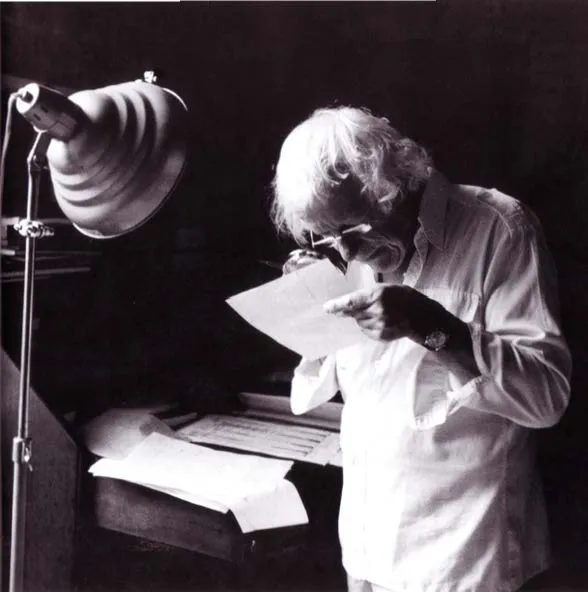
My decisions arise directly from the idea of my work. They depend on it alone, not on the world that remains outside its domain. The photographic Details, for example, called for a number of different visual decisions. One of them concerned the shirt I wear when the photograph is taken. Its neutral character is an indispensable element in preserving the uniformity of the photographs and joining them into a complete sequence of photographic self-portraits. If I photographed myself in a different shirt every day, the photographs intended to capture the traces left on my face by the passage of time would instead show changes in fashion. The white shirt carries a particular meaning: I chose white to accompany my undertaking, so that one day it might become one with the ‘painting’ of white on white. This item of clothing is therefore inextricably linked to a specific phase of my undertaking. The colour white possesses a particular dynamic: it is also the symbol of my protest against those artists who put on work clothes merely to attract attention or to perform the role of the artist.
The decision to photograph my own face arises from the indispensable need to capture the flow of time in all its complexity. I had to find an activity that would make it possible to record time even when I was not painting. Because my body bears the marks not only of the time that passes while I paint, but also of the time that passes while I sleep or perform other everyday activities, those traces also had to be documented. The photographs – Details of my face – which I take after each day’s work against the background of the Detail then being painted, and which relate to the last number painted, are an adequate medium for recording the physical changes in my body. My photographic self-portraits are situated in the context of various events that I try to anticipate so that I can counteract them effectively. Yet it is not always possible to keep everything entirely under control. I constantly guard the consistency of the sequence of my portraits. The rigours I imposed on myself oblige me to maintain the same facial expression before the camera. Only this constancy can bring out the traces time leaves on my face. Moreover, each photograph is a kind of test for me. Despite every available precaution, failures are inevitable. It is not easy to rid oneself of the thoughts and emotions connected with everyday matters in order to retain the same impassive expression every time. The most dramatic moment was my father’s death. I had to suppress the surge of emotion within me for the duration of that cruel photograph.
The way in which my paintings are displayed is strictly determined by the concept: I do not alter the paintings’ dimensions; I do not alter their form.
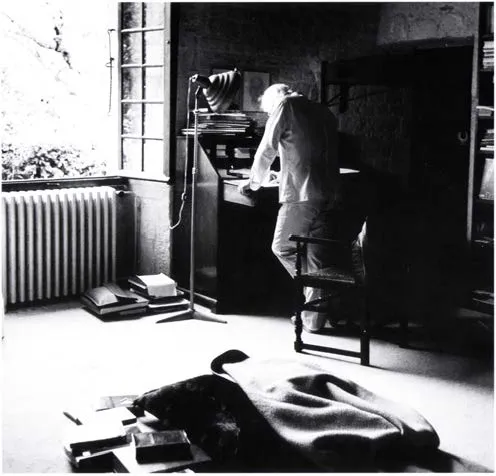
I do not construct formal installations or violate the space. The exhibition is to show what matters most: I want to make myself at home in the exhibition space, to feel there as though in my own home, to fill it with my presence so that I can invite others to meditate on one thing – life.
The artistic use of photography without a conceptual intention is vulnerable to deformation arising from a failure to control the chance that accompanies the making of photographs. My concept avoids this danger through the logic underlying the way in which it is realised. Anyone who does not counteract chance must, inevitably, content themselves with telling stories for the sake of telling them. Christian Boltanski sometimes presents saynètes in which, he maintains, he tells stories about himself, using photographs of unknown origin. On Kawara proceeds in a similar way in his daily typographic exercises. He tirelessly informs us that he has not yet taken his own life and sends us postcards as proof. The same applies to Hanne Darboven. When she meets an acquaintance, she immediately pastes their photograph into her calendar, circles the date of the meeting and highlights it in some particular way. And although On Kawara and Hanne Darboven may appear conceptually related to me, I have little in common with them. My concept cannot be compared with the intelligent, dialectical, yet anecdotal stories they produce. My undertaking is nothing other than a manifestation of life itself. The moment a work becomes a statement referring to an actual state of affairs, when time impresses its mark upon the objects borne by the concept, it ceases to be a pure anecdote. As in a diary, everyone can read in it the course of their own life. The photographs of my face are a picture of the life of everyone who looks at them.
How can one determine that a work – a painting or a sculpture – has been definitively completed? Can it be claimed that a painting is truly finished? Did Leonardo da Vinci, who at the height of his creative maturity continued to return to his Saint John the Baptist with its raised index finger, not fully realise how problematic it was to regard a painting as definitively finished? And not only for purely artistic reasons, but for logical and ethical ones too. In the gesture of that pointing finger, Leonardo sought to express the entirety of the universe, to penetrate it more deeply and reveal its unity.
From the standpoint of logic, Leonardo’s method possessed no means by which the painting could be completed. Nor did his rational consciousness perceive anything that would allow him to regard the search for unity as concluded. Only death fixed the final, yet wholly arbitrary, state of Saint John the Baptist’s pointing finger. Marcel Duchamp did try to avoid this question, but in the end he had to face it. If everything can be art, then the question of how art might be deepened becomes irrelevant. All that remains is the question of the reckless, arbitrary choice of what will be recognised as art a priori and what will not. By intellectually foregrounding that ‘everything is possible’, Duchamp brought the dimension of art to dialectical exhaustion. His escape into the world of chess is an admission that the work cannot be completed – an acknowledgement of incompletion (The Bride Stripped Bare by Her Bachelors, Even). This statement was transferred from the work of art to art in general: there was nothing left to be done.
In my concept, the notion of the fully finished work dates back to 1965: from the moment the sign 1 was placed on the first Detail, the whole – the Big Bang – came into being. Why is the Detail a logically closed whole? Because it begins with the number from which it proceeds and closes with the number towards which it moves. This is a diagonal finitude. The entire space of the work is a logical whole. This means that the Detail is not subject to correction: nothing in its structure can be rearranged, improved or removed. In this way, the Detail manifests aspects of an organic whole: improvement would be manipulation, while the removal of something would be amputation. Even an error, whether discovered or overlooked, is a quality, proof of the truth of the structure. Every Detail on the easel is always sufficiently existent to be finished; it is a state of permanent being. It is the verticality of being in its becoming, the manifestation of its relationship to the world and to the painting, the accumulation of the emotion of existence. Whether or not I am standing before the easel, my painting is always finished. Roman Opałka may be anywhere, but the painting of the path travelled by one existence – OPALKA 1965/1 – ∞ – exists without interruption. I live through the emotion of the continual fulfilment of the idea.
In order to understand time, one must accept death as a real dimension of life. Human existence as such is not yet a fullness but a being that lacks something. Being is defined by death. My concept is as simple and as complex as life. It develops from birth towards death. As the final emotion of existence.
The self-evidence of life determined by death corresponds to the self-evidence of death as the instrument (organon) of the work. In my ‘eureka’, death is the instrument of the concept; it is the objective definition of the end. My death is the logical and emotional proof of the work’s completion. My death closes my final Detail, completes it and determines it. In this sense, I possess logical and moral proof that the completion of the work is defined by its non-completion. The work will be finished because something is no longer there – the work is finished. In the ‘eureka’ of my concept, death is checkmate against infinity. Roman Opałka experiences the emotional certainty of objective proof that the work OPALKA 1965/1 – ∞ has reached fulfilment.
The medieval monk Fibonacci sought an arithmetical progression approaching the unimaginable rate at which rats reproduce. He proposed the progression: 1. 1. 2. 3. 5. 8. 13. 21. 34. 55. 89. 144. 233. 377. 610. 987. 1597. 2584… In thirty stages one reaches the number 1346269! Fibonacci’s macro-progression, however, does not correspond to the dynamics of human existence. At the beginning of life, a child experiences accelerated development: it is one, two, three, four years old… it doubles, triples and multiplies its age. Later, the dynamics of development pass into a continuity of duration: the time of learning, the time of adaptation, the time of taking root, the time of reflection and finally the time of wisdom. Consciousness settles into the dynamics of existence and perceives its limits: wisdom is the encounter with those limits. In my macro-progression, the stages 1. 22. 333. 4444. belong to the first Detail; the number 55555 stands at the end of the second Detail, yet I reached the next stage, 666666, only after seven years.
After 666666 (the digit 6 repeated six times), I asked myself: how much time would I need to reach the most important stage of my macro-progression, the digit 7 repeated seven times? I realised that, if all went well, I would need about thirty years to reach the number 7777777.
If we hypothetically take the span of an average human existence devoted exclusively to this kind of chanting of time, we will never reach a number consisting of eight eights. The number 88888888 represents the unattainable limit of the spacetime of human existence.
Unlike Fibonacci’s macro-progression, which overwhelms us, my macro-progression shows that 7777777 is the number corresponding to the spatiotemporal dimension of human life: it is a number that does not lapse into excess, but reaches the limits of existence and touches wisdom.