
The End of Painting
Jarosław Lubiak
The end here is not termination, but fulfilment: the fulfilment of the metaphysical purpose ascribed to art. According to Martin Heidegger, that purpose is the disclosure of the truth of being1. The purpose has been achieved; art has fulfilled the task set before it, and in fulfilling it has reached its end. This is simultaneously the end of humanity, the end of a certain epoch2.
This fulfilment occurs in the OPALKA 1965/1–∞ programme because it creates something that had never previously been created.
It creates an image of time.
This is not an allegorical, symbolic or metaphorical representation of the kind that proliferates throughout the history of painting. Nor is it an illustration of the many definitions of time known to philosophy and science.
The image of time created by OPALKA 1965/1–∞ is neither a representation nor an illustration of a prior idea or understanding of time. It is testimony to the experience of time.
Roman Opałka began the OPALKA 1965/1–∞ programme in 1965 by painting the number 1 in the upper left corner of a canvas, a white number on a black ground. Beginning with that number, Opałka continued counting, covering the canvas with a sequence of increasing numbers. The counting continued: the sequence covered successive canvases known as Details. They always measure 196 × 135 cm, and the numbers are always painted in white. The Details are elements of the complete work in which the programme is realised.
The laborious covering of the canvas with a sequence of numbers records the experience of time. Painting is a notation of time that creates its objectified image. It is time regained — testimony to hours, days, months and years spent before the easel.
The Charioteer of Delphi, the ancient statue of a young chariot driver, became Opałka’s artistic alter ego. The Charioteer endures unchanged in the pose it was given, just as the artist endures in his work before the easel, making a similar gesture. The Charioteer is missing an arm, recalling a situation at the very beginning of the programme when the artist lost feeling in his arm through the stress of deciding to put it into practice. To make that decision was to leap over a precipice, to immerse oneself in an incomprehensible abyss.
The leap and immersion lay in the decision to confront the mystery of time: the most fundamental sensation of existence and simultaneously something almost impossible to explain. St Augustine wrote: “What then is time? If no one asks me, I know what it is3. If I wish to explain it to someone who asks, I do not know.” Awareness of time is universal because we are immersed within it, yet this does not mean that its concept is universally accessible. The phenomenon of time escapes conceptualisation.
It cannot be comprehended, but it can be experienced. OPALKA 1965/1–∞ is such an endless experience of time. No one experienced it more fully than Roman Opałka. Yet because the programme rests on an unending experience, its content cannot be communicated. In undertaking the programme in all its radicality, Opałka condemned his work to incomprehension. No one, no viewer, will ever be able to receive the experience in its totality.
On the other hand, as St Augustine stated, if no one asks, we know what time is. OPALKA 1965/1–∞ therefore touches upon the most fundamental human experience: passing. It is consequently the most universal work ever created.
The most universal and the most incomprehensible.
Time can be given an image only through complete devotion. In a certain sense, OPALKA 1965/1–∞ is merely a “chanting of time”, its ceaseless enunciation by voice and hand. In speaking time, one can speak of nothing else.
Roman Opałka records his counting twice, painting the numbers on canvas and recording his voice. He simultaneously creates a visual and auditory image of time that combines two orders: synchronic and diachronic. This synthesis reveals how temporalisation is always spatialisation.
The double registration of counting — phonographic recording and painterly notation — allows the original presence to be reproduced on the basis of this dual inscription. It preserves the presence of the creating subject by retaining what is closest and most proper to him: the trace of the breath of life. This defines the identity of the work and the artist’s life, although that identity, as we shall see, is not absolute.
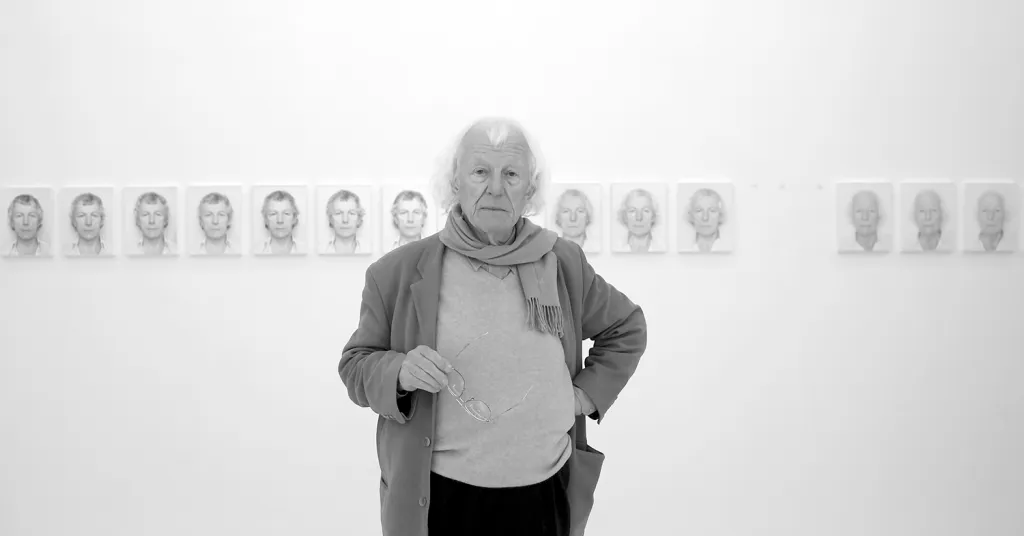
The presence of the creating subject and the identity of work and life are preserved through one further kind of notation: photographic recording. Every day, immediately after he finishes painting, Roman Opałka photographs his face in the same manner and wearing the same clothes. Some of the thousands of photographs made during the programme become part of OPALKA 1965/1–∞. They document how time inscribes itself within the human body and upon the human face.
The image of time is therefore created through a triple notation: painterly, phonographic and photographic. This reveals the deepest, perhaps absolute, identity of being and time. Human existence is being in time; it is passing. OPALKA 1965/1–∞ is a record, testimony, disclosure — an image — of passing.
Begun in 1965, the programme counts and “chants” passing time, while its photographs supplement the image of passing with a human dimension and reveal the inexorable process of ageing. In this way, the work discloses that being, as being in time, is what Heidegger called “being-towards-death”4. Death is an element of the programme. Yet there is nothing pathetic or tragic about its inclusion within the work.
It is as though in realising the programme Roman Opałka rid himself of anxiety. Perhaps he had time to become accustomed to death, since he had to presuppose it from the moment he began the work. The “chanting of time” therefore counts life just as it counts death, and every written and spoken number is a mark of death as much as a mark of life.
Roman Opałka possesses a profound awareness of this connection. An important element of OPALKA 1965/1–∞ is the concept of sfumato. For Leonardo da Vinci, its inventor, sfumato was a technique for abolishing or dispersing contrasts of colour within the chromatic continuum constituting the surface of a painting. Opałka invokes the concept but simultaneously displaces it, so that it ceases to be merely a technique of painterly modelling. For Opałka, sfumato is a means of abolishing the existential contrast between life and death. One is inseparably connected with the other. On each successive Detail, the artist lightens the ground by one per cent in relation to the colour of the previous canvas.
In the late Details, the ground becomes white, so that the difference between it and the painted numbers vanishes completely, as though time could dissolve into absolute timelessness. This is simultaneously a painterly means of abolishing the opposition between death and life. Only the recording of the voice continues the count. Where painterly notation is effaced, the phonographic record will continue to testify to the passage of time.
Time flows — being endures — despite the death of individual beings. One cannot therefore speak of an absolute identity between the work and the artist’s life, although one can speak of an absolute identity between the work and being in general. The end of an individual life is not the end of time and being, and the programme is their record and testimony.
Roman Opałka’s death does not close OPALKA 1965/1–∞. This makes the appearance of the Charioteer of Delphi in the programme more comprehensible. Unlike the artist, who as a temporal being is mortal, the Charioteer exists outside time and may therefore symbolically take the artist’s place.
Yet OPALKA 1965/1–∞ is immanently designed to transcend the artist’s death. This becomes possible by granting the work the status of ideality. Throughout the programme, Roman Opałka carefully eliminated every accident that might contaminate the concept’s purity. He sought to remove incidental sounds from recordings of his voice and to exclude photographs in which his facial expression departed from the one assumed. This objectification leads towards ideality.
The Octagon project grants OPALKA 1965/1–∞ the full status of ideality.
The Octagon is the material expression of the entire programme’s key concept. During its realisation, Roman Opałka recognised that human existence could be framed within a numerical model capturing the belonging of human being to time. The artist called this model a macro-progression of numbers. The number 1 — the initial number, symbol of unity — is followed by two 2s (22), then three 3s (333), four 4s (4444), and so forth. According to this macro-progression, seven 7s (7777777) constitute a horizon visible within the time of an individual human life. Eight 8s (88888888) form the horizon of infinity, unattainable by finite human life.
It is onto this infinity that the Octagon opens. Seven Details may be placed on seven of its sides; the eighth side will always remain open towards the unattainable, unpainted eight 8s. From seven loudspeakers will sound the artist’s voice counting the successive numbers covering the Details. The emissions from the individual speakers will overlap to form a polyphonic melody of passing time.
The Octagon is the form in which OPALKA 1965/1–∞ may be displayed after the artist’s death, with the exception of exact repetitions, in the same locations, of exhibitions he himself realised. Roman Opałka wished to exclude the possibility that accident, which he had so persistently eliminated from the work, might enter through arbitrary exhibition decisions.
The form of the Octagon is intended to guarantee the unimpeded transmission of the experience given an image by OPALKA 1965/1–∞. The ideal form of this geometric solid is to guarantee the ideality of the experience’s content. That content will therefore become universally accessible, irrespective of the time and place in which it is presented. The ideal form situates the work outside time, thereby making it resemble the Charioteer of Delphi.
Thanks to this ideality, OPALKA 1965/1–∞ can be presented in the absence of its creator — after his death — without losing any of the content it contains. This means the possibility of making present infinitely, the possibility of endless endurance in acts of presentation. Thanks to this ideality, the end of the creator’s life does not end the work. On the contrary, it opens onto the boundlessness of infinity…
1. Martin Heidegger, “The Origin of the Work of Art”, Polish trans. Janusz Mizera, in Off the Beaten Track, Warsaw, 1997, pp. 7–62.
2. See Jacques Derrida, “The Ends of Man”, Polish trans. Paweł Pieniążek, in Margins of Philosophy, Warsaw, 2002.
3. St Augustine, Confessions, Polish trans. Zygmunt Kubiak, Warsaw, 1987, p. 283.
4. See Martin Heidegger, Being and Time, Polish trans. Bogdan Baran, Warsaw, 1994. It may be worth quoting a passage that reveals a significant correspondence with Opałka’s programme: “Since temporality constitutes the primordial meaning of the being of Dasein, and since this entity is concerned in its being with that being itself, care must use ‘time’ and therefore must reckon with ‘time’. The temporality of Dasein develops ‘time-reckoning’. The ‘time’ experienced in such reckoning is the nearest phenomenal aspect of temporality. From temporality arises the everyday, common understanding of time, and this develops into the traditional concept of time.” Ibid., p. 330.