
On the Work of Roman Opałka
Gerhard Jürgen Blum-Kwiatkowski
Roman Opałka’s work has been discussed in many different ways. The question therefore arises whether anything more can be added, or whether everything on the subject has already been said. I believe, however, that the finitude within which Opałka moves requires us continually to refresh our perspective. Opałka himself formulated extensive definitions of his work, and these require no supporting explanation. What interests me, by contrast, are the incalculable consequences of his achievements.
I have seen many of his exhibitions, and on each occasion I have realised that the artist himself — this is my supposition — has no control over the way a viewer experiences them. This presupposes that the artist approaches the recipient without intending to impose manipulation.
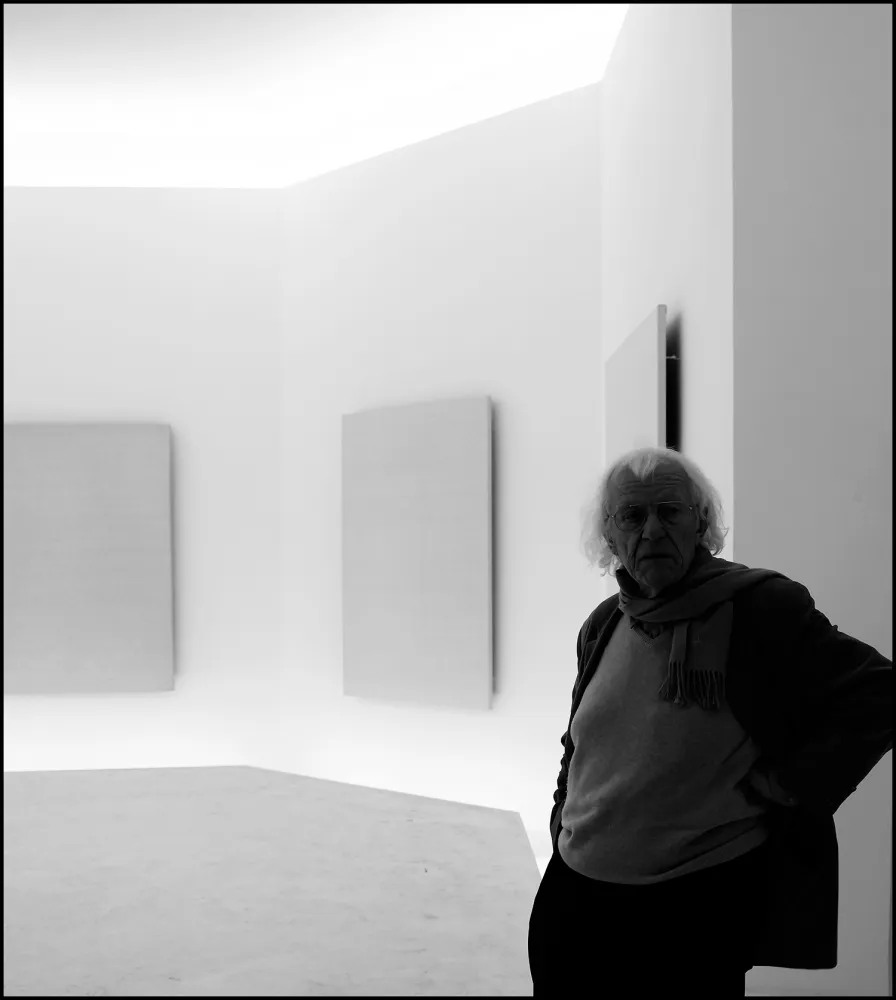
Opałka differs fundamentally from many artists known to us because he practises neither self-knowledge nor self-realisation. Nor does he impose his emotional world on others. All this lies outside his intention. The systematic succession of numbers in a mechanical order can be grasped rationally. It does not contradict his artistic motivation, because it does not anticipate the measure of expectation. Nor do the numbers serve as a measure of expected results. The conclusions produced by this give rise to a spiritual movement that, once dematerialised, attains an independence of its own.
After painting a white square on a white ground, Kazimir Malevich exclaimed: “I have pierced the blue lampshade of the sky and reached white” — white, that is, infinity — and then announced the end of painting. Opałka contradicts this formulation, because there is no end within infinity. The climactic experiences Opałka describes when identical digits recur — 11, 22, 222, 55555 and so on — belong to the artist’s subjective sensation, which cannot be transferred to the viewer without creative identification. Nor is this Opałka’s intention, because the experience arose accidentally and unexpectedly. It nevertheless makes us aware that anything unpredictable may occur during the process. Even the most precise advance calculations cannot guarantee the expected result.
Opałka’s idea arose at a time of great turning points, when industrialised materialism had taken control of everyday life. Henryk Stażewski said at the time: “Thoughts travel fastest: where they come from and where they are rushing, no one knows. If you managed to capture a single thought, that would be art.” I am convinced that Opałka’s idea was captured in a similar way. His decisive commitment enables us to penetrate unidentified dimensions. Through that decision, he opened a universe in which to exist. Within it, he finds opportunities to approach the essence of infinity. With his double-sided wooden book entitled The Endless Sentence, Eugen Gomringer says everything through his internal “you”. Only the “you” has the right to speak about itself, because no one else can exist within the “you”. The question arises: why do we struggle to find words with which nothing is said?
My reflections do not define Opałka’s ideas. They are merely introductory observations, pointing towards states we may not yet have recognised. This territory requires insight and quiet concentration. Perhaps we will then discover the riches of our own sensitivity. At the opening of the exhibition Freiraum, Ryszard Stanisławski, the former director of the Museum of Art in Łódź, said that most people cannot distinguish natural honey from artificial honey. This is precisely the problem: we have not yet acquired a universal language suitable for operating with concepts that exceed mechanically understood habits. Opałka does not address this problem. He stands above such considerations, avoiding shaping, decorating and constructing, and refusing to serve any function. His art, which enables the discovery of one’s own values, consists of demands directed solely towards himself. Such an attitude crosses the thresholds of art as traditionally understood because it draws attention to unknown territories. When we speak of development in thought, we do not find it in what is familiar. We must pierce the shell to discover how many mysteries await us; they will remain concealed until we take possession of them. Through his programme of Social Sculpture, Joseph Beuys attempted to enter a realm of energies unknown to us. His intention was noble, yet he did not succeed in elevating art through associations, events and phenomena. He became mired in preaching. Instructions and stories will not resurrect contemporary thought. Opałka avoids offering guidance that, in any case, could not detach us from external dependencies. These reflections came to me while visiting Opałka’s exhibition at Dresden’s Royal Palace. I was overcome by a state difficult to describe in words. I felt an ethereal liturgical breath, making me aware of a force that carried me beyond all imagination. I sensed that I was bound into and fused with a transcendental message proceeding from the artist. This did not make my emotions more sensitive, because it was something more than an imagination referring to familiar phenomena. One is tempted to say that being is a state of pure liberation.
Various stories mention different states of spiritualisation during which imaginary images appear. In my view, this involves a misunderstanding, because spiritual realms are not projections of materialised forms. And why should they be? The human being strives to rise above an imagination imposed by life and to reach the essence, not in order to materialise it.
Katarzyna Kobro decomposed the solid form into line and plane, annexing space. Her aim was to include the surroundings in the idea of her art. This became a major event in the art of the first half of the twentieth century, although her epigones do not assign it great importance. Opałka goes further, because he incorporates the invisible fullness of “nothingness”, thereby revealing the existence of eternally present being, an all-encompassing force.
We exist not because of the functions we produce, but through the force and energy emanating from the constellation of the universe. By becoming conscious of these laws, which have not yet been formulated, life can acquire new meaning. The struggle for existence obscures our knowledge of and faith in unknown beings, and it is for precisely this reason that we assign such a major role to art. Complicated situations arise in everyday life and produce a sense of helplessness. No one succeeds in mastering them without difficulty. Opałka’s path leads towards liberation from every accretion that prevents us from penetrating the depth of truth. He also avoids imagining phenomena built on mythological symbols and entangling the viewer in invented relationships.
The first encounter with an Opałka work liberates us from expectations that remain unfulfilled. His works generate a spiritual breath, producing a state of elevation in which emotional longing disappears while a new, unprecedented space opens before us. We appropriate it and wish to remain within it without coercive obligation. The symbiosis between works and person creates a cohesion of spirit, force and energy that defines itself. I understand the systemic language of numbers as a means of establishing contact with an unimaginable reality. His work cannot be compared with the familiar reflections on art with which we are bombarded daily. Roman Opałka’s message is an unceasing journey into the unknown. In this way, he supports our sensitivity so that we may find unimaginable content within ourselves. We will then discover the fullness of our existence. Fear and hope obstruct this understanding. Neither permits us to become courageous in making decisions about our own lives. Art does not become art merely by ceasing to be a commissioned service.
In remaining faithful to his principles, Opałka pays with his life. Thought, work and life merge into a whole that creates an attitude. They do not glorify, nor is it my intention to elevate him. Opałka was capable of rising by himself, without recommendation.
I have refrained from attempting an analytical grasp of the laws governing Opałka’s art. That would be the task of a scholar verifying the method, idea and value of the achievement. Nor have I assumed the role of censor, because, in the absence of precedents, I consider such an undertaking unjustified.