
ROMAN LIPSKI
Volker Schlöndorff
The disquieting colour of the sky and the noticeable consistency with which he painted it were the first things that struck me in his very early pictures – and that has not changed since. When driving at dusk, I often think: a Lipski sky. It dominates everything below, not through its beauty or dramatic clouds, but through the troubling premonition it carries. Is it a threat? A mysterious danger, as in a Stephen King novel? That is precisely how it is in Lipski’s American landscapes. Every idyllic barn, every seemingly welcoming New England façade appears to conceal some secret behind its closed doors. Even the bluest of his skies, the whitest cloud, conveys no peace. There is a latent violence.

Without doubt, his Polish villages, birch trees and socialist-style buildings made of prefabricated cheap concrete are as sad as the sky above them, though in a more melancholy way. A thin white line marks the boundaries of cosy pre-war farmsteads and separates them from the brutal concrete elements around them. The buildings persist beneath skies in colours never encountered in nature, yet perceived as entirely naturalistic. Sometimes a human figure appears, venturing into these rural or industrial landscapes, which in fact resemble film sets for stories of loss, grief and concealed violence.
Although beauty emanates from Lipski’s paintings, it is the beauty of an elegy – we know that loss and metaphysical sorrow function in them as aesthetic figures. They remind me of the work of Czesław Miłosz, a poet who often expressed grief at the modern cruelties he witnessed in Central Europe. We can immerse ourselves in sorrow while taking pleasure in the artistic expression of these works, knowing that they do not take place in the real world but belong to the world of art.
Translated into Polish by Agata Mendrychowska
*Volker Schlöndorff, German director of numerous feature films and documentaries, awarded an Oscar and the Palme d’Or at Cannes for his film adaptation of Günter Grass’s novel The Tin Drum. Professor of Film and Literature at the European Graduate School (EGS) in Saas-Fee, Switzerland. His autobiography Licht, Schatten und Bewegung was published in 2008 (Polish ed. Światło, cień i ruch. Moje życie i moje filmy, 2009).
If we accept that a painting exhibition can provide emotions and visual impressions akin to those of a film – itself a story composed of images or frames – then the paintings of both László Fehér and Roman Lipski carry the kind of tension familiar from cinema.
In Dinner of a Homeless II (2011), László Fehér depicted two blue forms against a uniform black background: a figure turned away from the viewer, wrapped in a blue hooded coat, and a rubbish-filled container beside it. The elements of the painting are isolated by being placed against the black ground, suspended in darkness, outside time. The contemplative, mysterious mood and the blue of the figure’s coat evoke sacred imagery and portraits of saints. The expressiveness of the scene is muted by the blue that predominates in the painting. At the same time, the black ground breaks through the torn coat into the figure’s shape. It is also unsettling that the figure has its back turned and its body is hidden beneath voluminous clothing (we cannot even be sure whether it is a man or a woman). The representation is anonymous, which may prompt a momentary identification with the figure in the painting and a simultaneous rejection of that thought. The eye is drawn to a red dot at the centre of the picture, recognisable as a Coca-Cola label. This element locates the scene in time, in the present day. In the context of the homeless figure, the Coca-Cola bottle acquires an ironic resonance. It featured in Pop Art works criticising consumerism. According to the artist, the cycle of paintings depicting homeless people is intended to reflect the social conditions and problems of post-communist Hungary.
Looking at Fehér’s paintings sometimes brings to mind the work of the Old Masters: through the literary layer of the image, the metaphor, the representation of a human being in a situation of suffering and solitude, but also through its visual aspect – here, the blue and contemplative character of Vermeer’s paintings. Other works make postmodern references to canonical figures in art history: Georges de La Tour, Caspar David Friedrich and Rembrandt.
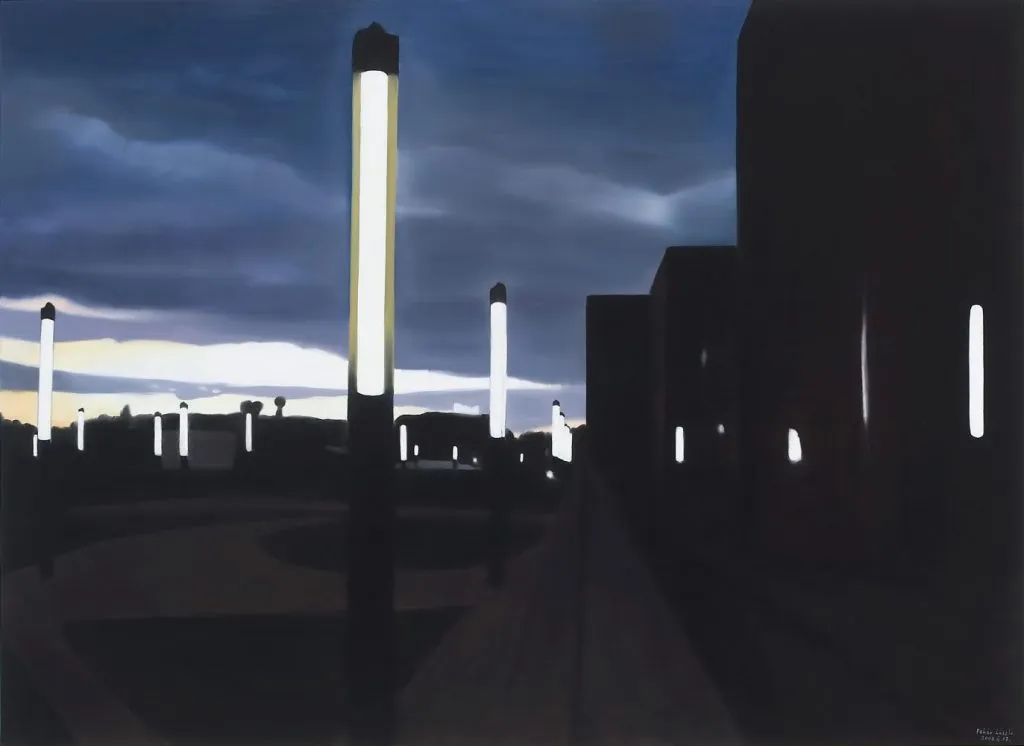
Fehér’s paintings are often inspired by the city’s nightlife. A cold light, like a flashbulb, illuminates his portraits and nocturnal scenes. The artist is an observer, like a photographer or flâneur. The everyday scenes in the paintings, mysterious by virtue of their nocturnal character, become metaphors of transience and melancholy: a child on a park avenue, a woman gazing at a distant glow, an arrangement of shining lamps forming a futuristic landscape. The self-portrait with a skull is likewise allegorical: the contrast between the symbolic element of the skull and a representation torn from the context of everyday life creates a surreal situation and tempers the pathos.
References to the canon of art history and the tension they generate through contrast with a contemporary representation are present in many of Fehér’s paintings. In a tondo format, used since the Renaissance in religious painting, especially for depictions of the Virgin Mary, Fehér portrays an Asian-featured woman against a yellow, gold-like ground (Wife of Molodkin, 2012). The fluorescent lights forming a halo around her head are, however, merely the lighting of a car park or underpass, which provides the setting for the portrait. Untitled (2010) is likewise a tondo; it could be seen as a continuation of the motif from Rembrandt’s Slaughtered Ox, a vanitas theme painted by many artists from Soutine to Bacon.
In the interview published in this catalogue, Fehér speaks of his inspiration by the Hungarian artist Lajos Vajda. This applies particularly to paintings in which human figures are constructed solely from outlines. Vajda’s linear Self-Portrait with a Skull (1936) – by an artist associated with the Parisian Surrealist circle – is likewise built entirely from contour lines, without modelling in light and shade or colour. The contrast between the dark ground and the empty figure creates an effect of reversal, a negative. The metaphorical significance of this device is defined by the skull and crossbones on the figure’s forehead. In a similar way, the figure in Fehér’s painting of a man in white clothes and a hat against a colourful landscape, Landscape III (2005), is cut out from its background. The chromatic tension between the whiteness of the figure and its surroundings makes us unsure whether this neutral figure belongs to the reality of the painting. The same applies to the boy in Landscape (2004), who looks as though he has found his way into the picture by chance, too close to its left edge.
Outline figures appear, among other places, in black-and-white tondo paintings of symbolic significance to the artist, who says of the first circular painting he made: ‘I wanted to paint a portrait of a friend of mine, but she died. During her funeral I felt that an enormous black hole suddenly surrounded me. There was something round and untouchable there. My dead friend appeared within it; she was transparent. She was smiling. So when I came home, I tried to paint her in her characteristic teddy-bear hat’1.
Fehér’s tondo paintings depict the uncanny – elements that are familiar (a swan, a human figure) and at the same time alien and mysterious (the swan as a vehicle, the unfilled outline of a human figure). This uncanniness produces a sense of unease. The same occurs in Roman Lipski’s paintings.
Nature as depicted by Lipski can be hostile, like the organic form entering the world of one of his paintings. It begins beyond the frame, as the composition suggests, and its scale in relation to the buildings depicted lends it an absurd, uncanny character. The climbing tendrils of this mysterious form, spreading and reaching towards the buildings, together with the colours of the painting, create an atmosphere of threat.
Defamiliarisation, mystery and the uncanny are elements of Roman Lipski’s language. Just as we do not quite know what the organic form entering the painting is, neither are there simple answers concerning Lipski’s other pictures. One of them, made after his journey to the United States, depicts a typical American house; yet the expressive patches of vegetation obscuring a red-hued sky, the stairs and railings running like a maze along the façade, and the grasses climbing them like flames make it impossible to pass the picture indifferently. The enigmatic nature of the scene transforms the painting into part of a story, a suspended moment in a film, before or after some event. The house in Lipski’s painting could be the site of a drama like the one in Alfred Hitchcock’s Psycho, whose appearance was itself inspired by a painting by Edward Hopper.
The composition of another picture, showing a house with railway tracks in the foreground, is a fairly legible reference to the American artist’s The House by the Railroad (1925). A dark wall of strange forest rises above a building with an old-fashioned New England façade. On closer inspection, one notices that where the roof ought to be, the painting contains a dark patch of undergrowth. If this were the artist’s intention, the attic windows would be suspended in mid-air without any support, as in the spectral house in another painting showing a building’s façade at close quarters.
In one interview, Roman Lipski says that painting is emotion for him. The pictures he painted last year approach expressive abstraction. His choice of colours is accidental, but it may determine the viewer’s associations – with a winter landscape, for example. This is not, however, a depiction of the naturalistic world. The artist draws inspiration from the digital, fictional world of the computer game Skyrim, which imitates the natural world of the landscape in an almost abstract manner.
The dynamism of the sharp angles in the painting and the band of irregular black-and-white patches running through it is so expressive that, in this abstract landscape, it could be an avalanche or a rushing stream heading straight out of the painting towards the viewer standing before it. It conveys drama, whereas László Fehér’s paintings conceal drama beneath the surface of representation, within the narrative layer.
In Roman Lipski’s earlier works, which were landscapes, nature was likewise often not rendered literally. It surprised with geometric shapes and unnatural colour.
In one painting, a dark patch (perhaps a wall of forest or an enormous hedge), cut off vertically, towers over a cluster of houses and forms a geometric composition with the red patch of sky above. The houses surrounded by such a landscape appear abandoned.
Because nature is an element of our everyday lives and of the world around us, it becomes a universal language of artistic expression intelligible to viewers. As in the Romantic paintings of Caspar David Friedrich, it carries mood and emotion. Over time, however, the artist increasingly distances himself from depictions of nature, moving away from them towards abstraction.
One possible association with Lipski’s pictures of nature bordering on abstraction is provided by Fehér’s landscapes in shades of yellow and pink with patches of green, where solitary figures gaze into the distance as in Friedrich’s Romantic paintings. Yet the characteristically contemporary distance from nature – also visible in Lipski’s abstract landscapes inspired by a computer game – is contained in a painting in which a figure looks at nature through the screen of a digital camera (Photographing the Landscape, 2005).
Roman Lipski’s latest paintings were inspired by Gustave Doré’s illustrations to the Bible. Doré’s nineteenth-century illustrations abound in macabre scenes and expression. Consider the one depicting David just after he has defeated the giant Goliath. David presents the crowd with Goliath’s head, severed from the body lying on the ground with its entrails protruding. That head, the crucial element generating tension, has been taken by Lipski from the context of the illustration and placed against a red ground suggestive of blood. This may offer a clue to how the artist’s paintings should be read. The intensity of the story remains within him, while the narrative is not transferred to the canvas. Roman Lipski’s paintings have no titles and are therefore open to the viewer’s interpretation. Looking at a painting, the recipient creates their own story. Colour has a part to play in this, giving it emotional expression.
What links the sensibilities of the two artists is an awareness of what arouses unease, of the uncanny, and of what is connected with the passage of time and the subconscious. Yet the element that constructs the exhibition is contrast. Roman Lipski’s emotional and dramatic paintings complement László Fehér’s narrative and measured painting in the exhibition.
1 Pauline Faure, László Fehér mysticism and realism. Interview with the artist in his Tác studio, Hungary, 30 September 2011, [in:] László Fehér [exhibition catalogue, Musée d’Art Moderne de Saint-Étienne Métropole], Milan, 2011, p. 39.
*Agata Mendrychowska, art historian and book editor, whose credits include Wojciech Wilczyk’s Niewinne oko nie istnieje, Teresa Tyszkiewiczowa’s diaries Notatki (1940–1983), and exhibition catalogues. Curator at Atlas Sztuki.