
László Fehér – Roman Lipski
Magdalena Lewoc
More than twenty years after the fall of the Iron Curtain, we should not be surprised that the first contact between the Polish painter Roman Lipski1 and the Hungarian painter László Fehér2 came about thanks to a Munich gallerist representing both artists3. More puzzling and symptomatic is the fact that Fehér, one of the more compelling contemporary painters, has so far remained largely unknown in Poland4. The same was true until recently of Lipski, whose first solo exhibition took place at Atlas Sztuki several years ago5.
Atlas Sztuki, which has followed Lipski’s artistic career since the first presentation of his paintings, is thus once again assuming the role of promoter of significant artistic phenomena that are little recognised in Poland. By showing a dozen or so canvases by Fehér alongside Lipski’s latest paintings, it enables the two artists to meet in person and to enter into a dialogue that, until now, has been mediated.
Before the decision to hold the exhibition in Łódź was made, however, an intrigued Lipski looked at Fehér’s paintings and noted with disbelief how evocative and contemporary a formula of figurative painting the latter had developed as early as the mid-1980s, long before the European painting boom began exploiting a similar aesthetic. Fehér, for his part, praised Lipski’s painting.
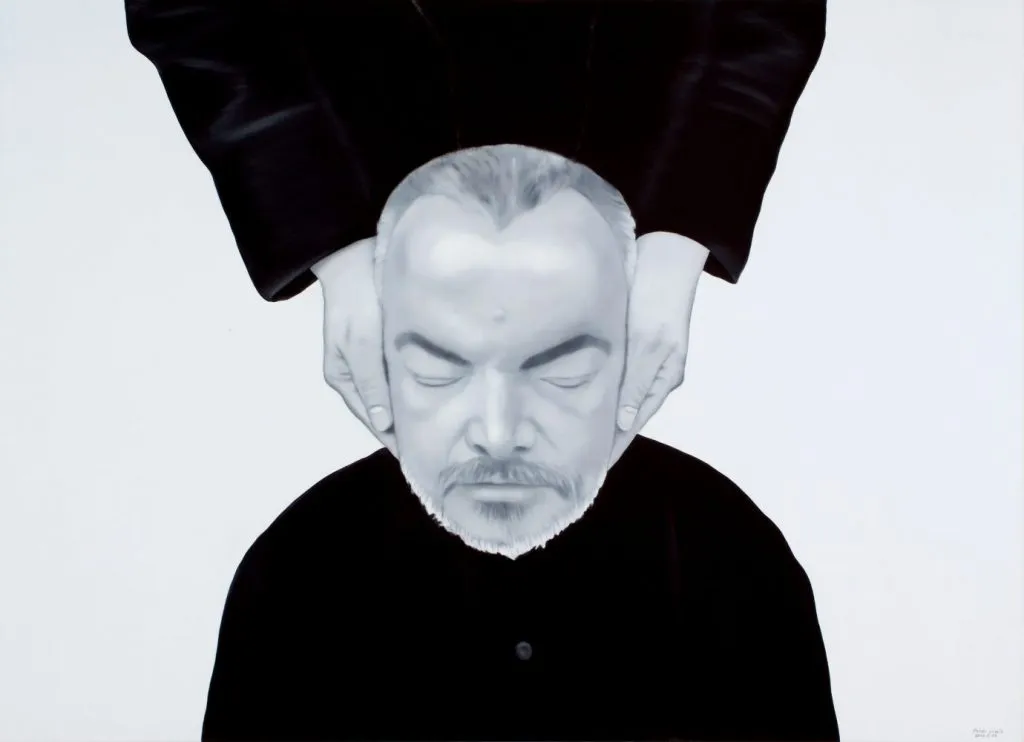
The two artists’ mutual curiosity has solid foundations. They have much in common: above all painting, the sole and exclusive medium of artistic expression they use; photography, with its distinctive methods of framing and recording reality, as the initial impulse behind their paintings; a personalised palette of colours, reduced and strongly contrasting; monumental compositions; and large-format canvases.
The analogies go deeper: both are outstanding painters with a perfect command of their craft, and both have developed an individual formula for the image based on a distinctive iconographic repertoire.
Yet the energetic potential of the painterly dialogue between Fehér and Lipski lies not only in formal coincidences. Nor is it created solely by the conviction that, in both cases, we are dealing with exceptional painting.
Is there, then, something more? Some subtler, less obvious realms to which Fehér’s and Lipski’s imaginations refer, making the confrontation between their work more than a meeting of two individualised, independently developed painterly worlds?
It seems that this less tangible bond between Fehér and Lipski is emotional rather than formal. It is formed by the surreal, spectral quality of the paintings, the disquieting relationship between the figures and objects appearing on the canvases and their surroundings, and the poetics of painterly space.
A melancholy aura, emptiness, reality captured on the threshold of mystery, nostalgic loss and the work of mourning are the interpretative threads that recur most often in critical texts accompanying the work of both painters. It was in this register that Lóránd Hegyi6 and Donald Kuspit7, among others, analysed Fehér’s paintings from the 1980s and 1990s, when the artist was establishing his distinctive canon of imagery.

Dominikus Müller8 and Christoph Tannert9 located Lipski’s canvases from several years ago, when he was entering the art world and gaining wider recognition, within similar registers. Where, then, might we look for the source of this particular aesthetic and sensibility?
Any attempt to answer this question invariably leads to an analysis of contexts. After all, it is context—or, to use Derrida’s term, the frame—that, as Piotr Piotrowski writes, is active and gives meaning to whatever covers the pictorial field. Or, put differently, it is we who perceive meanings through a process of ‘framing’, by virtue of our experience and sensibility10.
Within the network of possible contexts, cultural and historical coordinates—and therefore everything that determines the sensibility of both artists and viewers—are crucial. And at the level of collective experience, the biographies of Fehér and Lipski coincide to some extent.
Both were born ‘east of the West and west of the East’, or, as Milan Kundera writes in his famous essay, in a place full of contradictions which, after 1945, was geographically Central Europe, culturally the West and politically the East11. They grew up in a strange and ambiguous corner of Europe that experienced ideological extremes, where history returned as an insistent refrain. In a place that produced a kind of existential tension and a unique, ambivalent symbolic capital that is difficult to shed permanently and, at deeper levels of consciousness, probably impossible to escape altogether. In Central Europe—a semi-phantasmal space existing more within mental than actual geography, because, as Kundera concludes, it cannot be strictly defined: it is not a state, but a culture and a fate.
Even though Lipski’s and Fehér’s individual lives took different paths, and they observed the complex processes of post-communist transformation from different perspectives—Lipski emigrated from Poland to the West in the late 1980s and found his place on Berlin’s patchwork, cosmopolitan scene; Fehér never permanently left Budapest, either before or after the fall of the Berlin Wall, and built his international career from there—the imaginary of Central Europe, like its emotional climate with its sense of uncertainty and tension inscribed in the individual’s fate, and a certain psychological disposition not encountered elsewhere (about which Czesław Miłosz wrote repeatedly12), remains legible in the paintings foundational to both artists’ work (in Fehér’s case, canvases from the 1980s and 1990s; in Lipski’s, those from the first decade of the twenty-first century), echoing in their current projects.
Before turning to the significant shift in emphasis and the latest canvases presented at Atlas Sztuki, it is worth pausing over those paintings in which the distinctive semiotic and ideological space of another Europe made itself poignantly heard, and its explosive potential found extraordinary visual articulation.
In Fehér’s case, the ‘bite’ of Central Europe manifested itself, among other things, in his attitude towards grand history—in his distance from it and, at the same time, his strong dependence upon it. Different planes overlapped here: on the one hand, the experience of communism, which in this part of the continent was not merely an intellectual game or an ideological flirtation; on the other, the memory of the Jewish presence (and subsequent absence), upon which the twentieth century left a painful and indelible mark, and an awareness of the spectre of antisemitism haunting the region. This second plane was further intensified by Fehér’s personal encounter with Judaism13. In this context, the half-real, half-surreal, silent presence of spectral outlined figures poised on the boundary between life and death—which Fehér masterfully confronted with disquieting, alien and impenetrable space—acquired ambiguous, dark meanings rooted in the local context14. The archaeology of the everyday practised by Fehér was thus no longer merely an innocent painterly transposition of photographs found in family albums, but a metaphor for the contingency and fragility of individual human lives crushed by totalitarian machinery. Fehér’s elegiac painting of that period, exploring questions of memory and violence, did not communicate its content directly. It did so through uncomfortable images in which form becomes the principal means of expressing the inexpressible without lapsing into brutal literalness.
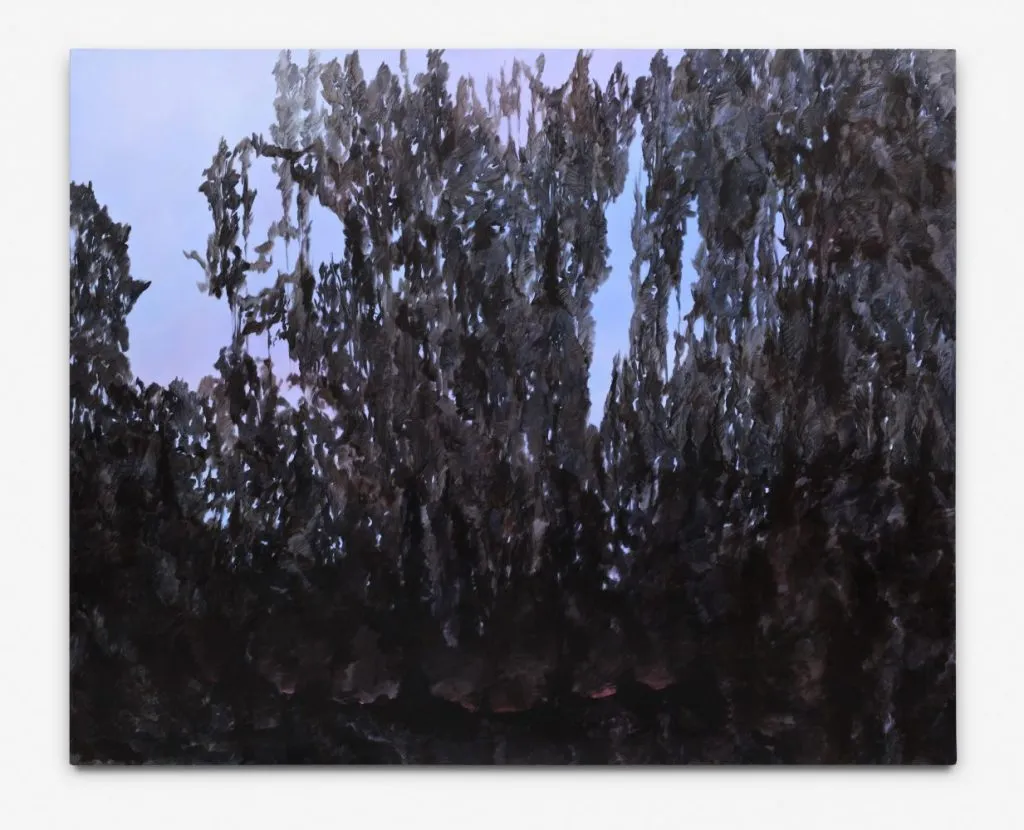
The distinctive nature of Central European sensibility in Lipski’s first mature paintings may be observed in their tender exposure of the greyness and aesthetic poverty of the local landscape, captured by the camera at the moment when that landscape was beginning to undergo dynamic, if chaotic, change. In these works Lipski referred above all to visual experience, to moving and often painful observations of reality. Many of the canvases produced at the time were inspired by post-communist realities and the ambivalent potential of the transformation period. Motifs of abandoned houses, housing estates and post-industrial relics returned obsessively—phantasmal images of a world suspended between past and future in an empty, threatening and therefore fascinating space full of ellipses. The power of these images rested on paradox: ugliness reveals a melancholy beauty; mute, anecdote-free scenes suggest layered, ambiguous and emotionally dense content. There may be no people here, yet it is difficult to resist the impression that Lipski’s paintings from that period are a fatalistic visual metaphor for human fate, always anchored in time and space and always burdened with some history.
Within this thematic framework, on the ground where historical, anthropological and personal layers intersect—turning towards the past (Fehér) and observing the fleeting nature of a world passing into oblivion (Lipski)—both artists developed, relatively early, shortly after the age of thirty, an original formula of painting in which the image became a complex emotional and formal instrument activating the viewer’s sensibility.
Yet the artistic practices of Lipski and Fehér, responding to impulses arising from their observation of reality, inevitably had to change in step with the fundamental transformations taking place around them. Their surroundings have evolved at an exceptional pace over recent years. After the fall of communism, Central Europe, with all its mental baggage, found itself within a far more complex global configuration and a sphere of transregional processes and experiences. History began to be displaced by the force of the present; geography by topography; while regional frameworks were burst apart by a new, transregional cosmopolitanism15.
Before our eyes, the once attractive and resonant concept of Central Europe as an imagined community began to lose its cognitive appeal, slowly passing into the history of ideas.
Fehér’s and Lipski’s painting did not remain indifferent to these new realities and processes. After 2000, a crucial reorientation occurred in Fehér’s work: the themes of memory and the exhumation of troublesome images gave way to the observation of reality in statu nascendi. Photography remained the principal tool for extracting individual shots from the stream of other images, but these were no longer frames from the family archive; they were photographs taken by the artist himself, showing people (or places) close to him. The figures portrayed are usually framed in unconventional ways—Fehér favours close-ups that sometimes distort bodily proportions, producing surprising visual effects. He increasingly counterpoints the ethereality and illusory presence of outlined figures with the material substance and specificity of the human body. At the same time, a new and compelling self-analytical strand appears in his painting, developed in a series of self-portraits.
In considering the turning point in Fehér’s work, Alexander Tolnay invokes Barthes’s concept of biographemes—significant elements linking an individual biography with history and giving rise to creative processes. He locates the reason for the reversal in the direction of Fehér’s work in the artist’s post-regime change of circumstances: having previously worked within a complex system of institutional and ideological restrictions, Fehér now consciously turns away from socio-political melancholy towards an optimistic focus on the here and now16. The artist himself spoke of a ‘temporal turn’ in one of his most recent interviews: ‘My figures are here and now; they do not communicate with the past, do not try to build a bridge to the future, and exist solely in the present, at the moment in which they were created’17. Yet when looking at Fehér’s new paintings, it is difficult not to feel that he has not eliminated from the background of the affirmed present the ellipsis and unease that defined his earlier painting—the tension between alienated, often solitary figures and the mysterious, impenetrable space surrounding them. In this sense, the reflective note of painting focused on the ephemeral nature of life continues to resonate in them.
And the new paintings write another chapter in a visual treatise devoted to the human condition.
In Lipski’s case, a similar process of shifting emphases while retaining the atmosphere of earlier paintings may be observed in recent years. Themes associated with post-communist scenery appear with diminishing frequency and are more often counterpointed by motifs drawn from culturally and geographically different regions18. Lipski himself emphasises that he is interested not so much in the critical observation of a reality subject to particular social and historical fluctuations as in openness to change, to the dynamic nature of reality in transit. He moves consistently towards increasingly phantasmal visions, initially still anchored in empirically experienced reality but soon referring to a digitally generated one. The paintings created recently become ever more surreal: houses begin to shake on their foundations, tongues of flame consume them, patches of red blast them from their foundations. The oneiric colour palette and catastrophic motifs further heighten the aura of the uncanny (das Unheimliche) so characteristic of Lipski’s paintings, experienced when something appears simultaneously familiar and strange—close yet threatening—giving rise to discomfort. In his most recent canvases, without abandoning his characteristic ways of creating tension within the image, Lipski expands the range of his artistic inspirations by referring to contemporary cyberculture. The starting point for this series is no longer photography, but visionary virtual simulations of reality. Painterly masses become dramatically dynamic and interpenetrate, at times creating a multidimensional space that transcends the constraints of Euclidean geometry. Lipski balances on the threshold of pure abstraction, although the painted motifs can still be identified as creatively transformed fragments of a mountainous, picturesque and menacing terrain. The hallucinatory tone of the series is intensified by a confusion of planes: familiar abandoned dwellings appear in an alien, bizarre setting, now drifting through a space no longer subject to the law of gravity.
The latest works by Fehér and Lipski certainly place both artists within the broad international circle of artists exploring today’s all-important world of the image; both also transcend regional contexts and limitations. Their painting practices are constantly evolving, responsive and open to the changes of a new cosmopolitan and global culture. Yet they retain a distinctive artistic identity, bound together by a particular painterly sensibility. One may venture that this sensibility is grounded to a large extent in their shared formative experience of the complex legacy of ‘another Europe’, which today helps shape the exceptional force and originality of the painterly idiom that each has succeeded in developing.
*Magdalena Lewoc, curator and art historian. Author of numerous exhibitions of contemporary art in Poland and abroad. Co-author and coordinator of the Mare Articum programme devoted to promoting contemporary art in the Baltic Sea region. Curator of several editions of the Baltic Biennale of Contemporary Art. Co-author of the profile and development strategy of the Zachęta Regional Collection of Contemporary Art in Szczecin. Since 2005, she has headed the Museum of Contemporary Art in Szczecin (a branch of the National Museum in Szczecin).
1 Roman Lipski was born in Nowy Dwór Gdański in 1969. In 1989, he moved permanently to Berlin, where he pursued painting independently. In the mid-2000s he was discovered by Erich Marx, one of Germany’s better-known collectors. Thanks to his talent and the collector’s support, Lipski entered the professional art world and rapidly built a brilliant career.
2 László Fehér was born in Székesfehérvár in 1953. He graduated from the Hungarian University of Fine Arts in Budapest (1976). He made his debut in the mid-1970s. One of Hungary’s most highly regarded painters, he has been present on the international art scene since the early 1980s.
3 The first, virtual contact between Lipski and Fehér was made possible by both artists’ collaboration with Ralf Dellert of Sophisticated Art in Munich.
4 Fehér’s works have been shown in Poland only three times, and exclusively in the context of group exhibitions: at Zachęta in Warsaw, in presentations of Hungarian art in 1990 and 1998 respectively, and at BWA Sokół in Nowy Sącz as part of the programme Galicia: Topographies of Myth in 2012.
Piotr Piotrowski discusses the reasons for the mutual lack of knowledge about art in the countries of the former Eastern Bloc in: Agorafilia. Sztuka i demokracja w postkomunistycznej Europie, Poznań 2010, p. 72.
5 Roman Lipski, Atlas Sztuki, 2010.
6 Lóránd Hegyi, László Fehér, 1997. Text available on the art-hungary.net portal.
7 Donald Kuspit, László Fehér: Memory and Abandonment, 1997. Text available on the artist’s website: www.feherlaszlo.hu
8 Dominikus Müller, in: Roman Lipski, Birgit Ostermeier Galerie, Berlin, 2008.
9 Christoph Tannert, in materials accompanying Lipski’s solo exhibition at Kunstverein Lippe—Lippische Gesellschaft für Kunst in Detmold, 2009.
10 Piotr Piotrowski, W stronę nowej geografii artystycznej, ‘Magazyn Sztuki’ 1998, no. 19, p. 83.
11 Milan Kundera, Zachód porwany albo tragedia Europy Środkowej, ‘Zeszyty Literackie’ 1984, no. 5, p. 15.
12 See, among others: Czesław Miłosz, Rodzinna Europa, Wydawnictwo Literackie, Kraków 2001.
13 Fehér became interested in Judaism and Jewish matters in his early youth. In the mid-1970s he decided to convert. He has been an active member of Budapest’s Jewish community ever since.
14 Piotr Piotrowski wrote about the significance of Fehér’s work in the context of Hungarian and Central European art before 1989 in: Awangarda w cieniu Jałty. Sztuka w Europie Środkowo-Wschodniej w latach 1945–1989, Poznań 2005, pp. 444–445.
15 Piotr Piotrowski wrote about the processes observed after 1989 and the twilight of Central Europe in: Agorafilia. Sztuka i demokracja w postkomunistycznej Europie, Poznań 2010.
16 Alexander Tolnay, Fehér László, 2002. Text available on the art-hungary.net portal.
17 Interview with Gudrun Szczepanek, in: László Fehér – Déjà-vu, Sophisticated Art, Munich, 2014. See pp. 7–10 of the catalogue.
18 I wrote more extensively about this period in Lipski’s work in 2010, in a text accompanying his solo exhibition at Atlas Sztuki.