
The Violence of Seduction
Marta Skłodowska
The art archive at Beeskow Castle is a collection — or rather an assemblage — of paintings from the northern regions of what was once known as East Germany. A second, similar collection is held in Dresden. After 1989, paintings for which there was no longer a place in the new reality were brought to Beeskow, a small town not far from Frankfurt an der Oder. They came, among other places, from industrial plants being closed down — once among the most important commissioners of art — and from various unions and associations, including youth organisations, central offices, cooperatives and local party headquarters. They documented the labour of building socialism and, at times, leisure spent in a prescribed manner; they portrayed people who were icons rather than individuals. In this way they were intended to communicate and replicate a particular image of the world. Agitation, seduction and attractiveness formed the brighter — indeed quite colourful, and today even capable of arousing nostalgia — side of a system based on coercion, violence and punishment1. They aestheticised power, giving it form and displaying its smile and optimism.
There is nothing extraordinary about this: consciously or not, art is usually a vehicle for particular ideologies, or simply for the ideas of its time. Yet what did the greatest harm to some of the paintings on display was that totalitarian systems regarded this aspect of art as the principal measure of its artistic value.
For precisely this reason, even though twenty-five years have passed since the fall of the Berlin Wall — the symbol of the Cold War that divided Germany along the boundary between the Soviet and American occupation zones — it remains unclear how East German art should be treated. In fact, the only extensive presentation to demonstrate that the history of German art did not unfold on just one side of the Wall was Art of Two Germanys/Cold War Cultures, organised in the United States for the Los Angeles County Museum of Art in 2009. It showed that, considered together, the two strands of German art complement one another and allow us to understand more fully the tension between them and between the sets of ideas behind each side. Both, after all, promised a simple recipe for happiness, a remedy for the tragedies humanity had endured: social harmony, future equality and freedom.
Viewed chronologically, the paintings can convey the dynamics of the entire system, which resulted from historical events shaping the relationship between the authorities and citizens.
The idea that art should present a particular vision of the world was nothing new in Germany. The category of de-generate art had already been devised and opposed to an idealising, classicising and illustrative art that presented the correct models. This time, however, the immediate source of forms that monumentalised and heroised everyday life was the USSR.
The wounds of war were given no time to heal. Subjects such as the extermination of the Jews remained entirely unprocessed, while efforts began immediately to consolidate socialist ideas and glorify the state and the workers. The only permissible wartime subjects concerned the communist movement’s struggle against Nazism. The construction of an earthly paradise was painted in the 1940s and continued into the 1950s. Everyone has dreams and fears. Here the dreams were to be shared and the fears lulled to sleep. Even the construction of the Berlin Wall in 1961 — intended to halt the exodus from East to West Germany — was presented, absurd as it seems today, as an attempt to protect the GDR from external dangers and harmful influences so that its citizens could continue to live in peace. Yet the Wall’s builders’ true intentions permeated art in a certain way, through the recurring motif of an open window or door in many paintings of the period.
Looking at many of these paintings from the heroic period of socialist construction and the artistic means they employ, it is all the more astonishing that, under comparable conditions, masterpieces of form and ambiguity such as Aleksander Kobzdej’s Bricklayers and Wojciech Fangor’s Figures could emerge in Polish Socialist Realist art. In East German art, ambiguity and authorial commentary are extremely rare. Anything individual, uncompromising, different or outside the norm is almost entirely removed from view; what remains are empty representations, “dull certainty and emotional suppression” (as Ewa Toniak described it in her book Giantesses). At the same time, one of the phenomena of today’s German art market — the Leipzig School, associated with the Academy of Fine Arts Leipzig (Hochschule für Grafik und Buchkunst) — originated in the GDR art of the 1960s. It was shaped by artists such as Wolfgang Mattheuer and Arno Rink, and later continued by Rink’s pupil Neo Rauch, one of German art’s brighter stars. Its distinctive character and success were determined precisely by the combination of figuration and design rooted in the aesthetics of the GDR with a palette characteristic of the period and capable of arousing nostalgia.
Official painting, however, still left no room for reflection. The creation of an idyllic iconosphere continued even after the 1963 trials of Auschwitz perpetrators revived the subject of the previously forgotten and repressed legacy of the Second World War. This found powerful expression only in the work of artists who managed to emigrate from East to West Germany, reaching its fullest form in the art of Georg Baselitz, one of Germany’s most important artists. For Baselitz, this experience became the source of his poignant, characteristically Expressionist treatment of the human figure, often turned upside down like the damned in scenes of the Last Judgement.
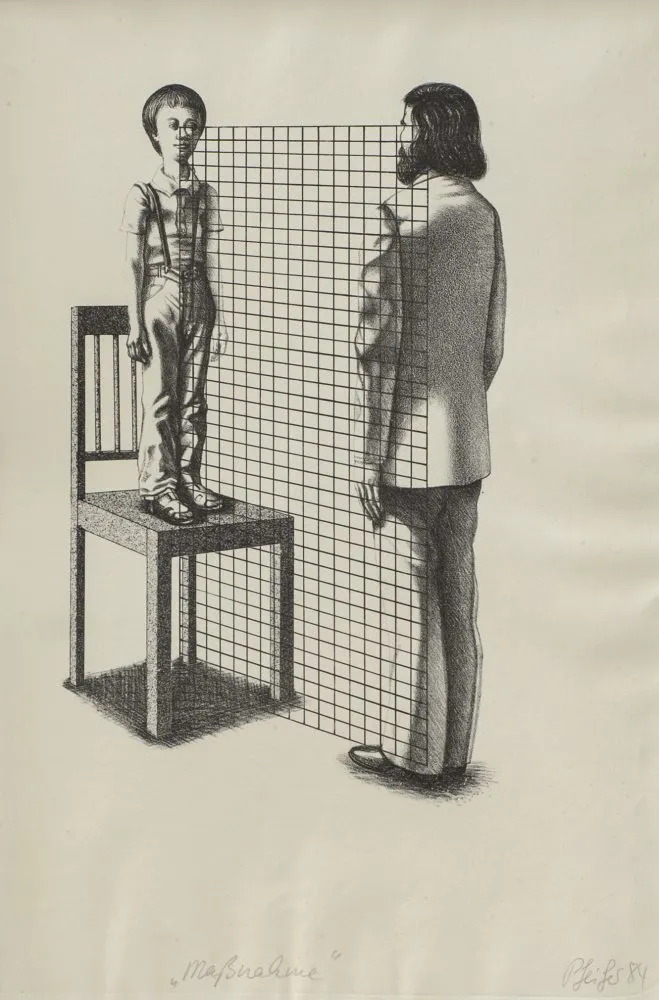
Critical tendencies could emerge only in the 1970s, under Erich Honecker. It was then that individual stories, often rather dark both metaphorically and literally, began to replace the grand narratives and tales that elevated socialist reality. Since direct criticism was still forbidden, meanings expressing doubt and dejection were concealed for safety, for instance behind a screen of mythology invoked in titles. Fellow citizens acquired harsh or vulgar features, resembling the inhabitants of the Weimar Republic portrayed by Otto Dix and presenting life as a tragic cabaret.
When the power of the USSR began to crumble in the 1980s, artists sensed it and allowed themselves still greater freedom. Works from the period record the growing exhaustion of people who stare at us as though waiting to be rescued while no longer believing their fate can improve. We can almost feel how desperately they lack air.
The effect is made even clearer by changes in the colours artists used: portraits and city views lose their colour and sink into ever deeper shades of grey, as though pure hues had vanished irrevocably from life and from the painter’s palette.
Performance, video, Body Art and the outstanding photography of Sibylle Bergemann also appeared at this time. New media became a counterpoint to official art and an escape route from the world of propaganda. Small-scale prints played a similar role, using symbolism and eluding strict control.
Like the holdings of any archive, the thousands of paintings in this collection — only a small portion of which we are presenting — contain many possible narratives and points of contact between the past and the present. One important strand concerns art’s Enlightenment role. Another is reflection on the GDR’s unprecedented system of public art commissions, which monopolised artistic practice — a subject clearly connected to today’s heated debate about how the state provides artists with a livelihood.
Once we dust off these paintings and begin to examine the faces, objects and situations emerging from the half-light, we will see more than the grand history produced by the clash of two political blocs and ideologies. We will also recognise that this art’s often naïve realism offers us an extraordinary opportunity to view the elements that made up the everyday lives of GDR citizens, inhabitants of housing estates and tower blocks. In this way, paintings and sculptures become testimonies to life at the time, equal to documents: anthropological records, equivalents of words and ideas. Alongside socialism, fashion, hairstyles, music, props and everyday objects also entered the frame… This is one of art’s virtues, including (or perhaps especially?) second-rate art.
In this instance, consciousness was meant to shape existence, while existence was reflected in the consciousness of images, just as Marx had wished.
1 Divided Dreamworlds: The Cultural Cold War in East and West, ed. Peter Romijn, Giles Scott-Smith and Joes Segal, Amsterdam, 2012, p. 2.
*Marta Skłodowska is an art historian who studied at the University of Łódź and the University of Bonn. She was a Robert Bosch Stiftung fellow at the Westfälischer Kunstverein in Münster (2010), writes about art, and works at the Museum of the City of Łódź.